MVMHardware Preview

DNOOO blank theme is active for local preview.

How to Prevent Corrosion in Table Surface Mechanisms for Coastal and High-Humidity Markets

The failure pattern is consistent: a furniture importer sources lift-top or coffee table mechanisms, ships product to coastal Florida, Queensland, or the Dutch coast, and starts getting warranty returns 12 to 18 months in. The mechanism still functions — barely — but the surface is visibly rusting, the finish is flaking, and the end customer is unhappy. The importer absorbs the return cost, the brand takes the hit, and the next sourcing cycle starts with the same question nobody asked the first time: what finish spec did you actually order?

Corrosion failure in table mechanisms is almost never a material problem. The steel underneath is usually fine. It's a surface treatment problem — wrong finish for the environment, underspec coating thickness, or a supplier who outsourced the surface treatment and lost control of the process. All three are preventable at the sourcing stage.

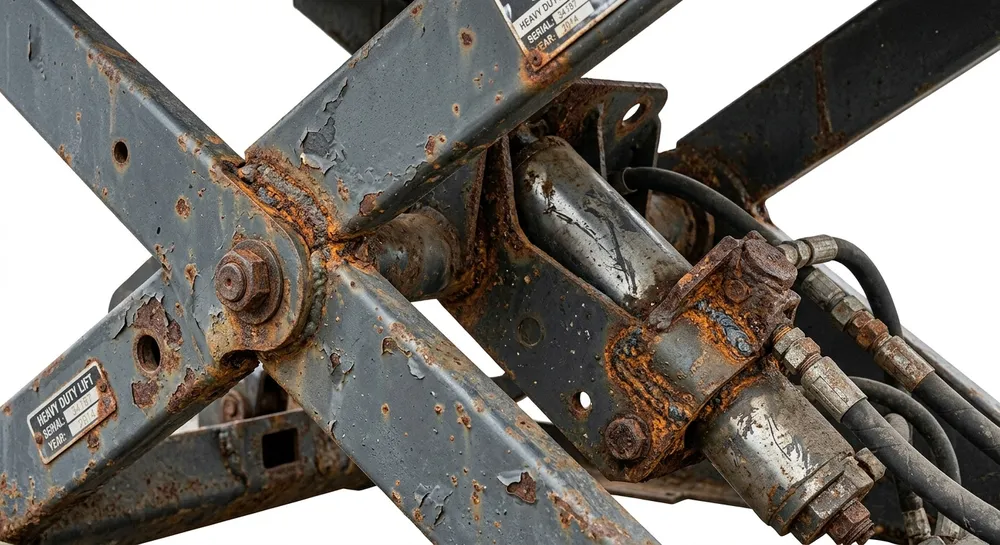
Corroded lift-top table mechanism showing rust and flaking finish after coastal deployment

Why coastal and humid environments accelerate mechanism failure faster than you expect

Salt air and high humidity attack steel through electrochemical corrosion — moisture and chloride ions work together to break down the oxide layer on bare or poorly protected steel. The mechanism geometry makes this worse. A lift-top table mechanism has stamped brackets, pivot pins, spring assemblies, and welded joints — all of which create surface discontinuities where coating coverage is thinner and where moisture pools.

The specific failure points we see most often:

  • Weld seams — heat from welding burns off zinc or disrupts powder adhesion in the heat-affected zone. If the surface isn't re-treated after welding, that seam is essentially bare steel.
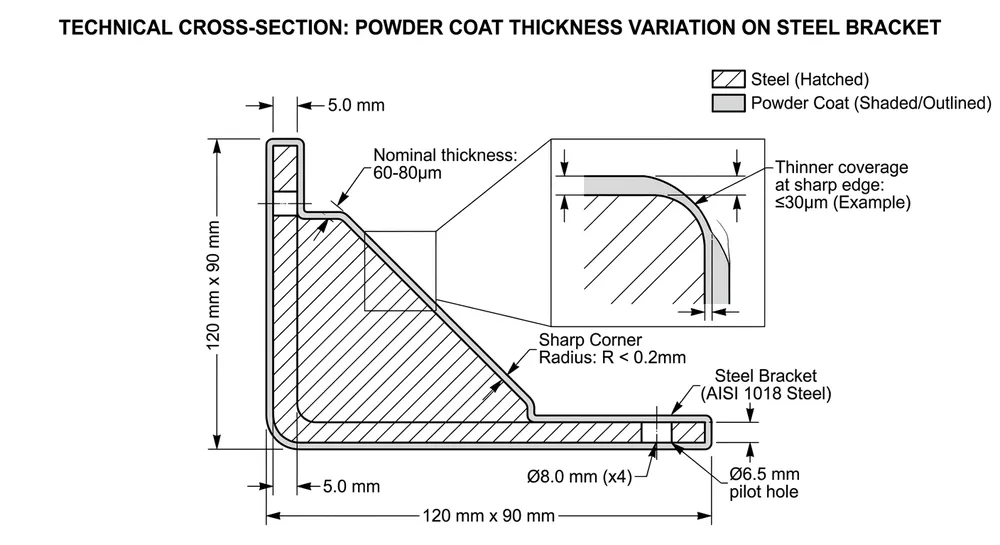
  • Stamped edges and cut ends — the shearing process leaves a raw edge. Powder coat struggles to build adequate thickness on a sharp edge; zinc plating covers it better but still needs passivation.
  • Pivot pins and spring contact points — these are high-wear areas where the finish gets abraded through normal use, exposing base metal.

In a dry inland environment, a mechanism with marginal surface treatment might last five years without visible corrosion. Put the same mechanism in a beachfront condo in Miami or a holiday rental in coastal New South Wales, and you're looking at visible rust within a year. The salt spray concentration in coastal air — even a kilometer from the waterline — is enough to accelerate corrosion by a factor of 10 or more compared to inland conditions.

(We've had buyers come to us after exactly this scenario. The previous supplier's finish looked fine in the factory photos. It just wasn't built for where the furniture was going.)

Surface finish options for table mechanisms: what each one actually protects against

There are three practical finish options for steel table mechanisms: powder coating, zinc plating, and nickel plating. Each has a different corrosion resistance profile, cost structure, and appropriate use case. Choosing the wrong one for your target market is the sourcing mistake that generates warranty returns.

Powder coating: the right choice for most coastal applications

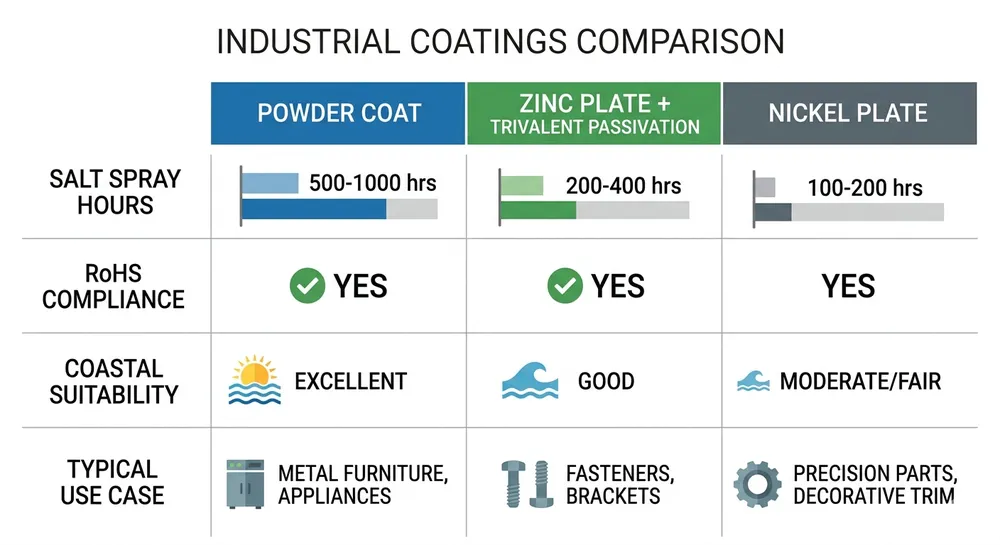
Powder coating at 60–80μm dry film thickness is the standard corrosion protection spec for furniture mechanisms going into coastal or high-humidity markets. At that thickness, a properly applied powder coat passes a 500-hour salt spray test per ISO 9227 — which corresponds to roughly 3–5 years of real-world coastal exposure depending on proximity to the waterline and local climate.

The critical variables are thickness consistency and pre-treatment. Powder coat applied at 40μm instead of 60μm will fail the salt spray test at 300 hours. Pre-treatment — typically iron phosphate or zinc phosphate wash before coating — determines adhesion. Skip the pre-treatment or run it at the wrong concentration, and the powder coat will delaminate at weld seams within months regardless of thickness.

Our automated powder line runs at 60–80μm with iron phosphate pre-treatment as standard. Every batch goes through a cross-hatch adhesion test and a sample pull for salt spray verification. The 500-hour rating isn't a marketing claim — it's a test result we can show you.

For coffee table mechanisms and other lower-profile hardware where the finish is partially visible, powder coat also gives you color flexibility. We run standard RAL colors with a 100-unit minimum for color changes — below that, the line changeover cost doesn't make sense for either side.

Cross-section diagram showing powder coat thickness measurement at 60-80 microns on steel furniture mechanism bracket

Zinc plating with trivalent chromium passivation: the spec for RoHS markets

Zinc electroplating provides corrosion protection through a sacrificial mechanism — the zinc corrodes preferentially, protecting the steel underneath. On its own, zinc plating offers moderate salt spray resistance (typically 96–200 hours depending on thickness). The passivation layer applied after plating is what extends that significantly.

There are two passivation chemistries: hexavalent chromium (Cr6+) and trivalent chromium (Cr3+). Hexavalent chromium is banned under RoHS and REACH — if you're selling into the EU, UK, or California, your mechanism cannot have Cr6+ passivation. This is a compliance issue, not a preference. We've seen buyers get product held at customs because the supplier used hexavalent passivation and didn't disclose it.

Our zinc plating line uses trivalent chromium passivation exclusively, which is RoHS and REACH compliant. We can provide material safety data sheets and RoHS compliance declarations with each order — standard documentation for EU and California buyers.

For table mechanisms, zinc plating with trivalent passivation is the right choice when:

  • The mechanism is largely concealed in the finished furniture (no aesthetic finish requirement)
  • The buyer needs RoHS documentation for EU or California market entry
  • The application is moderate humidity rather than direct coastal salt air exposure

For direct coastal exposure, we recommend powder coat over zinc-plated steel — the combination gives you both the sacrificial zinc layer and the barrier protection of the powder coat, which pushes salt spray performance above 720 hours.

Nickel plating: for visible hardware with moderate corrosion requirements

Nickel plating gives a bright, decorative finish with reasonable corrosion resistance — typically 200–400 hours salt spray depending on plating thickness. It's appropriate for exposed hardware components where appearance matters: visible pivot points, decorative brackets, surface-mounted fittings.

For structural mechanism components in coastal environments, nickel plating alone isn't sufficient. The corrosion resistance is lower than powder coat at equivalent cost, and nickel doesn't provide the sacrificial protection that zinc does. We use nickel plating selectively on visible hardware elements, not as the primary corrosion protection strategy for mechanism assemblies going into high-humidity markets.

Comparison table of powder coating vs zinc plating vs nickel plating for furniture mechanisms by salt spray rating and market application

Salt spray hour ratings: what the numbers mean for your specific market

Salt spray testing (ISO 9227 / ASTM B117) is the standard method for comparing corrosion resistance across finishes. The test exposes finished parts to a 5% sodium chloride mist at 35°C and measures how long before red rust appears on the base metal. Here's how to read the numbers against real deployment conditions:

Salt spray rating Typical real-world equivalent Recommended market application
96–200h 6–12 months inland/low humidity Dry inland markets only
200–500h 1–3 years moderate humidity General export, non-coastal
500h 3–5 years coastal exposure Coastal US, Australia, Northern Europe
720h+ 5+ years direct marine exposure Beachfront, marina, tropical coastal
1000h+ 7+ years severe marine Marine-grade specification, premium segment

The 500-hour threshold is the practical minimum for furniture going into coastal markets — Florida, California, the Gulf Coast, coastal Australia, the Netherlands, Scandinavia. Below 500 hours, you're accepting meaningful warranty risk on coastal accounts.

For buyers targeting beachfront hospitality — hotels, vacation rentals within 500 meters of the waterline — specify 720 hours minimum. The incremental cost difference between 500h and 720h spec is small at the mechanism level; the cost of a warranty return and replacement in a hospitality account is not.

(The 1000-hour spec exists, but for standard furniture mechanisms it's overspecification for most markets. We'd rather help you land on the right spec than sell you more coating than you need.)

What to require from your supplier before approving a sample

Most corrosion failures are locked in at the specification stage, not the production stage. By the time you're getting warranty returns, the sourcing decision that caused them was made months earlier. These are the questions to ask before you approve a sample:

Finish specification:

  • What is the dry film thickness of the powder coat, measured how and where? (Require minimum 60μm at flat surfaces, 50μm at edges)
  • What pre-treatment process is used before powder coating? (Iron phosphate or zinc phosphate — ask for the process sheet)
  • For zinc plating: is the passivation trivalent or hexavalent chromium? (Require trivalent for any RoHS market)

Testing documentation:

  • Can you provide a salt spray test report for this finish specification? (Require ISO 9227 or ASTM B117, minimum 500 hours for coastal markets)
  • Is the test report from an in-house test or a third-party lab? (Both are acceptable; ask for the actual report, not just a claim)
  • What is the cross-hatch adhesion rating for the powder coat? (Require GT0 or GT1 per ISO 2409)

Process control:

  • Is surface treatment done in-house or outsourced? (In-house is strongly preferable — outsourced treatment introduces batch variation you can't audit)
  • What QC checks are run on finished parts before shipment? (Ask for the inspection checklist)

Compliance:

  • For EU or California buyers: can you provide a RoHS compliance declaration for the surface treatment chemistry?
  • For any market: can you provide material safety data sheets for the coating materials?

A supplier who can't answer these questions with documentation — not just verbal assurances — is a supplier whose finish spec you can't verify. That's the sourcing risk that generates warranty returns.

How in-house surface treatment controls finish quality across your order

The batch variation problem is real. We've seen it from the buyer side when customers come to us after switching suppliers: two containers of the same mechanism, same part number, visibly different finish quality because the previous supplier's outsourced coating vendor changed their process between runs.

When surface treatment is outsourced, the furniture mechanism manufacturer loses direct control over pre-treatment chemistry, coating thickness, cure temperature, and QC checkpoints. Each of those variables affects salt spray performance. A supplier who outsources coating can tell you the spec they ordered — they can't guarantee the spec they received.

We run powder coating and zinc plating in-house at our 12,000 m² Guangdong facility. The same team that stamps and assembles the mechanism runs the surface treatment line. Pre-treatment chemistry is checked daily. Coating thickness is measured on every production batch with a calibrated gauge. Salt spray samples are pulled from each finish run and tested against the 500-hour threshold before the batch ships.

Factory-direct supply means the finish spec you approve on the sample is the finish spec on your production order. No outsourced vendor, no batch variation, no surprises at the destination port.

Our Table & Surface Mechanism range is available with powder coat (60–80μm, 500h salt spray standard), zinc plate with trivalent passivation (RoHS compliant), or combined zinc-plus-powder-coat for 720h+ coastal specification. For detailed steel grade and finish selection for table mechanisms, see our materials guide.

Supplier qualification checklist for coastal market sourcing

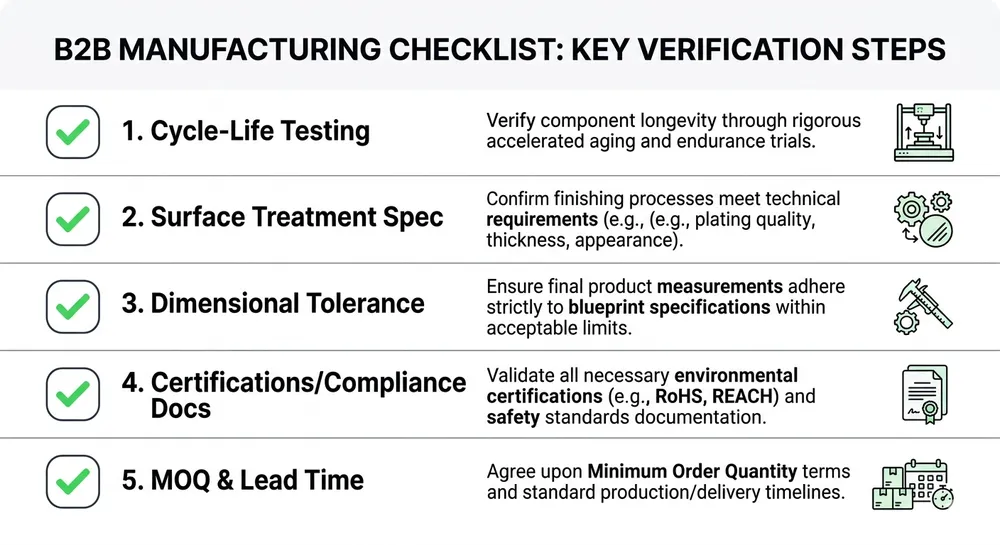
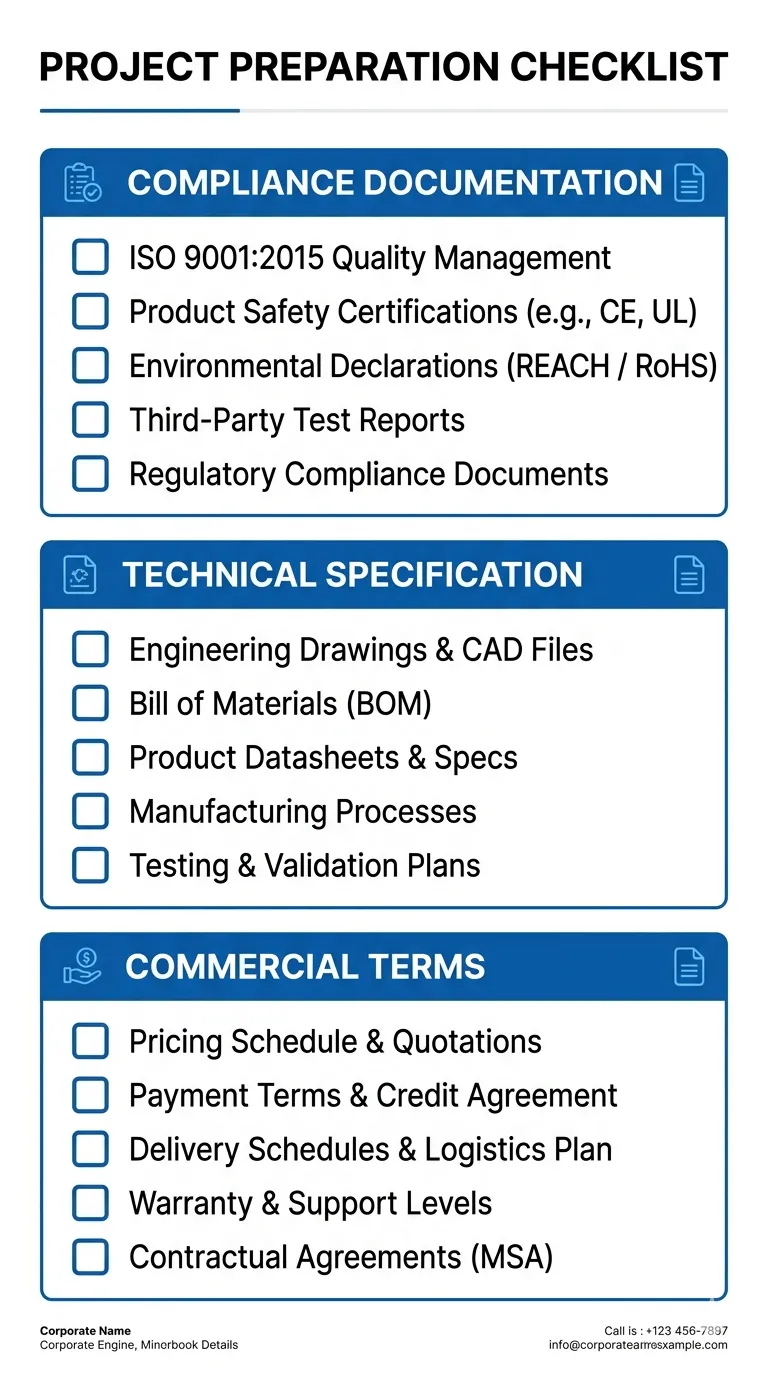
Before placing a production order for mechanisms destined for coastal or high-humidity markets, run through this checklist:

  • [ ] Powder coat DFT confirmed at 60–80μm minimum (measured, not estimated)
  • [ ] Pre-treatment process documented (iron or zinc phosphate)
  • [ ] Salt spray test report provided — 500h minimum, ISO 9227 or ASTM B117
  • [ ] Cross-hatch adhesion test result: GT0 or GT1
  • [ ] Passivation chemistry confirmed as trivalent Cr3+ (for RoHS markets)
  • [ ] RoHS compliance declaration available
  • [ ] Surface treatment confirmed as in-house (not outsourced)
  • [ ] QC inspection checklist for finished parts provided
  • [ ] Sample finish matches production spec in writing

If any item on this list gets a "we'll check on that" response, treat it as a red flag. Suppliers who control their surface treatment process can answer these questions immediately.

FAQ

What salt spray rating do I need for furniture mechanisms going to coastal Florida or Queensland?

500 hours minimum for standard coastal residential. For beachfront hospitality or properties within 200–300 meters of the waterline, specify 720 hours. The difference in mechanism cost is marginal; the difference in warranty exposure is significant.

Can I use the same mechanism spec for both coastal and inland markets?

Yes — a 500h powder coat spec works fine in inland markets too. You're not overspecifying for dry environments; you're just carrying a small cost premium that buys you a single SKU across your range. Most of our buyers who sell into mixed geographies standardize on the 500h spec rather than managing two finish variants.

What's the difference between trivalent and hexavalent chromium passivation, and why does it matter?

Hexavalent chromium (Cr6+) is a restricted substance under RoHS Directive 2011/65/EU and California Proposition 65. Furniture mechanisms with Cr6+ passivation cannot legally be sold in the EU or California. Trivalent chromium (Cr3+) provides equivalent or better corrosion performance and is fully compliant. Always ask your supplier which chemistry they use and request the compliance declaration in writing.

How do I verify a supplier's salt spray claim without running my own test?

Ask for the actual test report — not a spec sheet that lists "500h salt spray" as a feature, but the ISO 9227 or ASTM B117 test report with the test date, sample description, and result. Third-party lab reports (SGS, Intertek, Bureau Veritas) carry more weight than in-house reports, though both are acceptable if the methodology is documented. If a supplier can't produce a test report, the rating is unverified.

Does powder coating over zinc-plated steel actually improve corrosion resistance, or is it redundant?

It's additive, not redundant. Zinc plating provides sacrificial protection — if the powder coat is scratched through to bare metal, the zinc corrodes preferentially and slows base steel corrosion. The powder coat provides barrier protection that extends the zinc's service life. Combined, the two finishes push salt spray performance to 720h+ and give you a meaningful margin of safety for direct coastal exposure. For standard coastal residential, powder coat alone at 500h is sufficient. For beachfront or marine-adjacent applications, the combination is worth the incremental cost.

If you're sourcing lift-top table mechanisms or other table hardware for coastal or high-humidity markets and want a finish recommendation tied to your specific geography and volume, Request Quote with your mechanism type, target market, and annual quantity — we'll come back with a specific finish spec and landed cost estimate.

Steel Grade and Finish Selection for Table Surface Mechanisms: What Affects Long-Term Performance

Most finish failures and premature wear in table surface mechanisms don't trace back to bad assembly. They trace back to a material decision made at the RFQ stage — usually by someone who accepted the supplier's default spec without asking what it actually was.

This article covers the steel grades and surface finishes we use in table mechanism production, why we choose them, and what you should be asking your supplier before you commit to a production run.

Why the Steel Grade Decision Happens Too Late in Most Sourcing Cycles

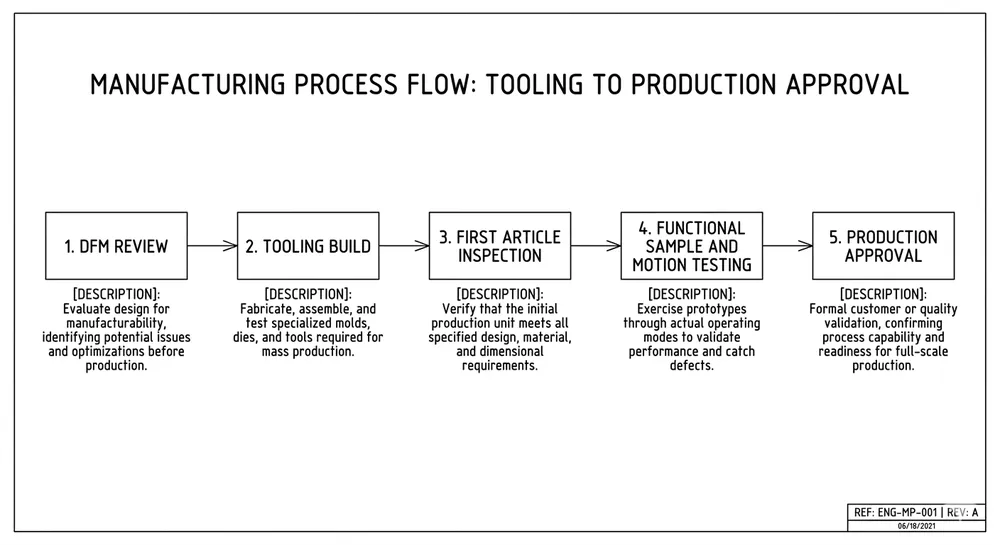
By the time a buyer receives samples, the steel grade is already locked. The tooling is cut, the blanks are stamped, and changing the material spec means restarting the production process. That's the window where a lot of sourcing mistakes get frozen in place.

The grade question needs to happen at RFQ — not at sample approval.

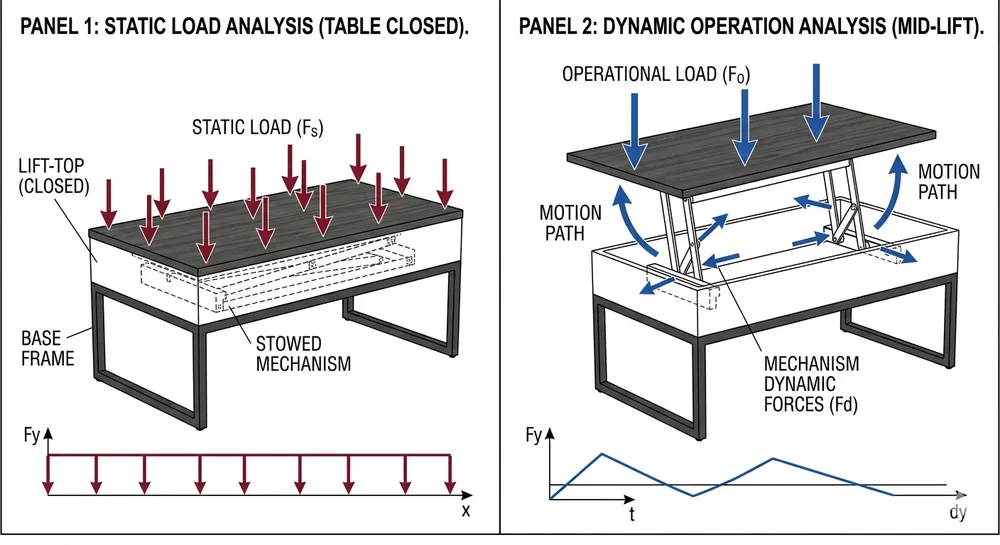
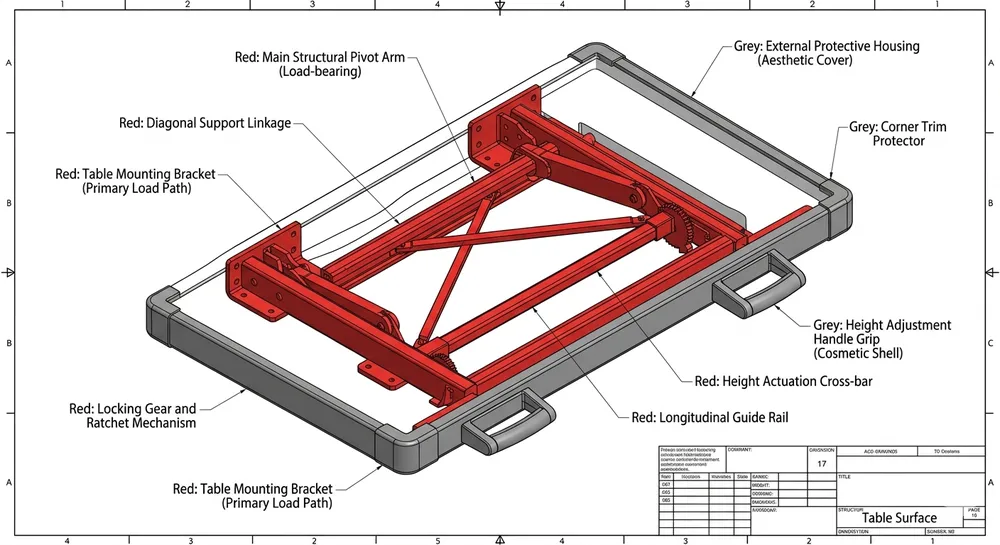
For table surface mechanisms specifically, the structural demands are asymmetric. The pivot arms, locking brackets, and slide rails carry real cyclic load. The decorative covers and trim pieces don't. Specifying the same steel grade across all components is either over-engineering the cosmetic parts or under-engineering the structural ones. We see both mistakes regularly.

Diagram showing structural load-bearing zones versus cosmetic zones in a table surface mechanism

Steel Grade Selection: What the Spec Sheet Should Actually Say

The two grades we work with most for table mechanism structural components are SPCC (cold-rolled carbon steel, JIS G3141) and SECC (electrolytic zinc-coated cold-rolled steel, JIS G3313). For higher-load applications — heavy-duty extension mechanisms, conference table slides rated above 80 kg — we move to Q235B or S235JR structural mild steel depending on the destination market's standard preference.

Here's how those grades compare across the decisions that actually matter at sourcing:

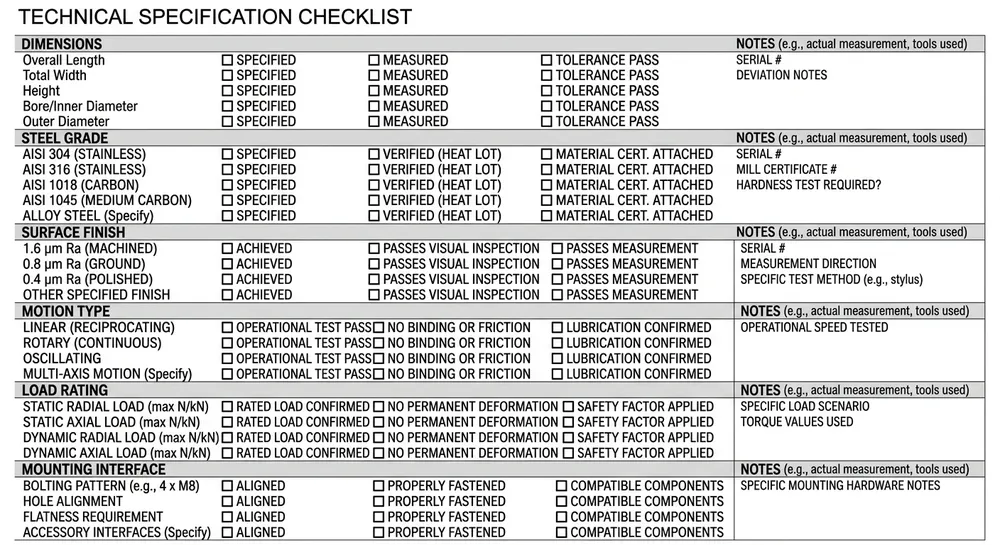
Grade Thickness Range Used Yield Strength (typical) Surface Finish Compatibility Best Application
SPCC 1.0 – 2.0 mm ~270 MPa Powder coat, zinc plate, nickel plate Standard pivot arms, brackets, mid-load slides
SECC 0.8 – 1.5 mm ~270 MPa Pre-coated; powder coat over zinc Cosmetic panels, light-load covers
Q235B 2.0 – 4.0 mm ~235 MPa Powder coat, paint Heavy-duty structural frames, high-load rails
S235JR 2.0 – 4.0 mm ~235 MPa Powder coat, paint EU-market structural components

A few things worth noting here. SPCC and Q235B have similar yield strength on paper, but Q235B is specified for thicker sections where bending radius and weld integrity matter more than surface finish quality. SPCC gives you a cleaner stamped edge and better powder coat adhesion at thinner gauges — that's why it's our default for the precision-stamped components.

(We've had buyers ask for SECC across all components to simplify their BOM. It works for cosmetic parts, but the zinc layer on SECC adds a variable to the powder coat adhesion process that we'd rather control ourselves through pre-treatment on SPCC. It's a small thing, but it shows up in salt spray results.)

Thickness Tolerances and Why They Matter More Than Grade Alone

Grade is half the story. Thickness tolerance is the other half, and it's the one that gets ignored most often.

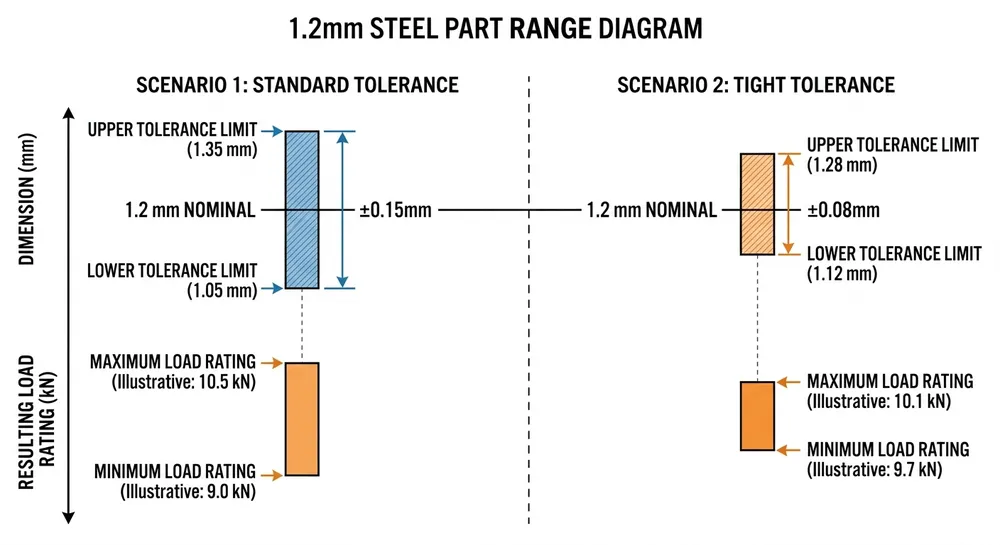
A nominal 1.2 mm SPCC blank from a mill with ±0.15 mm tolerance means your actual material could be anywhere from 1.05 mm to 1.35 mm. On a pivot arm that's been designed to a 1.2 mm spec, that 12% variance changes the bending force required, the spring-back angle after stamping, and the load rating of the finished part.

We source SPCC from approved mills with ±0.08 mm tolerance on structural components. That tighter spec costs more per coil — roughly 8–12% premium over standard tolerance material — but it eliminates the dimensional scatter that causes inconsistent mechanism feel across a production batch. If your supplier can't tell you their mill tolerance spec, that's a gap worth closing before you approve the sample.

Chart showing how steel thickness tolerance variation affects load rating and dimensional consistency in stamped mechanism components

Surface Finish Selection: The Three Options and Their Real Trade-offs

For table mechanisms, the finish decision isn't just aesthetic. It determines corrosion resistance, cycle-life friction behavior, and — for your downstream customers — warranty exposure.

We run three finish lines: zinc electroplating, nickel plating, and powder coating. Each has a specific role.

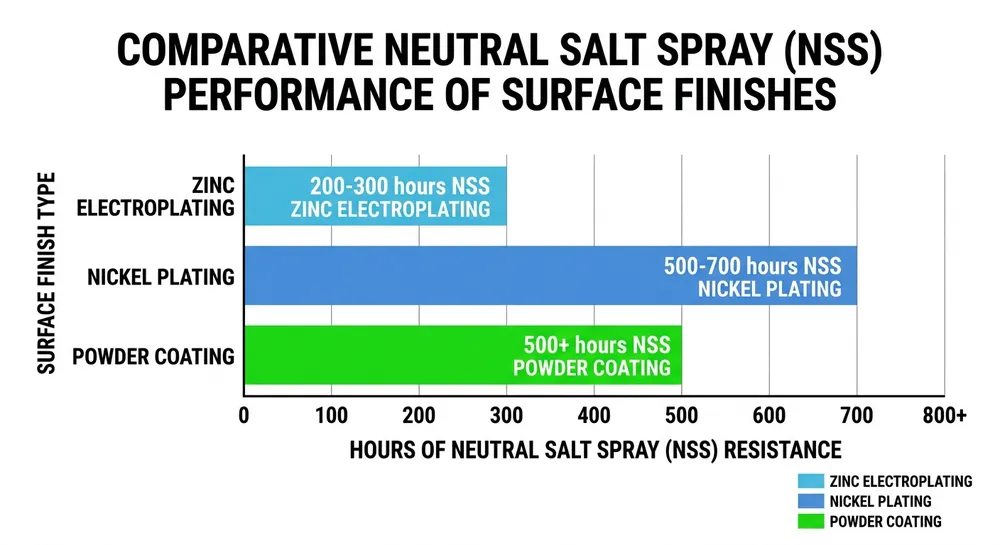
Zinc electroplating is the standard for internal structural components that won't be visible in the finished furniture. It's fast, cost-effective, and gives you 200–300 hours of salt spray resistance under neutral salt spray (NSS) testing per ISO 9227. That's adequate for indoor furniture in temperate climates. For coastal markets or high-humidity environments (Southeast Asia, Middle East), it's not enough on its own.

Nickel plating is what we use when the mechanism is partially visible and the buyer needs a premium surface appearance alongside corrosion resistance. Nickel gives you a harder surface (typically 400–600 HV depending on bath chemistry) and better wear resistance on sliding contact surfaces. The trade-off: it costs 30–40% more than zinc plating per unit, and it requires tighter pre-treatment control to avoid adhesion failures at weld seams.

Powder coating is the right answer when the mechanism is fully visible, when the buyer needs color matching to the furniture finish, or when the application involves higher humidity exposure. Our automated powder line runs at 60–80 μm consistent thickness, passes 500-hour NSS testing, and gives you zero VOC compliance for markets that require it. The limitation: powder coat adds 0.06–0.08 mm per surface, which matters on tight-tolerance sliding components. We account for that in the tooling spec, but if you're switching finish types mid-production, the dimensional clearances need to be re-checked.

Comparison chart of zinc plating, nickel plating, and powder coating salt spray test hours for table mechanism components

The Sourcing Trap: What "Standard Finish" Actually Means

When a supplier quotes "standard surface treatment," that phrase covers a wide range of actual practice. We've seen it mean anything from a thin zinc flash (under 5 μm) to a proper 8–12 μm zinc deposit with chromate passivation. The difference in corrosion performance between those two is not marginal — it's the difference between a mechanism that passes your customer's incoming inspection and one that shows white rust within six months of delivery.

The documents you should be requesting at RFQ stage:

  • Material Test Certificate (MTC) from the steel mill — confirms grade, thickness, and mechanical properties
  • Plating thickness report — specifies deposit thickness in μm, not just "zinc plated"
  • Salt spray test report — hours to first corrosion, tested per ISO 9227 or ASTM B117
  • Dimensional inspection report — confirms critical tolerances on sliding and pivot components

Most suppliers will provide these if you ask. The ones who can't, or who provide reports without traceable batch numbers, are telling you something about their QC process.

(We run 100% functional testing on all mechanisms before shipment, plus load-cycle verification on sampled units from each batch. The salt spray and plating thickness reports are part of our standard shipment documentation — you don't need to chase them.)

How Finish Choice Affects Your Downstream Market Risk

The finish decision has a direct line to your warranty exposure and RMA rate. Here's how it maps to the markets we ship into:

North America and Europe: Buyers in these markets typically specify powder coat or nickel plate for any visible mechanism component. The expectation is 3–5 year warranty coverage with zero surface defects. Zinc-plated components are acceptable for concealed structural parts only.

Middle East and Southeast Asia: High ambient humidity and salt air exposure in coastal cities (Dubai, Singapore, Ho Chi Minh City) mean zinc plating alone is undersized for mechanisms that will be used near windows or in open-plan spaces. We recommend powder coat or nickel plate for any mechanism going into these markets, regardless of whether it's visible.

Hospitality and contract furniture: Hotel and commercial furniture takes more abuse than residential. Cycle counts are higher, cleaning chemicals are harsher, and the cost of a warranty claim in a hotel installation is disproportionate to the unit cost. For this segment, we run nickel plate on all sliding contact surfaces and powder coat on all visible faces — the combination adds roughly 15% to the mechanism unit cost but eliminates the finish-related RMA risk entirely.

The pattern we see most often: buyers optimize for unit cost at the sourcing stage and absorb the warranty cost downstream. The math rarely works out in their favor.

What to Verify Before You Approve a Production Run

A sample that looks right isn't the same as a sample that's built right. Before you sign off on a production run for table surface mechanisms, these are the checks worth running:

  • Cross-section the plating on a destructive sample — confirm actual deposit thickness matches the spec
  • Run a 500-cycle load test on the mechanism at rated load — surface finish failures often appear at the pivot points first
  • Check dimensional clearances on sliding components after finish application — powder coat buildup is the most common cause of stiff or binding mechanisms in production
  • Request the MTC for the steel coil used in your batch — not a generic mill cert, but the one tied to your production lot

If your supplier can't provide lot-traceable documentation, that's a sourcing risk that doesn't go away after you approve the sample. It just moves downstream to your customers.

For buyers evaluating table surface mechanisms across multiple finish and grade configurations, we're set up to run comparative samples — same mechanism, different finish specs — so you can make the decision based on actual test data rather than supplier claims.

Frequently Asked Questions

What steel grade is standard for table surface mechanism pivot arms?

SPCC cold-rolled steel at 1.2–1.5 mm is the most common spec for pivot arms in standard residential and light commercial table mechanisms. For heavy-duty applications (conference tables, height-adjustable surfaces rated above 80 kg), Q235B at 2.0–3.0 mm is more appropriate. The grade matters less than the thickness tolerance — specify ±0.08 mm or tighter on structural components.

Is zinc plating sufficient for table mechanisms going to humid climates?

For indoor use in temperate climates, standard zinc electroplating (8–12 μm with chromate passivation) is adequate. For coastal markets, high-humidity environments, or any mechanism near exterior-facing windows, specify powder coat or nickel plate. The salt spray test threshold to ask for is 500 hours minimum per ISO 9227.

Does powder coating affect the dimensional tolerances of sliding mechanism components?

Yes. Powder coat adds 0.06–0.08 mm per coated surface. On tight-tolerance sliding rails and pivot pins, that buildup can cause binding if the tooling wasn't designed to account for it. Always confirm with your supplier that the tooling clearances were set with the finish thickness included in the spec.

What documents should I request to verify surface finish quality?

At minimum: a plating thickness report (in μm, not just "zinc plated"), a salt spray test report with hours to first corrosion, and a dimensional inspection report on the finished components. For steel grade verification, request the Material Test Certificate tied to your production lot.

What's the cost difference between zinc plating and powder coating on a table mechanism?

Powder coating typically adds 12–18% to the mechanism unit cost compared to zinc electroplating, depending on part geometry and batch size. Nickel plating runs 30–40% above zinc. For most buyers, the relevant comparison isn't finish cost vs. finish cost — it's finish cost vs. warranty claim cost in your target market.

If you're specifying steel grade and finish for a new table mechanism program, send us your target market, load rating, and any existing finish spec — we'll come back with a configuration recommendation and a quote. Request a quote here.

Lift-Top vs Rotating Table Mechanism: Which Motion Type Fits Your Product and Price Point

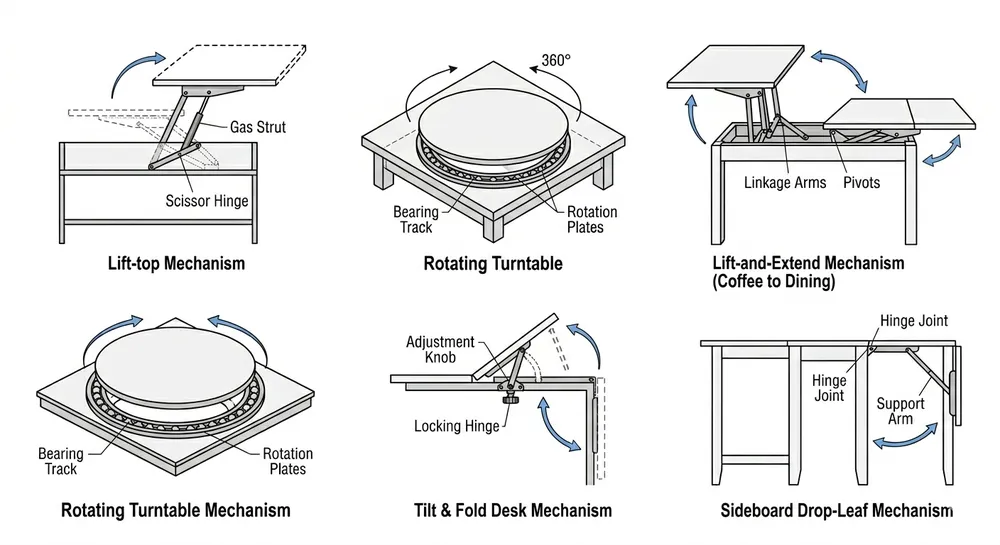
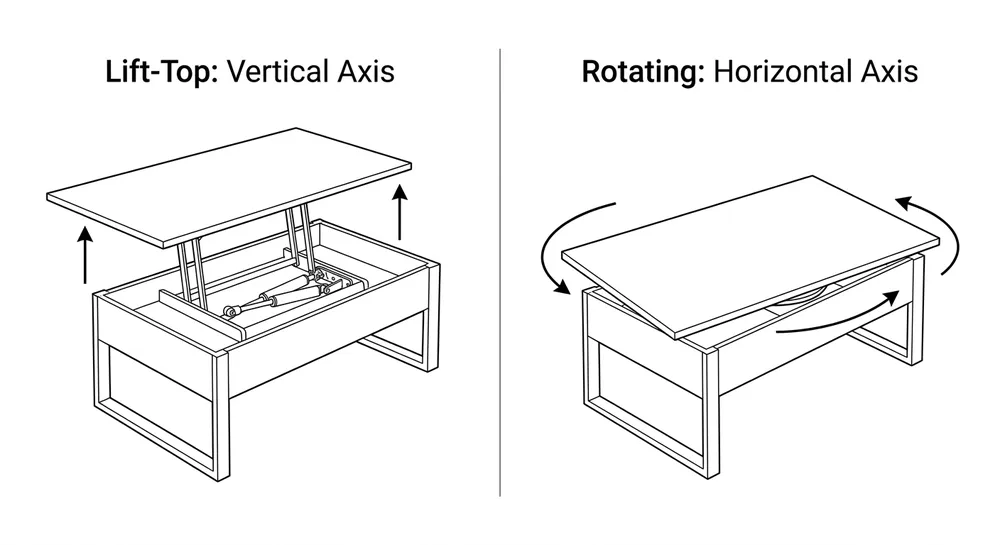
You've narrowed it down to two motion types. The lift-top mechanism raises the surface vertically — gas spring or spring-loaded, the tabletop comes up and locks at working height. The rotating mechanism pivots the surface on a central axis, swinging it from one position to another. Both solve a "the table needs to move" problem. They solve completely different versions of it.

The wrong choice doesn't just affect end-user experience. It affects your BOM cost, your packaging dimensions, your warranty exposure, and whether your product can compete at the price point your market expects. Here's how to read the difference commercially.

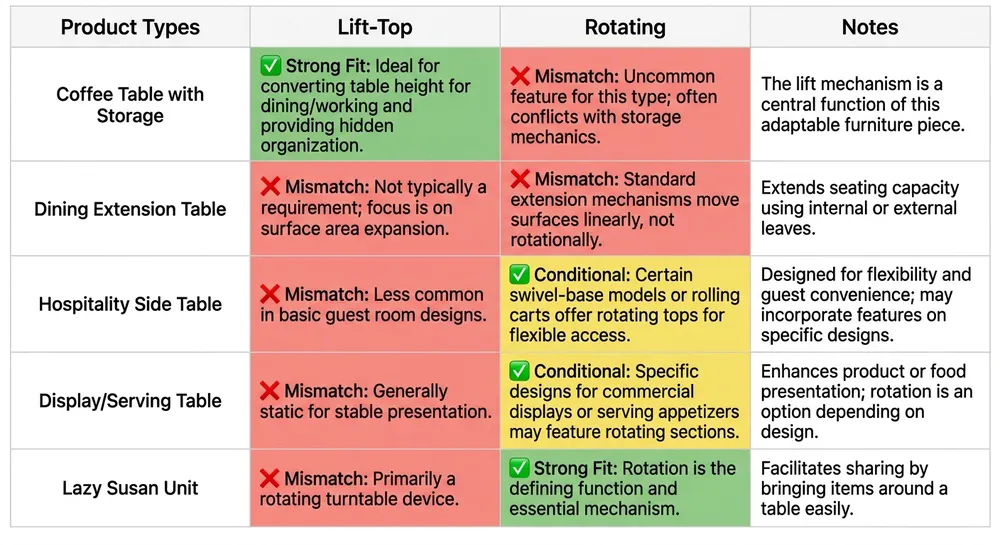
Quick verdict: If your product is a storage-access coffee table or height-adjustable occasional table, lift-top is the default — higher perceived value, proven retail demand, manageable cost at volume. If your product is a space-saving dining solution, a convertible serving table, or a lazy-susan-style display unit, rotating is the right motion type. Mixing them up costs you margin or kills the product concept entirely.

Side-by-side diagram showing lift-top table mechanism vertical motion versus rotating table mechanism pivot motion

Motion Type, Mechanism Anatomy, and What Each One Actually Costs to Build

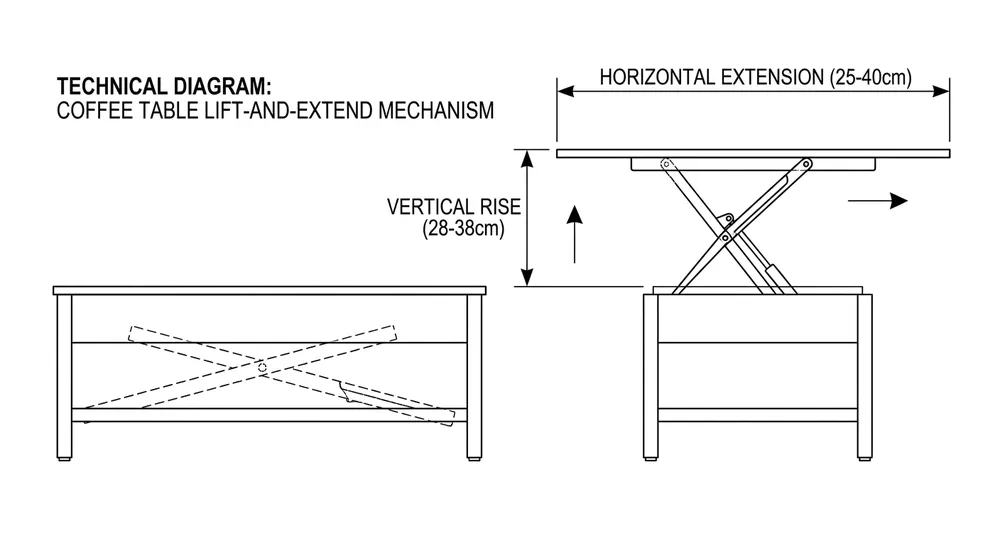
A lift-top mechanism is a four-bar linkage — two pivot arms, a connecting rod, and a spring element (either a gas spring cylinder or a coil spring). When the user pushes the surface forward and up, the linkage geometry converts that motion into a smooth vertical rise. The gas spring variant adds damping so the surface doesn't slam. The coil spring variant is simpler and cheaper but has a narrower weight range before the feel degrades.

We run both configurations on the same stamping lines. The gas spring version uses a 100–150N cylinder, 1.0–1.2mm cold-rolled steel arms, and zinc-plated or powder-coated finish. The coil spring version drops the cylinder cost but requires tighter spring calibration to the tabletop weight — if your furniture partner changes the top material without telling you, the mechanism feel changes. (We've seen this cause warranty complaints on otherwise solid products. It's worth specifying the top weight range in your purchase order.)

A rotating table mechanism is structurally simpler in one sense — it's a bearing plate, a central pivot post, and a locking detent or friction collar. But the engineering challenge is different: you need smooth rotation under load, zero wobble at the locked position, and a detent that holds reliably without requiring excessive force to release. Cheap rotating mechanisms fail at the bearing — they develop lateral play within 6–12 months of use, and the table surface starts to wobble. We use a double-row ball bearing race on our rotating units specifically to prevent this.

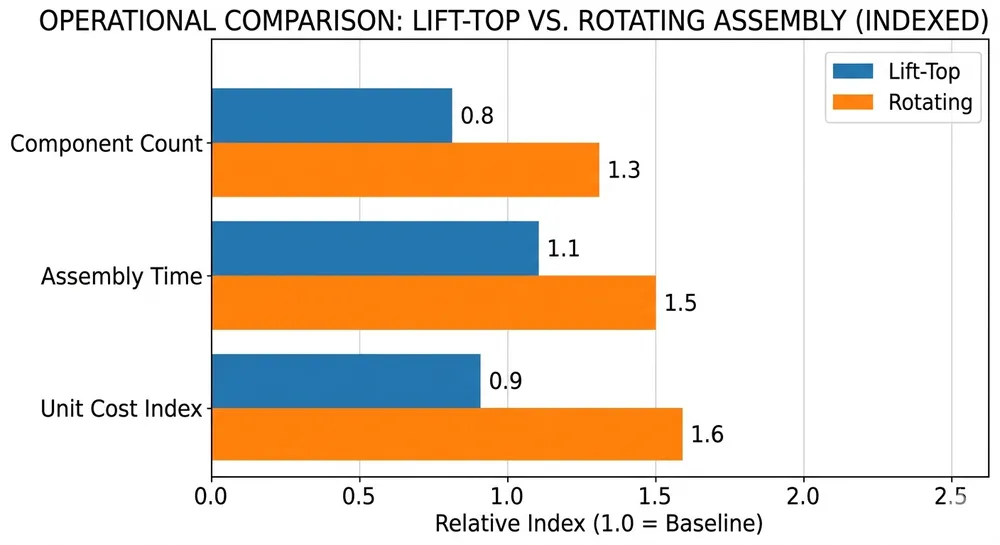
Cost structure differs meaningfully. A mid-spec lift-top mechanism — gas spring, powder-coated, rated for 15–25kg tabletop — runs higher in component count and assembly time than a comparable rotating mechanism. The rotating unit has fewer moving parts, but the bearing and pivot post are the cost drivers, and you can't cut corners there without sacrificing cycle life.

Dimension Lift-Top Mechanism Rotating Mechanism
Motion axis Vertical (lift + forward travel) Horizontal (pivot/rotation)
Core components 4-bar linkage, gas spring or coil spring, pivot pins Bearing plate, pivot post, detent/lock collar
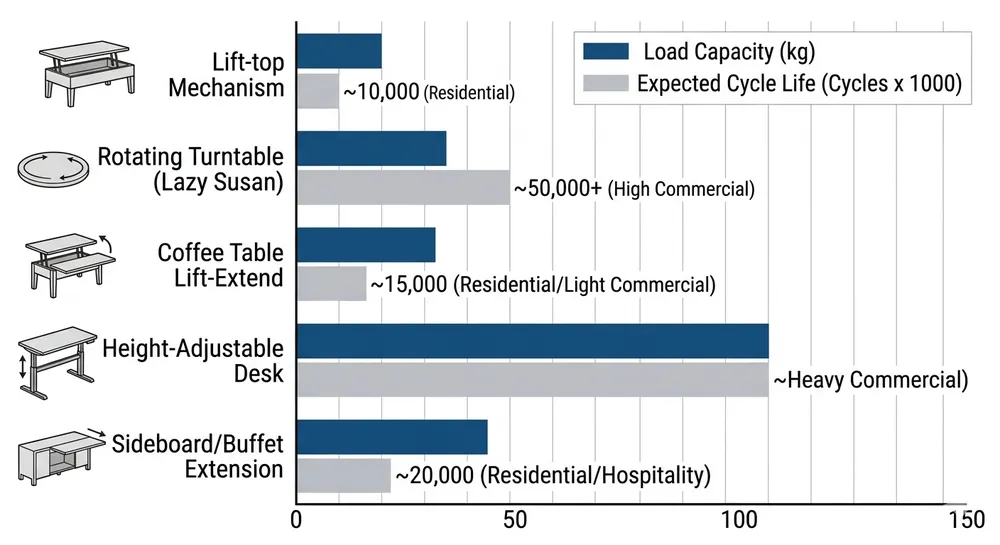
Typical tabletop weight range 8–30 kg depending on spring spec 5–20 kg (heavier tops stress the bearing)
Assembly complexity Medium — spring calibration required Lower — but bearing quality is critical
Relative unit cost Higher Lower to mid
Cycle life (standard spec) 20,000–30,000 cycles 15,000–25,000 cycles (bearing-dependent)
Packaging footprint Larger (linkage arms extend) Compact
Surface finish options Zinc plate, powder coat, nickel plate Zinc plate, powder coat
Bar chart comparing component count and relative unit cost between lift-top and rotating table mechanisms

The Hidden Cost the Spec Sheet Won't Show You

The spec sheet shows unit price. It doesn't show what happens downstream when you spec the wrong motion type for your market.

Lift-top in the wrong application: If you put a lift-top mechanism on a product that's primarily a dining or serving solution, you've added cost and complexity your buyer won't pay for. The vertical lift motion doesn't solve the space-conversion problem — it just raises the surface. Your retail price goes up, your margin compresses, and the product sits on the floor because the motion doesn't match the use case.

Rotating in the wrong application: A rotating mechanism on a coffee table that's supposed to provide storage access is a functional mismatch. The surface rotates but doesn't lift — there's no storage cavity access. Buyers return it. Your downstream customer files a warranty claim. You eat the freight both ways.

The more common hidden cost is spring miscalibration on lift-top units. If you're sourcing lift-top mechanisms and your furniture partner changes the tabletop from MDF to solid wood — or adds a glass insert — without updating the spring spec, the mechanism either won't hold position or will feel stiff and jerky. We calibrate spring force to a declared top weight range and document it on the shipment spec sheet. If your current supplier doesn't do this, you're one material change away from a batch of warranty claims.

On rotating mechanisms, the hidden cost is bearing degradation. A single-row bearing saves $0.80–$1.20 per unit at the factory. After 18 months of use, the table wobbles. Your customer's customer complains. Your customer asks for a replacement batch. That $1.00 saving cost you a reorder and a relationship. We switched to double-row bearing races on all rotating units after seeing exactly this failure pattern in returns from one of our European accounts. (The account is still with us — they appreciated that we identified the root cause and fixed it without being asked twice.)

Application Showdown: Which Motion Type Wins in Real Sourcing Scenarios

Scenario 1: Coffee Table with Hidden Storage — Lift-Top Wins

The product is a living room coffee table. The top lifts and slides forward to reveal a storage compartment and create a working surface at sofa height. This is the core lift-top application. The motion type is the product's value proposition — without it, it's just a table.

At this application, lift-top is the only correct answer. The gas spring variant is worth the cost premium because the damped motion is a key part of the perceived quality. Buyers in North America and Europe expect smooth, controlled lift — a coil spring version that bounces or requires two hands to operate will generate returns. Spec the gas spring, declare your top weight, and build the cost into your retail price. The motion is the margin driver here.

Scenario 2: Space-Saving Dining Table for Small Apartments — Rotating Wins

The product is a compact dining table where one section rotates out to extend the usable surface, or a round table where the top rotates to bring a serving section within reach. The value is space conversion and serving convenience — not storage access.

Rotating mechanism is the right call. The lower unit cost fits the price-sensitive small-apartment segment. The simpler mechanism means fewer assembly steps for your furniture partner. The key spec decision is bearing quality — don't let a supplier talk you into a single-row bearing to hit a lower price. The $1 saving will cost you more in after-sales than it saves in procurement.

Scenario 3: Convertible Occasional Table for Hospitality — Evaluate Both

A hotel room side table that needs to convert between a compact bedside position and an extended working surface. This is the scenario where both motion types are genuinely in play, and the decision comes down to your target price point and the hotel's maintenance tolerance.

Lift-top gives you a higher-value product with more perceived engineering — hotels can justify a higher FF&E budget line for it. Rotating gives you a simpler, lower-maintenance unit that housekeeping staff can operate without instruction. If your hospitality buyer is a budget hotel chain, rotating wins on total cost of ownership. If it's a mid-to-upper tier property, lift-top's perceived quality justifies the price.

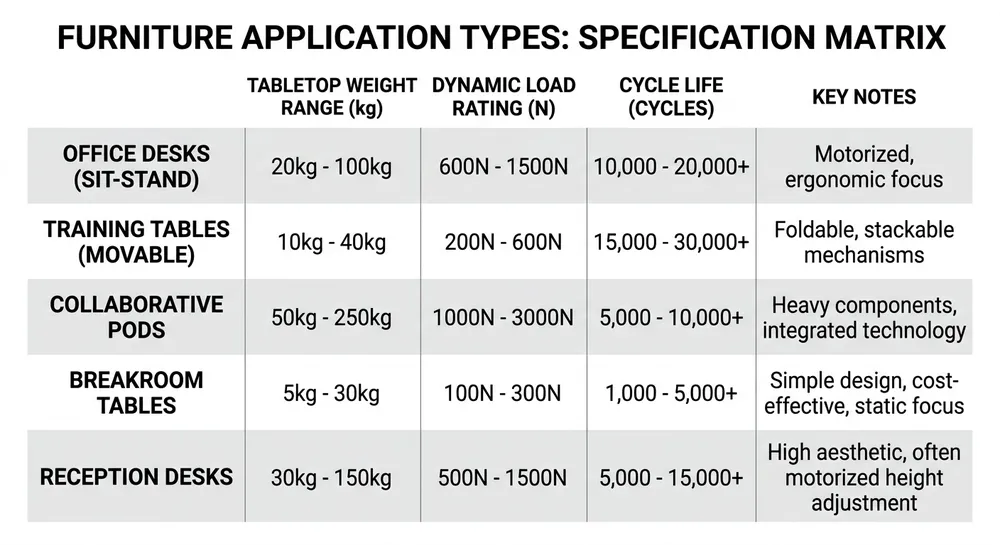
Decision matrix mapping lift-top and rotating table mechanism to furniture product types and market segments

What to Verify Before You Place the Order

Both mechanism types have sourcing traps. Here's what to check before your RFQ becomes a production problem.

For lift-top mechanisms:

  • Spring force rating vs. declared top weight — ask for the calibration spec sheet. If the supplier can't provide one, they're not calibrating to your top weight. That's a warranty risk.
  • Linkage arm thickness — 1.0mm is the minimum for standard residential use. Below that, you'll see arm deformation under repeated load. Ask for the steel gauge spec.
  • Gas spring end-of-life behavior — a quality gas spring loses pressure gradually and the surface descends slowly. A cheap one fails suddenly. Ask about the cylinder brand or spec.
  • Cycle life test documentation — 20,000 cycles minimum for residential, 30,000+ for commercial or hospitality. Ask for the test report, not just the claim.

For rotating mechanisms:

  • Bearing type and row count — single-row vs. double-row matters for long-term wobble resistance. Get it in writing.
  • Detent force spec — the locking position should hold under a 5kg lateral load without releasing. Ask how they test this.
  • Pivot post material — zinc alloy die-cast is standard and acceptable. Plastic pivot posts are a cost-cut that shows up in returns within a year.
  • Load rating at full rotation — some rotating mechanisms are rated for static load only. If your product will be used while rotating (serving table, lazy susan), confirm the dynamic load rating.

We document all of these on our shipment spec sheets and can provide test reports for any mechanism in our Table & Surface Mechanism range. ISO 9001:2015 means the documentation exists — it's not something we produce on request and then forget.

Frequently Asked Questions

Can I use a lift-top mechanism on a round table? Yes, but the linkage geometry needs to account for the top's center of gravity shifting as it lifts and travels forward. Round tops with a centered lift mechanism can tip if the spring force isn't calibrated correctly. We've done this configuration — it works, but it requires a custom spring spec and a wider pivot arm spread. Standard rectangular-top lift mechanisms won't transfer directly to a round top without adjustment.

What's the minimum order quantity for custom spring calibration on lift-top units? Our standard MOQ is 500 units for standard mechanisms. Custom spring calibration — where we tune the spring force to your specific declared top weight — is available from 500 units. Below that, the tooling and calibration cost doesn't make sense for either side. If you're in the 200–499 unit range, we can match you to the closest standard spring spec and document the compatible top weight range.

How do I know if a rotating mechanism bearing will last? Ask for the radial play specification after 10,000 cycles. A quality double-row bearing should show less than 0.3mm radial play at that point. If a supplier can't give you a number, they haven't tested it. We run cycle life tests on all bearing assemblies and can share the data.

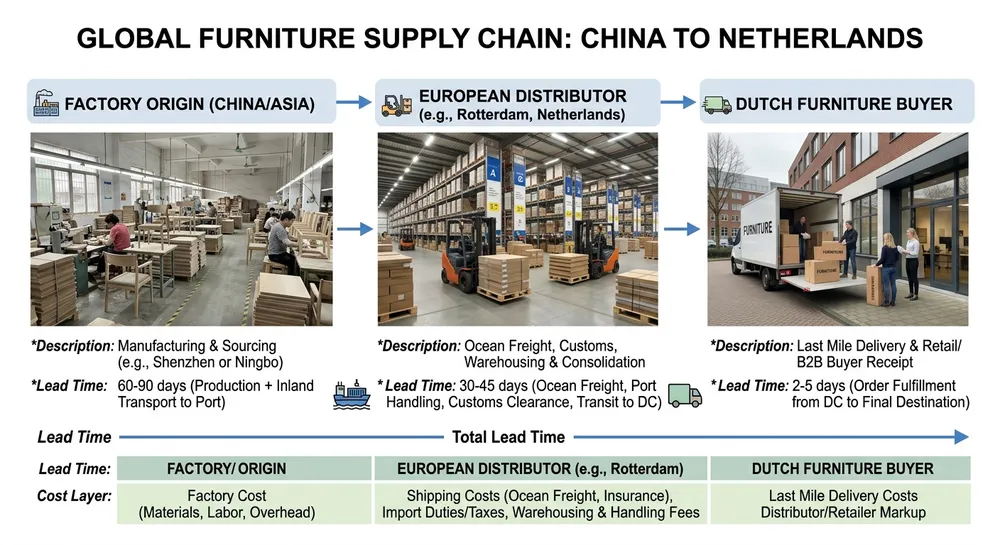
Lift-top or rotating — which ships more efficiently? Rotating mechanisms are more compact and pack flatter, so you get more units per carton and more cartons per container. Lift-top linkage arms add volume. For high-volume orders where freight cost is a meaningful line item, rotating mechanisms have a container loading advantage of roughly 15–20% more units per container depending on the specific model. Worth factoring into your landed cost calculation if you're ordering 2,000+ units.

What certifications apply to these mechanisms? Both mechanism types in our range carry CE marking and have passed SGS and RoHS testing. For North American buyers, we can provide documentation supporting CARB compliance for the wood components in packaged assemblies. Our facility is ISO 9001:2015 certified — audit reports available on request.

The motion type decision is a product architecture decision, not a hardware detail. Get it right before you finalize your furniture design, because changing it after tooling is expensive. If you're between the two options and your target retail price or product category isn't clearly pointing one direction, send us your product brief through our Request Quote page — we'll tell you which configuration protects your margin at your volume. “`