Misread a spring rate spec and you'll ship chairs that feel like sitting on a park bench. Underspec the load capacity and you're looking at warranty claims from your first container. These three parameters — tilt angle, spring rate, and load capacity — are where most sourcing mistakes happen with push back chair mechanisms, and they're also where the difference between a reliable supplier and a cheap one shows up fastest.
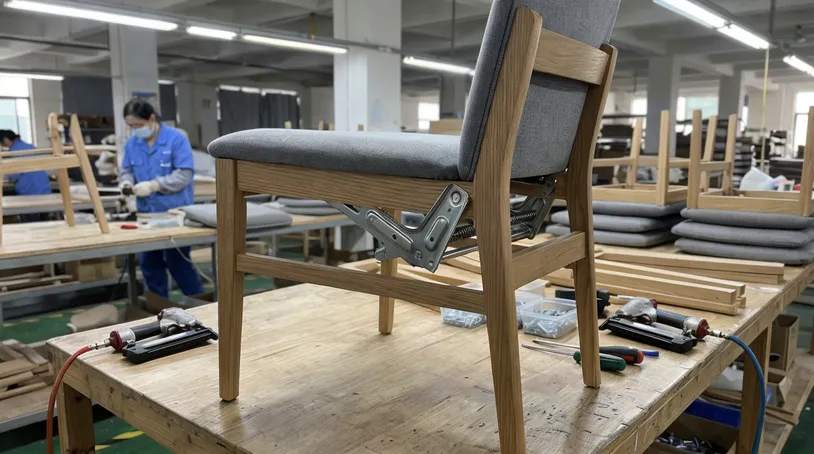
This isn't a primer on what a push back mechanism is. If you're reading this, you already know it's the tilt hardware that lets a chair recline under body pressure and return to upright when the user leans forward. What you need is a clear breakdown of how the specs work, what the numbers mean for your product line, and what to check before you commit to a supplier.

What the tilt angle range actually controls — and where buyers get it wrong
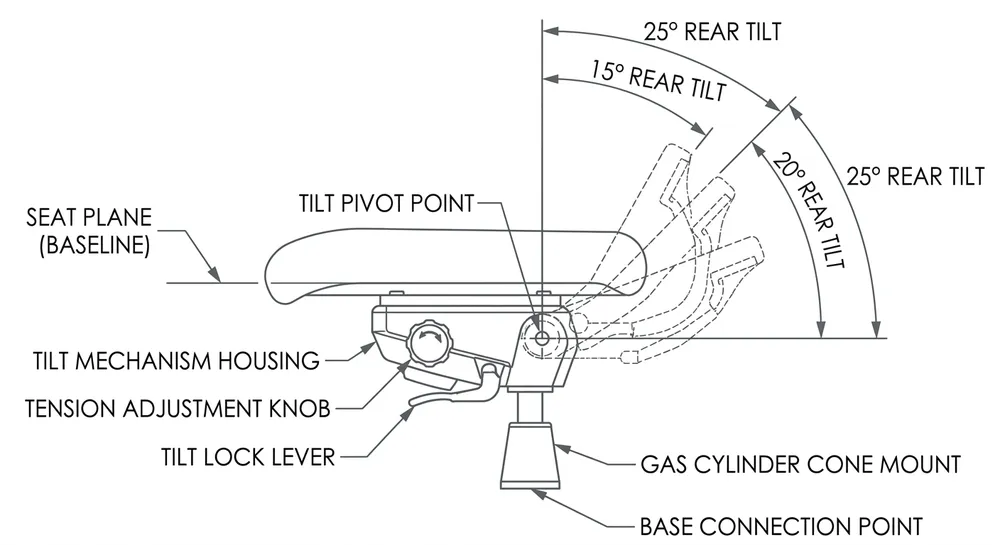
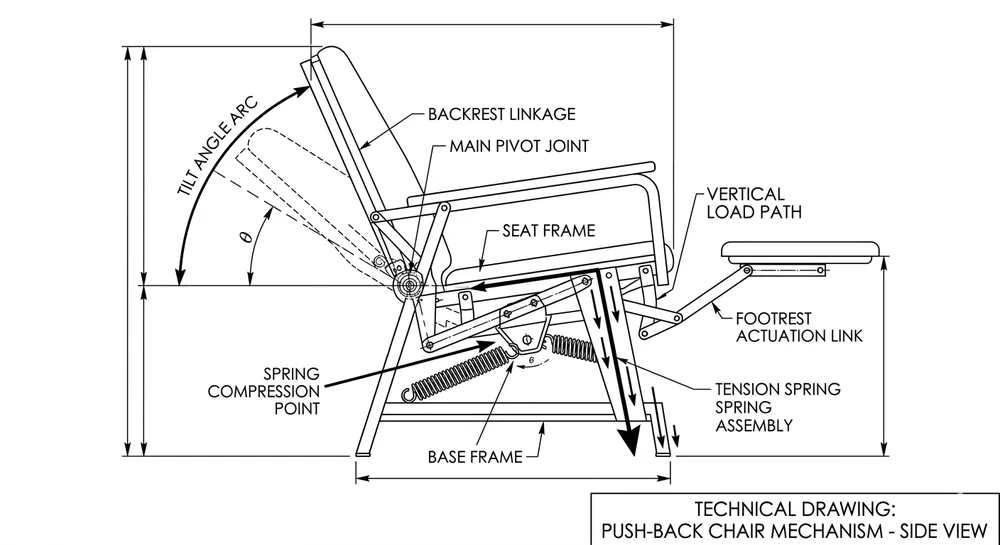
The tilt angle on a push back mechanism is the arc the seat-back travels through from upright to full recline. Standard production range is 15° to 25°, with most commercial office and task chair applications landing at 18° to 22°.
That number matters more than it looks. A 15° mechanism feels stiff and limited — fine for intensive task seating where you don't want users leaning back for long, but a liability if you're selling into lounge or executive segments where buyers expect a more generous recline. A 25° mechanism in a compact chair frame can cause the backrest to contact the user's lower back at an uncomfortable angle if the seat depth isn't matched correctly.
We run two standard tilt angle configurations: 18° for task and operator chairs, and 22° for executive and mid-back lounge applications. The tooling is different — the pivot geometry changes — so this isn't something you can adjust after the fact by tweaking the spring. (We've had buyers ask. It doesn't work that way.)
The other variable inside the tilt angle spec is the tilt ratio — how much the seat pan drops relative to the backrest travel. A synchronized tilt mechanism moves both seat and back together at a fixed ratio (typically 2:1 back-to-seat). A pure push back mechanism moves only the backrest, with the seat staying flat. If your product brief calls for synchronized movement, that's a different mechanism category entirely — see our Chair Mechanism category for the full range.
For push back specifically: confirm the tilt angle, confirm whether the seat is fixed or floating, and confirm the stop position is hard-stopped by the mechanism body rather than relying on the spring alone. Soft stops wear out. Hard stops don't.
Spring rate: the spec that determines how your chair feels in the showroom and survives in the field
Spring rate is measured in N/mm (newtons per millimeter of compression) and defines how much resistance the mechanism offers as the user reclines. Get this wrong and no amount of good frame design saves you — the chair either feels dead or fights the user.
Standard push back mechanisms ship with spring rates between 1.8 N/mm and 3.5 N/mm. Here's how that range maps to real applications:
| Spring rate | Recline feel | Typical application |
|---|---|---|
| 1.8 – 2.2 N/mm | Light, easy recline | Lounge seating, reception chairs, lighter user weight ranges |
| 2.3 – 2.8 N/mm | Medium resistance | General office, task chairs, mixed-use commercial |
| 2.9 – 3.5 N/mm | Firm, controlled recline | Executive seating, high-use environments, heavier user profiles |
Most of our standard mechanisms ship at 2.5 N/mm as a default. That covers the majority of commercial office applications without adjustment. But if you're building a product line for a specific market — hospitality seating for a hotel chain, for example, where the chairs see 12+ hours of daily use across a wide user weight range — we'd spec toward 2.8 to 3.0 N/mm and pair it with a tension adjustment knob so the end user can fine-tune.
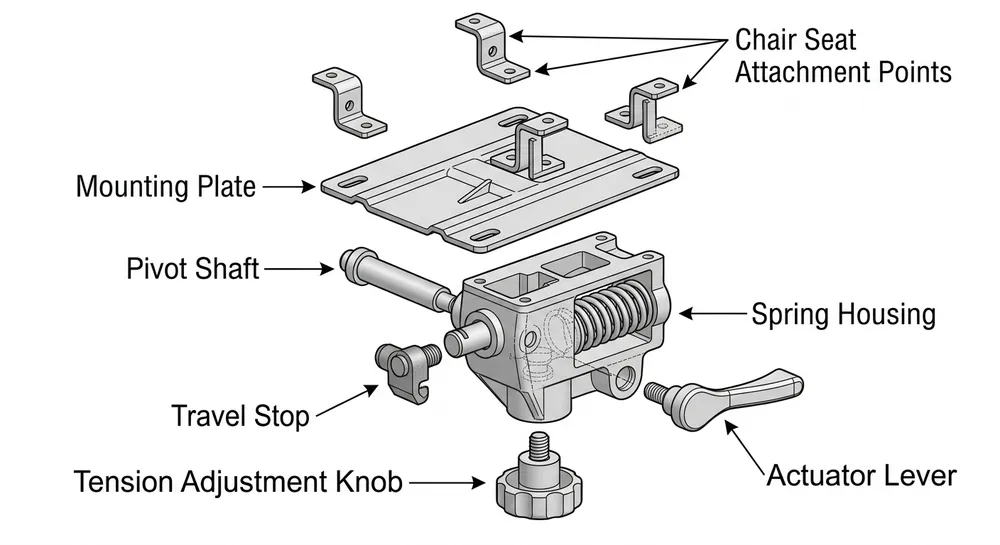
The tension adjustment knob is worth calling out separately. It's a threaded adjuster under the seat that lets the user increase or decrease spring preload, typically across a range of ±0.5 N/mm from the base rate. For B2B buyers, this is a margin feature: chairs with user-adjustable tension command a higher retail price point and generate fewer complaints from end users who find the default feel wrong for their body weight. We include it as standard on our mid-range and executive push back units.
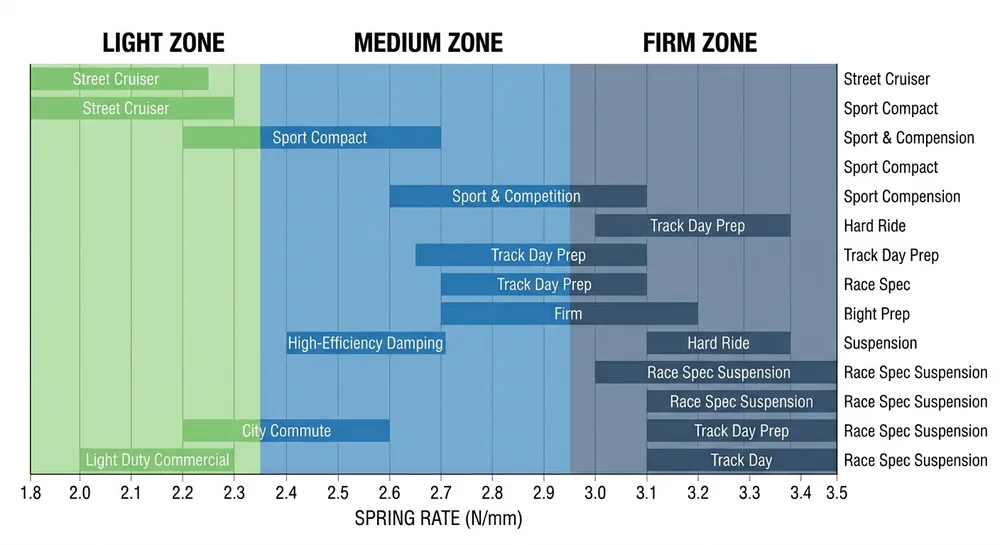
One thing we see buyers overlook: spring rate and tilt angle interact. A 22° tilt with a 2.0 N/mm spring will feel very different from a 22° tilt with a 3.0 N/mm spring — the first reclines easily and returns slowly, the second requires deliberate body pressure and snaps back crisply. Neither is wrong, but they suit different product positions. Decide on the feel profile before you finalize either spec.
Load capacity ratings: what the numbers mean and what they don't
Load capacity on a push back mechanism is rated in kilograms (or pounds for North American market documentation) and refers to the maximum static load the mechanism is designed to support in normal use. Standard commercial ratings run from 100 kg to 150 kg, with heavy-duty variants reaching 200 kg.
What the rating doesn't tell you is the dynamic load behavior — how the mechanism performs under repeated impact loading, which is what actually causes fatigue failure in the field. A mechanism rated at 120 kg static can fail prematurely if the pivot welds or spring housing aren't designed for the cyclic stress of a user dropping into the chair repeatedly over 50,000+ cycles.
This is where material and process choices matter more than the rated number. Our standard push back mechanisms use:
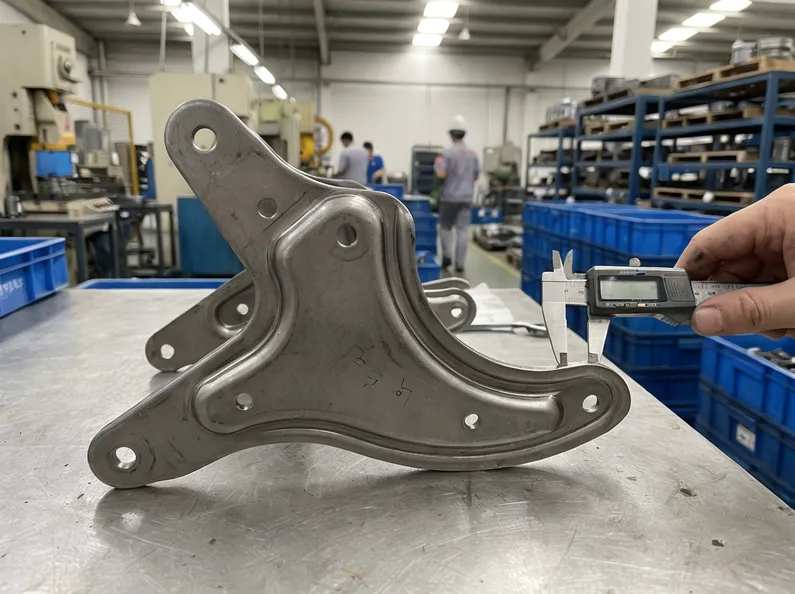
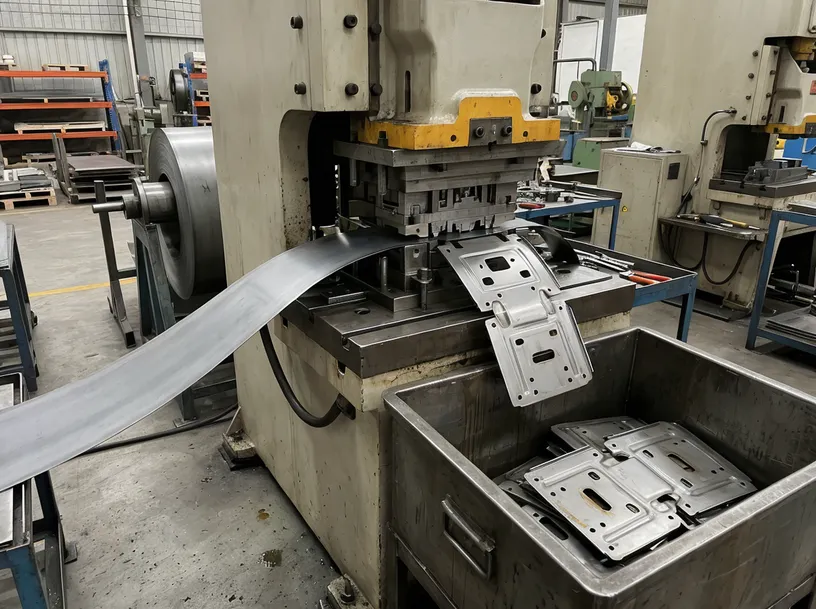
- Pivot plate: 3.0 mm cold-rolled steel, laser-cut and CNC-bent to ±0.2 mm tolerance
- Spring housing: zinc alloy die-cast, 380 MPa tensile strength minimum
- Tilt stop: hardened steel insert, press-fit into the mechanism body
- Surface treatment: zinc plating on steel components, powder coat on visible surfaces
The zinc alloy die-cast spring housing is worth a note. Some lower-cost mechanisms use stamped steel housings — cheaper to produce, but the spring seat geometry is less precise, which means the spring rate varies across a production batch. We switched to die-cast housings on this component specifically because we were seeing ±0.3 N/mm variation in spring rate on stamped versions, which is enough to make chairs from the same batch feel noticeably different. Die-cast holds the spring seat to ±0.05 mm, and the spring rate variation drops to ±0.1 N/mm across a batch.
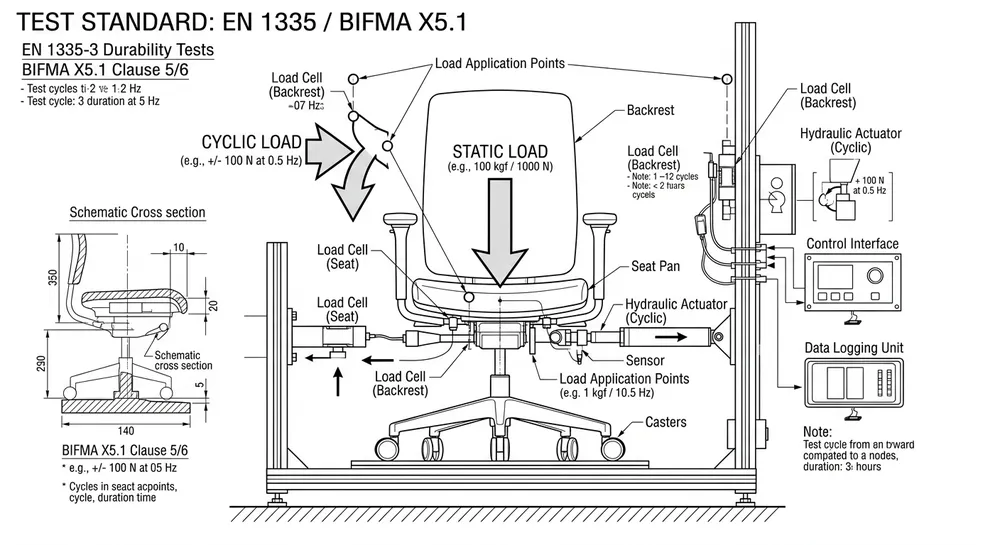
For load capacity verification, ask your supplier for the test report, not just the rated number. The test should reference a recognized standard — EN 1335 for European markets, BIFMA X5.1 for North American — and should include both static load and fatigue cycle results. A supplier who can only give you the rated number without a test report is giving you a marketing claim, not a specification.
How these three specs interact in a real product brief
Tilt angle, spring rate, and load capacity don't exist in isolation. A product brief that specifies one without the others is incomplete, and a supplier who quotes without asking about all three is either inexperienced or not paying attention.
Here's how we typically work through a product brief with a new buyer:
Step 1 — Application and user profile. What seating category? What's the target user weight range? Is this for a fixed installation (hotel, office fit-out) or retail distribution where end users vary widely?
Step 2 — Tilt angle selection. Task chair: 18°. Executive or lounge: 22°. Anything outside that range needs a conversation about frame geometry and seat depth compatibility.
Step 3 — Spring rate and tension adjustment. Single-rate spring for cost-sensitive products. Adjustable tension knob for mid-range and above. Spring rate selected based on user weight profile and recline feel target.
Step 4 — Load capacity and test standard. Confirm the target market's required standard (EN 1335 for Europe, BIFMA for North America). Confirm whether the buyer needs test reports included in the shipment documentation.
Step 5 — Surface treatment and finish. Zinc plating is standard. Nickel plating available for visible components in premium product lines. Powder coat color matching available on runs over 500 units.
We've been through this process with buyers across North America, Europe, the Middle East, and Southeast Asia since 2008. The brief above isn't a sales script — it's the actual sequence of questions that prevents a misspecified order from becoming a rework problem six months later.
The sourcing trap: rated specs vs. verified specs
The most common sourcing mistake with push back mechanisms isn't choosing the wrong spec — it's accepting a rated spec without verification. A supplier's product sheet might say "load capacity: 150 kg, spring rate: 2.5 N/mm, tilt angle: 20°." Those numbers are easy to print. What's harder to fake is a third-party test report showing the mechanism actually performed to those values under controlled test conditions.
Before you finalize a supplier, request:
- Dimensional inspection report for the pivot plate and spring housing (confirms the ±0.2 mm tolerance claim)
- Load test report referencing EN 1335 or BIFMA X5.1 (confirms static and cyclic load capacity)
- Spring rate batch test data (confirms consistency across a production run, not just a single sample)
- Surface treatment report — salt spray hours for zinc or nickel plating (minimum 96 hours for standard commercial, 240+ hours for coastal or humid market applications)
We run 100% functional testing on every mechanism before shipment — tilt cycle check, spring return verification, stop engagement test. Batch-level load testing is done on a sampling basis per ISO 9001:2015 protocol. Test reports are available on request for any active order.
(One thing worth knowing: if a supplier hesitates to share batch test data, that's usually because they don't have it. Spot-testing a sample for a buyer visit is not the same as systematic batch QC.)
Spec selection guide by market segment
Different export markets have different baseline expectations. Here's how the spec matrix typically maps:
| Market | Tilt angle | Spring rate | Load rating | Test standard |
|---|---|---|---|---|
| North America (office) | 18° – 20° | 2.5 – 3.0 N/mm | 136 kg (300 lb) | BIFMA X5.1 |
| Europe (office/task) | 18° – 22° | 2.3 – 2.8 N/mm | 110 – 120 kg | EN 1335 |
| Middle East (executive) | 22° | 2.8 – 3.2 N/mm | 130 – 150 kg | EN 1335 or custom |
| Southeast Asia (commercial) | 18° – 20° | 2.0 – 2.5 N/mm | 100 – 120 kg | Varies by buyer |
| Australia | 18° – 22° | 2.5 N/mm | 120 kg | AS/NZS 4438 |
These are starting points, not fixed rules. We've shipped 22° mechanisms with 3.0 N/mm springs to North American hospitality buyers and 18° mechanisms with 2.0 N/mm springs to European lounge furniture importers. The table reflects what most buyers in each market ask for — your product position may differ.
If you're entering a new market and unsure where to start, the safest default is 20° tilt, 2.5 N/mm spring, 120 kg load rating with EN 1335 test documentation. That configuration clears most commercial market requirements and gives you room to adjust based on buyer feedback after your first season.
FAQ
What is the standard tilt angle for a push back chair mechanism?
Most commercial push back mechanisms run between 18° and 22°. Task and operator chairs typically use 18°; executive and lounge applications use 20° to 22°. Anything outside that range requires a review of the chair frame geometry to confirm compatibility.
How do I choose the right spring rate for my product?
Start with the target user weight range and the intended seating category. Light lounge seating for a mixed user profile: 2.0 to 2.2 N/mm. Standard commercial office: 2.5 N/mm. Executive or high-use environments with heavier users: 2.8 to 3.2 N/mm. If you're distributing across a wide market, a mechanism with a user-adjustable tension knob covers more of the range without requiring multiple SKUs.
What load capacity do I need for North American office chairs?
BIFMA X5.1 requires testing to 300 lb (136 kg) for standard office seating. If you're targeting the North American market, confirm your supplier has a BIFMA-compliant test report, not just a rated number on a spec sheet.
What's the difference between a push back mechanism and a synchronized tilt mechanism?
A push back mechanism moves only the backrest — the seat stays flat. A synchronized tilt mechanism moves both seat and back together, typically at a 2:1 ratio. Push back is simpler, lower cost, and easier to maintain. Synchronized tilt offers better ergonomic support for long-duration seating. For the full range of chair tilt options, see our Push Back Chair Mechanism product page.
Can spring rate be adjusted after the mechanism is installed in the chair?
On mechanisms with a tension adjustment knob, yes — within the adjustment range (typically ±0.5 N/mm from the base rate). The base spring rate itself is set by the spring and cannot be changed without replacing the spring assembly. This is why getting the base rate right at the sourcing stage matters.
What documents should I request from a push back mechanism supplier?
At minimum: dimensional inspection report, load test report referencing EN 1335 or BIFMA X5.1, spring rate batch test data, and surface treatment salt spray report. For export to regulated markets, also confirm CE marking documentation if shipping to Europe.
If you're ready to spec a push back mechanism for your next product line, send your application details and target market to our team — we'll confirm the right tilt angle, spring rate, and load rating for your brief and provide a detailed quote with test documentation. Request Quote