

About MVMHardware
Furniture Mechanism Factory
MVMHardware is a dedicated furniture mechanism manufacturer based in Guangdong, China. We design and produce motion hardware — the part that determines whether the furniture works.
Our Products & Customers
What We Make and Who We Supply
MVMHardware is a dedicated furniture mechanism manufacturer based in Guangdong, China. We design and produce motion hardware — chair tilt mechanisms, recliner linkages, sofa bed frames, lift-top table fittings, hinge systems, and the full range of components that make furniture move the way it's supposed to.
We don't make the furniture. We make the part that determines whether the furniture works.
Founded in 2008 under Foshan Jinruida Import And Export Co., Ltd., we've spent 17 years building one thing: a factory that overseas buyers can source from without surprises. Mechanism hardware is a specialized category — tolerances matter, cycle life matters, surface finish matters — and we've been doing this long enough to know where the problems hide.
Factory-Direct Supply
We ship factory-direct. No trading layer, no markup chain. Your order is quoted, produced, inspected, and packed here, by the same team that designed the tooling.

Export Markets
Mechanism Categories We Produce
Who Sources From MVMHardware
Company History
How We Got Here
We started in 2008 running manual stamping and assembly lines, primarily supplying domestic furniture clusters in Guangdong. Export demand came early — by 2010 we were shipping container loads to European importers who needed consistent batch quality that manual lines couldn't reliably deliver.
That pressure pushed us to invest in progressive die stamping and semi-automated assembly before most of our peers in this category did.
The shift that changed our capability profile most was building out zinc alloy die-casting in-house. Most mechanism factories in this region outsource their die-cast components — knobs, adjustment collars, decorative covers — to third-party foundries, which means they have no control over dimensional consistency or surface quality on those parts.
Why In-House Die-Casting Matters
When a buyer sends back a sample saying the tilt knob feels loose or the finish is inconsistent batch-to-batch, nine times out of ten the root cause is the die-cast component. Owning that process means we own the fix.
We brought zinc alloy die-casting in-house around 2015. It's been one of the cleaner decisions we've made — full control over dimensional consistency and surface quality on every die-cast part that ships with our mechanisms.

Key Milestones
Outsource die-cast components — knobs, adjustment collars, decorative covers — to third-party foundries. No control over dimensional consistency or surface quality on those parts.
Zinc alloy die-casting in-house. We own the process, we own the fix. Consistent dimensional tolerances and surface finish on every die-cast component — no third-party foundry variables.
Inside the Factory: 12,000 m² of Mechanism Production
The facility runs 12,000 square meters across stamping, die-casting, surface treatment, assembly, and QC. Six dedicated production lines handle the full mechanism range — chair mechanisms on two lines, recliner and sofa hardware on two more, and table and door/hinge mechanisms on the remaining pair. That separation matters: your chair mechanism order doesn't queue behind a large sofa bed run.

Production Line Allocation
Process Flow
Cold-rolled steel coil stock feeds the progressive stamping presses, where mechanism plates, brackets, and linkage arms are formed to ±0.15mm tolerance. Zinc alloy die-casting handles the smaller precision components. Parts move to welding — MIG for structural joints on load-bearing assemblies, spot welding for lighter brackets — then to surface treatment before final assembly and testing.
Surface Treatment: In-House Full Line
Powder Coating
Runs at 60–80μm consistent film thickness across a batch — the spec range that passes 500-hour salt spray without adhesion failure. We ran thinner at 45–55μm to reduce material cost; the salt spray results on coastal-market shipments told us that was the wrong trade-off. We moved back up.
Nickel Plating
Used on components where dimensional tolerance after coating is critical. Powder adds thickness that can affect fit on tight-clearance assemblies — nickel plating preserves those tolerances.
Zinc Plating
Applied alongside nickel plating for tight-tolerance components where post-coating dimensional control is required. Chosen based on fit requirements of the specific assembly.
Core Manufacturing Capabilities
Progressive Die Stamping
Mechanism plates and structural brackets to ±0.15mm
Zinc Alloy Die-Casting
Adjustment components, knobs, and decorative hardware
MIG & Spot Welding
Structural and bracket assemblies
In-House Powder Coating
60–80μm, 500-hour salt spray rated
Nickel & Zinc Electroplating
Tight-tolerance components
Full Assembly & Functional Testing
End-of-line testing on every unit before packing
Quality Control: From Incoming Steel to Outgoing Container
ISO 9001:2015 is the framework. The actual process is three checkpoints that don't get skipped.
Incoming Inspection
Covers coil steel and zinc alloy ingot. We check material certification against mill reports, pull dimensional samples on the first stamped parts from each coil change, and hold any batch where hardness or thickness is outside spec.
We've had suppliers try to substitute material grade mid-contract — the incoming check is what catches it before it becomes your problem.
In-Process Inspection
Runs at the stamping stage (first-article and periodic dimensional checks), at welding (visual and pull-test on structural joints), and at surface treatment (film thickness measurement and adhesion cross-cut test on each coating run).
Outgoing Inspection
100% functional on every unit before packing. Not sampling — every unit. A mechanism that passes dimensional and load-cycle checks but has a sticky tilt lock or a misaligned mounting hole gets pulled at this stage.
CE and SGS certifications cover the product range for European and international market compliance. RoHS compliance is documented for buyers whose downstream customers require it.
50,000-Cycle Load Testing
Mechanism assemblies go through functional testing before they reach the final line — tilt range, lock engagement, load cycle. We run 50,000-cycle load testing on chair mechanisms as a standard batch qualification check, not a special request.
The 50,000-cycle figure is the minimum for commercial office chair certification in most markets. We use it as our floor, not our ceiling — mechanisms going to high-use commercial environments get spec'd and tested higher.

Certifications Held
Environmental Practices and Material Compliance
Powder Coating — Low-VOC
The powder coating line uses low-VOC formulations. No solvent-based liquid paint is used anywhere in the facility.
Wastewater — Closed-Loop Treatment
Wastewater from the electroplating line goes through a closed-loop treatment system before discharge, meeting Guangdong provincial standards.
Steel Scrap — Zero Landfill
Steel scrap from stamping is collected and sold to certified recyclers. Process waste is not landfilled.
RoHS Compliance — No Hexavalent Chromium
RoHS compliance on surface treatments means no hexavalent chromium in the plating process. The zinc plating line was converted to trivalent chromium passivation several years ago.
For buyers supplying into the EU or California markets, that documentation is available with shipment.
Worker Safety Standards
- GB standard requirements for stamping and plating environments
- PPE protocols and ventilation on the plating line
- Press guarding on all stamping equipment
- Internal audits quarterly; third-party audits available on request for buyers with supplier qualification requirements

R&D and Engineering: 12 Engineers, In-House Tooling
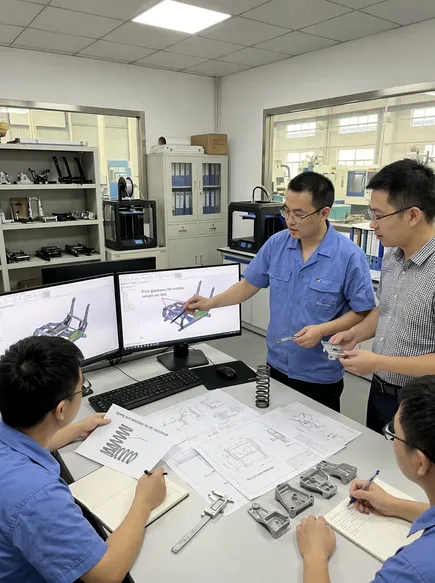
The engineering team is 12 people — mechanical engineers and tooling designers who work exclusively on mechanism hardware. That focus matters in this category. Furniture mechanism design involves specific trade-offs that generalist engineers get wrong:
Correct spring rate selection for tilt resistance — a trade-off generalist engineers routinely miscalculate.
Pivot geometry that directly affects the feel of a recliner's motion arc — not a parameter that can be approximated.
Die-cast wall thickness that balances weight against structural integrity — our engineers have been solving this for years, not learning it on your project.
OEM — Your Drawings, Our Production
We produce to your drawings and specifications. We'll review them for manufacturability and flag anything that will cause production problems — but the design is yours.
ODM — Brief to Production-Ready
Bring us a brief: target retail price, market segment, performance requirements, and aesthetic direction. We develop the mechanism design, build the tooling, run samples, and iterate until the spec is locked.
In-House Tooling: Faster Revision Cycles
Tooling is built in-house, which means faster revision cycles and no third-party tooling shop delays when a sample needs a geometry change.
MOQ — Honest Numbers
Standard catalog mechanisms: 500 units minimum.
For OEM/ODM tooling projects, MOQ depends on tooling amortization. We'll give you the honest number based on your spec — not a round figure designed to sound accessible.
Our Team
The People Running the Lines
Chief Engineer
18+ years in metal stamping and mechanism assembly. Has overseen tooling development for most of the current catalog — the institutional knowledge behind every production decision on the floor.
QC Team Lead
Came up through incoming inspection and in-process roles before taking the department. That background means they know exactly where shortcuts happen and where to look — not just what the checklist says.
Export Coordination
Senior coordinator with 10+ years managing shipments to European and North American buyers. Handles documentation, compliance paperwork, and container planning — knows customs requirements for each market without looking them up.
Logistics
Shipping to Your Market: Container Planning and Lead Time
Export Markets
Production Lead Time
From order confirmation and deposit receipt. Standard production items from existing tooling.
Schedule delivered milestone by milestone — not a single delivery date that obscures where the time goes.
Lock your spec before you place the order.
The 25–35 day window assumes confirmed artwork and specifications at order placement. The most common delay: buyers sending revised specs after production has started. It saves both parties.
Container & Packaging

Mechanisms are packed in standardized cartons sized for 40HQ loading. Pallet configurations for main product lines are pre-worked — your freight forwarder isn't improvising at the warehouse. Retail-ready packaging and branded cartons are handled as part of the OEM arrangement.
Export Documentation
Why Source With Us
Core Sourcing Advantages at a Glance
17 Years in Mechanism Hardware Exclusively
Not a general hardware factory that added mechanisms to the catalog. Every process, every engineer, every QC checkpoint is built around this one product category, so your order doesn't get treated like a side project.
In-House Die-Casting Eliminates a Common Failure Point
Dimensional inconsistency and surface defects on die-cast components are the leading cause of mechanism quality complaints. We control that process internally, so the fix is on our floor, not in a supplier negotiation.
100% Functional Testing Before Shipment
Every unit, not a sample. Mechanisms that pass dimensional checks but fail functional performance get pulled before they reach your container.
6 Dedicated Lines, 3M Units/Year — Your Order Has a Slot
Production line separation by product category means your run isn't competing for capacity with unrelated product types. 10,000-unit orders ship on schedule.
OEM/ODM with In-House Tooling
Faster sample iterations, no third-party tooling delays, and a 12-person engineering team that has seen the failure modes in this category before your project starts.
CE, SGS, RoHS Documentation Ready
Compliance paperwork ships with the order. Your customs broker and compliance team get what they need without chasing us for documents after the fact.
Get in Touch
Contact MVMHardware
Ready to discuss your mechanism requirements? Send us your specs, a sample reference, or your target price point — we'll come back with a specific recommendation and quote.