

Door Hinge Furniture Mechanism
Factory-Direct Supply
Factory-direct door hinge furniture mechanism — stamped steel and die-cast components, 17 years of production depth. Full category coverage: concealed cabinet hinges, soft-close dampers, pivot door systems, and overlay/inset configurations. Every unit 100% functionally tested before shipment.
Category Overview
What Door & Hinge Mechanisms We Produce
Door and hinge furniture mechanisms are the category we've been running on dedicated production lines since the factory's early years. The product range covers everything that controls how a cabinet door, wardrobe panel, or furniture enclosure opens, closes, and holds position: concealed cup hinges, soft-close integrated hinges, overlay and inset configurations, pivot hinges for frameless systems, and damper assemblies that manage closing velocity. If it connects a door to a carcass and controls its motion, it falls in this category.
We manufacture these as a door furniture mechanism manufacturer with full in-house process control — progressive die stamping for the hinge plates and mounting brackets, zinc alloy die-casting for the adjustment cams and housing components, and in-house surface treatment for the finished product. That vertical integration is what separates a mechanism factory from a trading company: when a buyer reports that the adjustment cam is slipping under load, we can trace it to the die-casting parameters and fix it on our floor, not in a supplier negotiation.
The category ships to furniture manufacturers, kitchen cabinet producers, wardrobe system assemblers, and importers who distribute into retail and contract channels across North America, Europe, the Middle East, Southeast Asia, and Australia. Standard MOQ is 500 units per SKU. OEM and ODM tooling projects are a regular part of our workload.
Learn more about our factory capabilities
Progressive die stamping for hinge plates and mounting brackets — in-house dimensional control.
Adjustment cams and housing components cast in-house — tolerance owned at the casting stage.
In-house surface finishing — nickel-plated, zinc-plated, and custom finish options available.
Full Category Range
Product Line Overview
The door and hinge mechanism line covers the configurations that account for the majority of cabinet and wardrobe hardware sourcing. Below is the current category range with the key differentiating characteristic of each type.
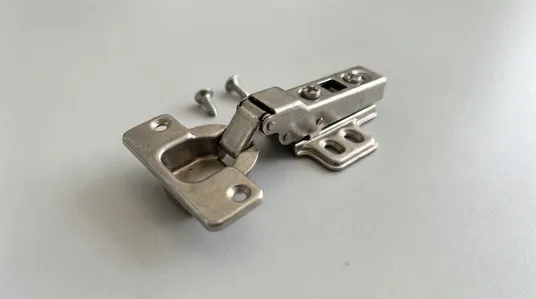
Concealed Cup Hinges
Cup hinges mount inside a 35mm bore on the door panel, keeping all hardware invisible from the exterior. Available in full overlay, half overlay, and inset configurations. Clip-on mounting plates allow tool-free door removal — relevant for buyers who need to service or replace doors in installed furniture without disassembling the carcass.
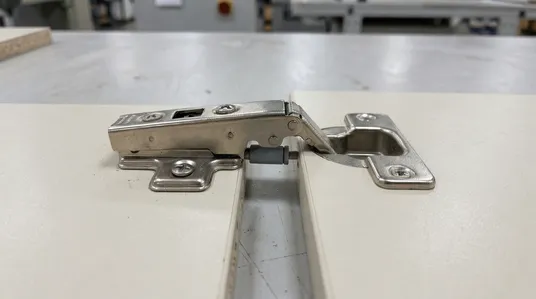
Soft-Close Hinge Mechanisms
Integrated soft-close dampers built into the hinge body — not added as a separate clip-on component. The damper engages in the final 15–20° of closing travel, decelerating the door to a controlled stop. Closing force calibrated for door weights in the 1.5–8 kg range, covering standard cabinet doors through heavier wardrobe panels.
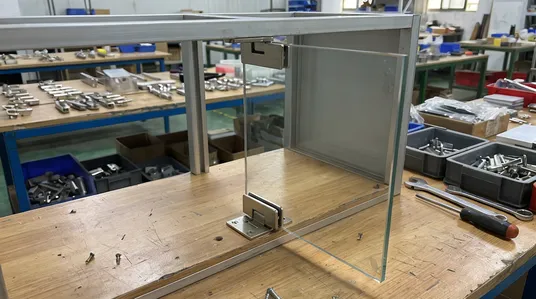
Pivot Hinge Systems
Pivot hinges mount at the top and bottom of the door rather than on the side, enabling full 90° or 180° swing on frameless and glass-door applications. The pivot point sits at the door edge, so the door sweeps a smaller arc — relevant for tight-clearance installations where a standard hinge would conflict with adjacent furniture or walls.
Overlay & Inset Configuration Variants
Beyond the hinge type, door furniture mechanism sourcing involves overlay specification: how much of the door face covers the carcass edge. Full overlay (covering the full carcass face), half overlay (shared carcass edge between two doors), and inset (door sits flush inside the carcass opening) each require different hinge geometry.
We stock and produce all three configurations across the concealed hinge range, so your order doesn't require separate suppliers for different cabinet configurations in the same project.
Damper & Soft-Close Add-On Assemblies
Standalone damper clips that retrofit onto existing hinge installations — relevant for buyers who are upgrading existing furniture lines or supplying aftermarket soft-close kits. These clip onto standard 35mm cup hinge mounting plates without modification to the door or carcass.
Discuss Your Specific Configuration Requirements
MOQ 500 units per SKU. OEM/ODM tooling projects welcome.
Procurement Reference
Technical Specifications: Category-Wide Parameter Ranges
Procurement professionals need to know whether our spec range covers their requirements before going deeper. Here are the category-wide parameters across the door and hinge mechanism line.
| Parameter | Range / Options |
|---|---|
| Hinge cup bore diameter | 35mm (industry standard) |
| Door thickness compatibility | 16–22mm (standard panel range) |
| Door weight capacity | 1.5–25 kg depending on hinge type |
| Overlay configurations | Full overlay, half overlay, inset |
| Opening angle | 90°, 110°, 165°, 180° (by model) |
| Soft-close cycle rating | 80,000 cycles (standard batch test) |
| Body material | Cold-rolled steel (SPCC), zinc alloy die-cast components |
| Surface finish options | Nickel plating, zinc plating, powder coating |
| Powder coat film thickness | 60–80μm |
| Salt spray resistance | 500 hours (powder coat), 200+ hours (nickel plate) |
| Adjustment axes | 3-way: lateral, depth, height |
| Mounting plate type | Clip-on (tool-free removal) or screw-fixed |
| Certifications | ISO 9001:2015, CE, SGS, RoHS |
| Standard MOQ | 500 units per SKU |
These are category-level ranges. Specific models carry their own exact values — click through to individual product pages for the precise specs on each configuration.
In-House Production
Manufacturing Process: Where Hinge Quality Is Actually Decided
Most hinge mechanism failures trace back to two points in the manufacturing process: the die-cast adjustment components and the surface treatment. We've seen both failure modes, which is why we run both processes in-house.
Stamping
Hinge plates, mounting brackets, and structural arms are formed on progressive die stamping presses from cold-rolled SPCC steel coil. Tolerance on stamped parts runs to ±0.15mm — tight enough that clip-on mounting plates engage consistently across a batch, and door alignment doesn't vary unit to unit. First-article dimensional checks run at every coil change; periodic checks run through the production run.
Die-Casting
The adjustment cam, hinge cup housing, and closing arm pivot components are zinc alloy die-cast. We brought die-casting in-house around 2015 specifically because outsourced die-cast components were the leading source of quality complaints — dimensional inconsistency on the cam profile causes the "adjustment slips under load" problem that generates warranty returns. In-house casting means we control the alloy composition, injection parameters, and post-cast dimensional check. When a sample fails, the fix is a parameter change on our machine, not a conversation with a subcontractor.
Surface Treatment
Full in-house line — nickel plating, zinc plating, and powder coating. The powder line runs at 60–80μm consistent film thickness, which is the spec that passes 500-hour salt spray without adhesion failure. We ran thinner for a period to reduce material cost. The salt spray results on coastal-market shipments told us that was the wrong trade-off. We moved back up and haven't revisited it. Nickel plating is used on components where dimensional tolerance after coating is critical — powder adds thickness that affects fit on tight-clearance assemblies like the clip-on mounting interface.
Assembly & Testing
100% functional testing on every unit before packing. Not sampling — every unit. A hinge that passes dimensional checks but has a sticky soft-close damper or a cam that won't hold adjustment gets pulled at this stage. CE and SGS certifications cover the product range for European and international market compliance.


Common Hinge Mechanism Failures — and How We Engineer Around Them
This is the section most supplier websites skip. We include it because buyers who have been burned by hinge quality problems are the ones who ask the right questions, and we'd rather answer them here than after you've received a container.
Adjustment Cam Slippage Under Load
The cam profile wears or deforms, and the door drifts out of alignment after installation. Almost always caused by dimensional inconsistency in the die-cast cam — either from alloy substitution or from worn die tooling run past its service life.
In-house die-casting with alloy certification on incoming ingot, and die tooling inspection intervals that pull tooling before dimensional drift reaches the cam profile tolerance limit.
Soft-Close Damper Failure Before Rated Cycle Life
Damper fluid leaks or the piston seal degrades, and the door starts slamming within a year of installation. This generates warranty returns and damages your buyer's brand with their end customers.
We run 80,000-cycle qualification on damper batches — not as a marketing number, but because it's the threshold where seal degradation shows up in testing. Batches that don't pass don't ship.
Powder Coat Adhesion Failure at the Hinge Cup Rim
The cup rim is a stamped edge — sharp geometry that's the hardest area to get consistent powder adhesion on. Adhesion failure shows up as flaking at the bore edge after installation, which is visible and generates complaints.
Phosphate pre-treatment on all stamped parts before powder application, and cross-cut adhesion testing on each coating run. The pre-treatment step adds process time and cost; it's not optional.
Clip-On Plate Engagement Loosening Over Time
The clip mechanism loses retention force after repeated door removal and reinstallation cycles. This is a stamping tolerance issue — the clip spring geometry needs to be held tight enough that retention force stays consistent across the product's service life.
We hold the clip spring arm geometry to ±0.1mm, tighter than the general ±0.15mm tolerance on other stamped components, specifically because this is where tolerance stack-up causes field problems.
Application Segments: Where This Category Generates Repeat Orders
Door and hinge furniture mechanisms are a consumable category for your downstream customers — furniture wears, gets upgraded, and gets replaced. The segments below are where we see consistent reorder patterns from our existing distribution customers.
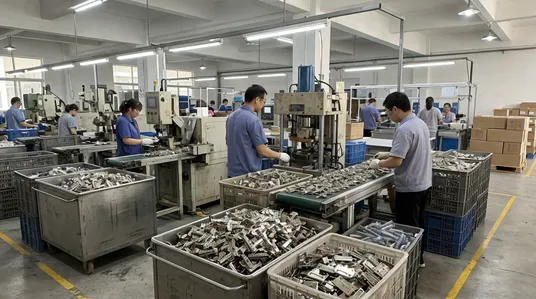
Kitchen Cabinet Manufacturing
A standard kitchen installation uses 20–40 hinges; a production cabinet manufacturer running 500 kitchens per month is ordering 10,000–20,000 hinges per run. Soft-close is now the baseline expectation in mid-market and above — buyers who aren't stocking soft-close integrated hinges are losing shelf position to competitors who are.
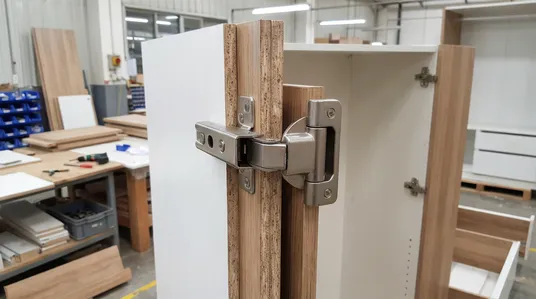
Wardrobe & Fitted Furniture Systems
Wardrobe panels run heavier than kitchen cabinet doors — 8–15 kg is typical for a full-height wardrobe door. This segment needs hinges spec'd for higher door weight, which means the pivot housing and mounting plate gauge matter more than in the kitchen segment.
Contract Furniture & Hospitality
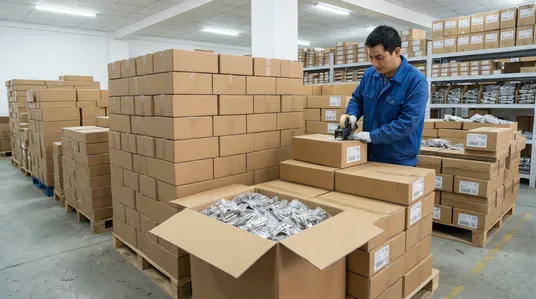
Hotels, serviced apartments, and commercial fit-out projects specify furniture in bulk — a single hotel project might specify 2,000–5,000 hinges across room furniture, wardrobe units, and built-in cabinetry. Contract buyers typically require CE documentation and test reports as part of the specification package.
Furniture Retail & Import Distribution
Importers who supply furniture retailers need consistent batch quality across reorders — a hinge that looks and functions identically in the third container as it did in the first. Our ISO 9001:2015 process controls are built around this requirement: same steel coil spec, same die tooling inspection intervals, same coating parameters batch to batch.
OEM Furniture Brands
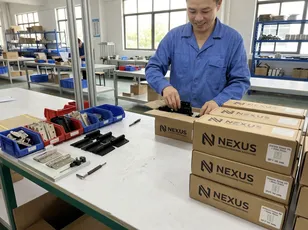
Brands that manufacture or source furniture under their own label often need custom hinge configurations — specific finishes, branded packaging, or modified geometry for proprietary cabinet systems. OEM tooling projects are a regular part of our workload.
MOQ for OEM tooling projects depends on tooling amortization; we'll give you the honest number based on your spec.
Specification Guide
Hinge Configuration Selection: Matching Spec to Application
The most common sourcing mistake in this category is specifying hinge type without confirming overlay configuration and door weight. Here's the decision logic we walk buyers through.
Overlay Configuration
Measure how the door sits relative to the carcass face. Three configurations:
- Full overlay — covers the full carcass edge; most common in frameless European-style cabinets.
- Half overlay — used where two doors share a center partition.
- Inset — sits flush inside the carcass opening; requires tighter tolerance on both hinge and cabinet construction.
Specifying the wrong overlay means the door won't close flush — a field installation problem that generates returns.
Door Weight
Specify the hinge's rated door weight capacity against your actual door weight with a margin — running a hinge at its rated maximum accelerates wear on the adjustment cam and mounting plate.
Soft-Close Requirement
Soft-close is now standard in mid-market kitchen and wardrobe applications in North America and Europe.
Opening Angle
Confirm the required opening angle before ordering — it's a different hinge geometry, not an adjustment.
Send us the door dimensions, panel material, and a photo of the carcass construction. We'll specify the right hinge and send back a quote with samples available.
Request Configuration Spec
Custom Manufacturing
OEM & ODM: Custom Hinge Mechanisms for Your Product Line
A significant portion of our door furniture mechanism production runs under OEM and ODM arrangements. The distinction matters for how you engage and what you bring to the table.
OEM
You supply the drawings and specifications; we manufacture to them. The design is yours — we make it work in production.
We review your drawings for manufacturability before committing to tooling.
If there's a geometry that will cause production problems or a tolerance that's tighter than necessary, we'll flag it.
Branded packaging and retail-ready cartons handled as part of the OEM arrangement.
Technical drawings, tolerances, finish specifications, and target volume.
ODM
You bring a brief. We develop the mechanism design, build the tooling in-house, run samples, and iterate until the spec is locked.
In-house tooling means faster revision cycles — a geometry change on a sample doesn't require coordinating with a third-party tooling shop.
Most ODM projects go through 2–3 sample rounds before the spec is confirmed.
Custom finish options available: nickel plating (bright or satin), zinc plating, powder coating in standard RAL colors or custom color matching on runs over 500 units.
Target retail price, market segment, door weight range, finish requirements, and aesthetic direction.

Custom Finish Options
MOQ Reference
OEM/ODM MOQ depends on tooling amortization. We give you the specific number based on your spec, not a round figure.
Ready to discuss your OEM or ODM project?
Send us your brief or drawings. We'll review for manufacturability and come back with a realistic spec, sample timeline, and MOQ based on your actual project — not a generic quote.
Shipping & Fulfillment
Export Logistics: Container Planning for Hinge Mechanism Orders
Hinges are a dense, small-format product — container loading efficiency is high, and packaging engineering matters for protecting finish quality in transit.
Finish-Protection Packaging
Each hinge is individually sleeved in PE foam inside a master carton. Carton dimensions are sized for 40HQ pallet loading. The foam sleeve prevents contact damage to nickel and powder-coat finishes during container transit — a finish scratch is a visible defect that generates returns. We've declined customer requests to reduce packaging on this basis, and return rate data supports that position.
Mixed-SKU Packing
For buyers ordering multiple overlay configurations or finish variants in one container, we configure mixed-carton packing to simplify your receiving and inventory process. Packing lists are itemized by SKU and carton for your warehouse team.
Production Lead Times
Standard catalog hinge items: 25–35 days from order confirmation and deposit. OEM/ODM projects with new tooling run longer — we provide a milestone schedule, not a single delivery date.
Full Export Documentation Package
Buyer Guidance
Frequently Asked Questions
Technical and sourcing questions from buyers specifying hinge mechanisms for furniture production and distribution.
What is the standard bore diameter for concealed cup hinges, and is it universal across brands?
35mm is the industry standard bore diameter for concealed cup hinges, and it is effectively universal — any 35mm cup hinge will fit a 35mm bore regardless of brand. The variation between manufacturers is in the overlay configuration, opening angle, and adjustment range, not the cup diameter. When specifying hinges for a cabinet line, confirm overlay and opening angle first; the 35mm bore is a given.
What door weight capacity do I need for wardrobe panel doors?
Full-height wardrobe doors in 18mm MDF or particleboard typically run 8–15 kg depending on door width and height. Specify hinges rated for at least 20% above your actual door weight — running a hinge at its rated maximum accelerates wear on the adjustment cam. For doors above 15 kg, use three hinges per door rather than two; the load distribution extends hinge service life significantly. Our pivot hinge range handles doors up to 25 kg on two-point mounting.
How do I prevent hinge adjustment from slipping after installation?
Adjustment slippage is almost always a die-cast cam quality issue — the cam profile is either dimensionally inconsistent from the factory or the alloy is soft enough to deform under sustained load. The fix at the sourcing stage is to specify hinges from a manufacturer who controls their own die-casting process and can document alloy certification. At the installation stage, confirm the adjustment cam is fully engaged (audible click on clip-on systems) and that the mounting screws are torqued to spec — undertorqued mounting plates allow micro-movement that mimics cam slippage.
What certifications are required for hinge mechanisms sold into the European market?
CE marking is the primary requirement for furniture hardware sold into the EU. For hinges, CE compliance covers the essential safety requirements under the relevant EN standards for furniture hardware. SGS third-party testing provides independent verification of compliance. RoHS compliance is required for products containing electronic components — for purely mechanical hinges, RoHS is relevant to surface treatment chemistry (no hexavalent chromium in plating). We ship CE declaration of conformity and SGS test reports with every European order.
What is the minimum order quantity for soft-close hinge mechanisms?
500 units per SKU for standard catalog soft-close hinges. For OEM configurations (custom finish, modified geometry, or branded packaging), MOQ depends on tooling requirements — we'll give you the specific number based on your spec. Most OEM hinge projects run at 1,000–2,000 units minimum to amortize tooling cost at a reasonable per-unit impact.
Full overlay vs. half overlay: which sells better in North American markets?
Full overlay dominates in North American frameless cabinet construction — it's the standard configuration for face-frame-free European-style cabinets that have become the market norm in mid-market and above kitchen cabinetry. Half overlay is used in face-frame cabinet construction where two doors share a center stile, which is more common in traditional-style cabinetry. If you're building a starter SKU mix for North American distribution, full overlay soft-close is the highest-volume configuration. We'd suggest stocking half overlay as a secondary SKU rather than leading with it.
Source Door & Hinge Mechanisms from MVMHardware
We've been producing door hinge furniture mechanisms since the factory's early years — it's one of the two dedicated production lines in our facility, not a side category. The engineering team has seen the failure modes in this product range, the QC process is built around the specific defect types that generate returns, and the export documentation is ready for your target market.
If you're building a new product line, expanding an existing hinge range, or looking to consolidate your hinge mechanism sourcing with a single factory-direct supplier, send us your requirements. A photo of what you're currently sourcing, your target retail price point, and your volume expectations is enough for us to come back with a specific recommendation and a detailed quote.
