

Door Mechanism | MVMHardware
Factory-direct door mechanism — stamped steel and die-cast components engineered for commercial furniture cycle life. Concealed, pivot, and soft-close configurations. Every unit 100% functionally tested before shipment. OEM/ODM tooling in-house.
Product Overview
What a Door Mechanism Is — and Where This Product Sits
A door mechanism is the hardware assembly that controls how a furniture door opens, holds position, and closes. That covers a wider range than most buyers initially scope: the hinge body and mounting plate are the visible components, but the mechanism also includes the adjustment cam, the closing damper, and the pivot geometry that determines the door's swing arc. Each of those sub-components has its own failure mode, and the quality of the door mechanism as a system depends on how well each one is controlled in production.
Within our door hinge furniture mechanism category, the door mechanism product line focuses on the complete motion-control assembly — not just the hinge plate, but the integrated system that determines how the door behaves across its service life. We produce these in concealed cup configurations, pivot systems, and soft-close integrated variants. The distinction from a bare hinge is that a door mechanism is specified and tested as a functional unit, not as individual components.
We've been running door and hinge mechanisms on dedicated production lines since the factory's early years. The engineering decisions in this product — die-cast cam geometry, damper calibration, clip-on plate retention force — are ones we've made, revised, and made again based on field feedback from buyers across four continents.

Configurations Available
- Concealed cup hinge systems
- Pivot door mechanisms
- Soft-close integrated variants
- OEM/ODM tooling in-house
Engineering Data
Technical Specifications
These are industry-standard values for this product type. Actual specifications vary by configuration — contact us for exact product data sheets on the specific model you're evaluating.
Dimensional & Compatibility
Soft-Close Data
Certifications
Specifications shown are industry-standard values for this product type. Contact us for detailed product data sheets on specific configurations.
Request Exact Specs & QuoteHow We Make the Door Mechanism: Process Decisions That Affect Your Returns
The category page covers our manufacturing process at the facility level — read the full process overview here. What's specific to the door mechanism product is where the production decisions get made that determine whether your buyers call you about warranty claims.
Adjustment Cam
The adjustment cam is the component that fails most often in the field. It's a die-cast zinc alloy part — the profile geometry controls how the door holds its adjusted position under load. When the cam is dimensionally inconsistent (from worn die tooling or alloy substitution at a third-party foundry), the door drifts out of alignment after installation.
We brought die-casting in-house specifically because outsourced cam components were the leading source of quality complaints we were seeing in the early years. We control the alloy composition, injection parameters, and post-cast dimensional check on every production run. When a cam fails a check, the fix is a parameter change on our machine — not a conversation with a subcontractor who has three other customers ahead of you.
Soft-Close Damper
Damper fluid leaks or piston seal degradation causes the door to start slamming within a year of installation — the kind of defect that generates warranty returns and damages your buyer's brand with their end customers.
80,000-cycle qualification on damper batches as a standard check, not a special request. Batches that don't pass don't ship.
The 80,000-cycle figure maps to a kitchen cabinet door opened three times daily for over 70 years — it's a meaningful threshold, not a marketing number.
Clip-On Mounting Plate Retention
Clip mechanisms lose retention after repeated door removal and reinstallation cycles if the spring arm geometry isn't held to tight enough tolerance.
Clip spring arm tolerance — tighter than our general ±0.15mm stamping tolerance
We hold this specifically because this is where tolerance stack-up causes field problems. A door that falls off its mounting plate during a client's site visit is a problem that ends supplier relationships.

100% Functional Testing
Not sampling — every unit. A mechanism that passes dimensional checks but has a sticky damper or a cam that won't hold adjustment gets pulled at this stage before packing.
Configuration Selection: Matching the Door Mechanism to Your Application
The most common sourcing error in this product is specifying hinge type without confirming overlay configuration and door weight. Here's the decision logic.
Overlay First
Covers the full carcass edge — standard for frameless European-style cabinets, which dominate mid-market and above in North America and Europe.
Used where two doors share a center partition.
Sits flush inside the carcass opening — requires tighter tolerance on both the mechanism and the cabinet construction.
Wrong overlay = door won't close flush = field installation problem = returns.
Door Weight Second
20% margin rule: Specify the mechanism's rated door weight capacity with at least 20% margin above your actual door weight — running a mechanism at its rated maximum accelerates wear on the adjustment cam and mounting plate.
Doors above 15 kg: Use three mounting points per door rather than two. The load distribution extends service life significantly.
Soft-Close or Standard
Soft-close is now the baseline expectation in mid-market kitchen and wardrobe applications across North America and Europe. If your buyers are supplying into these markets, specify soft-close integrated mechanisms rather than adding clip-on dampers as an afterthought.
Integrated dampers have better cycle life and a cleaner installation profile.
Clip-on dampers retrofitted onto standard hinges: shorter cycle life, added labor cost at the furniture assembly stage. The integrated mechanism is the better landed-cost decision for most applications.
Opening Angle Last
Standard concealed mechanisms — suitable for most kitchen and wardrobe applications.
Corner cabinets and appliance garages. This is a different hinge geometry, not an adjustment setting — confirm before ordering.
Send Us Your Application Details
Send us the door dimensions, panel material, and a photo of the carcass construction. We'll specify the right mechanism and send back a quote with samples available.
Get a Configuration Quote
Who Buys & Reorders
Market Segments: Where Door Mechanisms Generate Repeat Orders
Five buyer segments drive the volume in this product category. Each has distinct order patterns, compliance requirements, and supply expectations — here's how we serve each one.
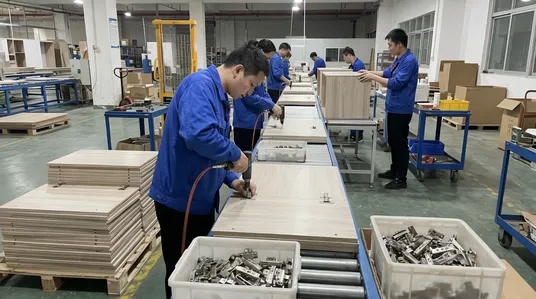
Kitchen Cabinet Manufacturing
A standard kitchen installation uses 20–40 door mechanisms. A production cabinet manufacturer running 500 kitchens per month is ordering 10,000–20,000 units per run. Soft-close integrated mechanisms are now the baseline expectation in mid-market and above — buyers who aren't stocking them are losing shelf position.
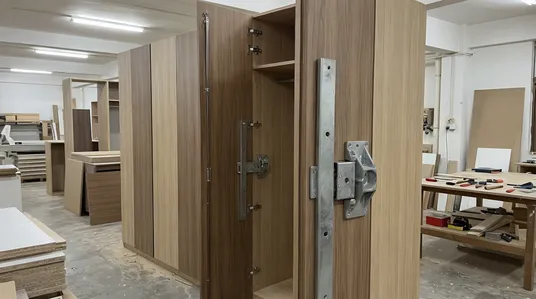
Wardrobe & Fitted Furniture Systems
Full-height wardrobe doors in 18mm board run 8–15 kg — pivot housing and mounting plate gauge matter more here than in the kitchen segment. Wardrobe system assemblers typically order in mixed configurations (multiple overlay types, multiple finish options) for a single project. Your ability to supply the full configuration range from one source is a meaningful advantage.
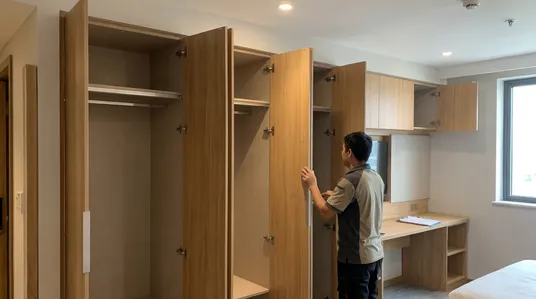
Contract Furniture & Hospitality
A single hotel fit-out might specify 2,000–5,000 door mechanisms across room furniture, wardrobe units, and built-in cabinetry. Contract buyers require CE documentation and test reports as part of the specification package — our CE and SGS certifications ship with the order. The compliance documentation is ready; you don't have to chase us for it after the container is booked.
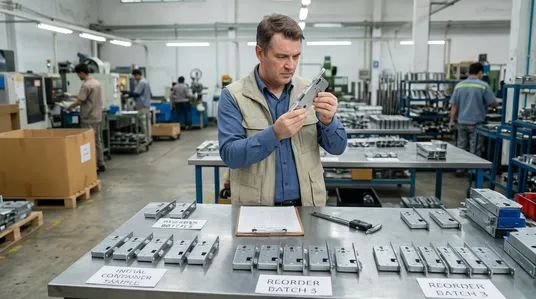
Furniture Retail Importers
Retail importers need batch-to-batch consistency across reorders — a mechanism that looks and functions identically in the third container as it did in the first. Our ISO 9001:2015 process controls are built around this: same steel coil spec, same die tooling inspection intervals, same coating parameters batch to batch. The buyer qualifying a new source after a quality problem is the buyer we're most confident talking to — the process controls are documented and auditable.
OEM Furniture Brands
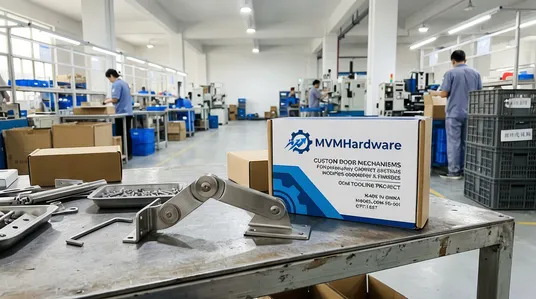
OEM brands sourcing mechanisms for proprietary cabinet systems often need custom configurations — specific finishes, modified geometry, or branded packaging. OEM tooling projects are a regular part of our workload. This segment has grown over the past few years as more furniture brands move toward proprietary hardware to differentiate their product lines — worth considering if you're building a branded furniture range.
What Can Be Changed — and What Can't
Customization Options and Limitations
Standard catalog door mechanisms are available from MOQ 500 units per SKU. Custom configurations follow the parameters below.
Available Customizations
| Dimension | Options | MOQ / Notes |
|---|---|---|
| Surface finish | Nickel plating (bright or satin), zinc plating, powder coating | 500 units (catalog finishes) |
| Powder coat color | Standard RAL colors | 500 units per color |
| Custom color matching | Available with color sample | 500+ units |
| Overlay configuration | Full overlay, half overlay, inset | Standard MOQ |
| Opening angle | 90°, 110°, 165°, 180° | Standard MOQ |
| Branded packaging | Retail-ready cartons, custom print | Part of OEM arrangement |
| Modified geometry (OEM) | Custom cam profile, arm geometry | MOQ per tooling amortization |
| Custom damper calibration | Door weight range adjustment | Engineering review required |
OEM Tooling Projects
For OEM projects with new tooling, MOQ depends on tooling amortization — we give you the specific number based on your spec, not a round figure. Most OEM door mechanism projects run at 1,000–2,000 units minimum to amortize tooling cost at a reasonable per-unit impact.
Send OEM Brief or DrawingsWhat Cannot Be Customized Without Tooling
Industry standard. Changing it means your product is incompatible with standard installation tooling in the field — this is a hard constraint, not a preference.
Full overlay, half overlay, and inset are different tooled parts — not adjustments to the same part. Switching overlay type requires a different SKU, not a modification.
Quality Assurance
Certifications and Compliance
The door mechanism product line ships with the following certifications, ready with the order.
ISO 9001:2015
Quality management system covering the full production process.
CE
European market compliance for furniture hardware, including declaration of conformity.
SGS
Third-party audit and test reports, available with shipment.
RoHS
Restricted substances compliance; surface treatments use trivalent chromium passivation — no hexavalent chromium.
North American Importers
We provide material and HTS classification documentation for your customs broker. Documentation is included with every shipment — no chasing paperwork after the container is booked.
California & EU Buyers
For markets with VOC or chemical compliance requirements, RoHS documentation and powder coat VOC compliance records are available on request. CE and SGS documentation ships with every European order.
Shipping & Documentation
Export Logistics for Door Mechanism Orders
Door mechanisms are a compact, dense product — container loading efficiency is high. Here is what to expect from order confirmation through delivery.

Carton Configuration & Finish Protection
Standard carton configuration packs mechanisms in individual PE foam sleeves inside a master carton, with carton dimensions sized for 40HQ pallet loading. The foam sleeve protects nickel and powder-coat finish from contact damage in transit — a finish scratch on a mechanism is a visible defect that generates returns from your buyers.
For mixed-SKU orders (multiple overlay configurations or finish variants in one container), we configure mixed-carton packing to simplify your receiving and inventory process. Packing lists are itemized by SKU and carton.
Production Lead Time
confirmation and deposit
Standard production lead time for catalog door mechanism items. OEM/ODM projects with new tooling run longer — we provide a milestone schedule, not a single delivery date.
Full Export Documentation Package
- Commercial invoice
- Packing list (itemized by SKU and carton)
- Bill of lading
- Certificate of origin
- CE declaration of conformity
- SGS test reports
- RoHS compliance documentation
- HTS classification documentation (North American importers)
Frequently Asked Questions
What door weight capacity do I need for wardrobe panel doors?
Full-height wardrobe doors in 18mm MDF or particleboard typically run 8–15 kg depending on door width and height. Specify mechanisms rated for at least 20% above your actual door weight — running at rated maximum accelerates wear on the adjustment cam. For doors above 15 kg, use three mounting points per door rather than two; the load distribution extends service life significantly. Our pivot mechanism range handles doors up to 25 kg on two-point mounting.
Integrated soft-close vs. clip-on damper add-on: which is better for a kitchen cabinet line?
Integrated soft-close mechanisms have better cycle life than clip-on damper add-ons — the damper is calibrated as part of the mechanism assembly and tested as a unit. Clip-on dampers are a retrofit solution: useful for upgrading existing furniture lines, but the cycle life is shorter and the installation adds labor at the assembly stage. For a new kitchen cabinet line supplying mid-market and above in North America or Europe, specify integrated soft-close from the start. The per-unit cost difference is small relative to the warranty claim risk from damper failure.
How do I prevent door mechanism adjustment from slipping after installation?
Adjustment slippage is almost always a die-cast cam quality issue — the cam profile is dimensionally inconsistent from the factory, or the alloy is soft enough to deform under sustained load. At the sourcing stage, specify mechanisms from a manufacturer who controls their own die-casting process and can document alloy certification. At the installation stage, confirm the adjustment cam is fully engaged (audible click on clip-on systems) and that mounting screws are torqued to spec — undertorqued mounting plates allow micro-movement that mimics cam slippage.
What certifications are required for door mechanisms sold into the European market?
CE marking is the primary requirement for furniture hardware sold into the EU. For door mechanisms, CE compliance covers essential safety requirements under the relevant EN standards for furniture hardware. SGS third-party testing provides independent verification. RoHS compliance is relevant to surface treatment chemistry — no hexavalent chromium in plating. We ship CE declaration of conformity and SGS test reports with every European order.
What is the minimum order quantity, and can I mix configurations in one order?
Standard MOQ is 500 units per SKU. You can mix configurations (overlay type, opening angle, finish) in a single order as long as each SKU meets the 500-unit minimum. For OEM configurations with custom tooling, MOQ depends on tooling amortization — we'll give you the specific number based on your spec. Mixed-SKU orders are packed and documented by SKU for your receiving team.
Full overlay vs. half overlay: which configuration sells better in North American markets?
Full overlay dominates in North American frameless cabinet construction — it's the standard for European-style cabinets that have become the market norm in mid-market and above kitchen cabinetry. Half overlay is used in face-frame cabinet construction where two doors share a center stile, more common in traditional-style cabinetry. If you're building a starter SKU mix for North American distribution, full overlay soft-close is the highest-volume configuration. Stock half overlay as a secondary SKU.
Source Door Mechanisms from MVMHardware
We've been producing door mechanisms since the factory's early years — it's a dedicated production line, not a side category. The die-casting is in-house, the QC process is built around the specific failure modes in this product, and the export documentation is ready for your target market.
If you're evaluating a new door mechanism supplier, the fastest way to qualify us is a sample order. Send us your current sourcing spec — a photo of what you're using, your target retail price point, and your volume expectations — and we'll come back with a specific configuration recommendation, a detailed quote, and samples available for testing with your own customers.