

Dedicated Chair Mechanism Manufacturer —
25+ Mechanism Types Produced In-House
Tilt, synchro, hydraulic, swivel, folding, and component-level parts. Every unit 100% functionally tested before it ships. OEM/ODM tooling supported with a 12-engineer R&D team.
About MVMHardware
What We Produce and How It Reaches You
MVMHardware is a chair mechanism manufacturer based in Guangdong, China, operating under Foshan Jinruida Import And Export Co., Ltd. since 2008. We produce the full range of chair motion hardware — tilt mechanisms, synchro units, gas lift assemblies, swivel bases, folding brackets, backrest hinges, and the individual plates and locks that hold them together. Twenty-five distinct product lines, all manufactured on our floor.
We sell factory-direct to furniture manufacturers, importers, wholesalers, and project contractors across North America, Europe, the Middle East, Southeast Asia, and Australia. There is no trading company between your purchase order and our production schedule. Your quote, your samples, your bulk run, and your QC reports all come from the same 12,000 m² facility and the same engineering team that designed the tooling.
Chair mechanisms are the highest-volume category in our factory — two of our six production lines run chair hardware exclusively, so your order has dedicated capacity rather than competing with unrelated product types for machine time.

Factory-Direct Supply
No trading company in the chain. Your order goes directly to the production schedule of the facility that designed the tooling.
Dedicated Chair Capacity
Two full production lines run chair hardware exclusively. Your order isn't competing with unrelated product types for machine time.
Global Export Experience
Shipping to 40+ countries across 5 continents since 2008. North America, Europe, Middle East, Southeast Asia, and Australia.
Explore Chair Mechanism Types
Browse Specific Mechanism Categories
Product Catalog
Chair Mechanism Product Line
With 25 product types under this category, we've organized them by function so you can locate what fits your sourcing needs quickly. Each links to a dedicated product page with detailed specs, drawings, and configuration options.
Tilt & Recline Mechanisms
These control how the seat and backrest respond to the user's weight and movement. They're the core of any task chair, executive chair, or conference seating line.
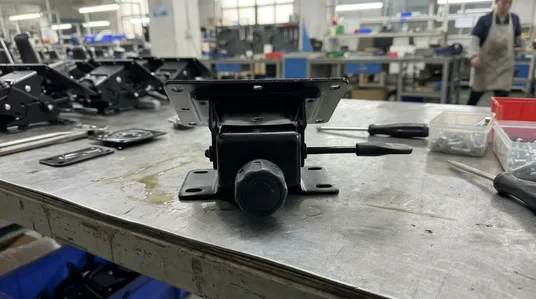
Tilt Chair Mechanism
Standard center-tilt with tension adjustment. The workhorse for mid-range office and task chairs.
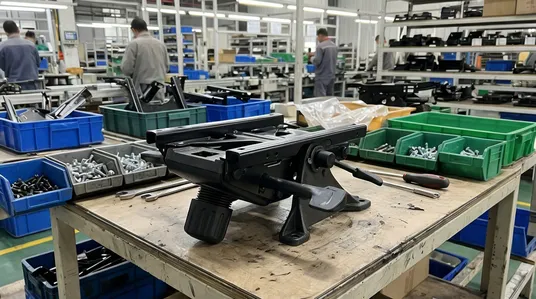
Forward Tilt Chair Mechanism
Adds a forward-tilt position (typically 5°) for active sitting postures. Growing demand in the ergonomic segment.
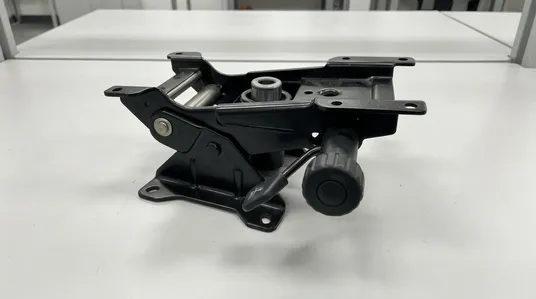
Knee Tilt Chair Mechanism
Pivot point shifted forward near the knees, so the seat front stays level during recline. Standard on executive and conference chairs.
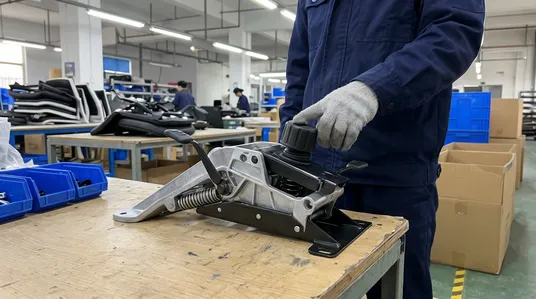
Synchro Chair Mechanism
Seat and backrest tilt at a synchronized ratio (typically 1:2 or 1:3). The premium tier for ergonomic task seating.
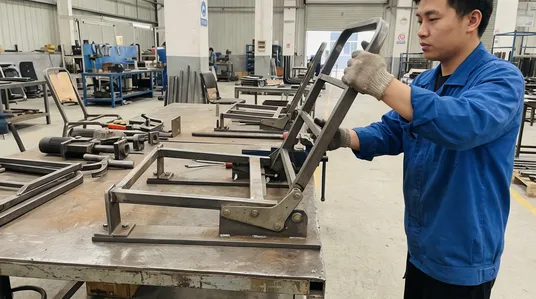
Push Back Chair Mechanism
Backrest reclines independently while the seat stays fixed. Common in guest chairs and lighter-duty task seating.


OEM/ODM Tooling and Custom Mechanism Development
If your chair design needs a mechanism that doesn't exist in our standard catalog, we have the tooling capability to develop it.
Our 12-person R&D and engineering team handles custom mechanism development end-to-end — from initial drawing review through first sample production.
Modified mounting patterns, non-standard pivot locations, integrated features.
Custom tilt ratios and angle ranges for synchro and multi-function mechanisms.
Knobs, levers, and covers in your specified geometry and finish.
Your branding on mechanism components and packaging.

Tooling is cut in-house, so sample iterations are faster than working through a third-party tool shop. Custom tooling projects have flexible MOQ arrangements based on tooling amortization — we'll work through the numbers with you during quoting.
Selecting the Right Chair Mechanism Type for Your Product Line
With 25 mechanism types in the catalog, the selection question isn't "which one is best" — it's "which one fits your target price point, end-use environment, and feature requirements."
By Price Tier of the Finished Chair
Simple mechanism, basic tilt, or lever mechanism. Minimal adjustment features, lowest unit cost.
High volume, tight margins — your landed cost per mechanism matters most.
Standard tilt, push-back, or basic synchro. One or two adjustment features that justify the price step-up.
This is where most office task chairs sit.
Synchro-tilt, forward tilt, knee tilt, or full ergonomic mechanism. Multi-axis adjustment is the feature set that supports premium pricing.
The mechanism cost is higher, but your margin percentage on the finished chair is also higher.
By End-Use Environment
Tilt, synchro, or ergonomic mechanisms with height adjustment.
Cycle life matters — these chairs get used 8+ hours daily.
Simple or metal mechanisms. Durability and low maintenance over adjustability.
Specify heavy-gauge options.
Folding or butterfly mechanisms.
Compact fold ratio and stack height determine your storage and transport efficiency.
Metal chair mechanisms with corrosion-resistant surface treatment.
Zinc plating or heavy powder coat.
By Order Pattern — Stocking for Distribution
If you're stocking for distribution rather than manufacturing a specific chair model, start with the five highest-velocity types. These cover the broadest range of downstream demand and give you inventory that moves.
Technical Reference
Category-Level Specifications
These are the general parameter ranges across our chair mechanism line. Individual product pages carry exact specs for each type.
| Parameter | Range Across Category |
|---|---|
| Base materials | Cold-rolled steel (SPCC/Q235), zinc alloy die-cast components |
| Steel thickness | 1.5 mm – 3.0 mm (varies by load rating) |
| Load capacity | 80 kg – 200 kg depending on mechanism type |
| Tilt angle range | 0° – 25° (adjustable by spring tension or gas cylinder) |
| Synchro ratio | 1:2 and 1:3 configurations available |
| Gas lift compatibility | Standard Ø50mm and Ø60mm cylinder bore |
| Surface treatments | Nickel plating, zinc plating, powder coating (black, silver, custom RAL) |
| Cycle life testing | 60,000 – 100,000 cycles (BIFMA X5.1 equivalent protocol) |
| Mounting patterns | Standard 4-hole, 6-hole, and custom patterns available |
| Operating temperature | -10°C to 60°C |
All mechanisms are tested to BIFMA-equivalent load and cycle standards. CE, SGS, and RoHS documentation ships with the order — your compliance team gets what they need without follow-up requests.
Buyer Segments
Market Segments Where Chair Mechanisms Move Volume
These are the commercial segments where our buyers build recurring revenue with chair mechanism hardware.
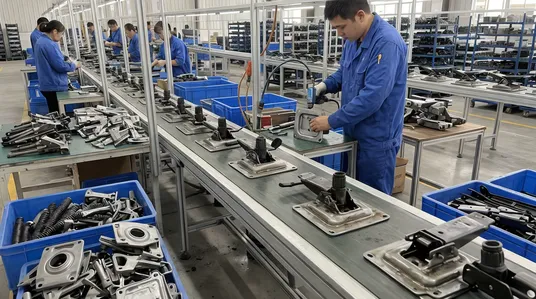
Contract Office Furniture
Office furniture manufacturers and contract dealers need consistent supply of tilt, synchro, and height-adjustment mechanisms across multiple chair models. You're typically running 3–5 mechanism SKUs across your seating line, and batch consistency matters because your assembly line can't stop to re-drill mounting holes when tolerances drift. We hold ±0.15mm on stamped plates, so your mounting patterns stay consistent across production runs.
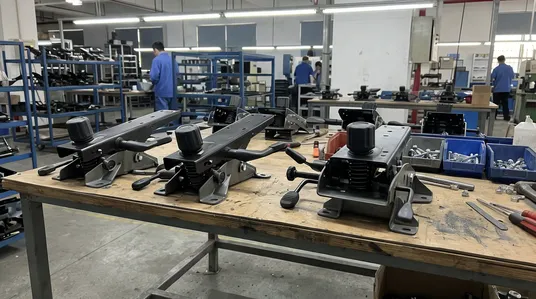
Ergonomic & Task Seating
Ergonomic chairs command higher retail margins, but the mechanism is where the value proposition lives. Synchro-tilt, forward tilt, seat slide, and multi-axis adjustment mechanisms are the components that justify a $400+ retail price point versus a $150 basic task chair. If you're building or importing an ergonomic line, the mechanism spec is your margin story. Our synchro and forward-tilt units are the two fastest-growing SKUs in our chair line — the ergonomic segment has driven that shift over the past four years.
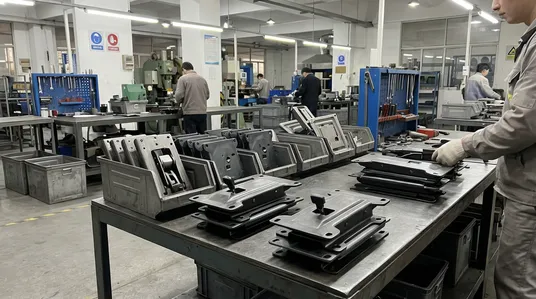
Institutional & Education
Schools, universities, government offices, and healthcare facilities buy seating on annual procurement budgets — 200 to 2,000 units per order, repeat annually. These buyers prioritize durability and low maintenance over adjustability. Simple mechanisms, heavy-gauge metal mechanisms, and folding mechanisms dominate this segment. High volume, predictable reorder cycles, and price sensitivity — your landed cost per unit matters more here than feature count.
Hospitality & Event
Hotels, conference centers, and event rental companies need folding and stacking chair mechanisms that survive constant setup-teardown cycles. The butterfly mechanism and folding mechanism lines serve this segment. Container-load orders are standard. Event rental companies are some of our most consistent repeat buyers — they reorder every 18–24 months as their fleet rotates.
Export & Distribution
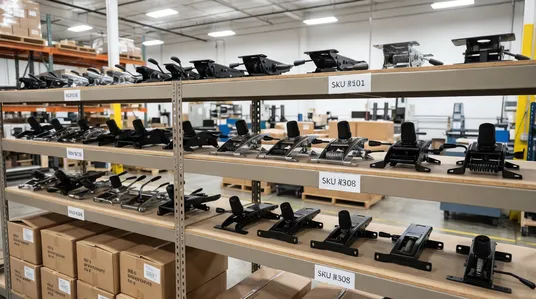
If you're a furniture hardware distributor or trading company, the breadth of our chair mechanism line means you can consolidate 20+ SKUs with a single supplier. One set of quality standards, one logistics relationship, one payment flow. That consolidation reduces your procurement overhead and gives you negotiating leverage on volume pricing across the full category.
Tell us which segment you're targeting — we'll recommend the mechanism mix.
How We Manufacture Chair Mechanisms — And What That Means for Your Order
Progressive Die Stamping
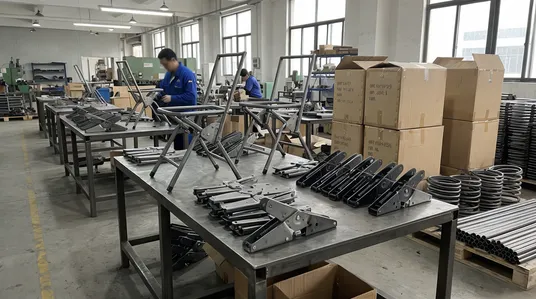
The mechanism plate is the structural backbone of every chair mechanism. We stamp these on progressive die presses from cold-rolled steel coil stock — SPCC for standard-duty mechanisms, Q235 for heavy-load applications.
Progressive dies produce the complete plate geometry (mounting holes, pivot slots, spring anchor points) in a single pass through the press, so dimensional consistency holds across a 10,000-unit run without operator-dependent variation.
We maintain tooling for all 25 mechanism types in-house. When you reorder, we're running the same die that produced your last batch — no re-tooling lead time, no dimensional drift between orders.
Zinc Alloy Die-Casting
Adjustment knobs, tilt-lock levers, decorative covers, and small precision components are zinc alloy die-cast. We brought this process in-house in 2015 specifically because outsourced die-cast parts were the leading source of quality complaints.
- Loose-fitting knobs from outsourced suppliers
- Inconsistent surface finish
- Dimensional variation causing assembly problems
Controlling the die-casting, trimming, and finishing on our own floor means the components your end users actually touch and operate meet the same standard as the structural parts they never see.
Welding and Assembly
Structural joints on load-bearing assemblies go through MIG welding. Lighter brackets and non-structural connections use spot welding. Every welded joint on a load-bearing mechanism gets visual inspection and periodic pull-testing.
The most common field failure we see in competitor mechanisms that come through our lab is weld cracking at the tilt pivot under cyclic load. Insufficient penetration is almost always the cause. We check penetration depth, not just bead appearance.
Final assembly runs on dedicated lines with go/no-go gauges at each station. Mechanisms are assembled, adjusted, and functionally tested as complete units before packaging.
Surface Treatment
Full in-house surface treatment: nickel plating, zinc plating, and powder coating.

100% Functional Testing — Every Unit, Not a Sample
Every chair mechanism that leaves our facility goes through functional testing. Not batch sampling — every unit.
Tilt Action
Smooth engagement and return across the full angle range verified on every unit.
Lock Positions
Positive engagement at each locking point, no slip under rated load.
Height Adjustment
Gas lift actuation force within spec, no drift under static load.
Swivel
Rotation smoothness and bearing play verified within tolerance.
Cycle Verification
Representative units from each production run complete accelerated cycle testing — 60,000+ cycles at rated load.
Load Testing
Statistical sample basis — 1.5× rated load applied to verify structural margin.
Incoming Material Inspection
Problems are caught before they enter production — not after they reach your customers.
- Coil steel thickness and hardness verification against mill certs
- Zinc alloy ingot composition checks
- First-article dimensional inspection on every die change
We've caught material grade substitutions from steel suppliers more than once. The incoming check is what keeps that from becoming your problem six months later.

OEM/ODM Tooling and Custom Mechanism Development
If your chair design needs a mechanism that doesn't exist in our standard catalog, we have the tooling capability to develop it.
Our 12-person R&D and engineering team handles custom mechanism development end-to-end — from initial drawing review through first sample production.
Modified mounting patterns, non-standard pivot locations, integrated features.
Custom tilt ratios and angle ranges for synchro and multi-function mechanisms.
Knobs, levers, and covers in your specified geometry and finish.
Your branding on mechanism components and packaging.
Tooling is cut in-house, so sample iterations are faster than working through a third-party tool shop. Custom tooling projects have flexible MOQ arrangements based on tooling amortization — we'll work through the numbers with you during quoting.
Selecting the Right Chair Mechanism Type for Your Product Line
With 25 mechanism types in the catalog, the selection question isn't "which one is best" — it's "which one fits your target price point, end-use environment, and feature requirements."
By Price Tier of the Finished Chair
Simple mechanism, basic tilt, or lever mechanism. Minimal adjustment features, lowest unit cost.
High volume, tight margins — your landed cost per mechanism matters most.
Standard tilt, push-back, or basic synchro. One or two adjustment features that justify the price step-up.
This is where most office task chairs sit.
Synchro-tilt, forward tilt, knee tilt, or full ergonomic mechanism. Multi-axis adjustment is the feature set that supports premium pricing.
The mechanism cost is higher, but your margin percentage on the finished chair is also higher.
By End-Use Environment
Tilt, synchro, or ergonomic mechanisms with height adjustment.
Cycle life matters — these chairs get used 8+ hours daily.
Simple or metal mechanisms. Durability and low maintenance over adjustability.
Specify heavy-gauge options.
Folding or butterfly mechanisms.
Compact fold ratio and stack height determine your storage and transport efficiency.
Metal chair mechanisms with corrosion-resistant surface treatment.
Zinc plating or heavy powder coat.
By Order Pattern — Stocking for Distribution
If you're stocking for distribution rather than manufacturing a specific chair model, start with the five highest-velocity types. These cover the broadest range of downstream demand and give you inventory that moves.
Sourcing Chair Mechanisms from China —
Pitfalls We've Seen and How to Avoid Them
We've been exporting chair mechanisms for over 15 years. These are the failure modes that cost buyers money, and the manufacturing decisions that prevent them.
Tilt Mechanism Fatigue Cracking
Failure Mode #1The tilt pivot is the highest-stress point on any chair mechanism. Undersized pivot pins or insufficient weld penetration at the pivot bracket cause cracking after 20,000–30,000 cycles — well within the first year of daily office use.
How We Prevent It
We MIG-weld all tilt pivot joints with verified penetration depth and test representative samples to 60,000+ cycles at rated load. If the pivot fails in testing, the entire batch gets reworked before it ships.
Die-Cast Component Fit Drift
Failure Mode #2Zinc alloy die-cast knobs and levers shrink as they cool. If the die-casting process isn't tightly controlled, dimensional variation between batches means your assembly line has to force-fit or reject components.
How We Prevent It
Because we die-cast in-house, we control the shot parameters, cooling cycle, and trimming on every run. Your batch-to-batch fit stays consistent.
Surface Treatment Adhesion Failure
Failure Mode #3Powder coat that flakes or bubbles within months is almost always a pre-treatment problem — oil residue or mill scale left on the steel before coating. A batch shipped to a coastal Australian distributor in 2012 came back with coating failure. The pre-treatment step has been non-negotiable since.
How We Prevent It
We run a full phosphate pre-treatment wash before every powder coat run. It adds a process step and cost, but it's the difference between a coating that survives 500-hour salt spray and one that fails at 150 hours.
Inconsistent Mounting Hole Patterns
Failure Mode #4If your mounting holes are off by even 0.5mm, your chair assembly line stops. Buyers who've sourced from factories using CNC drilling on individual plates know the difference.
How We Prevent It
Progressive die stamping eliminates this — the hole pattern is cut in the same press stroke as the plate geometry, so every plate in a 10,000-unit run is dimensionally identical.
Frequently Asked Questions —
Chair Mechanism Sourcing
What is the difference between a synchro-tilt and a standard tilt chair mechanism?
A standard tilt pivots the seat and backrest together as a single unit — the whole chair rocks. A synchro-tilt mechanism moves the seat and backrest independently at a fixed ratio, typically 1:2 (for every 1° the seat tilts, the backrest tilts 2°). The synchro design keeps the user's feet closer to the floor during recline, which is the feature that justifies the price premium on ergonomic task chairs.
If you're building a mid-range to premium office chair line, synchro is the mechanism that moves your product out of the commodity tier.
Synchro Chair MechanismHow do I choose between a knee-tilt and a forward-tilt mechanism?
Knee-tilt shifts the pivot point forward, near the user's knees, so the seat front stays relatively level during recline — this is the standard for executive and conference chairs where the user reclines while working at a desk. Forward-tilt adds a forward seat angle (typically 5°) for active sitting postures — drafting, lab work, or any application where the user leans toward their work surface.
Different end-use cases, different mechanism. If you're unsure which fits your target market, send us your chair design and intended retail positioning — we'll recommend the right configuration.
Ask Our TeamWhat cycle life should I specify for commercial-grade chair mechanisms?
For office task chairs used 8+ hours daily, specify a minimum of 60,000 cycles — that covers roughly 3–5 years of heavy use. For institutional or 24/7 environments (call centers, control rooms), push to 100,000 cycles.
commercial office
institutional use
We test to these thresholds using BIFMA X5.1 equivalent protocols. Specifying cycle life upfront in your purchase order protects you from warranty claims downstream.
Can I order chair mechanism components separately — plates, hinges, locks — instead of complete assemblies?
Yes. Our component lines (mechanism plates, backrest brackets, hinges, and locks) are available as standalone items. This is common for buyers who manufacture their own mechanism assemblies or need replacement parts for existing chair lines.
MOQ on components is typically lower than on complete mechanisms. Contact us with your part requirements for specific pricing.
Request Component PricingWhat is the MOQ for standard chair mechanisms, and can I mix types in one order?
Standard mechanisms start at 500 units per type. You can mix multiple mechanism types in a single order — we produce on dedicated lines, so different types run in parallel rather than sequentially. Mixed orders don't extend your lead time.
For new buyers, we recommend starting with a sample order (2–5 units per type) to verify fit with your chair frames before committing to production quantities.
What certifications do your chair mechanisms carry?
ISO 9001:2015 governs our quality management system. Individual mechanisms carry CE marking and are tested by SGS. RoHS compliance documentation is standard. All certification paperwork ships with the order.
If your market requires additional testing or certification (BIFMA, EN 1335, or market-specific standards), we can arrange third-party testing through our existing SGS relationship.
Start Sourcing Chair Mechanisms from MVMHardware
Most new buyers start with a sample order — 2–5 units across the mechanism types you're evaluating — to test fit, function, and finish against your chair frames. We can ship samples within 7–10 days of order confirmation.
Know What You Need?
Send us your specs or a reference sample. We'll match mechanism types, confirm tolerances, and prepare a quote based on your volume and delivery requirements.
Request a QuoteBuilding a New Chair Line?
Tell us your target price tier and end-use segment. We'll suggest the mechanism mix based on what's moving for our existing buyers in your region.
Learn About Our Factory