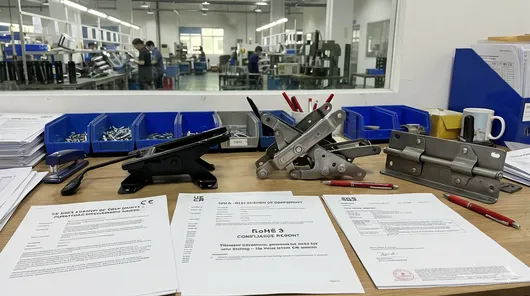
ISO 9001:2015 certified furniture mechanism manufacturer — CE, SGS, and RoHS documentation ships with every order.
We've been exporting mechanisms to North America, Europe, the Middle East, and Australia since 2008. Every market has its own compliance requirements. We've built the certification system and QC process to meet them without putting that burden on you.
We hold four certifications covering quality management, European market access, third-party audit verification, and restricted substances compliance. Here's what each one means for your sourcing decision:
Third-party accredited registrar
Quality management system across the full production process
Confirms our QC procedures are documented, audited, and consistently followed — not just claimed
Self-declaration with supporting technical file
Product compliance for the European Economic Area
Required for furniture mechanisms entering EU markets; declaration of conformity ships with your order
SGS Group
Third-party factory audit and product testing
Independent verification of our manufacturing and quality claims — audit reports available on request
Compliance documentation
Restriction of hazardous substances in surface treatments and materials
Required for EU market entry and California-bound shipments; trivalent chromium passivation on all zinc plating
Certification documents are available upon request. For European buyers, CE declaration of conformity and SGS reports ship with the order as standard. For North American importers, we provide the material and compliance documentation your customs broker needs for HTS classification.
Certifications tell you the system exists. This section tells you how it runs.
Every production run starts with incoming inspection on cold-rolled steel coil and zinc alloy ingot. We check material certifications against mill reports, pull dimensional samples from the first stamped parts off each coil change, and hold any batch where hardness or thickness falls outside spec. (We've had suppliers attempt material grade substitutions mid-contract — this checkpoint is what catches it before it becomes a problem in your shipment.)
Steel coil is sourced from approved domestic mills with consistent grade documentation. Zinc alloy ingot is checked for composition compliance before it enters the die-casting line. Nothing moves to production until incoming inspection signs off.
Three stages, each with defined pass/fail criteria:
First-article dimensional check on every new die setup, periodic checks during the run. Mechanism plates and brackets are held to ±0.15mm tolerance — the spec that keeps pivot geometry consistent across a batch.
Visual inspection and pull-test on structural joints. MIG welds on load-bearing assemblies, spot welds on lighter brackets — each joint type has its own pull-test standard.
Film thickness measurement and adhesion cross-cut test on every coating run. Powder coating runs at 60–80μm — the range that passes 500-hour salt spray without adhesion failure. Nickel and zinc plating are used where dimensional tolerance after coating is critical, since powder adds thickness that affects fit on tight-clearance assemblies.
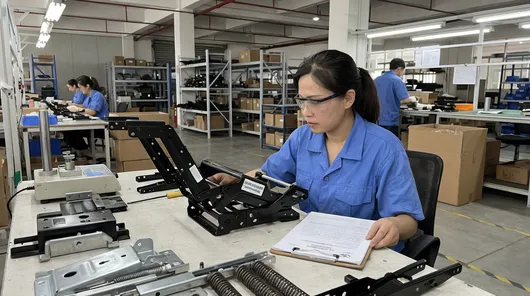
Mechanism sub-assemblies go through functional testing before they reach the final assembly line — tilt range, lock engagement, and load cycle are verified at this stage, not just at the end.
Every unit is functionally tested before packing. Not a statistical sample — every unit. A mechanism that passes dimensional and load-cycle checks but has a sticky tilt lock or a misaligned mounting hole gets pulled at this stage.
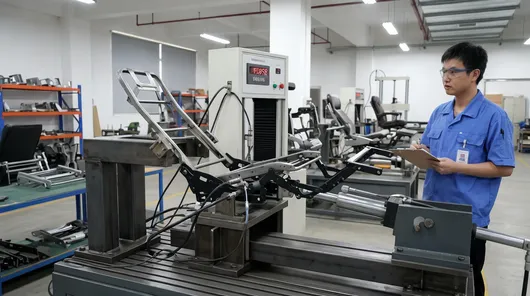
We run 50,000-cycle load testing on chair mechanisms as a standard batch qualification check. That's the minimum threshold for commercial office chair certification in most markets — we use it as our floor, not our ceiling. Mechanisms specified for high-use commercial environments get tested to higher cycle counts.
The practical result: your container doesn't carry defective units that passed dimensional inspection but fail in the field. That's the difference between 100% functional testing and sampling-based QC.
We ship to five major regions. Each has its own compliance landscape for furniture mechanisms.
CE marking is the primary market access requirement for furniture mechanisms entering the EU. Our CE technical file covers the full mechanism range — chair tilt mechanisms, recliner linkages, sofa bed frames, lift-top table fittings, and hinge systems. Declaration of conformity is issued per product line and ships with your order.
RoHS compliance is documented for all surface treatments. The zinc plating line uses trivalent chromium passivation — no hexavalent chromium, which is restricted under EU RoHS and REACH. For buyers supplying into Germany, France, Benelux, or Scandinavia, this documentation is ready without a special request.
SGS audit reports are available for buyers whose procurement process requires independent third-party verification of supplier quality systems — common among European importers and retailers with supplier qualification programs.
The US and Canadian markets don't require CE marking, but furniture mechanisms sold into commercial environments — office seating, hospitality, healthcare — are often subject to ANSI/BIFMA performance standards for chair mechanisms. Our 50,000-cycle load testing protocol aligns with BIFMA X5.1 endurance requirements for office seating. We can provide the test documentation your compliance team needs.
For US importers, we provide full HTS classification support documentation: material composition, country of origin, and compliance records. RoHS documentation is available for California-bound shipments subject to Prop 65 considerations on surface treatment chemistry.
Gulf Cooperation Council markets increasingly require CE-equivalent documentation for commercial furniture procurement, particularly for hospitality and government projects. Our CE technical file and SGS audit reports satisfy most GCC tender compliance requirements.
Australian buyers importing furniture mechanisms are subject to Australian Consumer Law product safety requirements. Our ISO 9001:2015 certification and 100% functional testing documentation provide the quality system evidence typically required for Australian importer compliance programs.
SGS is the world's largest inspection and testing company. Their audit of our facility covers manufacturing process verification, quality management system review, and product testing against declared specifications. For buyers whose procurement process includes supplier qualification — particularly European and North American importers with formal vendor approval programs — SGS audit reports provide independent verification that our quality claims hold up under external scrutiny.
We support third-party factory audits on request. If your organization uses BV (Bureau Veritas) or TÜV Rheinland as your preferred audit body rather than SGS, we can accommodate that. The audit process is straightforward: your nominated body schedules the visit, we provide full access to the facility, production records, and QC documentation. (Most buyers who request audits find the process takes one day on-site — we don't make it complicated.)
Audit reports are confidential to the requesting buyer unless we've agreed otherwise. If you need a fresh audit rather than our existing SGS report, contact us to coordinate timing with your sourcing schedule.
RoHS compliance isn't just a certificate — it required process changes on our plating line. The most significant: converting zinc plating from hexavalent chromium passivation to trivalent chromium. Hexavalent chromium produces a brighter, more corrosion-resistant finish and was the industry standard for decades. Trivalent chromium passivation requires tighter process control to achieve comparable salt spray performance, and the chemistry is more sensitive to bath temperature and pH variation.
We made that conversion several years ago. The trivalent process is now stable and consistently passes 500-hour salt spray on zinc-plated components. For buyers supplying into the EU, UK, or California, the RoHS documentation that ships with your order reflects actual process compliance, not a paper certificate on an unchanged line.
The powder coating line uses low-VOC formulations — no solvent-based liquid paint in the facility. Wastewater from the electroplating line goes through a closed-loop treatment system before discharge. For buyers with ESG supplier requirements or sustainability reporting obligations, we can provide the environmental compliance documentation your procurement team needs.
Trivalent chromium passivation — no hexavalent chromium. 500-hour salt spray compliant.
Low-VOC formulations. No solvent-based liquid paint in the facility.
Closed-loop treatment system on electroplating line before discharge.
Environmental compliance docs available for sustainability reporting obligations.
Our mechanisms are covered by ISO 9001:2015 (quality management system), CE (European market compliance), SGS (third-party audit and testing), and RoHS (restricted substances). Certification documents are available upon request; CE declaration of conformity and SGS reports ship with European orders as standard.
CE coverage applies across our full mechanism range: chair tilt mechanisms, recliner linkages, sofa bed frames, lift-top table fittings, and hinge systems. If you're sourcing a specific mechanism type and need confirmation that your product line is covered, send us the product reference and we'll confirm the applicable declaration.
The test runs the mechanism through 50,000 complete operation cycles under rated load — for a chair tilt mechanism, that means 50,000 tilt-and-return cycles at the mechanism's rated weight capacity. We check for dimensional change, functional degradation (tilt resistance drift, lock engagement force change), and structural failure at the end of the run. The 50,000-cycle threshold aligns with BIFMA X5.1 commercial office chair endurance requirements. Mechanisms for high-use commercial environments can be spec'd and tested to higher cycle counts — ask us when you're specifying.
Yes. For catalog mechanisms, existing test reports are available on request. For OEM/ODM projects, we run qualification testing on the approved sample before mass production begins and provide the test report as part of the sample approval package.
CE is a market access requirement — your product legally needs it to enter the EU. SGS is independent third-party verification of our manufacturing and quality claims. CE tells your customs broker the product is compliant. SGS tells your procurement team that our quality system has been independently audited. Most European buyers need CE; buyers with formal supplier qualification programs also want SGS. We have both.
If you're in the supplier qualification stage, we can send you the documentation package directly: ISO 9001:2015 certificate, CE declaration of conformity, SGS audit report, and RoHS compliance documentation. No need to wait until you've placed an order.
Send your request to [email protected] or reach us on WhatsApp at +86 132 1014 9517. If you have a specific mechanism type in mind, include the product reference and we'll pull the relevant test reports along with the certification documents.
For buyers evaluating our customization capabilities alongside our quality system, our OEM/ODM page covers the full collaboration model — from tooling development through sample approval and mass production.