

Recliner Chair Mechanism
Precision recliner chair mechanisms — manual and wall-hugger configurations, built to ±0.15mm stamping tolerance for consistent motion across your full production run.
Manufactured in-house at our 12,000 m² Guangdong facility. Every unit 100% functionally tested before shipment. ISO 9001:2015 and CE certified.
Product Overview
What This Mechanism Does — and Where It Fits Your Product Line
The recliner chair mechanism is the core linkage assembly that coordinates footrest extension and backrest recline in a single motion. When the occupant pulls the handle, the linkage geometry translates that input into synchronized movement across both axes — footrest rises, backrest tilts, and the two arrive at their endpoints together.

Fixed-Pivot Standard Recliner
Uses a fixed pivot point — the chair moves backward as it reclines, which requires clearance behind the chair. Simpler geometry, lower tooling cost for OEM production. The right choice for larger living spaces and markets where floor area is not a constraint.
- Lower tooling cost for OEM runs
- Simpler linkage geometry — easier frame integration
- Suited to larger living spaces with rear clearance

Forward-Slide Wall-Hugger
Repositions the pivot so the chair body slides forward as it reclines, maintaining wall clearance without the occupant feeling the shift. Getting that forward-slide geometry right took several tooling iterations — the pivot placement has to be precise enough that the motion feels natural, not like the chair is lurching forward. Refined across three tooling generations.
- Maintains wall clearance — no rear space required
- Refined pivot geometry across 3 tooling generations
- Strong demand in North American & European urban residential
Sourcing Decision: Standard vs. Wall-Hugger
The choice between standard and wall-hugger is a market positioning decision as much as a technical one. Standard suits larger living spaces and is simpler to produce — lower tooling cost if you're doing OEM. Wall-hugger is the configuration worth stocking if your target market is urban residential in North America or Europe, where apartment-scale living rooms are the norm and buyers specifically search for wall-clearance recliners.
That segment has grown consistently over the past several years. If you're building a product line for that market, wall-hugger is not optional — it's the expected configuration.
When Geometry Is Off: What Fails
When linkage geometry is off, the footrest stops short, the backrest overshoots, or the motion feels jerky through the arc. The mechanism is what your customer interacts with every time they use the chair — it's also the component most likely to generate a warranty return if the tolerances aren't held. Our ±0.15mm stamping tolerance is the spec that keeps that failure mode off your returns desk.
Engineering Data
Technical Specifications
Industry-standard values for this product type. Actual specifications may vary by configuration. Contact us for detailed product data sheets and confirmation against your frame drawings.
Mechanism & Materials
Performance & Ratings
Certifications & Compliance
Who We Supply
Market Segments and Order Patterns
Four distinct buyer types source from us — each with different spec priorities, volume profiles, and commercial logic. Understanding which segment you're in shapes the mechanism configuration conversation from the first call.

Residential Furniture OEM
Recliner chair manufacturers sourcing mechanisms separately from their upholstery and frame production. Order patterns run 2,000–8,000 units per SKU on quarterly replenishment cycles.
The mechanism spec is typically locked to the chair frame design, so dimensional consistency batch-to-batch matters as much as the initial sample approval. Our ±0.15mm stamping tolerance is what keeps the mechanism fitting the frame on the 10th container the same way it did on the first.

Furniture Importers — North American & European Retail
Importers building private-label recliner lines for mid-market retail need a mechanism that hits a target retail price point while meeting the cycle life and surface finish requirements for that channel.
We've spec'd mechanisms for this segment at multiple price tiers. The conversation usually starts with the target retail price and works backward to the mechanism configuration that protects the importer's margin.

Hospitality and Contract Furnishing
Hotels, serviced apartments, and short-term rental operators specifying recliners at volume. The spec for hospitality is different: 30,000+ cycle life, single-handle actuation, and surface finishes that hold up to housekeeping chemicals.
We've shipped into this segment in Southeast Asia and the Middle East — hospitality buyers in the Gulf region have been particularly active, driven by the serviced apartment expansion there. If you're specifying for hospitality, tell us the use environment and we'll recommend the configuration and surface treatment that fits.

E-Commerce Furniture Brands
Sourcing recliners for direct-to-consumer channels. The packaging and assembly requirements here differ from traditional retail — the mechanism needs to be packaged for end-user assembly with clear hardware and minimal tools.
We handle that as part of the OEM arrangement, including branded carton design if needed.
Manufacturing Process
How We Build It: Process Details That Affect Your Batch Quality
Every process decision below has a direct consequence for what you receive in your container. This isn't a factory tour — it's the explanation for why our batch-to-batch consistency holds where competitors' doesn't.
Progressive Stamping — Structural Components
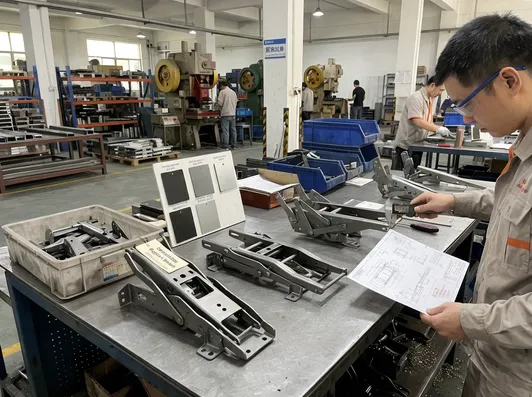
Cold-rolled steel coil feeds our progressive stamping presses for all structural components — the main linkage arms, base brackets, and footrest support plates.
Progressive die stamping produces these parts in a single continuous operation, which means the dimensional relationships between features on the same part are held by the die geometry, not by operator positioning. That's the process reason our ±0.15mm tolerance is achievable at production volume, not just on sample parts.
In-House Zinc Alloy Die-Casting
Zinc alloy die-casting handles the adjustment collar, handle fitting, and any decorative cover components. We brought die-casting in-house in 2015.
Die-cast components are where dimensional inconsistency and surface defects originate most often in mechanism assemblies. When a handle fitting feels loose or a finish is inconsistent batch-to-batch, the root cause is almost always the die-cast part. Owning that process means we own the fix — we don't negotiate with a foundry about whose batch was out of spec.
Welding and Surface Treatment
Structural joints — the base bracket-to-linkage arm connections and the footrest pivot mounts — are MIG welded. Lighter bracket assemblies use spot welding.
Every weld seam on powder-coated parts is ground and pre-treated before coating. This is the step that prevents powder coat adhesion failure at weld seams — the surface defect we see most often on competitor mechanisms that come back as samples from buyers switching suppliers.
Every Unit Tested Before Packing
The assembled mechanism goes through 100% functional testing before packing — not sampling. Every unit. A mechanism that passes dimensional checks but has a sticky lock or a footrest that stops 5° short gets pulled at this stage.
-
Full footrest extension cycle
-
Backrest recline range check
-
Lock engagement verification
-
Load test at rated capacity

Configuration & OEM
Customization: What Can Be Specified, What Can't
Not every requirement needs new tooling. Here's an honest breakdown of what's configurable on standard production runs versus what requires OEM investment.
Configurable on Standard Tooling
- Standard vs. wall-hugger pivot geometry
- Surface finish: powder coating (standard and custom colors on runs of 500+ units), nickel plating, zinc plating
- Handle style and position — left-side, right-side, or dual-handle configurations
- Mounting hole pattern matched to your existing frame drilling on runs of 500+ units
- Cycle life specification: standard 15,000-cycle residential or 30,000-cycle commercial/hospitality
Requires OEM Tooling
- Non-standard footrest extension arc or backrest recline range
- Modified linkage arm geometry for non-standard frame dimensions
- Custom die-cast handle or cover components with branded design
- Power-ready frame integration for motorized recliner actuation
MOQ & Tooling Reality
- Custom powder colors available on runs of 500 units or more — below that, line changeover cost doesn't make sense for either party.
- Geometry modifications affecting pivot point position require new tooling and a sample approval cycle — budget 3–4 weeks for that iteration.
- Competitor pattern matching on OEM runs is possible, but we need a sample or dimensioned drawing to confirm before committing to tooling.
500 units — OEM/ODM tooling projects quoted on your spec
We give you the honest tooling amortization number, not a round figure.
Documentation & Standards
Compliance and Certification for Your Target Market
The documentation your compliance team needs, ready at shipment — not on request after the fact. Specify your target market when you send the brief and we'll confirm which reports apply.
CE & SGS
Ships with CE declaration of conformity and SGS test reports — the documentation your compliance team needs for European market entry.
RoHS Compliance
RoHS compliance documentation available for buyers supplying into EU or California markets where restricted substance documentation is required at the component level.
ASTM & BIFMA
Test reports available to ASTM F1566 (furniture seating) and BIFMA X5.4 for commercial seating applications. Specify your target market and we'll confirm which documentation applies.
Surface Treatment: Trivalent Chromium Passivation
Our zinc plating line uses trivalent chromium passivation — no hexavalent chromium. This is the specification that satisfies RoHS and REACH requirements on the plating chemistry.
Material Safety Documentation
For buyers whose downstream customers require material safety documentation, we provide it with shipment — not on request after the fact.
Specify Your Market Upfront
Tell us your target market when you send the brief. We'll confirm which certification documentation your compliance team needs before production begins.
ISO 9001:2015 Manufacturing
Quality management system certification underpins the consistency of every production batch and the reliability of the test reports we provide.
Need specific certification documentation?
Tell us your target market and compliance requirements — we'll confirm what's available before you commit.
Frame Compatibility
Installation Fit and Frame Compatibility
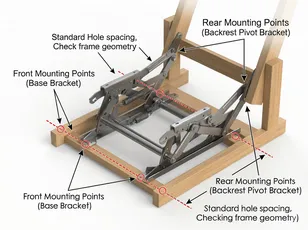
The recliner chair mechanism mounts to the chair frame via four-point bracket attachment — two front mounting points on the base bracket and two rear points on the backrest pivot bracket. Standard mounting hole spacing follows industry-common patterns, but recliner frame geometry varies enough across manufacturers that we recommend confirming fit against your frame drawings before committing to a production run.
New Frame Designs
Send us your frame drawings or a dimensioned sketch of the mounting area. We'll confirm whether the standard mechanism fits or whether a mounting pattern modification is needed before you commit to a production run.
Switching Suppliers
Send us a sample of the mechanism you're replacing. We'll confirm dimensional compatibility and identify any differences in the mounting geometry before you place an order — no guesswork on fit.
Wall-Hugger Clearance
The wall-hugger configuration has a larger footprint than the standard mechanism due to the forward-slide track assembly. The track needs approximately 8–10 cm of forward travel space inside the chair base. Confirm your frame's internal clearance dimensions before specifying wall-hugger.
Four-Point Bracket Attachment
Two front mounting points on the base bracket and two rear points on the backrest pivot bracket. Standard hole spacing follows industry-common patterns — but frame geometry varies enough that we always recommend a fit check before production commitment.
Product Range
Other Mechanisms in This Category
The recliner chair mechanism is one of four products in our recliner and sofa hardware line. If your product range extends beyond standalone recliner chairs, the following mechanisms cover the remaining sofa and sectional configurations.

Sofa Bed Mechanism
Full folding frame system for sofas with 90 cm+ seat depth. Deploys a complete mattress platform; designed for static sleeping loads across a wider span.
View Details
Sleeper Sofa Mechanism
Compact bi-fold or tri-fold linkage for shallower sofa profiles (75–85 cm seat depth) where the full sofa bed frame geometry doesn't fit.
View Details
Couch Mechanism
Modular sectional and chaise hardware for multi-seat sofa configurations, including power-ready frames for motorized reclining sections.
View DetailsFrequently Asked Questions
What is the MOQ for recliner chair mechanisms?
500 units for standard catalog configurations (standard manual and wall-hugger). For OEM/ODM projects with custom tooling, MOQ depends on tooling amortization — we'll give you the specific number based on your spec.
What's the difference between a standard recliner mechanism and a wall-hugger mechanism?
A standard recliner uses a fixed pivot point — the chair moves backward as it reclines, requiring 30–45 cm of rear clearance. A wall-hugger mechanism uses a forward-slide pivot track so the chair body moves forward as it reclines, maintaining wall clearance without requiring rear space. Wall-hugger is the configuration for urban residential markets where chairs are placed against walls; standard suits larger living spaces and is simpler to produce at lower tooling cost.
How do I prevent recliner mechanism binding after 6–12 months of use?
Binding at full footrest extension is almost always a pivot geometry issue caused by loose stamping tolerances — the linkage arms drift out of the correct angular relationship as dimensional variation accumulates across a production run. Specify a supplier holding ±0.15mm or tighter on stamping with periodic in-process dimensional checks throughout the run, not just first-article inspection. Also confirm that pivot pins are hardened steel — mild steel pivot pins wear oval under load cycles and introduce play that causes binding.
What cycle life rating do I need for hospitality applications?
Residential recliner mechanisms are typically rated at 10,000–15,000 cycles. Hospitality applications — hotels, serviced apartments — should specify 30,000 cycles minimum, given the higher use frequency and the cost of a field replacement in a hospitality setting. We produce both ratings; specify your use environment when you send the brief.
Can you match the mounting pattern of my current recliner mechanism supplier?
Yes, on OEM runs of 500 units or more. Send us a sample of the mechanism you're replacing or a dimensioned drawing of the mounting pattern. We'll confirm compatibility and identify any geometry differences before committing to tooling.
What surface finish is right for coastal or humid-climate markets?
Powder coating at 60–80μm is the specification for humid-climate and coastal markets — it passes 500-hour salt spray and protects against the corrosion that drives warranty claims in those environments. Nickel plating is used on tight-tolerance components where powder coat thickness would affect fit. For buyers with RoHS requirements, our zinc plating uses trivalent chromium passivation.
Source Your Recliner Chair Mechanisms Here
If you're evaluating recliner chair mechanism suppliers, the fastest way to confirm fit is a sample order against your frame. We can ship samples from catalog stock — tell us your frame dimensions, target configuration (standard or wall-hugger), and surface finish requirement, and we'll pull the closest match.
If you're developing a new recliner design and need a mechanism spec'd to fit, send us your frame drawings or a photo of what you're currently sourcing. Our engineering team will come back with a specific recommendation, a quote, and CAD drawings if the project moves forward.
Not sure whether the standard or wall-hugger configuration fits your market? Send us your target retail price point and market segment — we'll spec the version that protects your margin.