

Factory-Direct Table Surface Mechanisms
Lift-top, butterfly, flip-top, extension, and folding table fittings from a dedicated furniture mechanism manufacturer. 17 years producing motion hardware for furniture manufacturers and importers across North America, Europe, and beyond.
Full product line, in-house tooling, 500-unit MOQ.

Category Overview
What Table Surface Mechanisms Are — and What We Make
Table surface mechanisms are the hardware that makes a table do something beyond sitting still. The mechanism is what separates a functional piece from a static one — and it's the component that determines whether the furniture holds up through three years of daily use or generates a warranty claim in month four.
A lift-top that rises and tilts toward you, a butterfly leaf that folds out from center, a flip-top that rotates 180° to reveal storage, an extension slide that pulls the surface apart for an insert — each of these motions is defined entirely by the mechanism behind it. Get the mechanism wrong and the furniture fails. Get it right and it disappears into the product, doing its job invisibly across thousands of open-close cycles.
We've been manufacturing this category since 2008. At MVMHardware, table and surface mechanisms share a dedicated production line alongside our door and hinge hardware — separated from chair and recliner production so your table mechanism order isn't competing for press time with a large sofa bed run.
Our customers in this category are furniture manufacturers who need consistent batch quality across 2,000–20,000 unit runs, importers building private-label lines, and distributors who need a supplier that can hold spec across reorders. They're not buying one mechanism — they're buying a component that goes into every unit of a SKU they're staking their brand on.

Dedicated production line for table and surface mechanisms — not shared with sofa bed or recliner runs. Your batch gets consistent press time and tooling attention.
The Full Spectrum of Table Motion Hardware We Produce
Lift-Top Fittings
Rise-and-tilt mechanisms for coffee tables and ottomans. The surface lifts toward the user and locks at working height.
View Lift-Top RangeButterfly & Self-Storing Leaf
Leaf mechanisms that fold out from center or store beneath the table surface. Designed for dining tables requiring expandable seating.
View Coffee Table RangeFlip-Top Pivot Systems
180° rotation mechanisms that reveal concealed storage. Used in console tables, sideboards, and multi-function furniture.
View Rotating RangeExtension Slides & Folding Legs
Pull-apart extension slides for leaf inserts, plus folding leg brackets for drop-leaf and gate-leg table configurations.
View Desk & Extension RangeWho Sources Table Mechanisms From MVMHardware
Our table mechanism customers aren't buying a single unit to test. They're qualifying a component for a production run — and they need a supplier that holds spec across reorders, not just the first batch.
Consistent batch quality across 2,000–20,000 unit runs. Dedicated production line, no cross-category scheduling conflicts.
Building private-label lines that need a mechanism supplier who can hold spec and support OEM/ODM customization.
Stocking a mechanism range that needs to reorder reliably. Same tooling, same tolerances, same finish across batches.
Full Category Range
Product Line: Table & Surface Mechanism Range
Each mechanism below is a discrete product category with its own motion geometry, load spec, and tooling. We manufacture all of them in-house from cold-rolled steel with zinc plating on wear components.

Lift-Top Table Mechanism
The lift-top mechanism raises and tilts the table surface toward the user — the core fitting for coffee tables that convert to work height. The mechanical challenge is the motion arc: the surface needs to lift smoothly, hold at multiple angles without drift, and return without slamming.
We run these in cold-rolled steel with zinc plating on the pivot and spring components. Spring rate is calibrated to surface weight — a mechanism tuned for a 12 kg MDF top behaves differently than one under a 22 kg solid wood surface, and we spec accordingly when buyers provide their top weight.
Most quality complaints on lift-top mechanisms from other suppliers trace back to spring fatigue at the 6–12 month mark. The root cause is almost always an undersized spring cross-section, not the spring count. We run the spring wire at a heavier gauge than the minimum spec — it adds marginal material cost and meaningfully extends cycle life.

Butterfly Leaf Extension Mechanism
The butterfly mechanism stores the extension leaf under the table surface, folded in half, and deploys it by pulling the two table halves apart — the leaf unfolds and rises to surface level automatically.
The precision requirement is in the leaf alignment: when deployed, the leaf surface must be flush with the main top within ±0.5 mm, or the joint is visible and the table feels uneven. We hold that tolerance through the stamped steel guide rails and the pivot geometry on the leaf hinge.
This is one of the more mechanically complex products in the table hardware category, and it's where in-house tooling matters. The guide rail profile and the leaf hinge geometry interact — a change in one affects the other. Having our engineering team control both in the same tooling revision cycle means we can iterate a sample in days, not weeks.
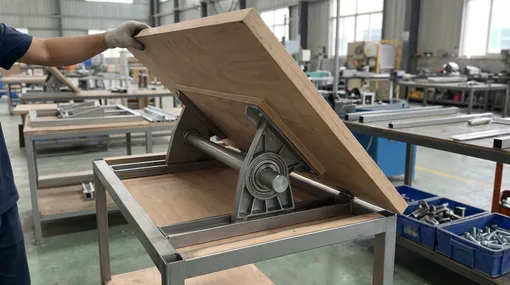
Flip-Top Pivot Mechanism
Flip-top mechanisms rotate the table surface 180° on a central pivot, typically to reveal an interior storage compartment or to fold the table flat for storage. The pivot bearing takes the full weight of the surface through the rotation — bearing quality and the pivot pin diameter are the two specs that determine whether this mechanism still operates smoothly at 50,000 cycles or starts to bind.
- ›16mm pivot pin — standard on full-rotation flip-top. Some suppliers run 12mm to reduce material cost; the difference in motion quality is perceptible within the first year of use.
- ›Die-cast zinc alloy bearing housing — produced in-house for dimensional control on bore tolerance, which determines play in the pivot.
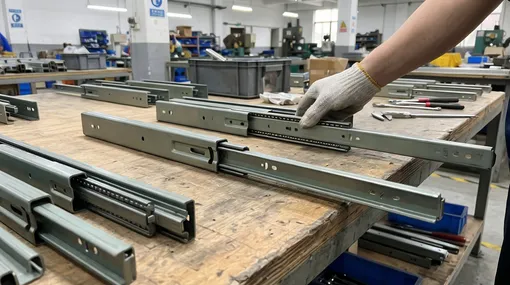
Extension Slide & Telescoping Rail
Extension table slides allow the table surface to pull apart for leaf insertion — the hardware that enables a 1.4m dining table to extend to 2.0m for entertaining. The functional requirement is smooth, parallel extension with no racking, and positive stop engagement at both the closed and extended positions.
- ›Cold-rolled steel with zinc phosphate pre-treatment before powder coating — the phosphate layer improves coating adhesion on rail contact surfaces, which are the primary wear point.
- ›Rail straightness held to ±0.3mm over full extension length — beyond that tolerance, racking force increases and the extension feels stiff.
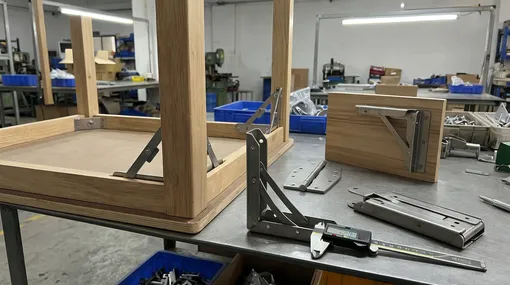
Folding Leg Bracket & Table Hinge
Folding leg brackets and table hinges cover the hardware for fold-flat tables — wall-mounted drop-leaf brackets, folding trestle leg fittings, and the hinge systems that allow table leaves to fold down. Load rating is the primary spec: a wall-mounted bracket supporting a 60kg surface load has different structural requirements than a lightweight folding trestle fitting.
- ›Rated by static load capacity, tested to 3× rated load as batch qualification standard.
- ›2.0mm cold-rolled steel bracket body — buyers requesting 1.5mm to reduce cost are advised: the weight saving is negligible; the load margin reduction is not.
Browse All Table & Surface Mechanism Product Lines
Each product line ships with full technical datasheets, load test reports, and OEM/ODM options. Factory-direct from Guangdong — ISO 9001:2015 certified.
Category Overview
Technical Specifications: Category-Wide Parameter Ranges
Procurement teams need to know whether our spec range covers their requirements before going deeper. Here's the category-level overview:
| Parameter | Range / Options |
|---|---|
| Primary material | Cold-rolled steel (SPCC), zinc alloy die-cast components |
| Steel thickness | 1.5mm – 2.5mm (structural brackets); 1.0mm – 1.5mm (guide rails) |
| Surface treatment | Zinc plating, nickel plating, powder coating (60–80μm) |
| Salt spray resistance | 500 hours (powder coat); 200 hours (zinc plate) |
| Pivot pin diameter | 12mm – 20mm depending on mechanism type and load rating |
| Load rating | 30kg – 120kg static (varies by product; test reports available) |
| Cycle life testing | 50,000 cycles minimum batch qualification |
| Dimensional tolerance | ±0.15mm on stamped components; ±0.3mm on rail straightness |
| Certifications | ISO 9001:2015, CE, SGS, RoHS |
| MOQ | 500 units (standard catalog); OEM/ODM by tooling arrangement |
| Lead time | 25–35 days from order confirmation |
Zinc Plating
Used on pivot components and spring hardware where dimensional tolerance after coating is critical. Adds minimal thickness — suitable for tight-clearance assemblies.
Nickel Plating
Available for buyers whose end market expects a premium finish on visible hardware. Delivers a refined surface appearance without sacrificing dimensional control.
Powder Coating
Standard for structural brackets and rail components where corrosion resistance matters more than dimensional precision. Adds 60–80μm per surface — account for this on fit-critical assemblies.
Sourcing Context
Where These Mechanisms Go: Market Segments Worth Sourcing For
Table surface mechanisms serve a range of furniture categories, each with distinct volume and margin profiles for distributors and importers.

Residential Multifunctional Furniture
Lift-top coffee tables and extension dining tables are staple SKUs for furniture retailers across North America and Europe — the mechanism is what justifies the price premium over a static table, and buyers in this segment reorder consistently once they have a working SKU. This segment has grown significantly for our customers over the past three years — worth building into your product line if you're not already there.

Home Office and Compact Living
Drives demand for flip-top and fold-flat mechanisms. Wall-mounted drop-leaf desks, fold-flat dining tables for small apartments, and convertible work surfaces are all mechanism-dependent products. The buyer profile here tends toward higher-spec hardware — the end consumer is paying for functionality, and a mechanism failure is a direct product return.

Contract and Hospitality Furniture
Hotel room desks, restaurant extension tables, conference room folding tables — requires mechanisms that hold up to commercial use cycles. This segment typically requires CE documentation and load test reports, which we provide as standard. MOQs in this segment tend to be larger and more predictable, which makes it attractive for importers building a stable supply relationship.

Outdoor and Garden Furniture
Uses folding leg brackets and table hinges in aluminum-compatible configurations. RoHS compliance is relevant here for buyers supplying into EU markets.
Sourcing Guidance
How to Specify the Right Mechanism for Your Product
The most common sourcing mistake in this category is specifying by mechanism type alone without accounting for the surface weight and use environment. Here's the decision logic we walk buyers through.
Surface Weight Drives Spring and Load Spec
For lift-top mechanisms, provide us your tabletop material and dimensions — we'll calculate the surface weight and confirm the spring rate. A mechanism specified for a 10kg surface will feel sluggish and wear prematurely under a 20kg top. This is the single most common cause of early mechanism failure in the field.
Use Environment Determines Surface Treatment
Indoor residential: zinc plating is sufficient. Coastal or humid environments (Southeast Asia, Florida, Gulf markets): specify powder coat over zinc phosphate pre-treatment — the phosphate layer is what makes the coating adhesion hold in high-humidity conditions. Outdoor: discuss with us before specifying; not all table mechanisms in our catalog are rated for direct weather exposure.
Cycle Life Requirement Maps to End Market
Residential use: 50,000 cycles is the standard floor. Commercial/hospitality: specify 80,000–100,000 cycles and ask for the test report. The mechanism design is the same; the spring and pivot components are uprated.
Leaf Alignment Tolerance Matters
For extension and butterfly mechanisms: if your end product is a premium dining table where surface flush is a visible quality signal, specify ±0.5mm leaf alignment tolerance and ask us to confirm it on the sample. If it's a mid-market product where ±1.0mm is acceptable, we can optimize the component cost accordingly.
Get a Configured Quote
Send us your tabletop spec, target market, and volume.
We'll come back with a specific mechanism recommendation and a quote that reflects the actual configuration, not a generic catalog price.
Engineering Quality
What Goes Wrong with Table Mechanisms — and How We Engineer Against It
This category has a short list of recurring failure modes. Buyers who've been burned by them once ask about them directly. Here's where the problems come from and what we do about it.
Spring Fatigue on Lift-Top Mechanisms
The surface lifts fine for the first few months, then starts to feel heavy or drops without holding position. Undersized spring wire cross-section, often combined with a spring rate that was never matched to the actual surface weight.
We run spring wire at a heavier gauge than the minimum spec, and we require buyers to provide surface weight before we confirm the spring selection. We don't ship a lift-top mechanism without knowing what it's going under.
Racking on Extension Slides
One side of the table extends further than the other, creating a diagonal gap at the joint. Rail straightness tolerance outside ±0.3mm, or insufficient rail length for the extension distance.
We hold ±0.3mm on rail straightness and size the rail length to the extension distance with a minimum 60% overlap at full extension — that overlap is what prevents racking under asymmetric load.
Pivot Binding on Flip-Top Mechanisms
The surface rotates smoothly when new, then stiffens over time. Undersized pivot pin diameter combined with a die-cast bearing housing with loose bore tolerance — the pin wears the bore oval, and the motion degrades.
We run 16mm pivot pins as standard and hold the bearing bore to ±0.05mm in our die-casting process. That tolerance is why we brought die-casting in-house — a third-party foundry won't hold ±0.05mm on a bore that size without a premium tooling arrangement.
Powder Coat Adhesion Failure at Weld Seams
Visible rust or coating lift at welded joints, typically appearing within 12–18 months in humid environments. Weld spatter and oxidation scale on the seam surface not fully removed before coating.
We grind and chemically treat every weld seam before the part enters the coating line. It adds a step, but it's the step that determines whether your coastal-market customers see rust on a mechanism that's supposed to last five years.
Ask for the Test Report
For commercial and hospitality applications requiring 80,000–100,000 cycle ratings, we can provide the cycle test documentation. Request it when you inquire — it's part of our standard qualification package for contract buyers.
OEM and ODM: Building Your Own Table Mechanism Line
A significant share of our table mechanism volume is OEM and ODM work — buyers who need a mechanism built to their specification or developed from a brief.
OEM — Your Drawings, Our Production
You supply the drawings. We review for manufacturability — if your geometry creates a stamping problem or a die-cast wall thickness that won't fill reliably, we'll tell you before we build tooling, not after. Production runs to your spec, packed with your branding if required.
ODM — Brief to Production Sample
You bring us the commercial brief: target retail price point, surface weight range, end market, and any aesthetic requirements (finish, visible hardware style). Our 12-person engineering team develops the mechanism design, builds the tooling in-house, and runs samples through our standard qualification cycle — dimensional check, functional test, load cycle.
We iterate until the sample matches your brief. Tooling is built and owned here, which means revision cycles run in days. When a sample needs a geometry change, we're not waiting on a third-party tooling shop's schedule.

What's Included in OEM Arrangements
- Branded packaging and retail-ready cartons
- Custom powder coat colors on runs of 100+ units
- Pre-production manufacturability review — geometry and wall thickness flagged before tooling spend
- In-house tooling ownership — revision cycles in days, not weeks
- Full qualification cycle: dimensional check, functional test, load cycle before sample sign-off
Logistics and Container Planning for Table Mechanism Orders
Table mechanisms ship KD (knocked-down) — components packed flat, not assembled — which significantly improves container utilization versus assembled units.
Lift-top mechanisms with spring assemblies pack less densely than flat extension slides.
Carton dimensions standardized for 40HQ loading. CBM-per-carton data provided with every order so you can calculate freight cost before the container is packed.
Export Documentation — Ships Complete
No chasing us for documents after the container has sailed. Every shipment includes:
Material and surface treatment documentation your customs broker needs for HTS classification — provided as standard.
CE declaration and test reports included as standard — no additional requests required.

Runs on a milestone schedule provided upfront at project start.
Frequently Asked Questions
What is the minimum order quantity for table surface mechanisms?
500 units for standard catalog mechanisms. OEM/ODM tooling projects have MOQs based on tooling amortization — we calculate the honest number from your spec and volume, not a generic floor. Most new buyers in this category start with a 500–1,000 unit trial order to validate the mechanism with their own product before scaling.
How do I match a lift-top mechanism to my tabletop weight?
Provide us the tabletop material, dimensions, and thickness — we calculate the surface weight and confirm the spring rate selection. The spring rate must be matched to the actual surface weight within ±15% for the mechanism to operate correctly and hold position without drift. If you're sourcing a mechanism without providing this data, you're guessing on the most critical spec.
What surface treatment should I specify for humid or coastal markets?
Powder coat over zinc phosphate pre-treatment. The phosphate layer improves coating adhesion on steel surfaces in high-humidity conditions — without it, powder coat can delaminate at the steel interface within 12–18 months in coastal environments. We run our powder line at 60–80μm film thickness, which passes 500-hour salt spray. For outdoor-adjacent applications, ask us about the specific mechanism's exposure rating before specifying.
What certifications are required for table mechanisms sold into the EU?
CE marking is the primary requirement for furniture hardware sold into the EU market. Our table mechanisms carry CE certification, and the declaration of conformity ships with every order. SGS test reports are available for buyers whose retail customers or compliance teams require third-party verification. RoHS compliance documentation is available for buyers supplying into markets with restricted substances requirements.
How do I prevent racking on extension table slides?
Racking — where one side of the table extends further than the other — comes from two sources: rail straightness tolerance outside ±0.3mm, or insufficient rail overlap at full extension. Specify rail straightness tolerance of ±0.3mm and confirm that the rail length provides at least 60% overlap at the maximum extension distance. Ask your supplier for the rail straightness measurement data from the production batch — if they can't provide it, the tolerance isn't being controlled.
Can table mechanisms be customized for non-standard tabletop sizes?
Yes. Standard catalog mechanisms cover the most common tabletop size ranges, but OEM configurations for non-standard dimensions are a routine part of our work. Bring us your tabletop dimensions, surface weight, and extension distance — we'll confirm whether a catalog mechanism covers it or whether a custom configuration is needed, and quote accordingly.
Source Table Mechanisms Factory-Direct
We've been making furniture mechanisms since 2008. For table and surface mechanisms specifically, the relevant facts are: a dedicated production line, in-house die-casting for the precision components that determine pivot quality, 100% functional testing before shipment, and a 12-person engineering team that has seen the failure modes in this category before your project starts.
If you're evaluating suppliers for a table mechanism program — whether it's a catalog SKU, a private-label line, or an OEM development project — send us your spec. We'll come back with a mechanism recommendation, a sample timeline, and a quote that reflects the actual configuration.