

Modular Furniture Mechanism
Connection and reconfiguration hardware built to survive repeated engagement cycles without degrading. Sectional sofa connectors, modular seating brackets, reconfigurable shelving hardware, and office furniture joining systems — tested to 500+ engagement cycles.
Engineering Context
What Makes Modular Mechanism Hardware a Different Engineering Problem
Most furniture hardware is designed to move once per use cycle — a hinge opens and closes, a slide extends and retracts. A modular furniture mechanism is designed to be disconnected and reconnected — reconfigured — repeatedly over the product's service life. That's a fundamentally different stress pattern, and it's where a lot of modular hardware fails in the field.
The commercial value of modular furniture is reconfigurability: a sectional sofa that can be rearranged, an office system that can be expanded or contracted as headcount changes, a shelving configuration that adapts to a new space. If the connection hardware degrades after 20 or 30 reconfigurations — developing play, losing its positive engagement, or requiring tools to operate — the product's core selling point disappears. Your downstream customers notice, and the warranty claims come back to you.
We test modular connectors to a minimum of 500 engagement cycles before a product qualifies for shipment. For commercial contract furniture applications — office systems, hospitality seating, rental furniture — that number goes up based on the use environment.
Three Variables That Determine Field Performance
The connector should feel the same on cycle 500 as it did on cycle 1.
Tested under both lateral and vertical load conditions across the full cycle count.
Should release cleanly without requiring excessive effort or tools.
Field Case: Engagement Cycle Degradation
We started tracking engagement cycle degradation as a specific failure mode around 2017, after seeing a pattern of warranty returns from a European distributor's modular seating line. The connectors passed standard load testing but developed perceptible play after 50–80 reconfigurations. The root cause was insufficient hardness on the male connector tab — we added a case-hardening step to the stamping process and the problem went away. That's now standard on all modular connector production.

Product Range
Modular Mechanism Product Range and Specifications
The modular furniture mechanism category covers several distinct hardware types, each with its own engineering requirements. Here's what we produce and the key specifications that drive sourcing decisions.
Sectional Sofa and Modular Seating Connectors
The most common application in this category. These connectors join adjacent sofa sections, chaise units, and modular seating modules — they need to hold the sections aligned under load (people sitting on the joint between two sections), release cleanly for reconfiguration, and survive repeated engagement without developing play.

| Parameter | Specification |
|---|---|
| Primary material | Cold-rolled steel (SPCC), 2.0–2.5mm stamped |
| Connector type | Hook-and-bar, cam-lock, or clip-type |
| Retention load (lateral) | 80–120 kg per connector pair |
| Retention load (vertical) | 60–80 kg per connector pair |
| Engagement cycles tested | 500 minimum; 1,000+ for commercial spec |
| Surface treatment | Zinc electroplate (standard) or powder coat |
| Standard MOQ | 500 units |
Modular Shelving and Storage Brackets
Connection hardware for modular shelving systems, wall-mounted storage units, and reconfigurable cabinet assemblies. The engineering requirement here is different from seating connectors — the primary load is vertical (shelf weight plus contents), and the connection needs to be repositionable without damaging the upright or leaving visible marks.
| Parameter | Specification |
|---|---|
| Primary material | Cold-rolled steel (SPCC), 1.5–2.0mm stamped |
| Bracket type | Pin-and-slot, clip-on, or bolt-through |
| Vertical load rating | 30–80 kg per bracket pair |
| Repositioning cycles | 200 minimum without deformation |
| Surface treatment | Powder coat (60–80μm) or zinc electroplate |
| Finish options | RAL color range (powder coat); zinc or nickel (electroplate) |
Reconfigurable Office Furniture Connectors
Panel connectors, worksurface joining hardware, and frame connection systems for modular office furniture. This segment has the highest reconfiguration frequency — office layouts change with headcount, and the hardware needs to hold up through multiple office reconfigurations over a 5–10 year product life.

| Parameter | Specification |
|---|---|
| Primary material | Cold-rolled steel (SPCC) + zinc alloy die-cast components |
| Connector type | Panel clip, worksurface bracket, or frame joining plate |
| Engagement cycles tested | 1,000 minimum (office spec) |
| Dimensional tolerance | ±0.10mm on locking components |
| Surface treatment | Powder coat or nickel electroplate |
| ISO 9001:2015, CE, RoHS |
Specifications shown are industry-standard values for this product type. Actual specifications may vary by configuration. Contact us for detailed product data sheets and load test reports.
Request SpecificationsMarket Segments Where Modular Mechanism Hardware Drives Repeat Orders
Modular furniture is a growth segment in several commercial categories, and the mechanism hardware is the component that determines whether the product delivers on its promise. Here's where the volume is and what it means for your sourcing.

Residential Modular Seating
Sectional sofas and modular sofa systems are the highest-volume segment for modular connectors. North American and European furniture retailers have expanded their modular sofa offerings significantly; the consumer appeal is reconfigurability for different room layouts.
Every sofa unit needs 4–8 connectors. A 500-unit sofa order means 2,000–4,000 connector sets. The reorder pattern is predictable once you're in the supply chain.

Contract & Hospitality Seating
Modular lounge seating for hotel lobbies, airport lounges, and corporate reception areas is a smaller-volume but higher-margin segment. These projects specify commercial-grade hardware with documented cycle life and load ratings because the furniture goes through professional installation and periodic reconfiguration by facilities teams.
A single hospitality project can run 200–500 seating modules. We can provide load test reports and cycle life documentation for project bids.

Modular Office Furniture Systems
Panel systems, benching systems, and reconfigurable workstations have the highest reconfiguration frequency and the strictest hardware requirements. Office furniture manufacturers building branded systems often need custom connector geometry that integrates with their proprietary frame profiles.
You bring the frame profile and connection brief — we develop the connector geometry, build tooling in-house, and iterate samples until fit and engagement feel match your spec. Several current customers started with a catalog connector and moved to custom geometry after the first product generation. The custom connector becomes part of the product's design identity and a barrier to component substitution by competitors.

Modular Shelving & Storage
Retail display, residential storage systems, and commercial shelving is a volume segment where the hardware is often specified by the system designer and sourced in bulk. Bracket hardware for modular shelving systems is a straightforward repeat-order category once the spec is locked.
Consistent dimensional tolerance. A bracket that's 0.3mm off position creates visible misalignment in an assembled shelving run.
How We Manufacture Modular Connectors: The Process Details That Affect Your Product
The manufacturing steps that matter most for modular mechanism hardware are the ones that determine engagement consistency and long-term retention — not the steps that are easiest to describe in a brochure.
Stamping Tolerance on Connector Geometry
Where engagement consistency starts. The male and female components of a modular connector need to fit within a tolerance band that's tight enough for positive engagement but loose enough to allow tool-free operation.
A connector stamped to ±0.20mm will feel inconsistent: some units snap in positively, others feel loose or require force. We check connector geometry with go/no-go gauges at the stamping stage, not just at final assembly.
Case Hardening on High-Wear Contact Surfaces
The step that determines long-term engagement consistency. The contact surfaces on a modular connector — the hook face, the cam surface, the clip spring — are subject to repeated metal-to-metal contact. Without sufficient surface hardness, these surfaces wear and the engagement geometry changes over time.
This is the step added after a 2017 warranty return pattern, and it's what allows us to guarantee 500-cycle engagement consistency rather than just initial engagement quality.
Spring Rate Calibration on Clip-Type Connectors
A step most buyers don't ask about but should. The spring element in a clip connector determines both the engagement force (how hard you push to connect) and the retention force (how much lateral load the connector resists before releasing). Too stiff and the connector is difficult to engage by hand; too soft and it releases under normal use loads.
We tune spring rate during tooling development and verify with a force gauge during production.
100% Engagement Testing Before Packing
Every connector set is engaged and disengaged at least once on the test fixture before it goes into the carton. The test fixture applies a standardized lateral load after engagement to verify retention. Units that engage but don't retain, or that require excessive force to disengage, are pulled.
This is not a sample-based check — it's every unit. No connector set ships without passing the engagement and retention test.
Process Documentation Available for Project Bids
For contract and hospitality projects requiring documented hardware specifications, we can provide load test reports, cycle life documentation, and process control records. These are available on request for project specification submissions.
Request Documentation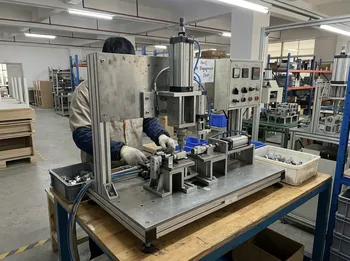
Customization: What Can Be Modified and What Can't
Modular furniture mechanism hardware is one of the more customizable categories we produce, because the connector geometry often needs to match a proprietary frame profile or a specific aesthetic requirement. Here's what's practical to customize and what the constraints are.
Connector Geometry & Engagement Profile
Fully customizable via ODM tooling. If your frame profile requires a specific hook geometry, cam profile, or clip configuration, we develop the tooling to match. This is the most common customization request in this category.
20–30 days standard · Longer for multi-component connectors
Material & Thickness
Standard range is 1.5–3.0mm cold-rolled steel for stamped components. Thicker gauge available for higher load ratings; thinner gauge for lightweight applications where load requirements allow.
Zinc alloy die-cast for complex connector geometry
Surface Treatment & Color
Powder coat in any RAL color, zinc electroplate, or nickel electroplate. Color matching to your furniture finish is standard for powder coat.
Powder coat adds 60–80μm to component dimensions. For tight-clearance connector assemblies, we typically specify electroplate to maintain dimensional consistency.
Packaging & Labeling
OEM packaging with your brand, part numbers, and installation instructions is available as part of the OEM arrangement. Retail-ready packaging for e-commerce or point-of-sale display is also available.
What Can't Be Customized Below MOQ
Custom connector geometry requires tooling investment, which is amortized over the production run. Below 500 units for standard catalog connectors, or below the ODM project MOQ for custom geometry, the tooling cost doesn't make commercial sense for either side. We'll give you the honest MOQ based on your spec — not a round number designed to sound accessible.
Compliance and Certification for Your Target Market
Modular furniture mechanism hardware ships with the compliance documentation your market requires. Here's what's confirmed and what's available on request.
Covers the full production process — incoming material inspection, in-process dimensional and functional checks, and 100% outgoing functional testing. QMS documentation available for supplier qualification audits.
European market compliance for the mechanism product range. CE declaration of conformity ships with European orders.
Third-party audit and product testing. SGS reports available with shipment for buyers whose customers or procurement processes require third-party verification.
Trivalent chromium passivation on all zinc plating; no hexavalent chromium in the process. RoHS documentation ships with orders for EU and California market requirements.
Market-Specific Documentation
For buyers supplying into markets with specific furniture hardware standards, we can provide load test reports and cycle life documentation formatted for project specification submissions.
-
BIFMA — North American commercial furniture
-
EN Standards — European residential and contract furniture
Load test reports and cycle life documentation are not automatically included but are available on request. Ask for this when you inquire — formatted for project specification submissions.
Product Range
Sibling Products in the Furniture Motion Mechanism Range
Modular connectors are one motion type in a broader range. If your product line requires other motion hardware, these are the related categories under the same manufacturing roof.
Rotating Furniture Mechanism
Swivel bases, lazy-susan fittings, rotating storage hardware. If your modular furniture system includes rotating elements, sourcing both from us means one compliance document set and one shipping relationship.
Folding Furniture Mechanism
Fold-flat and fold-down hardware. Relevant if your modular system includes folding table leaves or fold-down components.
Transformable Furniture Mechanism
Multi-position conversion hardware. If your modular seating system also converts between configurations (sofa to bed, for example), this is the complementary product.
Sliding Furniture Mechanism
Linear slide hardware for extending tables and pull-out shelving within modular storage systems.
Metal Furniture Mechanism
Structural metal hardware and load-bearing connection components for modular frame systems.
Full Motion Mechanism Range
View all furniture motion mechanism categories from one manufacturer — one compliance document set, one shipping relationship.
Buyer Guidance
Frequently Asked Questions
Decision-support answers for buyers specifying modular furniture mechanism hardware.
What is the minimum order quantity for modular furniture mechanism hardware?
500 units for standard catalog connectors. For custom connector geometry requiring new tooling, MOQ depends on tooling amortization — we quote the actual number based on your spec. Most new buyers start with a 500–1,000 unit trial order to qualify the connector with their own assembly process before scaling up.
How many engagement cycles should I specify for residential versus commercial modular furniture?
For residential modular seating — sectional sofas, modular storage — 200–500 cycles covers the expected reconfiguration frequency over the product's service life. For commercial applications — office systems, hospitality seating, rental furniture — specify 1,000 cycles minimum. High-frequency commercial environments (rental furniture reconfigured between tenants, for example) should go to 2,000 cycles. Tell us the use environment when you inquire and we'll recommend the appropriate test spec.
What's the difference between hook-and-bar, cam-lock, and clip-type modular connectors?
Hook-and-bar: Standard for residential sectional sofas — simple engagement, reliable retention under normal use loads, tool-free disengagement.
Cam-lock: More positive lock with higher lateral load resistance, used where the joint is subject to higher stress or where a more secure connection is required.
Clip-type: Used in lighter modular systems where the primary function is alignment rather than structural load transfer.
The right choice depends on your load requirements and how frequently the furniture will be reconfigured — send us your application brief and we'll recommend the configuration.
Can you match connector geometry to our proprietary frame profile?
Yes — this is standard ODM work for us. You provide the frame profile dimensions and the connection brief (engagement direction, retention load requirement, disengagement method), and we develop the connector geometry, build the tooling in-house, and run samples until the fit is confirmed. In-house tooling means faster iteration than factories that route tooling to third-party shops.
What surface finish should I specify for modular connectors going into visible furniture applications?
Hidden connectors: Zinc electroplate is the standard — adequate corrosion resistance, dimensional consistency, cost-effective.
Partially visible connectors: Nickel electroplate gives a bright metallic finish with tight dimensional tolerance.
Color-coordinated connectors: Powder coat in a matching RAL color is available, but note that powder coat adds thickness — confirm clearances with us before specifying powder coat on tight-tolerance connector assemblies.
Do you provide load test reports for project specification submissions?
Yes. For contract furniture projects that require documented load ratings and cycle life data for specification submissions, we can provide test reports in the format your project requires. This is not automatically included with standard orders — request it when you inquire and we'll include it in the quote.
Start Your Modular Mechanism Sourcing Conversation
Have a Connector Spec?
Send us your drawings or a sample reference — we'll match the geometry, confirm the load rating, and quote factory-direct with full compliance documentation.
Request a QuoteBuilding a New Modular System?
Send us your frame profile and the connection brief — engagement direction, retention load, reconfiguration frequency, and target price point. Our engineering team will come back with a connector proposal and tooling estimate.
Contact EngineeringConsolidating Mechanism Suppliers?
We produce the full range of furniture motion hardware — modular connectors, rotating mechanisms, folding hardware, sliding systems — from one facility. One supplier qualification, one compliance document set, one shipping relationship.
Discuss Consolidation