

Hinge Furniture Mechanism
Precision hinge furniture mechanism — stamped steel bodies, die-cast adjustment cams, 80,000-cycle soft-close dampers. Factory-direct from Guangdong.
Full configuration coverage: concealed cup hinges, soft-close integrated, pivot systems, overlay and inset variants. Every unit 100% functionally tested before it leaves the floor.
Product Overview
What This Product Is — and Where It Fits in the Category
A hinge furniture mechanism is the complete hinge assembly that connects a cabinet or wardrobe door to its carcass and controls how that door opens, closes, and holds position. That definition covers a lot of ground — which is why the door hinge furniture mechanism category exists to map the full range. This page is about the specific hinge mechanism product line we manufacture: the stamped steel and die-cast assemblies that go into production cabinet runs, wardrobe systems, and contract furniture projects.
The distinction that matters for sourcing: a hinge mechanism is not a commodity fastener. The adjustment cam, the damper piston, the clip-on mounting plate retention geometry — these are the components that determine whether your downstream customer gets a door that stays aligned for five years or one that drifts and slams within twelve months. We've been manufacturing these components in-house since 2008, and the engineering decisions we've made on each one are documented below.
If you're evaluating this product against other configurations in the category — pivot systems, standalone damper clips, or overlay-specific variants — the category overview covers the full selection logic. This page gives you the product-level detail you need to make a sourcing decision on the hinge mechanism line specifically.

Engineering Data
Technical Specifications
Standard parameters for our hinge furniture mechanism product line. Exact values vary by configuration — contact us for the specific data sheet on the model you're evaluating.
| Parameter | Standard Value / Range |
|---|---|
| Hinge cup bore diameter | 35mm (industry standard) |
| Door thickness compatibility | 16–22mm |
| Door weight capacity | 1.5–8 kg (standard); up to 25 kg (heavy-duty pivot) |
| Overlay configurations | Full overlay, half overlay, inset |
| Opening angle | 90°, 110°, 165°, 180° (by model) |
| Soft-close engagement range | Final 15–20° of closing travel |
| Soft-close cycle rating | 80,000 cycles (standard batch qualification) |
| Body material | Cold-rolled SPCC steel |
| Adjustment cam material | Zinc alloy die-cast (in-house) |
| Adjustment axes | 3-way: lateral, depth, height |
| Mounting plate type | Clip-on (tool-free) or screw-fixed |
| Surface finish options | Nickel plating, zinc plating, powder coating |
| Powder coat film thickness | 60–80μm |
| Salt spray resistance | 500 hours (powder coat); 200+ hours (nickel plate) |
| Certifications | ISO 9001:2015, CE, SGS, RoHS |
| Standard MOQ | 500 units per SKU |
Specifications shown are standard values for this product line. Actual parameters vary by model and configuration. Contact us for detailed product data sheets.
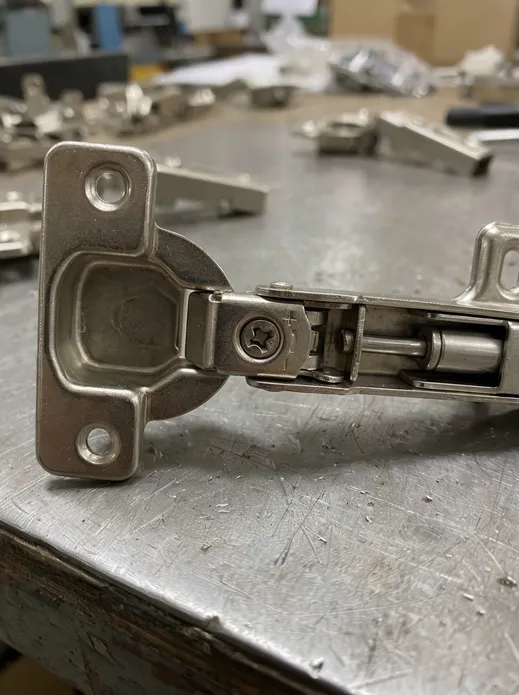
- Concealed cup hinges
- Soft-close integrated
- Pivot systems
- Full overlay, half overlay, inset
- 90° / 110° / 165° / 180° opening
Manufacturing Process
How We Make the Hinge Mechanism — and Why the Process Decisions Matter
Most hinge mechanism failures trace back to two components: the die-cast adjustment cam and the damper assembly. We've seen both failure modes across 17 years of production, which is why we run both processes in-house rather than outsourcing them.

Stamped Steel Body
Hinge plate, mounting bracket, and structural arm formed on progressive die stamping presses from cold-rolled SPCC steel coil. Dimensional tolerance: ±0.15mm overall. Clip spring arm held to ±0.1mm — the component where tolerance stack-up causes field problems. We tightened that spec after seeing a batch of returns from a European distributor where marginal clip engagement only showed up after repeated reinstallation.
Die-Cast Adjustment Cam
Zinc alloy die-cast, produced in-house on our own casting equipment. This is the component most commonly behind "adjustment slips under load" warranty returns — the cam profile wears or deforms when alloy is substituted or die tooling is run past service life. We control alloy composition through incoming ingot certification and pull die tooling for inspection before dimensional drift reaches the cam profile tolerance limit. When a sample fails, the fix is a parameter change on our machine, not a conversation with a subcontractor.
Soft-Close Damper
Engages in the final 15–20° of closing travel, decelerating the door to a controlled stop. Calibrated for door weights in the 1.5–8 kg range. We run 80,000-cycle qualification on damper batches as a standard check — not a marketing number, but the threshold where seal degradation shows up in testing. At three open-close cycles per day, that's over 70 years of kitchen cabinet use. Batches that don't pass don't ship.
Surface Treatment
Full in-house line — nickel plating, zinc plating, and powder coating. Powder line runs at 60–80μm consistent film thickness, the spec that passes 500-hour salt spray without adhesion failure. Phosphate pre-treatment on all stamped parts before powder application — the hinge cup rim is a stamped edge with sharp geometry that's the hardest area to get consistent adhesion on, and skipping pre-treatment is where flaking at the bore edge comes from. We cross-cut adhesion test every coating run.
100% Functional Testing
Every unit before packing. A hinge that passes dimensional checks but has a sticky damper or a cam that won't hold adjustment gets pulled at this stage. Not sampling — every unit.
Market Segments
Application Segments: Market Opportunities for Your Distribution Business

Kitchen Cabinet Manufacturing
A standard kitchen installation uses 20–40 hinges; a production cabinet manufacturer running 500 kitchens per month is ordering 10,000–20,000 hinges per run. Soft-close integrated is now the baseline expectation in mid-market and above in North America and Europe — buyers who aren't stocking soft-close hinge mechanisms are losing shelf position to competitors who are.
Consistent, predictable reorder cycles tied to production schedules — a reliable revenue base for distributors building a hardware line.

Wardrobe and Fitted Furniture Systems
Heavier door weights than kitchen cabinets — 8–15 kg is typical for a full-height wardrobe panel in 18mm board. This segment needs hinges spec'd for higher door weight capacity, which means the pivot housing gauge and mounting plate thickness matter more than in the kitchen segment.
Buyers supplying wardrobe system assemblers who are currently sourcing kitchen-spec hinges for wardrobe applications are sitting on a warranty claim waiting to happen — and a conversation about the right spec is a margin-protection argument your sales team can make.

Contract Furniture and Hospitality
A single hotel project might call for 2,000–5,000 hinges across room furniture, wardrobe units, and built-in cabinetry. Contract buyers typically require CE documentation and test reports as part of the specification package.
Our CE and SGS certifications ship with the order, so your bid doesn't stall waiting for compliance paperwork. This segment has grown steadily — hospitality fit-out cycles are long but the order sizes make them worth pursuing.

Furniture Retail and Import Distribution
Requires consistent batch quality across reorders — a hinge that looks and functions identically in the third container as it did in the first. Our ISO 9001:2015 process controls are built around this: same steel coil spec, same die tooling inspection intervals, same coating parameters batch to batch.
That consistency is what protects your brand with your retail accounts.
OEM & Private-Label
Customization Options for OEM and Private-Label Buyers
Standard catalog hinge mechanisms ship at 500 units MOQ per SKU. Custom configurations follow the OEM/ODM path our engineering team runs regularly.
What Can Be Customized
- Surface finish: nickel plating (bright or satin), zinc plating, powder coating in standard RAL colors or custom color matching on runs over 500 units
- Overlay configuration: full overlay, half overlay, inset — specify at order
- Opening angle: 90°, 110°, 165°, 180° — different hinge geometry, not an adjustment
- Mounting plate type: clip-on or screw-fixed
- Branded packaging and retail-ready cartons as part of OEM arrangement
- Modified geometry for proprietary cabinet systems (ODM path — we develop the design, build tooling in-house, run samples)
What Affects MOQ on Custom Work
Standard catalog configurations
500 units per SKU.
Custom finish on existing geometry
Typically 500–1,000 units depending on surface treatment line changeover.
New geometry requiring tooling
MOQ depends on tooling amortization — we give you the specific number based on your spec, not a round figure. Most OEM hinge tooling projects run at 1,000–2,000 units minimum to amortize tooling cost at a reasonable per-unit impact.
ODM Process
From Brief to Production-Ready Geometry
You bring a brief — target retail price, door weight range, finish requirements, market segment. We develop the mechanism design, build tooling in-house, run samples, and iterate.
In-house tooling means a geometry change on a sample is a parameter adjustment on our equipment, not a three-week wait on a third-party tooling shop. Most projects go through 2–3 sample rounds before spec is locked.
Send Us Your OEM Brief
Market Compliance
Compliance and Certification for Your Target Markets
The certifications we hold on the hinge furniture mechanism line — with documentation available for your customs broker, compliance team, or end customers.
ISO 9001:2015
Quality management system covering the full production process from incoming steel to outgoing container.
CE Marking
European market compliance covering essential safety requirements under EN furniture hardware standards. CE declaration of conformity ships with every European order.
SGS
Third-party audit and test reports available with shipment for buyers whose customers require independent verification.
RoHS
Restricted substances compliance. Zinc plating line uses trivalent chromium passivation (no hexavalent chromium), documented for EU and California market buyers.
North American Importers
We provide material and HTS classification documentation for your customs broker. This covers standard import requirements for the US and Canadian markets.
Other Market Standards
For buyers supplying into markets with specific furniture hardware standards beyond CE, contact us — we can advise on whether our current test reports cover your requirement or whether additional testing is needed.
Learn more about our manufacturing and certification capabilitiesLogistics & Fulfillment
Packaging and Container Planning
Hinge mechanisms are a dense, small-format product — container loading efficiency is high when packaging is engineered correctly.
Individual PE Foam Sleeves
Each hinge is packed in a PE foam sleeve inside the master carton. The sleeve protects nickel and powder-coat finish from contact damage in transit — a finish scratch is a visible defect that generates returns from your buyers.
40HQ Pallet-Optimized Cartons
Master carton dimensions are sized for 40HQ pallet loading. Container loading efficiency is engineered from the carton geometry up — not adjusted after the fact.
Mixed-SKU Order Configuration
For orders with multiple overlay configurations or finish variants in one container, we configure mixed-carton packing with itemized packing lists by SKU and carton. Your receiving team processes the shipment without sorting through unlabeled master cartons.
Production Lead Times
Full Export Documentation
- Commercial invoice
- Packing list
- Bill of lading
- Certificate of origin
- CE declaration of conformity
- SGS test reports
- RoHS compliance documentation

Buyer Guidance
Frequently Asked Questions
Technical and sourcing questions answered directly — the details that matter when specifying hinge mechanisms for production or distribution.
What is the difference between a soft-close hinge mechanism and a standard hinge with a clip-on damper?
An integrated soft-close hinge has the damper built into the hinge body — the closing deceleration is part of the mechanism's designed motion arc. A clip-on damper is a retrofit component that attaches to an existing standard hinge. Integrated soft-close has better cycle life because the damper geometry is matched to the hinge's closing force and travel arc from the design stage. Clip-on dampers are useful for upgrading existing furniture lines or supplying aftermarket kits, but for new production runs, integrated soft-close is the more reliable specification. We produce both; the right choice depends on whether you're supplying new production or an aftermarket channel.
What hinge opening angle do I need for corner cabinet applications?
Standard concealed hinges open to 110°. Corner cabinet applications — where the door needs to fold back against an adjacent panel — require 165° or 180° variants. This is a different hinge geometry, not an adjustment on a standard hinge. Specifying a 110° hinge for a corner application means the door physically cannot open far enough to clear the adjacent panel.
Confirm the required opening angle before ordering. We stock all four configurations.
How do I specify the right hinge for door weight in wardrobe applications?
Full-height wardrobe doors in 18mm MDF or particleboard typically run 8–15 kg depending on door width and height. Specify hinges rated for at least 20% above your actual door weight — running a hinge at its rated maximum accelerates wear on the adjustment cam.
Use two hinges per door. Specify hinges rated at minimum 18 kg (20% headroom above actual load).
Use three hinges per door. Load distribution extends service life significantly. Our heavy-duty pivot hinge range handles doors up to 25 kg on two-point mounting.
What causes hinge adjustment to slip after installation, and how do I prevent it at the sourcing stage?
Adjustment slippage is almost always a die-cast cam quality issue — the cam profile is dimensionally inconsistent from the factory or the alloy is soft enough to deform under sustained load.
Specify hinges from a manufacturer who controls their own die-casting process and can document alloy certification. We produce our adjustment cams in-house with alloy certification on incoming ingot; the dimensional spec on the cam profile is held to tolerance that prevents slippage under normal door load.
Confirm the adjustment cam is fully engaged and mounting screws are torqued to spec. Undertorqued mounting plates allow micro-movement that mimics cam slippage.
What is the MOQ for hinge furniture mechanisms, and how does it change for custom configurations?
Do your hinge mechanisms meet CE requirements for the European market?
Yes. CE marking covers the essential safety requirements under the relevant EN furniture hardware standards.
Source Hinge Furniture Mechanisms from MVMHardware
The hinge mechanism line runs on dedicated production capacity in our 12,000 m² facility — it's not a side category. The engineering team has seen the failure modes in this product range, the QC process is built around the specific defect types that generate returns, and the export documentation is ready for your target market.
If you're building a new hinge SKU mix, expanding an existing line, or looking to consolidate hinge mechanism sourcing with a single factory-direct supplier, send us your requirements. A photo of what you're currently sourcing, your target retail price point, and your volume expectations is enough for us to come back with a specific recommendation and a detailed quote.
