

Rotating Table Mechanism
Precision turntable hardware for lazy susans, display furniture, and commercial rotating surfaces. Smooth 360° rotation, rated load capacities from 30 kg to 150 kg, in-house die-cast bearing housings. Built for buyers who need consistent batch quality across reorders.

Sourcing Intelligence
What Makes a Rotating Table Mechanism Worth Sourcing Carefully
A rotating table mechanism sounds simple — a bearing assembly that lets a surface spin. In practice, the bearing preload, the housing bore tolerance, and the load rating determine whether your product feels premium or cheap within the first six months of use. A turntable that wobbles under load, develops play in the bearing after a year, or produces grinding noise at the pivot is a direct warranty claim. The mechanism is invisible when it works and very visible when it doesn't.
We've been producing rotating table mechanisms as part of our table surface mechanism range since the early years of the factory. The product looks straightforward from the outside — a top plate, a bottom plate, a bearing race between them. What varies is the bearing ball diameter, the race groove geometry, the housing material, and the preload setting.
Get those four parameters right for the load and use environment, and the mechanism runs smoothly for 100,000+ rotations. Get them wrong, and you're fielding returns at month eight.
Our rotating mechanisms are used in lazy susan dining hardware, display turntables, hospitality service trolleys, retail fixture rotating bases, and commercial presentation furniture. The common thread: buyers in these segments are staking their product's perceived quality on a component that costs a fraction of the finished piece. That's the sourcing decision worth getting right.

Ball diameter, race groove geometry, housing material, and preload setting — all tuned to your load.
Minimum batch qualification cycle life. Mechanisms that fail at month eight are a sourcing problem, not a use problem.
Bearing housings produced in our own die-cast facility. Bore tolerance held to ±0.05 mm.
Lazy susans, display turntables, hospitality trolleys, retail fixture bases, and commercial presentation furniture.
Engineering Data
Technical Specifications
Specifications shown are industry-standard values for this product type. Actual specifications vary by model and load rating. Contact us for detailed product data sheets and load-specific configurations.
Load ratings and dimensional tolerances are verified per batch. Test reports are available on request for all standard catalog models.
Bearing Housing: Why We Die-Cast It In-House
The bearing housing is the component that determines long-term rotation quality, and it's where most rotating mechanism quality problems originate. The housing bore holds the outer race of the bearing — if the bore is out of round by more than ±0.1mm, the bearing preload is uneven, and you get a mechanism that feels smooth in one rotational position and slightly stiff in another. At ±0.2mm out of round, the bearing wears unevenly and develops play within 12–18 months of regular use.
We brought zinc alloy die-casting in-house specifically because third-party foundries in this region won't reliably hold ±0.05mm on a bearing bore without a premium tooling arrangement that most mechanism factories don't want to pay for. Our die-casting team holds ±0.05mm on the bore as a standard production requirement, not a special request. Every housing goes through a bore gauge check before it moves to assembly — not sampling, every piece.
The bore tolerance spec is the single question we'd recommend asking any rotating mechanism supplier. If they can't give you a number, the tolerance isn't being controlled.
The top and bottom plates are stamped from 2.0mm SPCC cold-rolled steel on our progressive die presses, held to ±0.15mm on the mounting hole pattern. Mounting hole alignment matters for your assembly process — if the hole pattern drifts batch to batch, your downstream assembly line is shimming or forcing fits, which adds labor cost and creates inconsistent finished product.

Load Rating Selection: Matching the Mechanism to Your Application
Rotating mechanisms fail in the field almost always because of load mismatch — a mechanism rated for 30kg static load installed under a 60kg marble lazy susan, or a display turntable mechanism used in a commercial environment where it sees 500 rotations a day instead of the 50 it was designed for. Here's the selection logic we walk buyers through.
Static vs. Dynamic Load
The rated load is the static capacity — the weight the mechanism supports at rest. Dynamic load during rotation, including eccentric loading from items placed off-center, is typically 60–70% of static capacity for conservative specification.
If your lazy susan will carry a full set of condiments and a centerpiece, calculate the actual loaded weight and specify a mechanism rated at 1.5× that figure.
Rotation Frequency & Cycle Life
Rotation frequency determines cycle life requirement.
We produce both configurations — the bearing ball diameter and race depth are uprated for the commercial spec.
Diameter Affects Torque Feel
A 150mm diameter mechanism under a 5kg load feels lighter to rotate than a 400mm mechanism under the same load because the lever arm is longer.
Tell us the diameter and loaded weight — we'll confirm the torque range.
Send Us Your Load Spec and Application
We'll confirm the right model for your static load, rotation frequency, diameter, and torque feel requirements.
B2B Market Intelligence
Market Segments: Where Rotating Mechanisms Generate Margin
Four distinct buyer segments drive volume in this category — each with different order sizes, tolerance requirements, and documentation expectations. Understanding where your product lands determines which spec decisions actually move margin.

Dining & Kitchen Lazy Susans
Lazy susan hardware is a staple SKU for furniture importers and kitchenware distributors across North America and Europe — the mechanism is a commodity component in a high-reorder product. Buyers in this segment typically run 1,000–5,000 unit orders per SKU and reorder 2–3 times per year once a product is established.
The margin opportunity is in spec differentiation: a mechanism with stainless steel bearing balls and nickel-plated plates commands a meaningful price premium over a basic zinc-plated unit, and the end consumer can feel the difference.

Retail Display & POS Fixtures
Product display turntables, rotating jewelry stands, and motorized display bases use rotating mechanisms where surface finish matters alongside function — the hardware is often visible. Nickel-plated or powder-coated plates are standard for this application.
Order volumes tend to be smaller (200–500 units per SKU) but margins are higher, and the buyer base includes fixture manufacturers and retail display companies who reorder on project cycles.

Hospitality & Food Service
Rotating service trolleys, lazy susan inserts for restaurant tables, and rotating condiment stands require mechanisms that hold up to commercial use frequency and pass food-contact adjacent material requirements. RoHS compliance is relevant for buyers supplying into EU hospitality markets.
This segment orders in the 500–2,000 unit range and values documentation: CE declaration and SGS test reports are expected, not optional.

Office & Conference Furniture
Monitor stands, rotating desktop organizers, and swivel presentation platforms use mechanisms with moderate load ratings (15–40kg) but high cycle life requirements for commercial office environments.
Buyers here are often office furniture OEMs who need a mechanism that integrates cleanly into their assembly process — consistent mounting hole patterns and tight plate flatness tolerance matter as much as the rotation spec.
The display fixture segment has grown noticeably over the past two years — worth considering if you're building out a B2B fixture supply line. Nickel-plated and powder-coated finish options are stocked specifically to serve this buyer profile.
Finish Selection Guide
Surface Treatment Options and What They Mean for Your Market
Surface treatment affects three things: corrosion resistance, appearance, and dimensional tolerance on the bearing interface. The right choice depends on your end market and whether the mechanism is visible in the finished product.
Zinc Plating
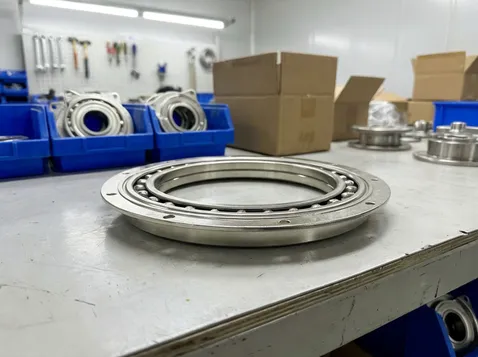
Standard for mechanisms where the hardware is hidden — inside a lazy susan base, under a table surface. Provides 200-hour salt spray resistance, adequate for indoor residential and commercial environments.
Nickel Plating
Specified when the mechanism is visible or semi-visible — display turntables, open-base lazy susans, decorative rotating stands. The finish is brighter and more uniform than zinc, and it photographs well for product listings.
Powder Coating
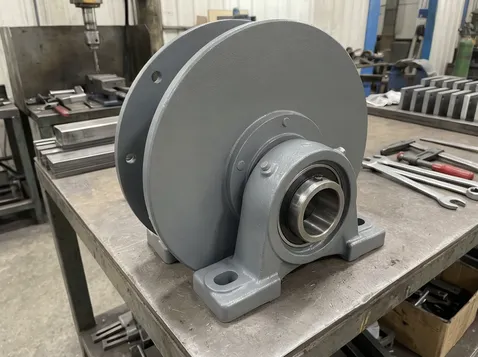
Used when the mechanism will be exposed to humidity or when a specific color match is required. Applied at 60–80μm over zinc phosphate pre-treatment — the phosphate pre-treatment is what makes coating adhesion hold in high-humidity environments.
Powder Coat & Bearing Fit: A Common Supplier Failure Point
What to check when qualifying a new source
The 60–80μm coating thickness is applied to the plates, not the bearing housing bore. The bore stays at the die-cast dimension — it must be masked before coating. Buyers who've had fit problems with powder-coated rotating mechanisms from other suppliers have usually encountered a factory that didn't mask the bore, and the coating buildup created interference with the bearing race.
Powder coat builds up inside the bearing housing bore. Coating thickness creates interference fit with the bearing race — mechanism binds or requires forced assembly, damaging the bearing.
Bore is masked prior to powder coat application. Die-cast dimension is preserved. Bearing race seats correctly to spec. No interference, no forced assembly, no field failures.
(zinc & nickel plating)
over zinc phosphate
stocked for standard SKUs
Customization: What We Can Build to Your Spec
Standard catalog rotating mechanisms cover the most common diameter and load combinations. Custom configurations are a routine part of our work — here's what's adjustable and what isn't.
Plate Diameter
100mm to 600mm in standard catalog. Custom diameters outside this range are available with tooling; we'll quote the tooling cost and amortization MOQ based on your volume projection.
Load Rating
30kg to 150kg across the standard range. Higher load ratings up to 250kg are available in custom configurations with uprated bearing assemblies and 2.5mm plate stock.
Mounting Hole Pattern
Standard patterns are designed for common furniture assembly configurations. Custom hole patterns are a stamping die modification — low tooling cost, fast turnaround. Send us your mounting drawing and we'll confirm compatibility or quote the modification.
Surface Finish
Any RAL powder coat color on runs of 100+ units. Custom plating specifications (e.g., black nickel, brushed nickel effect) are available on runs of 500+ units — the plating line setup cost makes smaller runs uneconomical for either side.
Bearing Ball Material
Standard is carbon steel. Stainless steel bearing balls are available for food-adjacent applications or buyers whose end market has specific material requirements. Stainless balls add approximately 15–20% to the mechanism unit cost.
Branding & Packaging
OEM packaging with your brand, retail-ready cartons, and custom labeling are all handled as part of the OEM arrangement. Blind drop-shipping capability is available for e-commerce buyers.
What Can't Be Customized Without Significant Tooling
The bearing race geometry and the housing die are fixed per load rating model. If your application requires a non-standard race geometry — for example, a very low-profile mechanism for a thin tabletop application — that's an ODM project. Bring us the brief and we'll develop it.
Quality Control on Rotating Mechanisms
100% functional testing before shipment means every unit, not a sample pull. A mechanism that passes the dimensional checks but has a rough spot in the rotation arc or measurable bearing play gets pulled before it reaches your container.
Functional Test — Every Unit
- Rotation smoothness through 360° in both directions
- Torque measurement against the rated range
- Bearing play check — axial and radial
- Plate flatness verification
Load Cycle Qualification
One batch per production run goes through the full cycle test before the run ships. The test report is available with your order.
Incoming Material Inspection
Hardness and dimensional check against mill certificate on every incoming lot.
Composition verification to confirm alloy spec before it enters the die-casting line.
Thickness and hardness checked against SPCC spec. Coil suppliers have attempted to deliver underspec material — the incoming check is what catches it before it becomes a field problem.
Learn more about our manufacturing and QC capabilities on our About page.
Frequently Asked Questions
What is the MOQ for rotating table mechanisms?
500 units for standard catalog mechanisms. Custom configurations with tooling modifications have MOQs based on tooling amortization — we calculate the honest number from your spec and volume, not a generic floor. Most new buyers start with a 500–1,000 unit trial order to validate the mechanism in their product before scaling.
How do I select the right load rating for my application?
Take the maximum loaded weight your surface will carry, multiply by 1.5 for a conservative safety margin, and specify a mechanism rated at or above that figure. For dynamic applications (mechanisms that rotate under load, not just support static weight), use 60% of the static rating as your working load limit. Send us your application details — tabletop diameter, maximum loaded weight, and rotation frequency — and we'll confirm the right model.
Rotating table mechanism vs. lazy susan bearing: what's the difference?
A lazy susan bearing is typically a thin stamped steel ring bearing — low profile, low cost, adequate for light residential use (under 20kg, low rotation frequency). A rotating table mechanism is a full plate-and-housing assembly with a precision ball bearing race, rated for higher loads and higher cycle life. If your product will carry significant weight or see commercial use frequency, the mechanism is the right spec. If it's a lightweight kitchen turntable for occasional use, a bearing ring may be sufficient — and we make both.
What causes a rotating mechanism to develop wobble or play over time?
Almost always one of two root causes: bearing bore out of tolerance (the housing bore is not round, causing uneven bearing preload and accelerated wear), or bearing balls undersized for the load (the balls deform slightly under repeated load cycling, creating play in the race). Ask your supplier for the bore tolerance spec on the housing and the bearing ball hardness rating. If they can't provide those numbers, the quality isn't being controlled at the right points.
Can rotating mechanisms be used in outdoor or high-humidity environments?
Standard zinc-plated mechanisms are rated for indoor use. For high-humidity environments (coastal markets, outdoor-adjacent applications, commercial kitchens), specify powder coat over zinc phosphate pre-treatment — the phosphate layer is what makes the coating adhesion hold under sustained humidity. For direct outdoor exposure, discuss with us before specifying; bearing sealing and plate material selection need to be confirmed for the specific environment.
What certifications does this product carry?
ISO 9001:2015 (quality management system), CE (European market compliance), SGS (third-party audit and testing), and RoHS (restricted substances). CE declaration of conformity and SGS test reports ship with every order. RoHS compliance documentation is available on request.
Source Rotating Table Mechanisms Factory-Direct
We've been making furniture mechanisms since 2008 — the full factory background is on our About page. For rotating mechanisms specifically: in-house die-casting on the bearing housing (the component that determines long-term rotation quality), 100% functional testing on every unit, and a 12-person engineering team that has worked through the failure modes in this category before your project starts.
If you're evaluating suppliers for a rotating mechanism program — catalog SKU, private-label line, or custom development — send us your spec. We'll come back with a model recommendation, a sample timeline, and a quote that reflects the actual configuration.
Contact Us
- Email [email protected]
- WhatsApp +86 132 1014 9517
- MOQ 500 units (standard catalog)