

Furniture Motion Mechanism | MVMHardware
Dedicated furniture motion mechanism manufacturer — rotating, sliding, folding, transformable, and modular hardware from a single factory source.
17 years producing motion hardware for furniture manufacturers and importers across North America, Europe, the Middle East, and beyond. 6 production lines, 3,000,000 units/year, 100% functional testing before shipment.
Manufacturing Perspective
What Furniture Motion Mechanism Means at the Manufacturing Level
Walk into our facility in Guangdong and the first thing you notice is that everything here is about movement. Not furniture — movement. The stamped steel plates, the die-cast pivot collars, the welded linkage arms, the tested assemblies rolling off the line — every component exists to make a piece of furniture do something it couldn't do if it were just wood and fabric bolted together.
A furniture motion mechanism is the hardware that enables controlled movement in a furniture piece: rotation, sliding, folding, transformation between configurations, or modular reconfiguration. The category covers a wide range of motion types, but the manufacturing challenge is consistent across all of them — tight tolerances on moving parts, cycle life that holds up under real use, and surface finishes that survive the shipping and installation process without degrading the fit.
We've been manufacturing in this category since 2008 under Foshan Jinruida Import And Export Co., Ltd. The product range has expanded considerably since then, but the core discipline hasn't changed: precision stamping, in-house die-casting, controlled surface treatment, and 100% functional testing on every unit before it leaves the floor.
If you're sourcing furniture motion mechanisms for a product line you're building or distributing, that's the manufacturing foundation your supply chain is sitting on.

Motion Types in This Category
The Manufacturing Discipline
Certifications & Quality Standards
Product Families
The Motion Mechanism Product Line
Seven product families cover the full range of furniture motion types we manufacture. Each has its own engineering requirements — the pivot geometry on a rotating mechanism is a different problem from the track tolerance on a sliding mechanism, which is a different problem again from the locking logic on a transformable frame. We run dedicated lines for these categories rather than mixing them, which keeps setup tolerances consistent and your batch quality predictable.

Rotating Furniture Mechanism
Rotation hardware for swivel bases, lazy-susan table fittings, rotating storage units, and display furniture. The critical spec here is bearing load rating and rotational smoothness under load — a rotation mechanism that binds or develops play after 6 months of use generates warranty returns that come back to your brand, not ours.
Bearing races and housings stamped in-house to ±0.15mm — the tolerance that keeps rotation smooth across the product's full service life.

Sliding Furniture Mechanism
Linear slide hardware for extending tables, pull-out shelving, sliding door fittings, and drawer extension systems. Track straightness and carriage fit are the manufacturing variables that determine whether a sliding mechanism feels precise or sloppy.
Track straightness held to 0.3mm per 500mm of travel — loose enough to allow thermal expansion, tight enough that there's no perceptible play in the closed position.
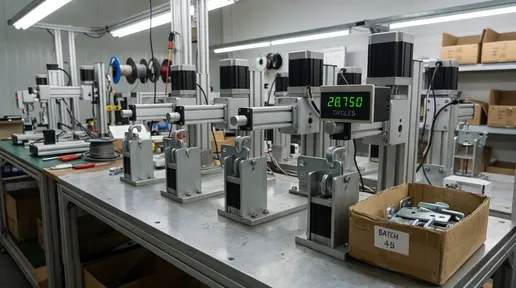
Modular Furniture Mechanism
Connection and reconfiguration hardware for modular seating systems, sectional sofa connectors, modular shelving brackets, and reconfigurable office furniture. The commercial value of modular furniture is that end-users can reconfigure it — which means the connection mechanism has to engage and disengage repeatedly without degrading.
We test modular connectors to 500 engagement cycles minimum; for commercial contract furniture applications, that number goes up.
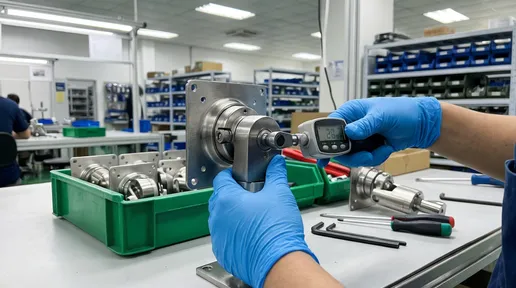
Rotation Mechanism
Precision rotation hardware for applications requiring controlled angular positioning: monitor arms, display stands, adjustable-angle work surfaces, and similar. Distinct from the broader rotating furniture mechanism category in that these applications often require indexed positions or friction-controlled rotation rather than free spin.
The torque spec on the friction joint is the critical variable — too loose and the position doesn't hold, too tight and the user can't adjust it. We tune friction joints to spec during assembly and verify with a torque gauge before packing.
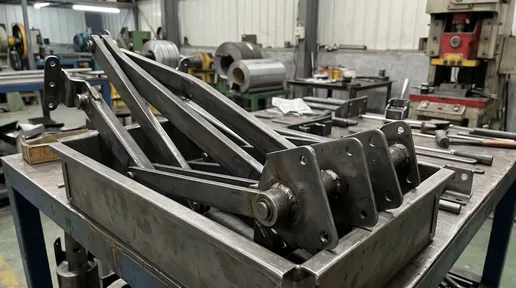
Metal Furniture Mechanism
Structural metal hardware for furniture frames requiring motion capability: steel linkage arms, stamped brackets, welded pivot assemblies, and load-bearing connection hardware. This is the raw structural layer that other mechanism types are built on.
Cold-rolled steel coil stock, progressive die stamping to ±0.15mm, MIG welding on structural joints. Surface treatment options — powder coat, zinc plate, nickel plate — selected based on application environment and tolerance requirements.

Folding Hardware
Folding Furniture Mechanism
Fold-flat and fold-down hardware for folding tables, wall-mounted fold-down desks, folding bed frames, and collapsible storage. The hinge pivot and locking detent are the two points where folding mechanisms fail in the field — either the pivot develops slop from wear, or the lock stops engaging cleanly.
Standard batch qualification for folding hardware. High-cycle commercial applications get spec'd higher on request.

Multi-Position Conversion
Transformable Furniture Mechanism
Multi-position conversion hardware for furniture that changes function: sofa-to-bed frames, dining-to-desk conversions, storage ottomans with lift tops, and similar configurations. Transformable mechanisms are the most mechanically complex in this category — they typically involve multiple pivot points, a locking sequence, and a motion arc that has to feel intentional rather than accidental.
Our engineering team has been designing these linkages long enough to know where the geometry goes wrong: pivot spacing that creates a dead spot mid-travel, spring rates that make the conversion feel heavy, locking detents that require two hands to engage. We design around those failure modes from the first sample.
Transformable mechanisms are where OEM/ODM work is most common — buyers in this segment often have a specific conversion sequence in mind that doesn't match any catalog item. Our in-house tooling capability means we can develop custom linkage geometry without routing through a third-party tooling shop, which cuts sample iteration time significantly.
Seven Mechanism Categories. One Factory Source.
Each category above links to a dedicated product page with full specifications, application guidance, and sourcing details. If your application spans multiple mechanism types, our engineering team can advise on integration.
Production Infrastructure
Manufacturing Capabilities Behind Every Motion Mechanism
The reason we can supply across all seven motion categories from one facility is that the core manufacturing processes are shared — stamping, die-casting, welding, surface treatment, assembly, testing. What changes between product families is the tooling, the assembly sequence, and the test protocol. The infrastructure is the same.
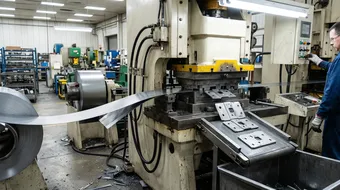
Progressive Die Stamping
Cold-rolled steel coil feeds the presses, producing mechanism plates, brackets, linkage arms, and structural components to ±0.15mm dimensional tolerance. A bracket 0.5mm out of position changes the motion arc of the mechanism it's part of. First-article dimensional checks on every new coil, periodic checks through the run.
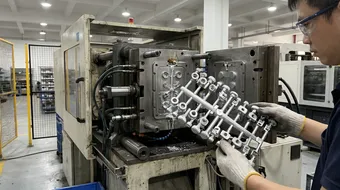
Zinc Alloy Die-Casting
Handles smaller precision components — pivot collars, adjustment knobs, locking detents, decorative covers. Brought in-house around 2015 because dimensional inconsistency and surface defects on outsourced die-cast parts were the leading cause of mechanism quality complaints. Owning the process means we own the fix when something is off.
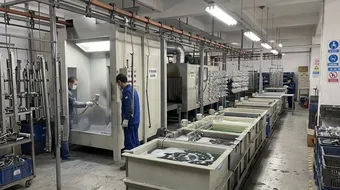
Surface Treatment
Full in-house line: powder coating at 60–80μm film thickness (500-hour salt spray rated), zinc electroplating, and nickel electroplating. Powder coat adds thickness that can affect fit on tight-clearance assemblies — components where dimensional tolerance after coating is critical go to the plating line. That call is made during engineering review, not after the first batch comes back with fit problems.
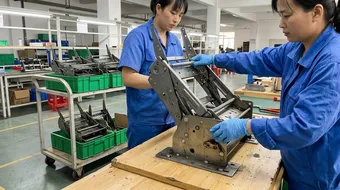
100% Functional Testing
Every unit, not a sample pull. A mechanism that passes dimensional inspection but has a sticky pivot, a lock that doesn't engage cleanly, or a slide that binds under load gets pulled at the final test station. Protocol defined per product family — rotation smoothness and load rating for rotating mechanisms, travel straightness and end-stop engagement for sliding mechanisms, fold cycle and lock engagement for folding hardware.
Specification Guide
Material and Finish Selection: What Drives the Decision
Buyers sourcing furniture motion mechanisms for the first time sometimes ask which surface finish they should specify. The honest answer is that it depends on three things: the application environment, the tolerance requirements of the assembly, and what your downstream market expects visually.
| Material / Finish | Used For | Key Advantage | Limitation / Note |
|---|---|---|---|
| Cold-Rolled Steel (SPCC) | Stamped structural mechanism components | Machines cleanly, holds tight tolerances, takes surface treatment well | Right call for most indoor furniture — residential, office, hospitality |
| Zinc Alloy Die-Cast | Adjustment hardware, covers, pivot components with complex geometry | Enables curved profiles, integrated bosses, undercuts stamping cannot produce | Less strong than stamped steel in thin sections — not used for primary load-bearing structural members |
| Powder Coating | Components where appearance matters and dimensional tolerance after coating is not critical | 60–80μm, RAL color range available, 500-hour salt spray; 800-hour spec available for coastal/high-humidity markets | Adds thickness — not suitable for tight-clearance assemblies |
| Zinc Electroplating | Tight-clearance pivot assemblies, threaded components, precision slides | Thinner and more dimensionally consistent than powder coat; RoHS-compliant trivalent chromium passivation | Hexavalent chromium is not used in our process |
| Nickel Electroplating | Visible hardware in premium furniture lines where mechanism is partially exposed in the design | Bright metallic appearance with tight dimensional tolerance | Specified where both aesthetics and precision fit are required simultaneously |
Compliance documentation: For EU market orders, RoHS documentation ships with the order. For North American importers, we can provide the material compliance documentation your customs broker needs for HTS classification without you having to chase us for it after the fact.
Where Furniture Motion Mechanisms Fail — and How We Engineer Around It
Motion hardware fails in predictable ways. After 17 years in this category, we've seen the same failure modes come back repeatedly, and we've built our manufacturing process around preventing them.
Pivot Wear & Dimensional Drift
The most common long-term failure in rotating and folding mechanisms. The pivot bore enlarges over time from metal-to-metal contact, and the mechanism develops play that gets progressively worse.
Insufficient hardness on pivot components or inadequate surface treatment at the contact interface.
Hardened steel inserts at high-wear pivot points with a bonded PTFE-based dry lubricant film applied during assembly — not grease, which attracts debris and degrades over time.
Lock Engagement Failure
The failure mode that generates the most warranty returns in this category. The lock stops engaging cleanly — either it requires excessive force, or it doesn't hold under load.
Tolerance stack-up: individual components are within spec, but assembly tolerance accumulates to the point where lock geometry is marginal.
Tighter assembly tolerances on locking subassemblies (±0.1mm vs. the ±0.15mm standard for structural components) and 100% lock engagement testing under load before packing.
Surface Delamination at Weld Seams
Shows up in powder-coated mechanisms after 6–12 months in the field. Powder coat adhesion fails at weld seams because weld spatter and the heat-affected zone create a surface that doesn't bond well without proper preparation.
Skipping surface preparation at weld seams before the coating line — a common cost-cutting step at volume factories.
Every weld seam is ground and chemically pre-treated before the coating line. It adds a step — and it's the step that prevents the bubbling and peeling that generates customer complaints.
Die-Cast Dimensional Inconsistency
Batch-to-batch variation in pivot collars, adjustment knobs, and locking detents — the failure mode that's hardest to catch at incoming inspection if you're buying from a factory that outsources die-casting.
Variation is subtle enough to pass a spot-check but significant enough to cause fit problems in assembly — especially when die-casting is outsourced.
Die-casting runs in-house. We pull dimensional samples from every casting run and hold batches that are outside spec before they reach the assembly line.
Understanding these failure modes is worth your time before finalizing a sourcing decision. The difference between a mechanism that lasts and one that generates warranty returns is almost always traceable to one of these four root causes — and to whether the factory has built a process around preventing them.
Matching Motion Type to Your Product Category
Different furniture segments use different motion types, and the commercial logic for each is worth understanding if you're building or expanding a product line.

Residential Furniture Importers
Sourcing for North American and European retail typically requires the broadest motion type coverage — rotating mechanisms for accent furniture, sliding hardware for extending dining tables, folding mechanisms for space-saving pieces, and transformable frames for sofa beds and convertible seating.
The emphasis is on consistent quality across batches — your retail buyers will notice if batch 3 feels different from batch 1.

Contract & Hospitality Manufacturers
Mechanisms that hold up under commercial use cycles — hotel room sofa beds that convert daily, restaurant seating that folds for storage, office furniture that reconfigures between tenants. The cycle life requirement is higher than residential.
A warranty claim in a hotel property involves labor costs that dwarf the hardware cost. We spec and test higher for commercial applications — tell us the use environment when you inquire and we'll quote the appropriate spec.
Furniture OEM Manufacturers
Building branded product lines often requires custom motion sequences that don't match catalog items — a specific conversion arc, a proprietary locking mechanism, a motion type that's part of the product's design identity.
Our ODM capability covers this: you bring the brief, we develop the mechanism design, build the tooling in-house, and iterate samples until the spec is locked.
Distributors & Wholesalers
Building a mechanism hardware catalog benefits from sourcing across motion types from a single supplier — rotating, sliding, folding, transformable, modular, and structural metal hardware from one factory means one set of compliance documents, one shipping relationship, and one quality standard across your SKU range.
This is one of the reasons buyers in this segment tend to consolidate with us once they've run a trial order — the alternative is managing 3–4 suppliers for what is essentially one product category.
OEM and ODM: Custom Motion Mechanism Development
A significant portion of what we produce is custom — mechanisms designed to a buyer's brief rather than pulled from the catalog. The motion mechanism category is one where custom development is commercially justified more often than in simpler hardware categories, because the motion sequence itself can be a product differentiator that your competitors can't easily replicate.
OEM Work
Your design, our production
You supply the drawings and specifications. We review for manufacturability — if your design has features that will cause production problems or tolerance issues, we'll flag them before tooling is cut, not after the first sample run.
Manufacturability review before tooling is cut
Production to your spec — the design remains yours
Tolerance and geometry issues flagged early, not after first sample run
ODM Work
Your brief, our engineering
You bring a brief: target retail price point, market segment, performance requirements (load rating, cycle life, motion arc), and any aesthetic direction. Our 12-person engineering team develops the mechanism design, builds the tooling in-house, runs samples, and iterates until the spec is locked.
12-person engineering team handles full mechanism design
In-house tooling — geometry revisions happen on our floor, not in a supplier negotiation
Tooling investment and MOQ quoted on actual complexity, not a round figure

Why In-House Tooling Changes the Development Cycle
In-house tooling means faster revision cycles — when a sample needs a geometry change, the tooling revision happens on our floor, not in a supplier negotiation with a third-party shop. This is the operational difference between a development partner and a production-only vendor.
Tooling investment and MOQ for ODM projects are quoted based on your spec. We give you the honest number based on the actual tooling complexity, not a round figure designed to sound accessible.
Send your brief, a reference sample, or a sketch of the motion sequence. We'll return a development proposal.
Sourcing Confidence: Certifications and Quality Documentation
Compliance documentation is part of the product, not an afterthought. Here's what ships with your order and what's available on request.
ISO 9001:2015
Quality management system certification covering the full production process from incoming material to outgoing shipment.
CE Compliance
European market compliance for the mechanism product range. Required for EU distribution and retail channels.
SGS Tested
Third-party audit and product testing. SGS reports available with shipment for European buyers on request.
RoHS Compliant
Trivalent chromium passivation on all zinc plating — no hexavalent chromium. Documentation available for EU and California market requirements.
Supplier Qualification & Third-Party Audits
For buyers with supplier qualification requirements, third-party factory audits are available on request. Our QC team lead came up through incoming inspection and in-process roles — they know exactly where the shortcuts happen in this category and where to look during an audit.
Incoming inspection and in-process experience means our QC lead knows the failure points in this category — not just the audit checklist.
What Ships With Your Order
Ships with order. Covers full production process scope.
Available with shipment for European buyers on request.
Available for EU and California market compliance requirements.
Available on request for buyers with supplier qualification requirements.
Buyer Guidance
Frequently Asked Questions
What is the minimum order quantity for furniture motion mechanisms?
500 units for standard catalog items. For OEM/ODM tooling projects, MOQ depends on tooling amortization — we quote the honest number based on your spec. Most new buyers in this category start with a 500–1,000 unit trial order to qualify the product with their own customers before scaling up.
What cycle life should I specify for commercial versus residential furniture applications?
For residential furniture, 20,000–30,000 cycles covers the expected service life for most motion types. For commercial applications — hotel rooms, restaurant seating, office furniture — specify 50,000 cycles minimum, and for high-use environments (daily-use sofa beds in rental properties, for example) go to 80,000–100,000 cycles. We test to whatever spec you require; tell us the use environment when you inquire and we'll recommend the appropriate test protocol.
How do I prevent a folding or transformable mechanism from developing lock engagement problems in the field?
Lock engagement failure is almost always a tolerance stack-up issue — individual components are within spec, but the accumulated assembly tolerance puts the lock geometry at the margin. The prevention is tighter assembly tolerances on locking subassemblies and 100% lock engagement testing under load before shipment. Ask your supplier specifically how they test lock engagement — a spot-check on a sample pull is not sufficient for this failure mode.
What surface finish should I specify for furniture mechanisms going to coastal or high-humidity markets?
Standard powder coat (60–80μm, 500-hour salt spray) is adequate for normal indoor environments. For coastal markets or high-humidity climates — Southeast Asia, Gulf region, coastal North America — specify the 800-hour salt spray option, which uses a higher-build primer coat under the topcoat. Zinc electroplating is an alternative for components where dimensional tolerance after coating is critical; it provides comparable corrosion resistance in a thinner, more dimensionally consistent layer.
What's the difference between a rotating furniture mechanism and a rotation mechanism in your product line?
Rotating furniture mechanisms are designed for free-spin applications — swivel bases, lazy-susan fittings, rotating storage — where the goal is smooth, unrestricted rotation under load. Rotation mechanisms in our catalog are designed for controlled angular positioning — monitor arms, adjustable-angle surfaces, display stands — where the mechanism needs to hold a set position under load, either through indexed detents or friction-controlled resistance. The engineering requirements are different: one optimizes for smooth rotation, the other for position retention.
Can you produce mechanisms with custom motion sequences not in your catalog?
Yes — ODM development is a significant part of what we do. You bring a brief describing the motion sequence, load requirements, and target price point; our engineering team develops the linkage geometry, builds tooling in-house, and runs samples until the spec is locked. In-house tooling means faster iteration than factories that route tooling to third-party shops. Send us your brief and we'll come back with a development proposal.
Get Started
Start Your Sourcing Conversation
New to This Category
Send us your target market and volume expectations — we'll suggest a starter SKU mix based on what's moving for our existing distributors in that region.
Already Sourcing Mechanisms
Send us your current spec sheet or a sample reference — we'll match the spec, flag any manufacturability issues, and quote factory-direct.
Building a Custom Product
Send your brief, a sketch, or a reference sample of the motion sequence you need. Our engineering team will review and come back with a development proposal.