

Chair Mechanism Plate
Precision-stamped chair mechanism plates — consistent hole patterns, tight tolerances, available individually or as part of a complete mechanism kit.
Standard 4-hole and 6-hole patterns in stock. Custom geometries supported with in-house tooling. Every plate dimensionally verified before shipment.

Product Overview
What a Chair Mechanism Plate Is — and Why Tolerance Is the Only Spec That Matters
The chair mechanism plate is the structural base that connects the seat pan to the tilt or swivel mechanism below it. Four or six mounting holes, a defined bolt circle, a center bore for the gas lift cylinder — it sounds simple. The problem is that "simple" parts are where assembly lines break down. If your mounting holes are off by 0.5mm, your chair frames don't align. If the plate thickness is inconsistent batch to batch, your torque specs drift and your assembly jigs stop working.
We stamp chair mechanism plates on progressive dies from cold-rolled steel coil — SPCC for standard-duty applications, Q235 for heavy-load configurations. The progressive die cuts the full plate geometry — mounting holes, center bore, edge profile, any spring anchor slots — in a single press stroke.
That's not a process detail for its own sake: it means the hole pattern relationship is mechanically fixed by the die, not dependent on operator setup or CNC repositioning between operations. A 10,000-unit run comes out dimensionally identical from first piece to last.
Tolerance holds at ±0.15mm across the hole pattern. That's the threshold where your assembly line can run fixed jigs without manual adjustment per piece — and it's tighter than what most buyers get from factories using CNC drilling on individual blanks.
Field note: We've had buyers send us plates from previous suppliers with hole-pattern drift of 0.8–1.2mm across a batch. That's not a quality problem you catch on incoming inspection — you catch it when your assembly line starts rejecting frames.

Single-Stroke Die
Full geometry cut in one press stroke. Hole relationships fixed by tooling, not operator setup.
Batch Consistency
10,000-unit runs dimensionally identical from first piece to last. Fixed jigs, no per-piece adjustment.
±0.15mm Tolerance
Tighter than CNC-drilled individual blanks. Assembly line runs without manual correction.
SPCC & Q235 Steel
Cold-rolled SPCC for standard duty. Q235 for heavy-load configurations requiring higher deformation resistance.
Technical Data
Plate Specifications — Standard Configurations
These are the industry-standard configurations we stock and produce at volume. Custom geometries are covered in the next section.
| Parameter | Standard Value |
|---|---|
| Base material | SPCC cold-rolled steel (standard duty) / Q235 (heavy duty) |
| Plate thickness | 2.0 mm – 3.0 mm (specify by load rating) |
| Standard hole patterns | 4-hole (bolt circle: 65×65mm) / 6-hole (bolt circle: 70×70mm) |
| Center bore diameter | Ø28mm (standard gas lift) / Ø32mm (heavy-duty gas lift) |
| Load capacity | Up to 150 kg (standard) / up to 200 kg (heavy-duty Q235) |
| Surface treatment | Zinc plating (standard) / powder coating (custom RAL, runs ≥500 units) |
| Plating thickness | 8–12μm zinc (standard corrosion protection) |
| Operating temperature | -10°C to 60°C |
| Mounting hardware | M8 bolts standard; M10 available on heavy-duty plates |
| Cycle life (as component) | Verified to 60,000+ cycles at rated load in complete mechanism assembly |
Specifications shown are industry-standard values for this product type. Contact us for exact data sheets and to confirm specifications against your chair frame drawings.
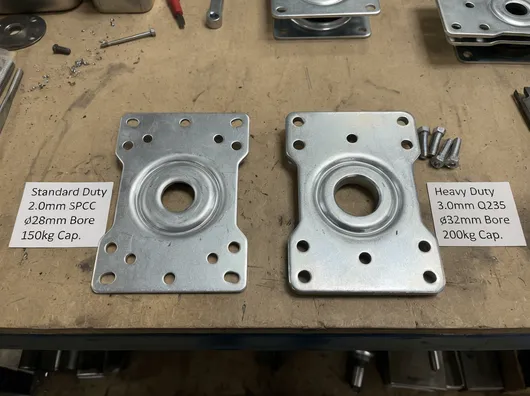
Standard for mid-range office and task chairs. 4-hole or 6-hole pattern, Ø28mm center bore, zinc plated. Load capacity up to 150 kg.
For institutional and industrial seating. Extra gauge meaningfully changes deformation resistance under eccentric loading — off-center sitting, hard armrest lean. Ø32mm bore, M10 hardware, up to 200 kg.
Stamping Process and Dimensional Consistency — What Protects Your Assembly Line
A progressive die press feeds steel coil through a series of stations in a single continuous stroke. At each station, a different operation happens — blanking, piercing, forming, trimming — until the finished plate exits the die fully formed. The critical point is that all hole positions are cut relative to the same datum in the same press stroke. There is no repositioning, no fixture change, no operator-dependent alignment step between the center bore and the mounting holes. The geometric relationship between features is locked in the die geometry itself.
What this means for your production: every plate in a batch has the same hole pattern, to the same tolerance, regardless of where it falls in the production run. Your assembly jigs work on piece 1 and piece 9,847 without adjustment. When you reorder six months later, we're running the same die — the new batch matches the old batch dimensionally. No re-qualification, no jig adjustment, no rejected frames at the start of a new production run.
We maintain tooling for all standard plate configurations in-house. Die maintenance is on our schedule, not a third-party tool shop's. When a die needs a punch replacement or a clearance adjustment, it happens on our floor within a day, not after a two-week external turnaround.
The alternative — CNC drilling on individual blanks — is flexible for prototypes and very small runs, but introduces operator-dependent variation that compounds across a large batch. We use CNC for first-article samples and custom one-off geometries. For production quantities, progressive stamping is the only process that delivers the consistency your assembly line needs.

Custom Plate Geometries — OEM Tooling and Modified Patterns
Standard hole patterns cover most chair frame designs, but not all. If your chair uses a non-standard bolt circle, an asymmetric mounting pattern, integrated features (cable routing slots, anti-rotation tabs, reinforcing ribs), or a non-standard center bore, we cut custom tooling in-house.
Tooling is cut by our in-house tooling team — the same engineers who designed the standard catalog dies. First sample from a new custom die typically comes back in 20–30 days from drawing approval, depending on complexity. Revision cycles are fast because the tool shop is on the same floor as the engineering team.
MOQ on custom tooling projects is negotiated based on tooling amortization. For buyers who need a custom plate geometry but can't commit to high volumes upfront, we'll work through the numbers honestly — there's a minimum that makes the tooling investment viable, and we'll tell you what it is rather than quoting a round number.
One thing we see regularly: buyers who want a custom plate geometry but haven't finalized their chair frame design. We'd rather wait for a locked drawing than cut a die that needs revision. Send us a drawing when it's confirmed — we'll turn the sample around quickly.

What We Can Modify or Develop From Scratch
Bolt Circle Diameter & Pattern
Any 4-hole or 6-hole geometry, or non-standard configurations to match your frame design.
Center Bore Size & Profile
Standard Ø28mm and Ø32mm, or custom bore with anti-rotation flat for your specific mechanism shaft.
Plate Outline Geometry
Rectangular, trapezoidal, or irregular profiles to fit specific seat pan designs and frame constraints.
Integrated Features
Reinforcing ribs, cable management slots, anti-rotation tabs, weld-nut inserts — stamped in-die, not added post-process.
Thickness
1.5mm to 4.0mm depending on load requirements. Above 3.0mm we typically recommend Q235 over SPCC for the yield strength.
From drawing approval to first sample. Revision cycles are fast — tool shop is on the same floor as engineering.
Send Your Drawing or Reference Sample
We'll review your geometry, confirm the tooling path, and give you an honest MOQ based on actual amortization — not a round number. Locked drawings only; we'll wait if your frame design isn't finalized.
Integration Guidance
Fit with Complete Chair Mechanism Assemblies
If you're sourcing plates as a standalone component to integrate with mechanisms from another supplier — or with your own in-house mechanism — here's what to confirm before ordering.
Center Bore Compatibility
Our standard Ø28mm bore fits the most common gas lift cylinder diameter. If your gas lift uses a Ø32mm or non-standard bore, specify this on your order. We can also supply plates with a tapered bore profile if your cylinder uses a friction-fit rather than a bolt-flange mount.
Mounting Hole Pattern Match
Confirm your chair frame's bolt circle against our standard patterns before ordering. If you're sending us a drawing, include the bolt circle diameter, hole diameter, and any countersink or counterbore requirements.
Plate Thickness and Mechanism Stack Height
The plate thickness affects the total mechanism stack height, which determines seat height range when combined with your gas lift stroke. If you're working to a specific seat height specification, confirm the plate thickness is accounted for in your stack-up calculation.
Surface Treatment and Clearance
Powder coating adds measurable thickness. If your mechanism assembly has tight clearances at the plate interface, confirm the surface treatment spec with us before production.
Sourcing Complete Mechanism Assemblies?
For buyers sourcing complete mechanism assemblies from us, the plate is already integrated and pre-tested as part of the assembly — you don't need to manage these fit parameters separately. The full chair mechanism line covers tilt, synchro, swivel, hydraulic, and all other mechanism types with plates included.
Quality Assurance
Quality Verification — What Happens Before Your Plates Ship
Every plate goes through dimensional verification before it leaves the facility. Plates that fail dimensional checks at any stage are pulled from the batch — we don't rework out-of-tolerance plates. They're scrapped and the die is checked before the run continues.
First-Article Inspection
Full dimensional check on every die run against drawing — including hole position, bore diameter, plate thickness, and edge profile.
Periodic In-Process Checks
Hole pattern sampling at defined intervals through the production run, with go/no-go gauges at the press.
Surface Treatment Verification
Zinc plating thickness measured by XRF on each plating batch. Powder coat film thickness measured by magnetic gauge on each coating run.
100% Visual Inspection
Before packing: surface defects, burrs at hole edges, and any deformation from handling are checked on every plate.

Certifications and Documentation
ISO 9001:2015 governs the QC framework. CE and SGS documentation is available with shipment. For buyers who need incoming inspection reports or first-article inspection reports with their order, we provide these as standard — specify the requirement when you place the order.
Incoming inspection reports and first-article inspection reports are available as standard. Specify the requirement when placing your order.
Shipping & Fulfillment
Packaging, Container Loading, and Logistics
Plates are packed in corrugated cartons with interleaved kraft paper to prevent surface contact and plating damage during transit. Standard carton quantities are sized for efficient container loading — we've worked out the pallet configurations so your freight forwarder isn't improvising at the warehouse.
Standard Carton Packing
Corrugated cartons with interleaved kraft paper between plates. Prevents surface contact and protects plating finish throughout transit. Carton quantities are pre-calculated for container loading efficiency.
Mixed-SKU Orders
Multiple plate geometries or thicknesses packed by SKU with clear carton labeling. A detailed packing list maps carton numbers to part numbers and quantities — so your receiving team can pull specific SKUs for different production runs without sorting through mixed cartons.
OEM & Branded Packaging
Private-label cartons, custom part numbering, and specific labeling for FBA or distributor warehouse requirements are handled as part of the OEM arrangement. Specify your packaging requirements at the quoting stage.
40HQ Container Capacity
A 40HQ container typically holds 80,000–120,000 units depending on plate size and carton configuration. The exact loading plan ships with your shipping documents so your logistics team can plan warehouse space accurately before the container arrives.

Buyer Guidance
Frequently Asked Questions — Chair Mechanism Plate Sourcing
Technical and procurement questions answered for buyers qualifying chair mechanism plates for production or replacement part programs.
What is the standard hole pattern for a chair mechanism plate, and will it fit my chair frame?
The most common standard is a 4-hole pattern on a 65×65mm bolt circle, with M8 holes. A 6-hole pattern on a 70×70mm bolt circle is the second most common, used on heavier-duty mechanisms. Before ordering, confirm your chair frame's bolt circle diameter and hole size against these standards. If your frame uses a non-standard pattern, send us the drawing — we'll confirm whether our standard tooling covers it or whether a custom die is needed.
Can I order chair mechanism plates without ordering complete mechanism assemblies?
Yes. Plates are available as standalone components with a 500-unit MOQ on standard configurations. This is common for buyers who manufacture their own mechanism assemblies, stock replacement parts, or build private-label mechanism kits. Contact us with your plate specification for pricing.
What steel grade should I specify for heavy-duty seating applications?
For chairs rated above 150 kg or used in high-abuse environments (institutional, industrial, 24/7 use), specify Q235 steel at 3.0mm thickness. SPCC at 2.0–2.5mm is appropriate for standard commercial office seating rated to 120–150 kg. If you're unsure, send us your load rating and end-use environment — we'll recommend the right spec.
How do I verify that plates from a new batch will match my existing jigs and assembly fixtures?
Request a first-article inspection report with your order. We provide full dimensional reports on the first pieces from each production run, including hole position measurements, bore diameter, and plate thickness. If you're qualifying a new supplier or a new batch after a tooling change, this report is what your quality team needs to sign off on the batch before it goes to your assembly line.
What is the lead time for standard plates versus custom tooling?
Standard catalog plates ship in 20–30 days from order confirmation. Custom tooling projects — new die geometry, non-standard hole patterns, integrated features — run 45–60 days from drawing approval to first sample, with production following after sample sign-off.
Do your plates comply with RoHS and REACH requirements for the EU market?
Yes. Zinc plating uses trivalent chromium passivation (no hexavalent chromium). Powder coating uses RoHS-compliant formulations. Full compliance documentation ships with the order. For REACH SVHC declarations, contact us at the quoting stage and we'll include the relevant material declarations with your shipment documents.