

Structural Metal Furniture Mechanism
Stamped steel linkage arms, welded pivot assemblies, and load-bearing brackets built to the tolerances that motion hardware demands. The metal layer is where mechanism quality is decided — we stamp, weld, and finish these components in-house, to ±0.15mm, with 100% functional testing before shipment.
Product Overview
What Metal Furniture Mechanism Covers — and Where It Sits in the Product Line
Metal furniture mechanism is the structural hardware layer: the stamped steel plates, welded linkage arms, pivot assemblies, and load-bearing brackets that form the skeleton of a motion furniture piece. Every other mechanism type in our catalog — rotating, sliding, folding, transformable — is built on top of this structural metal foundation.
When that foundation is dimensionally inconsistent or structurally marginal, the motion mechanism it supports fails in the field regardless of how well the pivot or locking hardware is designed.
We produce these components from cold-rolled steel (SPCC) coil stock through progressive die stamping, MIG welding on structural joints, and in-house surface treatment. The output is the raw structural hardware that furniture manufacturers and mechanism assemblers integrate into their product lines — either as catalog components or as custom-stamped parts developed to a buyer's drawing.
This page covers the metal furniture mechanism product specifically. For the full motion mechanism range — rotating, sliding, folding, transformable, modular — see the furniture motion mechanism category.

The base layer every motion mechanism type is built upon
Standard catalog components or custom-stamped to your drawing
Stamping, welding, and surface treatment under one roof
Supports rotating, sliding, folding, and transformable mechanisms
Manufacturing Process
Material and Process: How We Build the Structural Layer
Material Selection: SPCC and Q235
The choice is consequential, not complicated
We run SPCC cold-rolled steel as the standard for stamped mechanism plates and linkage arms. SPCC machines cleanly through progressive dies, holds tight tolerances through the stamping process, and takes surface treatment without adhesion problems. For structural brackets and pivot assemblies carrying higher loads, we step up to Q235 where the yield strength requirement calls for it.
Stamped mechanism plates, linkage arms — clean die performance, tight tolerance retention, reliable surface adhesion
Structural brackets, pivot assemblies — higher yield strength for commercial-grade and contract applications
Steel Thickness by Application
1.5mm to 4.0mm — matched to load rating
Steel thickness across the structural mechanism range runs 1.5mm to 4.0mm depending on the load rating of the component. We've had buyers spec thinner to save weight and landed cost, and we'll run it if that's what you need — but we'll tell you where the structural margin gets thin before you commit to the tooling.
Standard linkage arms for sofas, recliners, convertible furniture — residential load ratings
Load-bearing pivot brackets for hotel sofa bed frames, contract seating bases — higher yield demand
Production Process
SPCC coil stock through progressive dies. Dimensional tolerance held to ±0.15mm on mechanism plates and brackets.
Load-bearing assemblies. Weld penetration and bead consistency checked visually and by pull-test on every welded assembly carrying a load rating.
Used on lighter bracket assemblies where joint geometry allows. Faster cycle, consistent joint quality at lower load ratings.
Applied after structural assembly. Treatment type matched to assembly environment and buyer specification.
Why ±0.15mm Matters
A bracket that's 0.5mm out of position changes the motion arc of the mechanism it supports — showing up as binding, uneven travel, or premature wear at the pivot point. First-article dimensional checks run on every new coil change; periodic checks run through the production run.
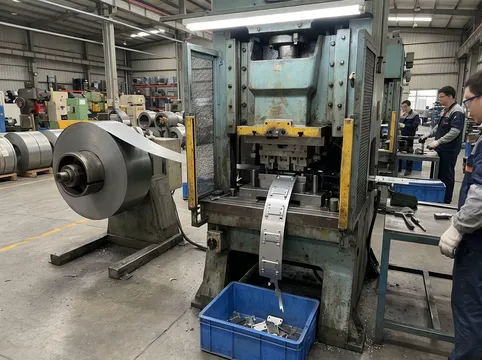
Progressive die stamping — SPCC coil to finished mechanism plate
Runs on every new coil change. Catches material batch variation before it enters the production run.
Not a sample pull — every welded assembly carrying a load rating is pull-tested before it moves to surface treatment.
Dimensional checks continue through the production run — not just at first article. Drift is caught before it compounds.
Surface Treatment: Matching the Finish to the Assembly
Three surface treatment options available, choice driven by assembly requirements not just appearance.
Powder Coating
60–80μm film thickness, RAL color range. Standard finish for structural components where appearance matters and dimensional tolerance after coating is not critical.
Passes 500-hour salt spray — adequate for indoor furniture in normal environments. For coastal markets or high-humidity climates, an 800-hour option uses higher-build primer under topcoat.
Process note: powder coat adhesion fails at weld seams if surface isn't properly prepared. Every weld seam is ground and chemically pre-treated before the coating line — preventing bubbling and peeling that generates warranty returns 6–12 months after delivery.
Zinc Electroplating
Used where dimensional tolerance after coating is critical — tight-clearance pivot assemblies, threaded components, precision slides.
Plating layer is thinner and more dimensionally consistent than powder coat. RoHS-compliant trivalent chromium passivation; no hexavalent chromium in process.
Nickel Electroplating
Used for components where bright metallic appearance is required alongside tight dimensional tolerance — visible hardware in premium furniture lines where the mechanism is partially exposed in the design.
In-House Surface Treatment Line
Surface treatment runs entirely in-house — no routing to third-party finishing shops. This controls pre-treatment, coating parameters, and inspection at every stage. Film thickness is measured on every coating run; adhesion cross-cut tests are run per batch.
Technical Specifications
Industry-standard parameters for the metal furniture mechanism product range. Actual specifications vary by component configuration and load rating — contact for exact product data sheets.
| Parameter | Specification |
|---|---|
| Primary structural material | Cold-rolled steel SPCC; Q235 for high-load applications |
| Steel thickness range | 1.5mm – 4.0mm (application-dependent) |
| Dimensional tolerance (stamped) | ±0.15mm standard |
| Dimensional tolerance (locking subassemblies) | ±0.10mm |
| Welding method | MIG (structural joints); spot welding (light brackets) |
| Surface treatment options | Powder coat (60–80μm), zinc electroplate, nickel electroplate |
| Salt spray rating — standard | 500 hours (powder coat) |
| Salt spray rating — coastal/humid option | 800 hours |
| Load cycle testing | 50,000 cycles standard; higher on request |
| Certifications | ISO 9001:2015, CE, SGS, RoHS |
| Standard MOQ | 500 units (catalog items) |
| OEM/ODM | Available; in-house tooling and engineering |
| Lead time (catalog items) | 25–35 days from order confirmation |
Specifications shown are industry-standard values for this product type. Actual specifications may vary by configuration. Contact us for detailed product data sheets.
Applications
Where Metal Furniture Mechanism Components Are Used
The structural metal layer is present in every motion furniture category. The commercial opportunity for buyers in this segment is that structural hardware is a recurring, high-volume component — furniture manufacturers reorder it on production cycles, not one-off projects.

Sofa Bed and Convertible Seating Frames
The steel linkage arms and pivot brackets in a sofa bed frame carry the full weight of the mattress and occupant through the conversion cycle — this is not a place to run thin on material spec or weld quality. Furniture manufacturers building sofa bed lines typically order 2,000–5,000 units per run; the reorder cycle follows their production schedule, which makes this a predictable, repeatable segment for distributors supplying into the furniture manufacturing cluster.

Recliner and Chair Mechanism Bases
Stamped steel plates and welded pivot assemblies serve as the structural foundation for the tilt and recline hardware. The metal base components are often sourced separately from the motion hardware itself — furniture manufacturers buy the structural layer from one supplier and the tilt mechanism from another, or source both from us. Either way, the structural components are a standalone procurement item with their own reorder cycle.

Lift-Top and Extending Table Hardware
Requires precision-stamped brackets and slide rails that hold dimensional tolerance through repeated use. The structural metal components here are visible in the deployed position, so surface finish matters alongside dimensional accuracy. Nickel-plated brackets are common in this application for premium table lines.

Contract and Hospitality Furniture
Hotel room furniture, restaurant seating, office reconfigurable pieces — runs at higher cycle life requirements than residential. The structural metal components for commercial applications are spec'd at 3.0–4.0mm thickness and tested to 50,000+ cycles.
Buyers supplying into the contract furniture segment can justify a premium on these components because the specification is verifiable and the alternative — field failures in a hotel property — carries labor and brand costs that dwarf the hardware cost.
The contract furniture segment has been growing steadily — hospitality renovation cycles and the shift toward reconfigurable office furniture are both driving demand for higher-spec structural hardware. Worth paying attention to if you're building your distribution catalog.
Custom Manufacturing
OEM and Custom Stamping: When Catalog Components Don't Match Your Drawing
A significant share of what we produce in this product line is custom — stamped to a buyer's drawing rather than pulled from the catalog. Furniture manufacturers with proprietary frame designs need structural components that match their geometry exactly; catalog items rarely fit without modification.

OEM Stamping
You supply the drawings. We review for manufacturability — wall thickness, bend radius, hole placement relative to edges — and flag anything that will cause tooling problems or dimensional issues before the die is cut.
Production runs to your spec; the design is yours. Tooling is built in-house, which means revision cycles happen on our floor when a first sample needs a geometry adjustment.

ODM Development
You bring a brief: the furniture type, the load requirement, the motion sequence it needs to support, and your target cost. Our engineering team — 12 mechanical engineers and tooling designers who work exclusively on mechanism hardware — develops the component geometry, builds the tooling, and runs samples until the spec is locked.
We've designed structural components for sofa bed frames, recliner bases, extending table hardware, and modular seating systems. The failure modes in each application are familiar territory.
Catalog MOQ
Minimum order quantity for standard catalog items.
OEM/ODM Tooling
Tooling projects quoted based on your spec and tooling complexity — the honest number, not a round figure designed to sound accessible.
Manufacturability Review
Wall thickness, bend radius, hole placement — flagged before tooling starts, not after first samples fail.
Ready to Send Your Drawing or Brief?
Whether you have a finished drawing or just a load requirement and a furniture type, we can work from either starting point.
Quality Control on Structural Components: What We Actually Check
Structural metal components carry load. The QC protocol reflects that.
Incoming Inspection
Coil steel and zinc alloy ingot — material certification checked against mill reports, dimensional samples pulled on the first stamped parts from each coil change. We've had suppliers attempt material grade substitution mid-contract; the incoming check is what catches it before it becomes a structural problem in your product.
In-Process Inspection
Runs at three stages:
- Stamping — first-article and periodic dimensional checks to ±0.15mm
- Welding — visual and pull-test on every structural joint
- Surface treatment — film thickness measurement and adhesion cross-cut test per coating run
Mechanisms go through functional testing before reaching the final line.
Outgoing Inspection
100% functional on every unit before packing. A component that passes dimensional checks but has a weld that didn't fully penetrate, a surface that delaminated at the seam, or a pivot bore that's out of round gets pulled at this stage.
Not sampled — every unit.
Documentation ships with the order. For buyers with supplier qualification requirements, third-party factory audits are available on request. Learn more about our manufacturing capabilities and certifications.
Frequently Asked Questions
What steel thickness should I specify for commercial versus residential furniture mechanism components?
For residential furniture — sofas, dining tables, bedroom pieces — 1.5–2.5mm SPCC is the standard range for structural mechanism components. For commercial applications where the furniture sees daily use cycles (hotel rooms, restaurant seating, office furniture), specify 3.0–4.0mm for primary load-bearing brackets and pivot assemblies.
The thickness difference adds to landed cost, but a structural failure in a commercial installation carries labor and liability costs that make the hardware cost difference irrelevant. Tell us the use environment when you inquire and we'll recommend the appropriate spec.
What is the difference between powder coat and zinc plating for metal furniture mechanism components?
The decision is driven by dimensional tolerance requirements, not just appearance.
Adds measurable thickness — on tight-clearance pivot assemblies or threaded components, that thickness affects fit. Standard for structural brackets and linkage arms where fit tolerance is not critical.
Right choice wherever the coated component needs to maintain precise fit in an assembly. Deposits a much thinner, more consistent layer than powder coat.
For structural brackets and linkage arms where fit tolerance is not critical, powder coat is standard and provides adequate corrosion protection for indoor furniture environments.
What is the MOQ for custom-stamped metal furniture mechanism components?
MOQ depends on tooling amortization — the number varies based on component complexity and tooling cost.
We quote the honest figure based on your specific drawing, not a generic round number. Most buyers running custom structural components start with a tooling investment conversation before committing to volume.
How do I prevent weld seam corrosion on powder-coated metal furniture mechanism parts?
Weld seam corrosion — specifically, powder coat delamination at the weld — is caused by inadequate surface preparation before coating. The weld spatter and heat-affected zone don't bond well with powder coat unless the surface is ground and chemically pre-treated first.
"Do you grind and pre-treat weld seams before the coating line?"
A supplier who skips this step will produce components that look fine at delivery and develop bubbling and peeling 6–12 months into the field.
Can metal furniture mechanism components be supplied with RoHS-compliant surface treatment for EU market requirements?
Yes.
Uses trivalent chromium passivation — no hexavalent chromium in our process.
Uses low-VOC formulations.
RoHS compliance documentation ships with the order for EU-bound shipments. For buyers supplying into California or other markets with additional restricted substance requirements, material compliance documentation is available on request.
Explore the Range
Related Products in the Motion Mechanism Range
Metal furniture mechanism components are the structural foundation — the motion hardware that sits on top of them determines the furniture's function. Depending on what your product line requires:
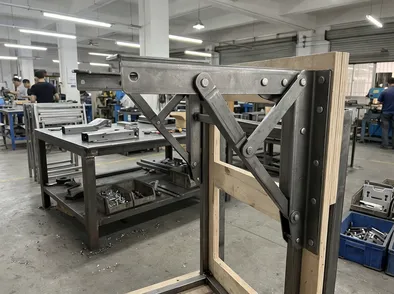
Folding Furniture Mechanism
Fold-flat and fold-down hardware for folding tables, wall-mounted desks, and collapsible frames. The structural metal brackets and pivot assemblies on this page are the base layer these folding mechanisms mount to.
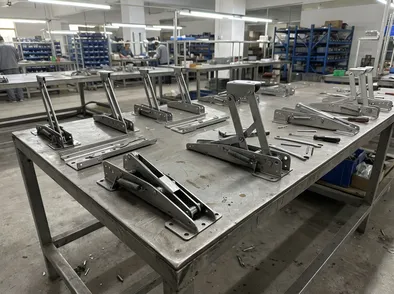
Transformable Furniture Mechanism
Multi-position conversion hardware for sofa beds, dining-to-desk conversions, and storage ottomans. The load-bearing linkage arms and welded pivot assemblies are sourced from this product line.
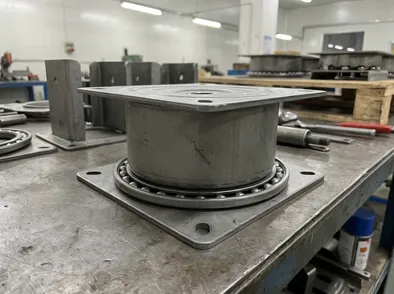
Rotating Furniture Mechanism
Swivel bases and rotation hardware. The stamped steel base plates and bearing housings are structural metal components sourced from this product line.
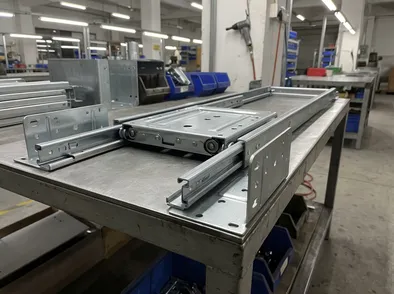
Sliding Furniture Mechanism
Extending table and pull-out hardware. Precision-stamped track brackets and carriage components are the structural metal layer for this motion type.
Not sure which combination of structural and motion hardware fits your product? Send us your furniture brief — we'll spec the full hardware package and quote it together.
Start Your Sourcing Conversation
Ready to Source Structural Metal Components?
Already have a drawing?
Send it over — we'll review for manufacturability and come back with a quote and any tooling notes within a few days.
Sourcing for the first time?
Tell us the furniture type, the target market, and your volume expectations. We'll recommend the material spec, surface treatment, and component configuration based on what's working for buyers in your segment.
Consolidating suppliers?
Send your current spec sheet or a sample reference — we'll match the spec and quote factory-direct, with full compliance documentation included.