

Precision Rotation Mechanism
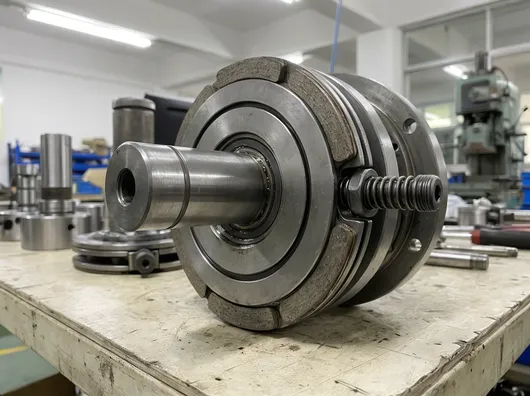
Friction joints, indexed detents, and torque-tuned assemblies built to hold position under load. Distinct from free-spin swivel hardware — engineered for applications where the position has to stay where you put it.
Torque verified on every unit before shipment.

Engineering Distinction
What Separates a Rotation Mechanism from a Swivel Base
Most buyers who land here already know the difference, but it's worth stating precisely — the two product types get conflated in sourcing conversations and the confusion leads to wrong specs.
Swivel Base / Rotating Furniture Mechanism
Optimized for smooth, unrestricted rotation under load. The design goal is frictionless movement. Position retention is not a design requirement — the mechanism is intended to spin freely.
View Rotating Furniture MechanismRotation Mechanism
Engineered to resist rotation and hold a set angular position — either through indexed detents that lock at defined angles, or through a friction joint that holds any position within its range. Position retention is the entire design intent.
The Commercial Cost of Specifying the Wrong Type
The commercial consequence of specifying the wrong type is a product that fails in the field. We've seen both failure modes come back as warranty claims from buyers who sourced on price without specifying the torque requirement.
Will drift under the weight of the screen. No torque resistance means no position hold.
Display stand won't hold its angle on a retail floor. Torque spec is the critical variable.

Built for Position-Retention Applications
The torque spec on the friction joint — measured in Newton-meters — is the critical variable we tune during assembly and verify before every unit ships.
- Monitor arms
- Adjustable-angle display stands
- Work surface tilt hardware
- Camera and lighting rigs on furniture-mounted systems
Engineering Data
Technical Specifications
Industry-standard parameters for this product type. Actual specifications vary by configuration — contact us for exact data sheets on your target application.
| Parameter | Specification |
|---|---|
| Primary structural material | Cold-rolled steel (SPCC), zinc alloy die-cast pivot components |
| Steel thickness (load-bearing arms) | 1.5mm – 3.0mm depending on load rating |
| Pivot component material | Zinc alloy die-cast, hardened steel inserts at wear surfaces |
| Dimensional tolerance (stamped) | ±0.15mm standard |
| Friction joint torque range | 0.5 – 8.0 N·m (tunable to spec) |
| Indexed detent options | 15°, 30°, 45°, 90° standard; custom angles available |
| Load capacity (typical range) | 2kg – 25kg depending on arm geometry and torque spec |
| Rotation range | Up to 360° continuous; limited-arc versions available |
| Surface treatment | Powder coat (60–80μm), zinc electroplate, nickel electroplate |
| Salt spray rating | 500 hours standard (powder coat); 800-hour option available |
| Cycle life testing | 50,000 cycles minimum; higher on request |
| Certifications | ISO 9001:2015, CE, SGS, RoHS |
| Standard MOQ | 500 units |
| Lead time (catalog items) | 25–35 days from order confirmation |
Specifications shown are industry-standard values for this product type. Contact us for detailed product data sheets specific to your application.
Need Exact Data Sheets?
Send us your load and torque requirements. We'll return application-specific specs and a quote.
Request a QuoteQuality Control
The Torque Tuning Process — Why It Matters for Your Returns Rate
Friction joint torque is not a fixed property of the mechanism — it's a variable that has to be set during assembly and verified before shipment. The torque value determines whether the mechanism holds position under the load it will actually see in use.
We tune friction joints during final assembly using a calibrated torque wrench, setting each unit to the specified N·m value for that product configuration. Then every unit goes through torque verification at the outgoing test station — not a sample pull, every unit — before it's packed. A unit that reads outside the ±10% tolerance band on the torque gauge gets pulled and re-adjusted.
We started doing 100% torque verification after a batch of 2,000 units went out with friction joints that were within our then-acceptable range but at the loose end of it. The load on the application — a heavier-than-spec monitor — pushed them over the edge. The returns cost more than the extra assembly time would have for the entire year's production. We tightened the tolerance and made verification mandatory.
The torque spec we set is based on your stated load requirement. When you inquire, tell us the weight of the object the mechanism will support and the arm geometry — we'll calculate the required torque and quote the configuration that holds it reliably.

Market Segments
Application Segments and Commercial Opportunity
Each of these represents a market your buyers are actively purchasing in — not a lifestyle description, but a sourcing pattern with real volume and margin logic.

Monitor and Display Arms
The highest-volume segment for this mechanism type. The commercial furniture and ergonomic workspace market has been expanding steadily, and the mechanism is the component that determines whether a monitor arm holds its position or drifts — which is the primary quality complaint in this category.
Distributors supplying office furniture manufacturers or ergonomic product brands need a rotation mechanism supplier who can hold torque spec across batches, because batch-to-batch torque variation is what generates warranty claims at scale.

Retail Display and POS Hardware
Rotation mechanisms in adjustable-angle product stands, tablet display mounts, and signage holders. The volume per SKU is lower than monitor arms, but the margin is higher because the application is more specialized and buyers are less price-sensitive than in commodity furniture hardware.
Retail fixture manufacturers and display hardware distributors in this segment typically order 500–2,000 units per SKU, with multiple SKUs per season.
Adjustable-Angle Work Surfaces and Drafting Hardware
Tilt tables, drafting boards, architect's desk fittings — use friction-controlled rotation mechanisms for the tilt adjustment. This is a smaller segment by volume but a consistent one; the buyers are specialized furniture manufacturers who reorder on a predictable cycle once they've qualified a supplier.
This segment has grown as remote work has driven demand for home office furniture with adjustable work surfaces — worth building into your product line if you're not already there.
Camera and Lighting Rigs on Furniture-Mounted Systems
An emerging segment driven by content creation and video conferencing furniture. The mechanism requirements are similar to monitor arms — controlled angular positioning, position retention under load — but the aesthetic requirements are often higher because the hardware is visible in the final product.
Nickel-plated finish options are common in this segment.
Tell us your target segment and volume
We'll recommend the right configuration for your application and order size.
Custom Development
OEM and ODM: Custom Rotation Mechanism Development
A significant share of what we produce in this category is custom — mechanisms designed to a buyer's torque spec, load rating, rotation range, or aesthetic brief rather than pulled from the catalog. The rotation mechanism category is one where custom development is commercially justified because the torque spec and geometry are application-specific, and a mechanism tuned for your product's load and use environment performs better than a catalog item adapted to fit.
OEM Work
You supply the drawings and torque specifications. We review for manufacturability — if your design has features that will cause production problems or tolerance issues in the friction joint assembly, we'll flag them before tooling is cut. Production is to your spec.
ODM Work
You bring the brief: target load rating, rotation range, detent or friction requirement, target retail price point, and any aesthetic direction. Our 12-person engineering team develops the mechanism geometry, builds tooling in-house, runs samples, and iterates until the torque spec is locked.
In-house tooling means faster revision cycles — a geometry change that affects friction joint performance gets resolved on our floor, not in a negotiation with a third-party tooling shop.
Standard catalog MOQ is 500 units. ODM tooling projects are quoted based on your spec — we give you the honest number based on actual tooling complexity.
Send Load Requirements & Rotation Spec
ODM Brief Checklist
- Target load rating
- Rotation range requirement
- Detent or friction specification
- Target retail price point
- Aesthetic direction (if applicable)
Quality & Compliance
Certifications and Compliance Documentation
ISO 9001:2015
Quality management system covering the full production process.
CE
European market compliance for the mechanism product range.
SGS
Third-party audit and product testing. SGS reports available with shipment.
RoHS
Trivalent chromium passivation on all zinc plating. Documentation available for EU and California market requirements.
Supplier Qualification & Factory Audits
For buyers with supplier qualification requirements, third-party factory audits are available on request. All certification documentation is available for review prior to order placement.
Manufacturing Capabilities & Quality ProcessTechnical Guidance
Frequently Asked Questions
What torque specification should I request for a monitor arm rotation mechanism?
It depends on the monitor weight and the arm geometry — specifically the distance from the pivot to the center of mass of the supported load. As a starting point: for a 5–8kg monitor on a standard arm, 2.5–4.0 N·m at the friction joint is the typical working range. For heavier displays (10–15kg), 5.0–7.0 N·m. Give us the monitor weight and arm length when you inquire and we'll calculate the correct spec — an under-torqued friction joint is the primary cause of monitor arm drift complaints, and it's entirely preventable at the sourcing stage.
What is the difference between indexed detent and friction-controlled rotation mechanisms?
Indexed detents lock at defined angular positions (15°, 30°, 45°, 90° standard) with a positive mechanical engagement — the user feels the detent click and the position is held mechanically. Friction joints allow continuous adjustment to any angle within range, held by calibrated friction resistance. Detents are better for applications requiring precise, repeatable positioning; friction joints are better for applications requiring flexible adjustment. Both types require correct specification of the load to perform reliably — the detent geometry and friction torque are both load-dependent.
How do you prevent friction joint drift over the product's service life?
Two things: hardened steel inserts at the friction interface to resist wear, and a bonded PTFE-based dry lubricant film applied during assembly. Grease-based lubrication degrades and attracts debris over time; the PTFE film holds up through the product's service life without maintenance. We also set friction torque at the upper end of the specified range during assembly — this accounts for the slight reduction in friction that occurs during the initial break-in period and keeps the mechanism within spec throughout its service life.
What is the minimum order quantity for custom torque specifications?
500 units for catalog mechanisms with a custom torque setting — torque tuning is done during assembly and doesn't require tooling changes. For custom geometry (different arm length, rotation range, or detent angles), MOQ depends on tooling requirements and is quoted based on your spec.
Can rotation mechanisms be certified for specific markets beyond CE?
CE covers European market requirements. For North American markets, we can provide material compliance documentation for HTS classification and RoHS documentation for California requirements. If your target market requires additional certifications — UL, BIFMA, or others — contact us with the specific standard and we'll advise on test report availability or testing options.
Get a Quote
Start with Your Load Spec
The most useful thing you can send us is simple: the weight of the object the mechanism will support, the arm geometry or distance from pivot to load center, and whether you need indexed positions or continuous adjustment. From that, we can specify the correct torque, recommend the right configuration from the catalog or flag that a custom spec makes more sense, and quote factory-direct.
Already sourcing rotation mechanisms and looking to consolidate or improve quality? Send us your current spec or a sample — we'll match it, identify any torque or tolerance issues, and quote the equivalent.
Contact Us Directly
- Weight of the supported load (kg)
- Arm length / pivot-to-load-center distance
- Indexed positions or continuous adjustment
- Target market / certification requirements