Germany's furniture manufacturing and import sector runs on documentation, batch consistency, and compliance. If you're sourcing recliner mechanisms — the linkage assemblies, tilt hardware, and motion components that go inside upholstered recliners and sofa sets — you already know the local supply picture is thinner than it looks. Most of what's available through German and European channels is distributed hardware, not factory-direct product. That distinction matters when you're managing margin, qualifying a new SKU, or trying to lock in consistent batch quality across a multi-container program.
This shortlist covers 10 real suppliers relevant to the German market: European distributors with local stock and service infrastructure, and factory-direct manufacturers with CE credentials and documented QC processes. The goal isn't a fake ranking — it's a sourcing framework that helps you understand what each supplier model delivers and where the trade-offs land.

What German Buyers Actually Need From a Recliner Mechanism Supplier
Before the shortlist, the evaluation criteria. German furniture manufacturers and importers operate in a market where downstream customers — retailers, contract furnishers, hospitality buyers — expect documentation, not just product. A mechanism that works in the sample but ships inconsistently across batches creates warranty exposure that lands on your balance sheet, not the supplier's.
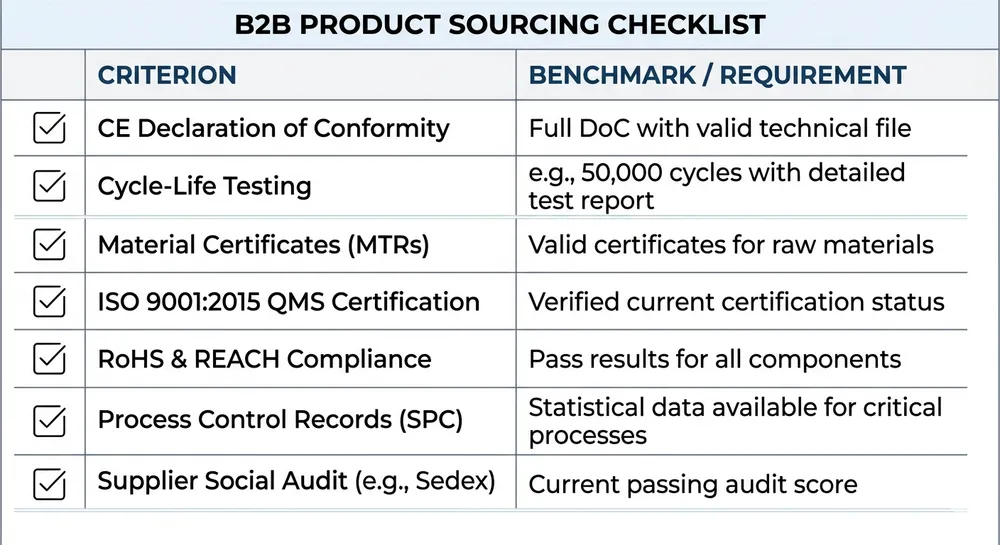
The criteria that separate serious suppliers from catalog fillers in this market:
CE Declaration of Conformity — Not just a CE mark on the box. A proper DoC with the applicable directives, notified body reference where required, and the technical file available on request. German customs and downstream compliance teams will ask for it.
RoHS compliance documentation — Surface treatments on recliner mechanisms (plating, coating) must be free of restricted substances. Hexavalent chromium in zinc plating is the most common failure point. Trivalent chromium passivation with documented process records is what you need.
Cycle-life testing — The commercial benchmark for recliner mechanisms is 50,000 full-cycle load tests. Some suppliers quote this number; fewer can show you the test report. Ask for the actual report, not a spec sheet claim.
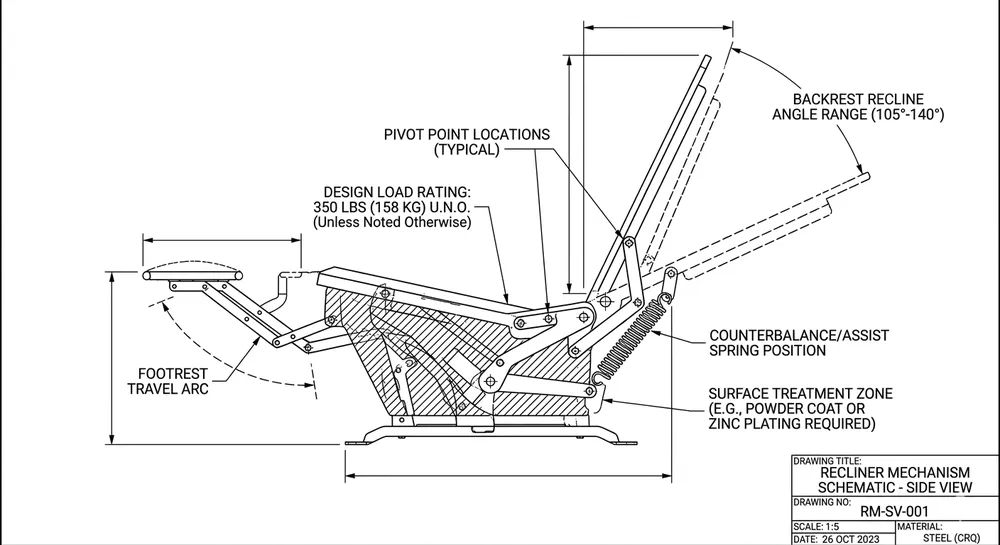
Dimensional tolerance — Mechanism plates and linkage arms stamped to ±0.15mm or tighter. Loose tolerances cause assembly variation at your production line and field failures at the joint. This is where cheap stamping shows up.
Batch consistency — The hardest thing to verify from a catalog. Ask for incoming inspection records from existing European buyers, or request a multi-batch sample comparison before committing to volume.
MOQ and container economics — European container shipments from China typically run 40HQ. A supplier whose MOQ forces you to mix SKUs inefficiently adds hidden cost to every order. Standard MOQ of 500 units per SKU with clean carton configurations for 40HQ loading is the practical floor.
Documentation completeness — Commercial invoice, packing list, bill of lading, certificate of origin, CE DoC, SGS test reports, and RoHS declaration. If a supplier can't confirm all of these ship with the order, you'll be chasing paperwork after the container arrives.
The 10 Suppliers: European Distributors and Factory-Direct Manufacturers
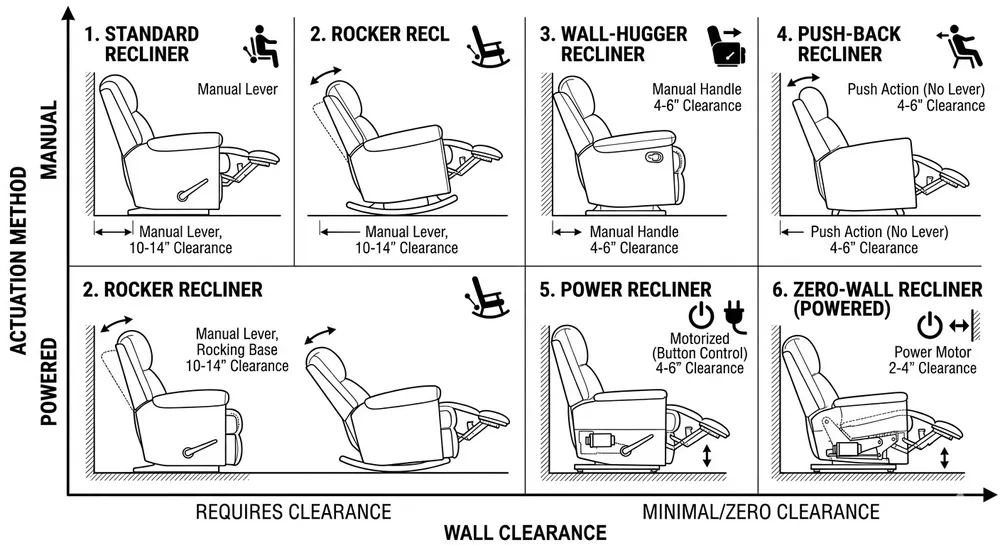
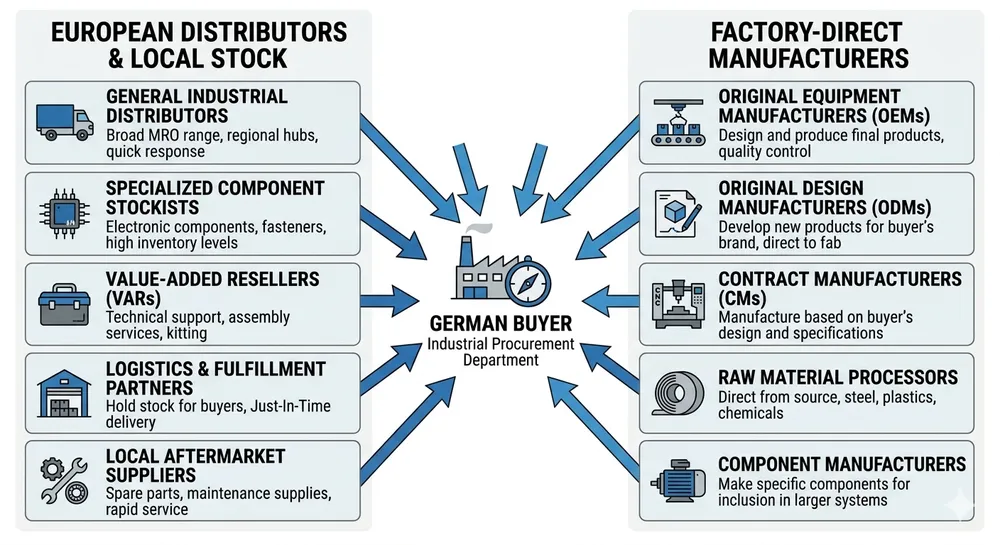
The German recliner mechanism supply landscape splits into two distinct models. Understanding which model you're dealing with determines your cost structure, lead time, and quality-control leverage.
European Distributors and Hardware Brands
These suppliers offer local stock, short replenishment cycles, and familiar communication. The trade-off is a distribution markup layered on top of the manufacturing cost — and in most cases, limited ability to customize specifications or access the factory's QC documentation directly.
—
1. Leggett & Platt — leggett.com
The dominant global OEM for recliner mechanisms. Leggett & Platt's Furniture Components division supplies mechanism assemblies to major upholstered furniture manufacturers worldwide, including European brands. Their European distribution infrastructure means product is accessible, and their mechanism engineering is mature. For buyers sourcing at scale with standard configurations, L&P is the benchmark the rest of the market is measured against. The limitation: they primarily serve large-volume OEM accounts. If your volumes are below their commercial threshold or you need custom specifications, you're likely working through a distributor rather than direct.
—
2. Hettich — hettich.com
Kirchlengern-based, one of Germany's most recognized furniture hardware manufacturers. Hettich's core strength is cabinet and drawer hardware — hinges, runners, lift systems — but their product range extends into motion hardware relevant to upholstered furniture. German-made, German documentation standards, and a dense dealer network across the DACH region. For buyers who need local sourcing with minimal compliance friction, Hettich's distribution infrastructure is hard to match. Recliner-specific mechanism depth is narrower than dedicated motion hardware specialists.
—
3. Grass GmbH — grass.eu
Austrian manufacturer with strong German market penetration. Grass specializes in furniture motion systems — drawer systems, flap fittings, and hinge technology — with engineering precision that aligns well with German quality expectations. Their dealer and distribution network covers Germany comprehensively. Similar to Hettich, the core catalog skews toward cabinet hardware; recliner linkage assemblies are a narrower part of their offering. Worth evaluating if you're consolidating hardware sourcing across multiple furniture categories.
—
4. Häfele — haefele.com
Nagold-based hardware distributor with one of the broadest furniture hardware catalogs in Europe. Häfele stocks and distributes across the full furniture hardware spectrum, including motion and mechanism components. Their value is breadth and availability — if you need a mechanism component quickly for a production run or a replacement part, Häfele's warehouse network is a practical answer. As a distributor rather than a manufacturer, they carry multiple brands and the pricing reflects the distribution layer. For repeat-volume procurement of a specific mechanism SKU, the economics of buying through Häfele versus sourcing factory-direct become relevant at relatively modest annual volumes.
—
5. Blum — blum.com
Austrian manufacturer, globally recognized for hinge and drawer systems. Blum's engineering and quality standards are among the highest in European furniture hardware. Their German distribution is well-established. Like Grass and Hettich, Blum's catalog centers on cabinet hardware rather than upholstered furniture mechanisms — recliner linkages and sofa motion hardware are outside their primary product scope. Relevant if your sourcing spans cabinet and upholstered furniture hardware and you're evaluating a consolidated supplier relationship.
—
6. Sugatsune — sugatsune.com
Japanese precision hardware manufacturer with European operations. Sugatsune's strength is precision motion hardware — hinges, stays, and positioning systems — engineered to tight tolerances. Their European office serves the German market. For buyers who need precision-grade motion components and are willing to pay for Japanese manufacturing standards, Sugatsune is a credible option. Recliner mechanism assemblies are not their primary product focus; their catalog is stronger in architectural and cabinetry hardware.
—
Factory-Direct Manufacturers
These suppliers manufacture the mechanisms themselves. The advantages are direct pricing (no distribution markup), access to factory QC documentation, customization capability, and the ability to build a direct supplier relationship. The trade-off is longer lead times, container-minimum economics, and the need to do your own supplier qualification work upfront.
—
7. Foshan Nanhai Oulang Hardware — oulang-hardware.com
Foshan-based recliner and sofa mechanism manufacturer. Oulang produces recliner linkage assemblies and sofa motion hardware for export markets including Europe. CE certification is part of their compliance profile. As a Foshan manufacturer in the furniture hardware cluster, they have access to the regional supply chain for steel and components. Worth including in a supplier comparison if you're evaluating multiple factory-direct options — request batch test reports and a CE DoC before shortlisting.
—
8. Anhui Lianke Furniture Hardware — lianke-hardware.com
Anhui-based manufacturer of recliner linkages and sofa bed mechanisms. Lianke supplies European buyers and carries CE documentation for their mechanism range. Their product focus is on the motion hardware category specifically, which means their engineering and QC processes are built around mechanism performance rather than general hardware. Evaluate alongside Foshan-cluster suppliers for a comparison of regional manufacturing approaches and pricing.
—
9. Foshan Shunde Recliner Hardware Manufacturers (cluster)
The Shunde district of Foshan is the highest-concentration manufacturing cluster for upholstered furniture hardware in China. Multiple factories in this cluster export recliner mechanisms to European buyers, with varying levels of CE compliance documentation and QC rigor. If you're running a broader supplier search, Shunde is where most of the factory-direct options originate. The challenge is qualification: the cluster has both serious manufacturers and assembly operations with thin QC infrastructure. Verifying cycle-life test reports and CE DoC authenticity before placing a container order is non-negotiable.
—
10. MVMHardware (Foshan Jinruida Import And Export Co., Ltd.) — mvmhardware.com
Factory-direct recliner mechanism manufacturer based in Guangdong, China. 17 years exclusively in furniture mechanism hardware — not a general hardware factory that added mechanisms to the catalog. The distinction matters for German buyers: mechanism hardware is a specialized category where tolerances, cycle life, and surface treatment interact in ways that generalist factories get wrong. Full profile in the section below.
—
Local Sourcing: Where European Distributors Have the Advantage
Before the factory-direct case, the honest picture of where local supply wins.
Urgent small orders — If you need 50–200 units to fulfill a rush order or replace a failed batch, a European distributor with local stock is the right answer. Factory-direct from China on a 25–35 day production lead time doesn't solve a problem that needs solving this week.
Emergency replacement parts — Warranty claims and field failures happen. Having a local distributor relationship for replacement mechanism components protects your service commitments to downstream customers.
Compliance timing — If you're entering a new product category and need to move quickly through a compliance review, sourcing from a European supplier with established CE documentation can compress your timeline. Factory-direct requires you to do the compliance verification yourself.
Mixed-SKU small runs — Distributors like Häfele carry broad catalogs. If you need small quantities across multiple mechanism types for a product development phase, a distributor's breadth is more practical than managing multiple factory-direct relationships.
The honest trade-off: local convenience is real, and for the scenarios above, it's worth the premium. The question is whether you're paying that premium on your core repeat-volume procurement — and what it's costing your margin annually.
The Cost of the Distribution Layer on Repeat Volume
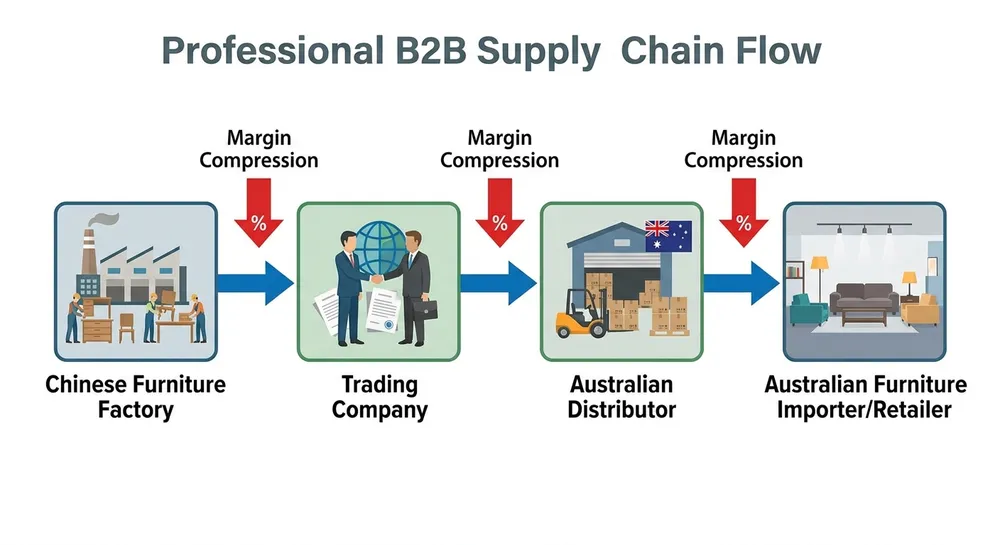
A European distributor's pricing reflects their cost structure: warehousing, local sales infrastructure, currency hedging, and the manufacturer's margin before theirs. For a mechanism that costs €4.50 factory-direct landed in Hamburg, a distributor price of €7.50–€9.00 is a reasonable market expectation — not a markup to resent, but a cost to account for.
At 5,000 units per year, that €3–4.50 spread is €15,000–€22,500 in annual margin compression. At 20,000 units, it's €60,000–€90,000. Those numbers don't automatically make factory-direct the right answer — you need to factor in the cost of supplier qualification, container logistics, and the working capital tied up in a larger minimum order. But they do make the calculation worth running.
The other cost that doesn't show up in unit price: documentation gaps. German buyers who source through trading companies or unverified factory-direct suppliers frequently report post-shipment document chasing — CE DoC that doesn't match the shipped product, SGS reports for a different SKU, RoHS declarations that are generic rather than product-specific. That administrative friction has a real cost in compliance team time and customs delay risk.
(We've had buyers come to us after a container was held at Hamburg because the CE documentation from their previous supplier referenced a different product model. Getting that resolved took three weeks and cost more than the unit-price savings they thought they'd captured.)
MVMHardware: Factory-Direct Recliner Mechanisms for the German Market
We've been making furniture mechanisms since 2008 — exclusively mechanisms, not a general hardware catalog with mechanisms added as a line extension. That focus shapes everything from our tooling investment to our QC process design.
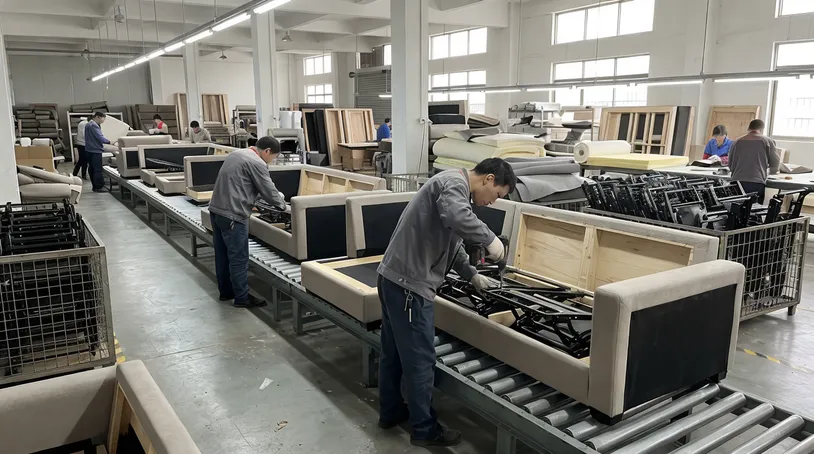
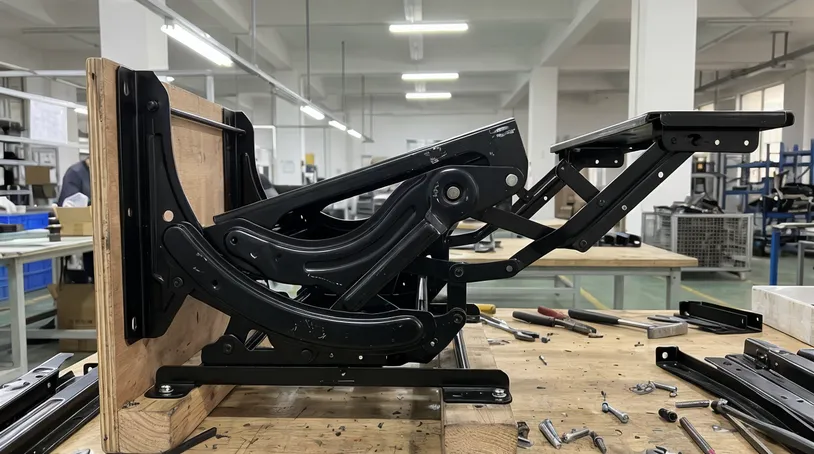
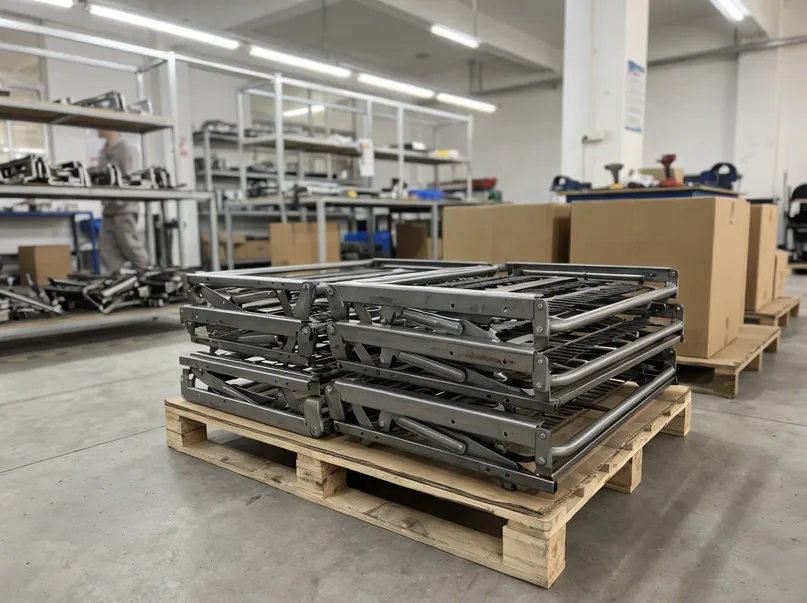
The facility is 12,000 m² in Guangdong, running 6 dedicated production lines at 3,000,000 units annual capacity. Recliner and sofa hardware runs on two dedicated lines — your order doesn't queue behind chair mechanism or table fitting production runs.
Stamping Tolerance and Die-Cast Control
Mechanism plates, linkage arms, and structural brackets are stamped from cold-rolled steel coil to ±0.15mm tolerance on progressive dies. That tolerance spec matters at your assembly line: loose-tolerance stamping causes variation in pivot geometry that shows up as inconsistent recliner motion feel across a production batch — the kind of quality complaint that's hard to trace back to the mechanism until you've already shipped product to your customer.
The die-cast components — adjustment knobs, collars, and decorative covers — are produced in-house on our own zinc alloy die-casting equipment. Most mechanism factories in this region outsource die-casting to third-party foundries, which means they have no direct control over dimensional consistency or surface quality on those parts. We brought die-casting in-house in 2015 specifically because batch-to-batch inconsistency on outsourced die-cast components was the leading cause of quality complaints we were seeing. Owning that process means when a dimensional issue appears, the fix is on our floor the same day, not in a supplier negotiation that takes two weeks.
100% Functional Testing — Not Sampling
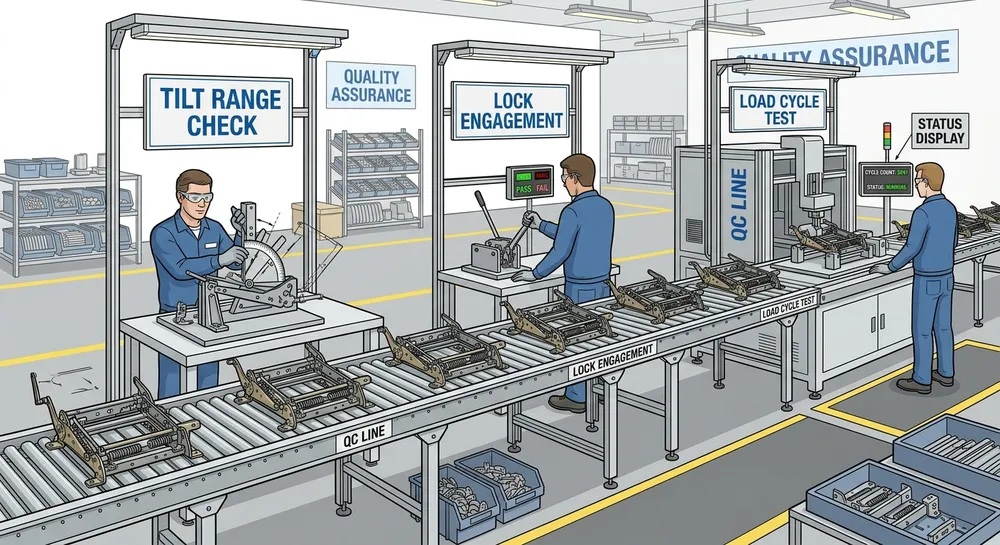
Every mechanism unit goes through functional testing before it's packed. Not a statistical sample — every unit. The test covers tilt range, lock engagement, load cycle, and mounting hole alignment. A unit that passes dimensional inspection but has a sticky lock or a misaligned hole gets pulled at this stage.
The 50,000-cycle load test runs as a standard batch qualification check, not a special request. For mechanisms going into commercial or high-use applications, we test higher — the 50,000-cycle figure is our floor, not our ceiling. Test reports are available with the order.
(German buyers specifically ask about this more than any other market we ship to. The expectation that documentation matches the actual shipped product — not a generic spec sheet — is consistent across every German account we've worked with. We've built the documentation process around that expectation.)
CE, SGS, and RoHS — Ships With the Order
CE declaration of conformity, SGS test reports, and RoHS compliance documentation ship with every European order. The CE DoC references the specific product models in your shipment — not a generic document that covers a broad product family. Your customs broker and compliance team get what they need without chasing us after the container departs.
RoHS compliance on surface treatments: the zinc plating line runs trivalent chromium passivation. No hexavalent chromium in the process. The documentation is product-specific and available for your compliance file.
Surface treatment is a full in-house line: powder coating at 60–80μm consistent film thickness (500-hour salt spray rated), nickel plating, and zinc plating. The powder line spec is the range that passes salt spray without adhesion failure — we ran thinner at 45–55μm for a period and the coastal-market results told us that was the wrong trade-off.
Certifications
- ISO 9001:2015 — Quality Management System
- CE — European market compliance, product-specific DoC
- SGS — Third-party audit and test reports
- RoHS — Restricted substances, trivalent chromium passivation documented
MOQ and Container Economics
Standard MOQ is 500 units for catalog mechanisms. Carton configurations are sized for 40HQ loading — your freight forwarder isn't improvising pallet configurations at the warehouse. Standard production lead time is 25–35 days from order confirmation.
OEM/ODM is available for buyers who need custom specifications, private-label packaging, or mechanism designs developed to their brief. In-house tooling means sample iterations don't wait on a third-party tooling shop. Our OEM/ODM capabilities page covers the process in detail.
For the full Recliner & Sofa Mechanism catalog — load ratings, finish options, and standard configurations — the category page has the current range.
How to Vet a Recliner Mechanism Supplier Before a Container Order
Whether you're evaluating a European distributor or a factory-direct manufacturer, the qualification process for a container-scale commitment follows the same logic.
Step 1 — Request the CE Declaration of Conformity for the specific SKU you're ordering. Verify that the product model number on the DoC matches what you're buying. Generic DoCs that cover a broad product family without model-specific reference are a red flag.
Step 2 — Request the cycle-life test report. Ask for the actual SGS or third-party lab report, not a spec sheet claim. Verify the test standard referenced and the cycle count achieved.
Step 3 — Request a multi-batch sample comparison. Order samples from two or three production batches if possible, or ask for dimensional measurement records from recent production runs. Batch consistency is the hardest thing to verify from a single sample.
Step 4 — Confirm RoHS documentation is product-specific. Ask for the RoHS declaration that references your specific mechanism model and surface treatment process. Confirm trivalent chromium passivation if zinc plating is involved.
Step 5 — Confirm full export documentation list. Commercial invoice, packing list, bill of lading, certificate of origin, CE DoC, SGS reports, RoHS declaration. If any of these require post-shipment follow-up, factor that administrative cost into your supplier evaluation.
Step 6 — Verify container loading configuration. Ask for the carton dimensions and 40HQ loading plan for your SKU. Inefficient container loading adds freight cost that doesn't show up in the unit price comparison.
Sourcing Route Decision Guide
| Scenario | Recommended Route |
|---|---|
| Urgent order, under 500 units, needed within 2 weeks | European distributor with local stock |
| Emergency replacement parts for warranty service | European distributor |
| First container order, new mechanism SKU, standard configuration | Factory-direct with CE/SGS documentation |
| Repeat-volume program, 2,000+ units/year | Factory-direct — run the landed-cost comparison |
| Custom specification or private-label requirement | Factory-direct with OEM/ODM capability |
| Compliance-critical project, documentation timeline tight | Verify DoC availability before committing to either route |
| Cost-sensitive bid, margin under pressure | Factory-direct — the distribution layer is the first cost to remove |
The right sourcing route depends on your order profile, not a general preference for local or overseas supply. For buyers running annual volumes above 2,000 units of a consistent SKU, the factory-direct economics are worth the qualification investment. For buyers with irregular demand or urgent replenishment needs, a European distributor relationship alongside a factory-direct primary supplier is a practical hybrid.
Frequently Asked Questions
What CE documentation should ship with a recliner mechanism order for Germany?
A proper CE Declaration of Conformity referencing the specific product model, the applicable EU directives (typically Machinery Directive 2006/42/EC for mechanism assemblies and RoHS Directive 2011/65/EU for restricted substances), and the manufacturer's name and address. The DoC should be in German or English. A CE mark on the product without a corresponding DoC is not sufficient for German customs or downstream compliance requirements.
What cycle-life standard applies to recliner mechanisms for the European market?
50,000 full-cycle load tests is the commercial benchmark for recliner mechanisms in European markets. This aligns with EN 1728 and related furniture testing standards. The test should be conducted by an accredited third-party lab (SGS, TÜV, Intertek) and the report should reference the specific mechanism model tested, the load applied, and the cycle count achieved without failure.
What is the typical MOQ for factory-direct recliner mechanism orders from China?
500 units per SKU is a practical floor for serious factory-direct manufacturers. Below that, the production economics don't work cleanly for either side. For a 40HQ container, a typical recliner mechanism order runs 3,000–8,000 units depending on mechanism size and carton configuration — so a 500-unit MOQ is relevant for buyers who are mixing multiple SKUs in a single container.
How do I verify batch consistency before committing to a container order?
Request dimensional measurement records from two or three recent production batches for the specific SKU. Ask for the incoming inspection records for the steel coil and die-cast components used in those batches. If the supplier can't provide batch-level QC records, that's a signal about their process discipline. A multi-batch sample comparison — ordering physical samples from different production runs — is the most direct verification method.
What is the landed cost difference between European distributor pricing and factory-direct for recliner mechanisms?
The distribution markup on mechanism hardware in Europe typically runs 40–80% above factory-direct landed cost, depending on the distributor's cost structure and the mechanism category. On a €4.50 factory-direct landed unit, European distributor pricing commonly runs €7.50–€9.00. At 5,000 units annually, that spread is €15,000–€22,500. The factory-direct route adds qualification cost, container logistics management, and longer lead times — the net economics depend on your volume, order frequency, and internal logistics capability.
—
If you're building a shortlist for a container order or a new mechanism SKU, send your specifications — mechanism type, load rating, finish requirement, and target volume — to MVMHardware and we'll come back with a specific recommendation, CE documentation summary, and a landed-cost quote for your market.
“`