

Forward Tilt
Chair Mechanism
The component that separates an ergonomic chair from a standard task chair.
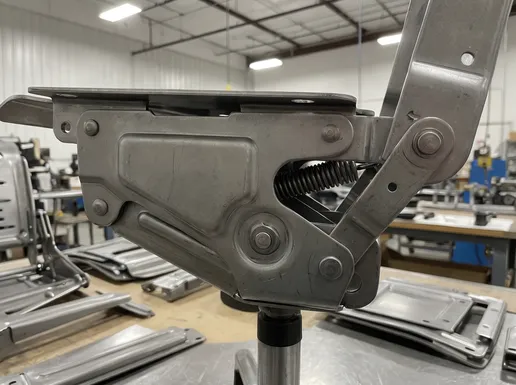
Adds a forward seat angle (typically 5°) for active sitting postures. Stamped to ±0.15mm, 100% functionally tested, CE and SGS certified. OEM/ODM tooling supported.

Product Overview
What the Forward Tilt Mechanism Does — and Why It Commands a Price Premium
A forward tilt chair mechanism adds one function that a standard tilt mechanism doesn't have: the ability to angle the seat forward, typically 5° below horizontal. That single degree of motion changes the end-user posture entirely — the pelvis tilts forward, the lumbar curve is maintained naturally, and the user's weight shifts toward active engagement rather than passive recline.
For drafting tables, standing-height desks, lab benches, and any workstation where the user leans toward their work surface, this is the mechanism that makes the chair functional rather than just present.
We produce forward tilt mechanisms on dedicated lines in our 12,000 m² Guangdong facility. This page focuses on the forward tilt unit specifically: its specs, its commercial applications, and what to verify before you source it.
Request a QuoteActive Sitting Posture
The 5° forward seat angle tilts the pelvis forward, maintains the natural lumbar curve, and shifts the user's weight toward active engagement rather than passive recline.
Purpose-Built Workstations
Drafting tables, standing-height desks, lab benches — any workstation where the user leans toward their work surface. This mechanism makes the chair functional rather than just present.
The Commercial Case
The forward tilt function moves a chair out of the commodity tier. The mechanism cost difference between a standard tilt and a forward tilt unit is modest. The retail price difference is not.
Buyers in the $200–$400 bracket purchase on ergonomic specification rather than price alone — meaningfully higher margin percentage.

Engineering Data
Technical Specifications
Industry-standard parameters for this mechanism type. Actual specifications may vary by configuration — contact us for detailed product data sheets and drawings.
Specifications shown are industry-standard values for this mechanism type. Contact us for exact product data sheets, load test reports, and CAD drawings.
Need Exact Data Sheets?
Contact us for load test reports, CAD drawings, and configuration-specific product data sheets for your order volume.
Get Specs & QuoteCertifications
BIFMA X5.1 equivalent cycle testing at rated load.
The Mechanism in Production — What We Do Differently
The forward tilt function introduces a design challenge that a standard tilt mechanism doesn't face: the mechanism must hold a stable forward position under load without creep, and the transition between forward, neutral, and reclined positions must be positive and repeatable across 60,000+ cycles. That's where most of the engineering attention goes on this unit.
Mechanism Plate & Pivot Geometry
Stamped from cold-rolled steel coil on progressive dies — same ±0.15mm tolerance as our full chair mechanism line. Pivot pin seats are machined to a tighter tolerance than the plate stamping alone achieves, because the forward tilt detent relies on consistent pivot geometry to engage cleanly. A 0.3mm deviation makes the forward position feel vague rather than positive — the kind of tactile quality issue that generates returns from your downstream customers.
Dedicated Tilt Tension Spring
A spring rate calibrated for a standard 15°–20° rear tilt range doesn't behave correctly when you add a 5° forward position — the resistance curve changes. We tuned the spring specification for this mechanism type independently rather than adapting a standard tilt spring. The adaptation approach produced acceptable feel in the neutral-to-rear range but inconsistent forward position behavior under varying user weights. The dedicated spring spec resolved it.
In-House Zinc Alloy Die-Casting
The tilt knob, forward tilt actuator lever, and adjustment collar are die-cast in-house. We brought die-casting inside in 2015 specifically because outsourced die-cast parts were the leading source of batch-to-batch inconsistency on mechanism assemblies. The actuator lever on a forward tilt mechanism is a higher-wear component than a standard tilt knob — it gets actuated every time the user shifts between sitting modes. Dimensional consistency on that part matters for long-term function, not just initial assembly.
100% Functional Testing
Every completed mechanism goes through 100% functional testing before it leaves the floor: forward tilt engagement and lock, rear tilt range and tension, lock position engagement, and gas lift actuation. Representative units from each production run complete accelerated cycle testing at 60,000+ cycles under rated load. If a batch shows detent wear or spring fatigue before the cycle threshold, it doesn't ship.
Market Segments Where Forward Tilt Mechanisms Drive Margin
Ergonomic Office Seating
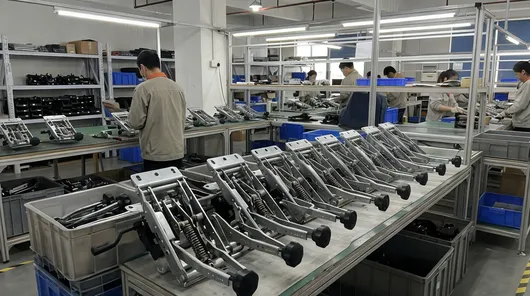
The ergonomic office chair market is where forward tilt mechanisms move the most volume. Furniture manufacturers building chairs in the $200–$500 retail range need a mechanism spec that justifies the price point — forward tilt, combined with synchro or standard tilt and height adjustment, is the feature set that does that.
Downstream buyers — office furniture dealers, corporate procurement teams, e-commerce ergonomic brands — are increasingly specifying forward tilt as a standard feature rather than an upgrade, driven by remote work ergonomics awareness and standing desk adoption.
Distributor note: Corporate office furniture refreshes on 5–7 year cycles, and ergonomic seating is typically the first category refreshed when budgets open. A distributor who establishes a forward tilt chair line with a consistent mechanism spec can expect predictable reorder volume rather than one-off project orders.
Active Sitting & Specialty Seating
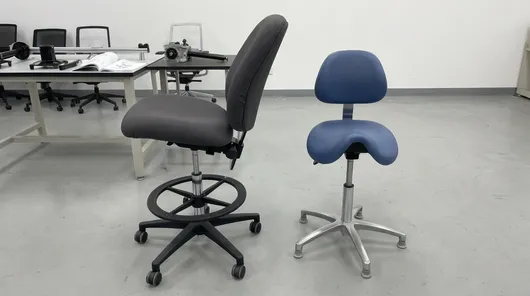
Drafting chairs, saddle-style seating, lab and cleanroom chairs, and dental/medical stools all use forward tilt as a primary function rather than an optional feature. These are lower-volume segments than contract office, but the margin profile is different — specialty seating buyers are purchasing on specification, not on price.
A dental stool manufacturer who specifies your forward tilt mechanism is not shopping on price per unit; they're qualifying a supplier who can hold spec across production runs.
Segment trend: Healthcare and lab furniture buyers are sourcing mechanisms directly rather than through furniture OEMs — order sizes are smaller but the relationships are stickier. This segment has grown steadily over the past three years.
Export Distribution
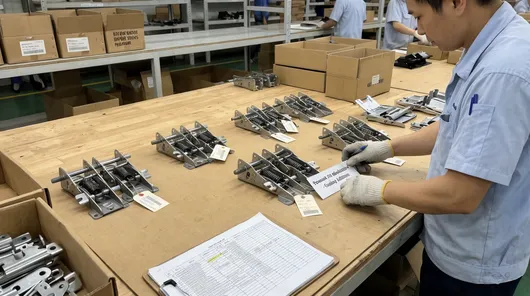
If you're a furniture hardware distributor supplying multiple chair manufacturers, the forward tilt mechanism is a natural addition to a tilt mechanism catalog. Buyers who already stock standard tilt and synchro mechanisms from you will ask for forward tilt when they move upmarket.
Consolidating the forward tilt SKU with your existing mechanism supplier reduces your procurement overhead and gives you a single quality standard across your tilt mechanism range.
Procurement advantage: Single supplier for standard tilt, synchro, and forward tilt mechanisms — one quality audit, one lead time to manage, one point of contact for batch consistency issues.
Tell us your target segment and volume
We'll recommend the right configuration for your application and order profile.
Mechanism Selection
Forward Tilt vs. Knee Tilt: Choosing the Right Mechanism for Your Chair Line
These two mechanisms are frequently confused because both are positioned as upgrades from standard tilt. They serve different end-use cases, and stocking the wrong one for your market is a sourcing mistake worth avoiding.
| Forward Tilt Mechanism | Knee Tilt Mechanism | |
|---|---|---|
| Primary function | Adds forward seat angle for active postures | Shifts pivot forward so seat front stays level during recline |
| Typical tilt range | 5° forward to 15°–20° rear | 0° to 15°–20° rear (no forward position) |
| End-use fit | Drafting, lab, active sitting, standing desk pairing | Executive chairs, conference seating, desk work with recline |
| Retail positioning | Ergonomic/active seating | Executive/premium task seating |
| User motion | Leans toward work surface | Reclines while keeping feet on floor |
Choose Forward Tilt
If your chair line targets active postures, drafting applications, or standing-desk pairing, forward tilt is the correct specification. Users lean toward the work surface; the mechanism supports that motion.
Choose Knee Tilt
If your line targets users who recline while working at a desk — executive chairs, conference chairs, high-back task chairs — the knee tilt mechanism is the right specification. Keeps feet on the floor during recline.
We supply both; the selection depends on your end-use positioning, not on which mechanism is "better."
OEM / ODM
Customization Options and OEM/ODM Capability
Standard forward tilt mechanisms ship at 500-unit MOQ with the specifications in the table above. The following customization options are available — confirm specific parameters during quoting.
Geometry & Function
- Forward tilt angle: standard 5°; modified angles available on OEM tooling (confirm feasibility with engineering)
- Rear tilt range: adjustable within spring rate range; extended ranges require spring specification change
- Mounting hole pattern: standard 4-hole default; custom patterns stamped to your drawing
- Gas lift bore: Ø50 mm standard; Ø60 mm available
Surface Treatment
- Zinc plating: standard
- Powder coating: black (RAL 9005) standard; custom RAL colors on runs over 500 units
- Nickel plating: available for components where post-coating dimensional tolerance is critical
Components & Branding
- Actuator lever style: lever or button actuation configurations
- Tilt knob geometry: custom die-cast geometry available on OEM tooling
- Private-label packaging and component marking
Modified Pivot Geometry, Non-Standard Tilt Ranges, Integrated Features
Our 12-person engineering team handles feasibility assessment and tooling development in-house. Sample iterations run faster than working through a third-party tool shop. Send us your drawing or a reference sample and we'll come back with a manufacturability assessment and tooling quote.
Send Your Specs for an OEM Assessment
Logistics & Fulfillment
Packaging, Container Loading, and Landed Cost
Everything you need to calculate landed cost per unit before committing to an order — packaging specs, container loading figures, and OEM fulfillment options.
Individual Carton Protection
Each mechanism ships in its own carton with foam protection specifically around the actuator lever and tilt knob — the components most vulnerable to transit damage.
40HQ Container Loading
Cartons are sized for 40HQ loading efficiency. Pallet configurations are pre-worked so your freight forwarder isn't improvising at the warehouse. Typical load: 3,000–5,000 units depending on configuration and packaging density.
OEM & White-Label Packaging
For e-commerce and Amazon FBA buyers: mechanisms can be packed in retail-ready cartons with your branding. Blind drop-shipping and white-label packaging are handled at the OEM stage — confirm requirements during quoting.
Exact container loading figures are provided with your quote so you can calculate landed cost per unit accurately before committing to an order. No guesswork at the freight stage.
Quality & Market Access
Certifications and Compliance
All certification documentation ships with the order. EU and North American importers receive the documentation they need without a follow-up request.
Standard Certifications
Quality management system — governs the full production and QC process.
European market compliance — declaration of conformity ships with every order.
Third-party audit and product testing through our established SGS relationship.
Restricted substances compliance — no hexavalent chromium, lead within limits.
Documentation Included With Every Order
- CE declaration of conformity — included automatically for EU buyers, no follow-up required.
- SGS test reports — shipped with the order for EU market supply chains.
- Material and compliance documentation for HTS classification — available for North American importers.
If your market requires BIFMA X5.1, EN 1335, or other standards, we can arrange third-party testing through our existing SGS relationship. Specify your compliance requirements during quoting.
Frequently Asked Questions
What is a forward tilt chair mechanism and how does it differ from a standard tilt?
A standard tilt mechanism pivots the seat and backrest together in a single rearward arc. A forward tilt mechanism adds a second position: the seat can angle forward, typically 5° below horizontal, for active sitting postures. The user engages the forward position via a lever or button, sits with the pelvis tilted forward and the lumbar curve maintained, then returns to neutral or reclines as needed. The forward position is what justifies the ergonomic specification — without it, the chair is a standard task chair regardless of what the marketing says.
What applications is the forward tilt mechanism best suited for?
Drafting chairs, lab and cleanroom seating, dental and medical stools, standing-desk companion chairs, and any application where the user's primary posture is leaning toward a work surface rather than reclining away from it. In contract office furniture, forward tilt is increasingly specified on premium task chairs as a standard feature rather than an upgrade — the ergonomic segment has driven that shift over the past several years.
What cycle life should I specify for commercial use?
For standard office environments (8-hour daily use), 60,000 cycles covers 3–5 years of heavy use. For high-use commercial environments — call centers, 24/7 operations, shared workstations — specify 100,000 cycles. We test to BIFMA X5.1 equivalent protocols. Specify your cycle life requirement in the purchase order; we'll confirm the test standard and provide documentation.
What is the MOQ, and can I order samples first?
Standard MOQ is 500 units. For new buyers, we recommend a sample order of 2–5 units to verify fit with your chair frames and test the forward tilt function before committing to production quantities. Samples ship within 7–10 days of order confirmation.
Can the forward tilt angle be customized?
The standard configuration is 5° forward. Modified angles are possible on OEM tooling — the pivot geometry and detent system need to be re-engineered for a different angle, so this is a tooling project rather than a parameter adjustment. Send us your target angle and application brief; our engineering team will assess feasibility and provide a tooling quote.
What certifications does this mechanism carry?
CE, SGS, RoHS, and ISO 9001:2015. Documentation ships with the order. If your market requires BIFMA, EN 1335, or other standards, we can arrange third-party testing — specify requirements during quoting.
Get a Quote for the Forward Tilt Chair Mechanism
Most buyers in this category start with a 2–5 unit sample to test fit and function against their chair frames before placing a production order. If you already have a spec — mounting pattern, load rating, surface finish, cycle life requirement — send it over and we'll quote against it directly. If you're building a new ergonomic chair line and need mechanism recommendations, tell us your target retail price point and end-use segment; we'll suggest the configuration that fits your margin structure.
Contact Us