

Knee Tilt Chair
Mechanism
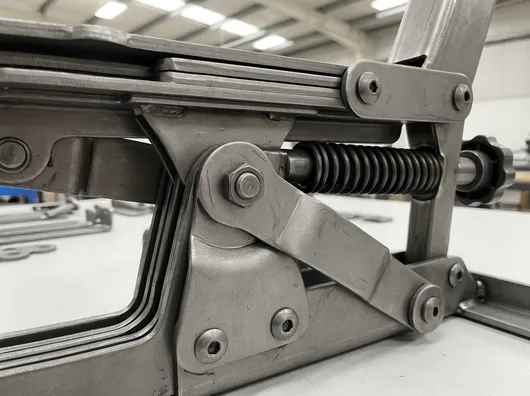
Forward pivot geometry — the standard for executive and conference seating that reclines without lifting the seat front. Stamped from cold-rolled steel to ±0.15mm, 100% functionally tested before shipment.
Fits standard gas lift cylinders. OEM mounting patterns and custom configurations supported.

Mechanism Engineering
What the Knee Tilt Does — and Why It's the Right Mechanism for
Executive and Conference Seating
The knee tilt mechanism shifts the tilt pivot point forward, positioning it near the front edge of the seat rather than at the center. When the user reclines, the seat front stays relatively level — it doesn't rise and lift the user's thighs off the cushion the way a center-tilt mechanism does. The backrest travels through its full recline arc while the seat maintains a stable, near-horizontal position.
That geometry is why knee tilt is the standard specification for executive chairs and conference seating. Users at these price points are typically reclining while remaining at a desk or table — they need their feet to stay grounded and their posture to stay controlled. A center-tilt mechanism that lifts the seat front during recline breaks that working posture. The knee tilt doesn't.
From a sourcing standpoint, this matters because the mechanism is the feature that justifies the price tier. An executive chair at $350–$600 retail needs a mechanism that performs differently from a $120 task chair — and the knee tilt pivot geometry is the specific engineering decision that creates that performance difference. If you're building or importing executive or conference seating, the knee tilt is the mechanism that supports your retail positioning, not just a component choice.
We produce this mechanism on dedicated stamping and assembly lines, with the same ±0.15mm plate tolerance and 100% functional testing protocol that covers our full chair mechanism range.
See our manufacturing capabilities
Forward Pivot
Pivot positioned 60–70% toward seat front — seat stays level as backrest reclines.
Executive Standard
The mechanism specification that separates $350–$600 executive chairs from $120 task chairs.
Grounded Posture
Feet stay on the floor during recline — critical for desk and conference table use.
Dedicated Lines
Stamped and assembled on dedicated lines with ±0.15mm tolerance and 100% functional test.
Technical Data
Knee Tilt Mechanism Specifications
Industry-standard parameters for this mechanism type. Contact us for exact product data sheets and engineering drawings.
Specifications shown are industry-standard values for this mechanism type. Actual specifications may vary by configuration. Contact us for detailed product data sheets.
Request Data Sheet
Get exact drawings, tolerances, and configuration options for your project.
Request Quote or Data SheetManufacturing Detail
Pivot Geometry and Plate Construction — What We Actually Build
The knee tilt's defining characteristic is the pivot location, but the engineering that makes it work reliably is in the plate geometry and the spring assembly. Here's how we build it.
Progressive-Die Stamped Plate
The mechanism plate is stamped from cold-rolled steel coil on progressive dies — the pivot slot, mounting holes, spring anchor points, and gas lift bore are all formed in a single press pass. This eliminates the dimensional variation you get when these features are machined or drilled separately.
Plate Thickness: 2.0–2.5mm
The forward pivot geometry requires a longer plate than a center-tilt mechanism — the structural load path from the pivot to the rear mounting points is longer, which means the plate carries more bending moment under recline load. We run the standard knee tilt plate at 2.0–2.5mm thickness to handle that load path.
Thinner-plate versions from other suppliers — 1.5mm — pass static load tests but show fatigue cracking at the pivot bracket after 30,000–40,000 cycles. The extra material cost is small; the warranty claim cost is not.

In-House Die-Cast Spring Knob
Spring tension adjustment uses a multi-position knob — zinc alloy die-cast, produced in-house. The knob engages a threaded collar that compresses the tilt spring, giving the end user 3–5 resistance positions. Because we die-cast these components ourselves, the thread engagement and dimensional fit are consistent batch to batch.
Loose-fitting or binding tilt knobs are almost always a die-cast tolerance problem; owning that process means we own the fix before it ships.
Market Opportunity
Market Segments Where Knee Tilt Mechanisms Drive Margin
Executive and High-End Office Seating
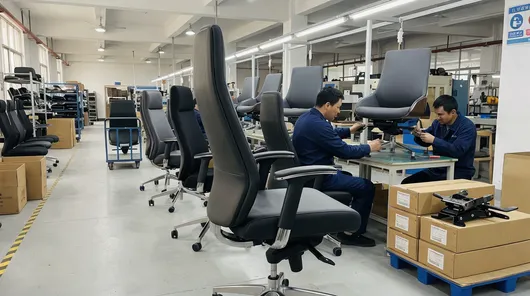
This is the primary volume segment for knee tilt. Executive chairs at $300–$600 retail are sold on the strength of their recline quality — the mechanism is the product, not just a component.
Furniture manufacturers and importers building executive lines need a mechanism that performs consistently across a production run, because a single batch of mechanisms with inconsistent tilt feel or lock engagement generates warranty claims that erode the margin on the entire order.
Contract office furniture dealers supplying corporate fit-outs typically specify executive chairs in quantities of 50–500 units per project, with repeat orders as clients expand or refresh.

Conference and Boardroom Seating
Conference chairs are a distinct commercial opportunity from task seating. They're specified by interior designers and facilities managers on project budgets, ordered in uniform quantities — typically 12–60 units per conference room — and replaced on 7–10 year cycles.
The knee tilt mechanism is standard for conference chairs because users recline during long meetings while remaining at the table — the seat-level geometry is a functional requirement, not a premium feature.
For distributors supplying the contract furniture market, conference seating is a high-margin, project-driven segment with predictable reorder patterns. Once your chair model is specified into a project, the reorder is straightforward.
Premium Hospitality Seating
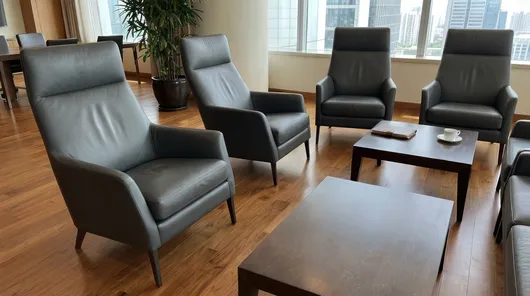
Hotel lobbies, executive lounges, and premium co-working spaces specify seating that combines recline comfort with a controlled, professional appearance. Knee tilt mechanisms fit this application because the recline motion is smooth and contained — the seat doesn't rock dramatically, which suits environments where the furniture needs to look composed even when in use.
These buyers typically order 20–200 units per property, with multi-property rollouts creating larger aggregate volumes.
We'll recommend the right configuration for your application.
Customization Options for OEM Chair Manufacturers
Standard catalog knee tilt mechanisms cover most executive and conference chair applications. Where they don't, we have the tooling capability to modify or develop from scratch.
What Can Be Customized
-
Mounting hole pattern
We hold tooling for standard 4-hole and 6-hole patterns; custom patterns are cut in-house with a 25–35 day sample lead time.
-
Plate dimensions
Seat width and depth dimensions can be adjusted within the structural constraints of the forward pivot geometry.
-
Tilt angle range
Spring rate and stop geometry can be modified to change the maximum recline angle — typically 12°–22° range.
-
Load rating
Heavy-duty configurations with thicker plate and reinforced pivot hardware available for 150 kg+ applications.
-
Surface finish
Zinc plating (standard), powder coat in black or custom RAL, nickel plating for premium appearance applications.
-
Tilt knob design
Custom die-cast knob geometry and finish for OEM branding.
What Cannot Be Customized Without New Tooling
The forward pivot position is fixed by the die geometry — moving the pivot location requires new tooling. If your chair design requires a specific pivot-to-mounting-point dimension that differs from our standard, that's an ODM tooling project.
We'll quote it with a clear tooling cost and amortization structure.
Standard catalog mechanisms
MOQ based on tooling amortization — honest number per your spec

Ready to assess fit for your chair frame?
Send us your chair frame drawings or a reference mechanism — our engineering team will assess fit and come back with a quote.
Compliance and Certification for Your Target Market
The knee tilt mechanisms we ship carry CE marking and SGS third-party testing. ISO 9001:2015 governs the quality management system.
CE Marking
Declaration of conformity ships with every order for EU market buyers. No need to request separately.
SGS Third-Party Testing
SGS audit reports available on request. Third-party testing through our existing SGS relationship for EN 1335 or BIFMA certification if required.
ISO 9001:2015
Quality management system certification governs our manufacturing process end to end.
RoHS Compliance
Documentation standard with every shipment. No hexavalent chromium in the plating process — trivalent chromium passivation on zinc-plated components. Shipped automatically, not on request.
Cycle Life Testing
BIFMA X5.1 equivalent protocols — 60,000 cycles at rated load as the standard qualification threshold.
North American Import Docs
Material and compliance documentation your customs broker needs for HTS classification provided with every shipment.
Market-Specific Compliance Notes
CE declaration of conformity ships with the order. RoHS documentation included automatically — increasingly requested even for B2B hardware components.
Full material and compliance documentation for HTS classification. BIFMA certification through accredited lab available via SGS relationship on request.
If your market or customer requires EN 1335 testing or BIFMA certification through an accredited lab, we can arrange third-party testing through our existing SGS relationship.

RoHS documentation is increasingly requested by EU and California-market buyers even for B2B hardware components — we keep it current and ship it automatically rather than waiting for you to chase it.
Fulfillment & Export
Packaging, Container Loading, and Logistics
Knee tilt mechanisms are packed in standardized export cartons, individually wrapped to prevent surface damage during transit. Carton dimensions are sized for 40HQ container loading efficiency — we've worked out the pallet configurations so your freight forwarder isn't improvising at the warehouse.
For buyers who need retail-ready packaging, branded cartons, or specific labeling for FBA or warehouse receiving, that's handled as part of the OEM arrangement. Blind drop-shipping and white-label packaging are available for distributors who sell direct to furniture manufacturers.
Full export documentation ships with every order: commercial invoice, packing list, bill of lading, certificate of origin, CE declaration, SGS test reports, and RoHS compliance documentation. Standard production lead time for catalog mechanisms is 25–35 days from order confirmation and deposit.
Individually wrapped, 40HQ-optimized pallet configurations. No improvisation at the warehouse.
Branded cartons, FBA labeling, blind drop-ship, and white-label options for distributors.
Commercial invoice, packing list, B/L, certificate of origin, CE declaration, SGS reports, RoHS.
25–35 days from order confirmation and deposit for catalog mechanisms.
Sourcing Guidance
Frequently Asked Questions — Knee Tilt Mechanism Sourcing
What is the difference between a knee tilt and a center tilt chair mechanism?
A center-tilt mechanism pivots at the center of the seat — when the user reclines, both the seat front and backrest move, lifting the user's thighs off the cushion. A knee tilt shifts the pivot forward, near the front edge of the seat, so the seat front stays relatively level during recline. The practical result: the user's feet stay grounded and their working posture stays controlled. This is why knee tilt is the standard for executive and conference chairs where users recline while remaining at a desk.
What load capacity should I specify for executive chair applications?
For standard executive chair use (single-shift office environment), 120 kg rated load is the industry standard. For heavy-duty applications — 24/7 environments, larger user populations, or markets where buyers specify conservatively — specify the 150 kg configuration. The difference is plate thickness and pivot hardware; the mounting pattern and overall dimensions stay the same, so it's a drop-in upgrade for your chair frame.
How does the knee tilt mechanism affect chair frame design?
The forward pivot position means the mechanism plate extends further toward the seat front than a center-tilt plate. Your seat pan mounting points need to accommodate this geometry. We provide dimensional drawings with sample orders — verify fit against your frame before committing to production quantities. If your existing frame was designed around a center-tilt mechanism, there's usually a straightforward adaptation; send us your frame drawing and we'll confirm compatibility.
What is the MOQ, and can I order samples first?
Standard MOQ is 500 units for catalog mechanisms. For new buyers, we recommend starting with 2–5 sample units to verify fit and function against your chair frames. Samples ship within 7–10 days of order confirmation. Sample cost is credited against your first production order.
Can the tilt tension adjustment be configured for different user weight ranges?
Yes. The spring rate can be specified at the order stage — lighter spring for user populations under 80 kg, standard spring for 80–120 kg, heavy spring for 120–150 kg. Most buyers specify standard spring for general commercial use and offer the heavy-duty option as a separate SKU for markets where it's needed. We can supply both configurations from the same order if your volume supports it.
Knee Tilt vs. Other Mechanisms in This Category
| Mechanism | Pivot position | Seat behavior during recline | Typical application |
|---|---|---|---|
| Knee tilt | Forward (near seat front) | Seat front stays level | Executive, conference, premium task |
| Standard tilt | Center | Seat front rises with recline | Mid-range task and office chairs |
| Forward tilt | Center + forward angle | Adds forward seat tilt position | Active sitting, drafting, ergonomic |
| Synchro tilt | Center, seat/back independent | Seat and back move at fixed ratio | Premium ergonomic task seating |
The knee tilt and synchro tilt are both premium-tier mechanisms, but they serve different use cases. Knee tilt is optimized for recline comfort at a desk — the seat stays level so the user can lean back without losing their working position. Synchro tilt is optimized for dynamic sitting — the coordinated seat-back movement supports posture through a full range of motion. If your chair is positioned as an executive recline chair, knee tilt. If it's positioned as an ergonomic task chair for all-day use, synchro.
Source Knee Tilt Mechanisms from MVMHardware
We've been producing knee tilt mechanisms for executive and conference chair manufacturers since the early years of our export business — it's one of the mechanisms where we've accumulated the most tooling iterations and the clearest picture of where the failure modes hide.
If you have an existing mechanism you're looking to replace or improve on, send us a sample or dimensional drawing — we'll assess compatibility with our standard tooling and come back with a specific recommendation.
If you're designing a new chair line and need to spec the mechanism from scratch, tell us your target retail price, end-use environment, and any frame constraints — our engineering team will recommend the configuration and provide drawings for your frame designer.