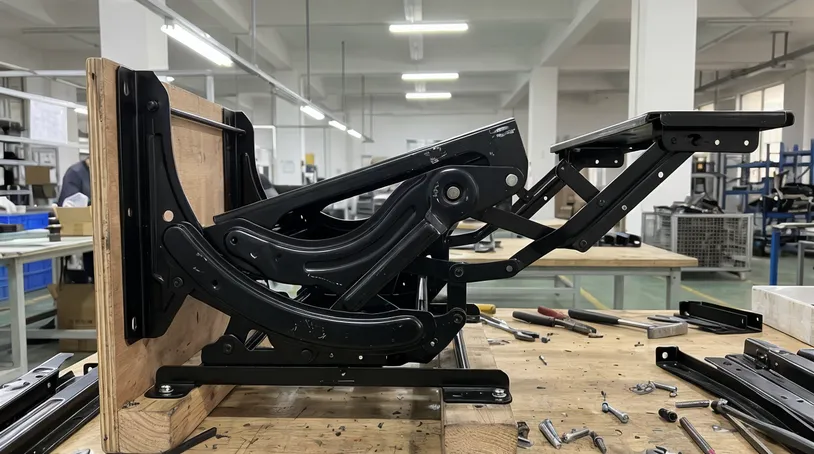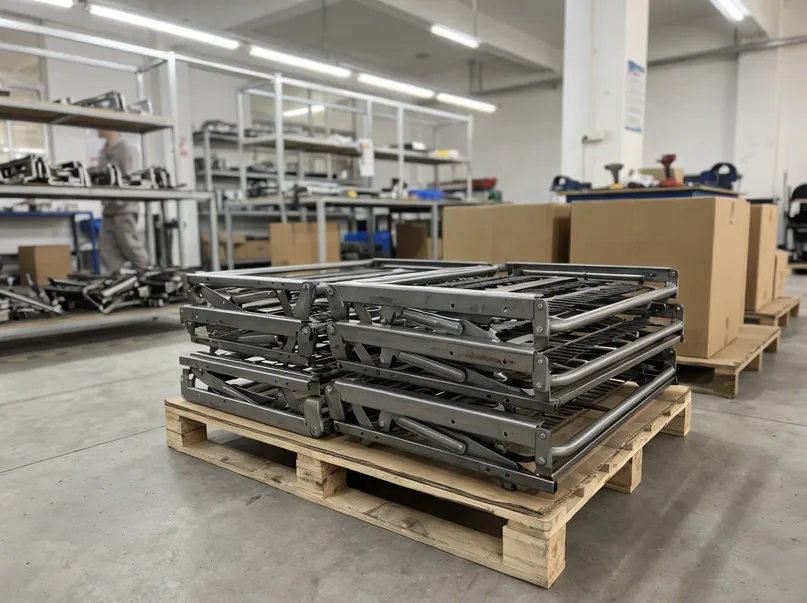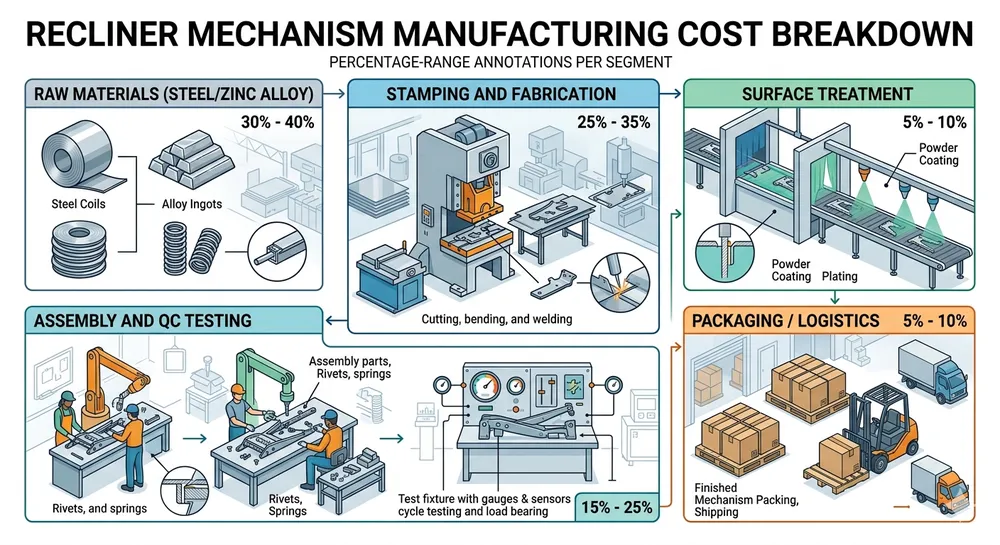
Most pricing confusion in this category comes from the same place: two mechanisms look identical in a product photo, one quotes at $4.50 and the other at $16.00, and nobody explains why. You end up either overpaying for specs you don't need or buying something that fails at 8,000 cycles when your warranty covers 50,000.
We've been manufacturing recliner mechanisms since 2008. This breakdown covers what actually drives the number on your quotation — not in theory, but from the factory floor.

Raw Material: Where Most of the Cost Lives
Steel is the dominant input. A standard recliner linkage assembly uses cold-rolled steel plate — typically 2.0mm to 3.0mm gauge for the main side plates, with thinner stock (1.2–1.5mm) for secondary brackets and pivot supports. The grade matters: Q235 is common in budget mechanisms; SPCC or equivalent cold-rolled grades give tighter dimensional tolerance and more consistent yield strength, which matters when you're stamping complex profiles at volume.
Zinc alloy die-casting adds cost where it appears — handle knobs, decorative covers, and some pivot housings use ZA-8 or Zamak 3 alloy. Die-cast parts cost more per unit than stamped steel, but they allow geometry that stamping can't produce cleanly. When a supplier swaps a die-cast pivot housing for a bent-steel substitute to cut cost, you usually see it in the feel of the mechanism — slop in the pivot, uneven resistance through the recline arc.
Spring wire is the third material variable. The recline return spring and the footrest extension spring both need consistent wire diameter and temper. Undersized or under-tempered spring wire is one of the most common failure modes we see in returned samples from the market — the spring takes a set after 5,000–10,000 cycles and the mechanism stops returning to upright cleanly.
(We source spring wire from two approved mills and run incoming hardness checks on every coil. It sounds like overkill until you've seen a container of sofas fail warranty because the spring wire was 0.1mm undersize.)
Stamping Complexity and Tooling Amortization
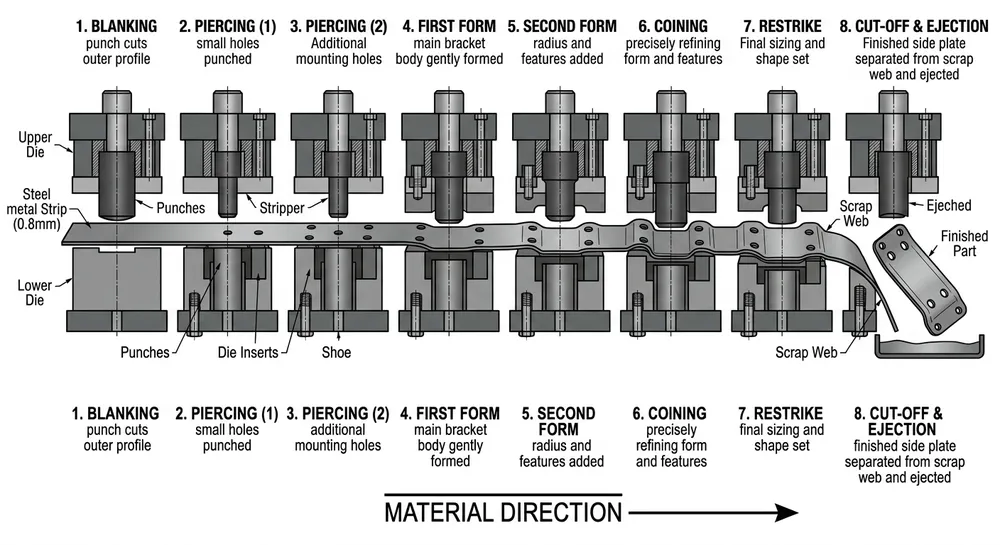
The side plates of a recliner mechanism are not simple blanks. A typical profile involves 6–10 progressive die stations: blanking, piercing, forming, coining, and sometimes a restrike pass to hit tight flatness tolerances on the pivot hole locations. The more complex the profile, the more die stations, the higher the tooling cost — and the higher the per-piece cost if the run volume doesn't amortize the tooling efficiently.
This is where MOQ and unit price are directly connected. A mechanism with a complex stamped profile on a 500-unit order carries a higher per-unit cost than the same mechanism on a 5,000-unit order, because the tooling amortization spreads differently. When you see a supplier quote the same price regardless of quantity, they're either running very simple tooling or they're hiding the tooling cost somewhere else in the margin.
We run 6 production lines across our 12,000 m² facility, and progressive die stamping is the core of our process. For standard catalog mechanisms, tooling is already amortized — your 500-unit order gets the same stamped quality as a 10,000-unit run. For OEM profiles, we quote tooling separately and amortize it over the agreed volume, so the per-unit cost is transparent.
Surface Treatment: The Cost You Can See and the Risk You Can't
Surface treatment is where budget mechanisms cut corners most aggressively, and where the cost difference is hardest to see in a photo.
The three main options we run:
| Treatment | Typical Cost Premium | Salt Spray Performance | Best For |
|---|---|---|---|
| Zinc electroplating | Baseline | 72–120 hrs | Dry indoor use, cost-sensitive |
| Nickel plating | +15–25% | 200–300 hrs | Mid-range, visible components |
| Powder coating | +20–35% | 500+ hrs | Export markets, coastal/humid climates |
Zinc plating is the cheapest and the most common in the $4–$7 mechanism range. It's adequate for dry indoor environments, but it's not what you want if your furniture is going to coastal markets, humid climates, or anywhere with salt air. We've seen zinc-plated mechanisms from budget suppliers show surface rust within 18 months in Gulf region deployments — that's a warranty claim problem for your customer, not just an aesthetic one.
Powder coating adds cost but changes the risk profile entirely. Our automated powder line runs 60–80μm consistent thickness, and we test to 500-hour salt spray before approving a surface treatment spec for export. If your target market includes North America, Australia, or the Middle East, the powder coat premium is cheaper than the RMA cost.
Nickel plating sits in the middle — better corrosion resistance than zinc, lower cost than powder coat, and it gives a cleaner appearance on visible hardware. We use it on handle components and exposed pivot covers where aesthetics matter to the end product.
Cycle-Life Engineering: The Spec That Separates Price Tiers
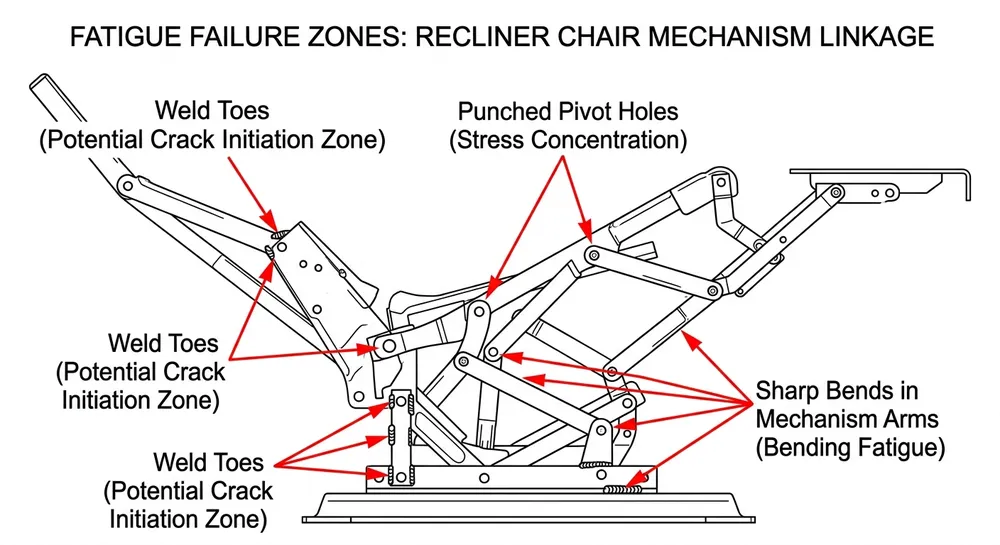
A recliner mechanism is a fatigue component. It flexes, loads, and returns thousands of times over its service life. The engineering decisions that determine cycle life — pivot hole tolerance, spring wire spec, rivet vs. bolt assembly at key joints — are invisible in a product photo but show up clearly in a load-cycle test.
Industry reference points for cycle-life ratings:
| Mechanism Grade | Typical Cycle Rating | Typical Application |
|---|---|---|
| Economy | 10,000–20,000 cycles | Entry-level residential |
| Standard | 30,000–50,000 cycles | Mid-range residential, hospitality |
| Commercial | 80,000–100,000+ cycles | Contract furniture, healthcare |
The difference between a 20,000-cycle mechanism and a 50,000-cycle mechanism isn't just the test result — it's the pivot hole tolerance (±0.1mm vs. ±0.05mm), the spring wire diameter, the rivet shank diameter at the main pivot, and whether the side plates are coined flat at the pivot zone or just formed. Each of those decisions adds cost. None of them are visible until the mechanism fails.
We run 100% functional testing on every unit before shipment, and load-cycle verification on production samples per batch. If you're sourcing for a hospitality or contract furniture application, ask your supplier for the cycle-life test report — not just the claimed rating, but the actual test data. A supplier who can't produce it is quoting you a number, not a verified spec.
(The most common sourcing mistake we see: buyers spec a 50,000-cycle mechanism, get quoted a price that only makes sense for a 20,000-cycle build, and don't find out until the first warranty season.)
Assembly Method and Labor Content
How a mechanism is assembled affects both cost and durability. The main variables are riveting vs. bolting at pivot joints, manual vs. semi-automated assembly, and whether the final adjustment (recline angle, footrest extension stop) is set and locked at the factory or left for field adjustment.
Riveted pivot joints are faster to assemble and lower cost, but they're permanent — if a pivot wears, the joint can't be serviced. Bolted joints with nylon-insert locknuts cost more in hardware and assembly time, but they allow field adjustment and are preferred in commercial and healthcare applications where serviceability matters.
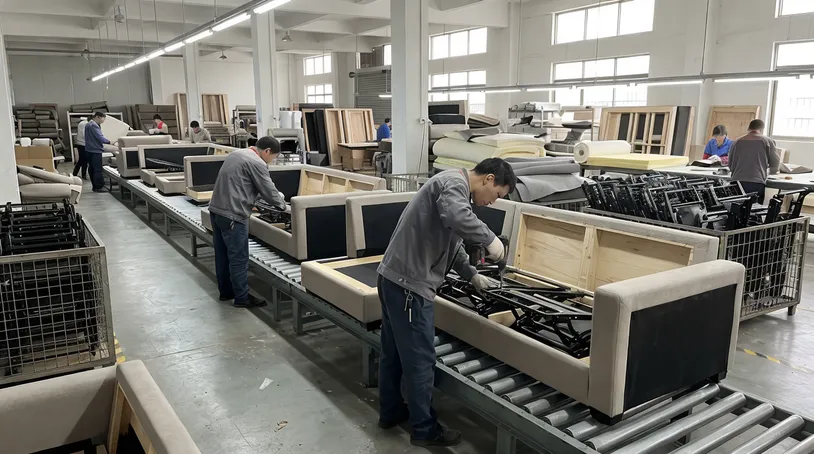
We run semi-automated assembly on our standard catalog mechanisms — consistent torque on fasteners, consistent spring pre-load, consistent recline angle setting. Manual assembly lines are still in our facility for custom configurations and low-volume OEM runs, but the tolerance stack-up on a fully manual line is wider. That matters when you're trying to hit a consistent recline angle across a 2,000-unit batch.
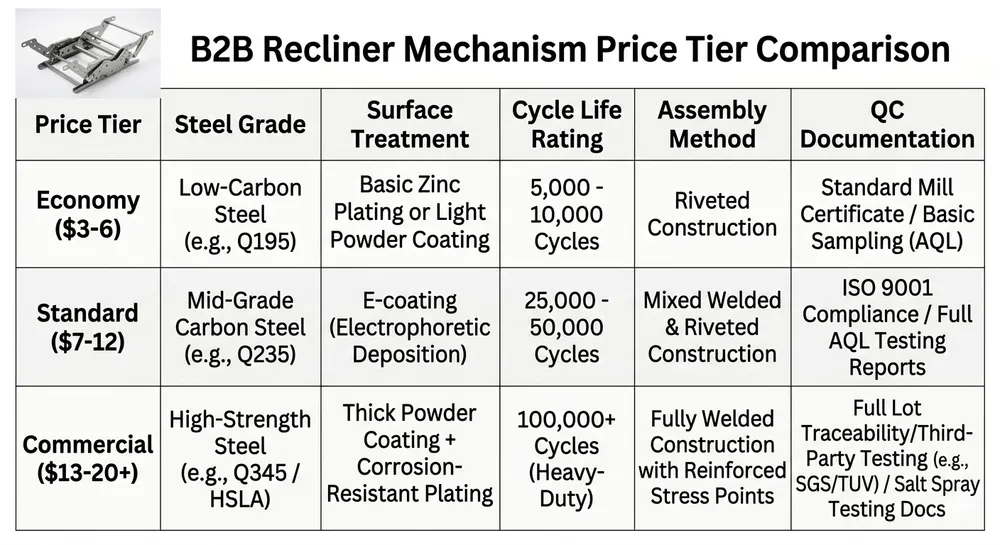
What the Price Tiers Actually Mean
Putting it together, here's what the price ranges in the market typically reflect:
| Price Range (FOB) | What You're Getting |
|---|---|
| $3–$6 | Q235 steel, zinc plating, manual assembly, 10,000–20,000 cycle rating, no test documentation |
| $7–$12 | SPCC steel, nickel or powder coat, semi-auto assembly, 30,000–50,000 cycles, batch test reports available |
| $13–$20+ | Tight-tolerance stamping, full powder coat or nickel, bolted pivots, 80,000+ cycles, full QC documentation, OEM support |
These are FOB China reference ranges for standard catalog mechanisms. Custom profiles, OEM tooling, and special surface treatments move the number. So does order volume — a 500-unit order and a 5,000-unit order on the same mechanism don't cost the same per unit.
The $3–$6 range isn't always wrong. If you're sourcing for a price-sensitive domestic market with low warranty exposure and short product cycles, a 15,000-cycle mechanism with zinc plating may be exactly right. The mistake is buying it when your application needs 50,000 cycles and your warranty covers three years.
The Sourcing Documents Worth Requesting
When you're evaluating suppliers at RFQ stage, the documents that actually tell you something:
- Load-cycle test report — should state the test standard, load weight, cycle count, and pass/fail criteria. A claimed rating without a report is marketing.
- Salt spray test report — relevant if your market has any humidity or coastal exposure. Ask for the hours and the standard (typically ISO 9227 or ASTM B117).
- Dimensional inspection report — pivot hole locations and tolerances. This matters if you're integrating the mechanism into a frame with tight clearances.
- Material certificate — steel mill cert for the main structural plates. Confirms the grade you're paying for.
We hold ISO 9001:2015 certification and carry CE, SGS, and RoHS documentation. For export orders, we can provide batch-level QC reports, salt spray test data, and cycle-life test reports on request. These aren't extras — they're part of what you're paying for when you move up from the $4 tier.
Landed Cost Is Not the Same as Unit Price
One more variable that doesn't show up in the mechanism price: how the mechanism affects your total landed cost.
Packaging density matters. A mechanism that ships KD (knocked-down flat) packs 30–40% more units per carton than one that ships assembled. On a 40-foot container, that's a meaningful freight cost difference. We design our standard mechanisms to ship flat where the assembly sequence allows it, and we can advise on carton configuration for container optimization.
Weight matters too. A mechanism that uses zinc die-casting extensively will be heavier than an equivalent stamped-steel design. For air freight or markets with high import duties on weight, that adds up. We've had buyers switch from a die-cast-heavy design to a stamped equivalent specifically to reduce freight cost — the mechanism was $1.50 cheaper per unit and saved another $0.80 in freight. That's a real margin improvement.
If you're comparing two mechanism quotes and one is $2 cheaper per unit, run the landed cost calculation before you decide. The cheaper mechanism may cost more by the time it clears customs and reaches your warehouse.
Common Questions from Importers
What's the minimum order for a standard recliner mechanism? Our MOQ is 500 units for standard catalog mechanisms. For OEM or custom profiles, MOQ depends on tooling amortization — we'll quote both the tooling cost and the per-unit price together so you can see the full picture.
Can I get a sample before committing to a production order? Yes. Most buyers in this category start with 2–5 sample units to test fit and cycle life against their frame design. We ship samples with full spec documentation so you can run your own evaluation.
What cycle-life rating do I need for hospitality or contract furniture? For hospitality (hotels, serviced apartments), 50,000 cycles is the practical minimum. For healthcare or high-use commercial environments, specify 80,000+ and ask for the test report. The mechanism will be used harder and more frequently than residential, and warranty claims in those segments are expensive.
How do I know if a supplier's cycle-life claim is real? Ask for the test report, not just the number. The report should name the test standard, the load applied (typically 100–120 kg for a recliner mechanism), the cycle count, and the pass criteria. If a supplier can't produce the report, the number is a guess.
Does surface treatment affect the mechanism's function over time? Yes, indirectly. Corrosion at pivot points increases friction and wear. A mechanism that starts smooth can become stiff or develop play in the joints after 2–3 years in a humid environment if the surface treatment wasn't adequate. This is the failure mode that generates the most warranty claims in coastal and tropical markets.
—
For a full overview of our Recliner & Sofa Mechanism range — including standard catalog specs, cycle-life ratings, and surface treatment options — the category page has the detail you need to match a mechanism to your application. When you're ready to compare options or get pricing on a specific configuration, request a quote with your target market, volume, and any frame integration requirements.