Most US furniture importers find recliner mechanism suppliers the same way: a Thomasnet search, a few Alibaba pages, maybe a referral from a freight forwarder. The result is usually a short list of distributors with opaque pricing, a handful of trading companies presenting themselves as factories, and one or two genuine manufacturers buried somewhere in the middle. This guide cuts through that noise.
Below is a working list of 10 real suppliers — domestic distributors, international manufacturers, and factory-direct options — mapped against the criteria that actually matter for a repeat-volume import program: MOQ, certifications, OEM capability, and whether you're buying from the factory or from someone who bought from the factory.
The ranking isn't a quality score. It's a sourcing landscape. Read it as a map, not a leaderboard.

What US Importers Are Actually Paying For When They Source Locally
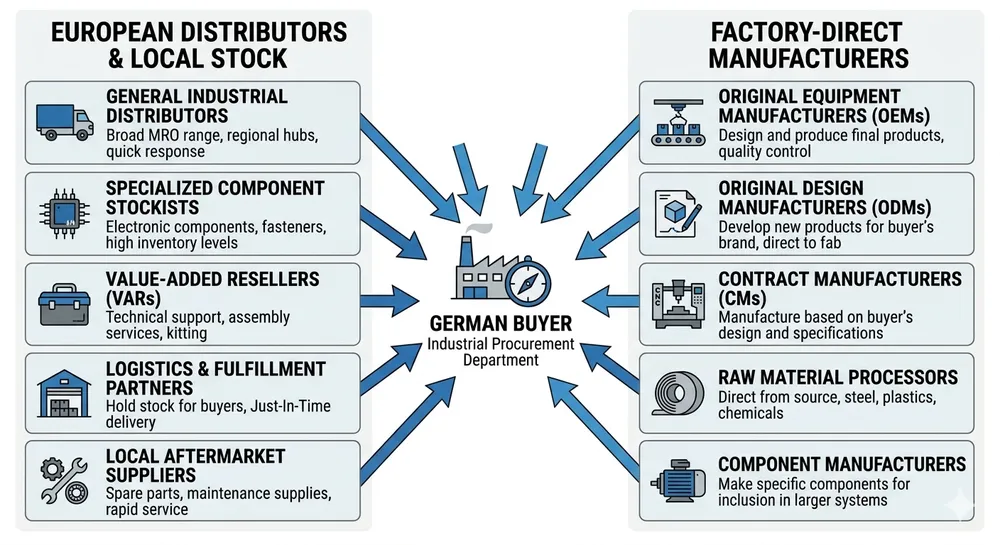
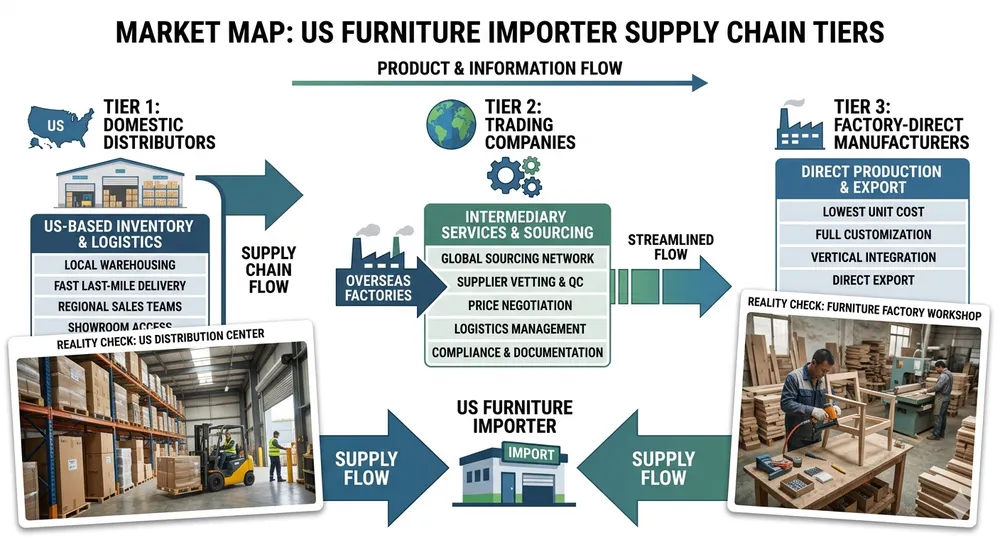
Before the list, a structural point worth understanding: the US recliner mechanism market doesn't have many domestic manufacturers. What it has is a well-developed distribution layer — companies that import mechanisms from China, stock them in US warehouses, and sell them at domestic margins. That's a legitimate service. You get faster replenishment, easier returns, and a phone call in your time zone. You also pay for all of it.
The typical markup through a domestic distributor runs 40–70% above factory price, depending on volume and SKU. For a furniture importer buying 500–2,000 units per order, that margin compression is real. At 1,000 units of a mid-grade recliner mechanism, the difference between distributor pricing and factory-direct pricing often covers your ocean freight and still leaves margin on the table.
That's not an argument against local sourcing. It's context for when local sourcing makes financial sense — and when it doesn't.
How to Evaluate a Recliner Mechanism Supplier Before You Commit
The questions that separate a reliable supplier from a risky one aren't complicated. They're just not the questions most buyers ask on the first call.
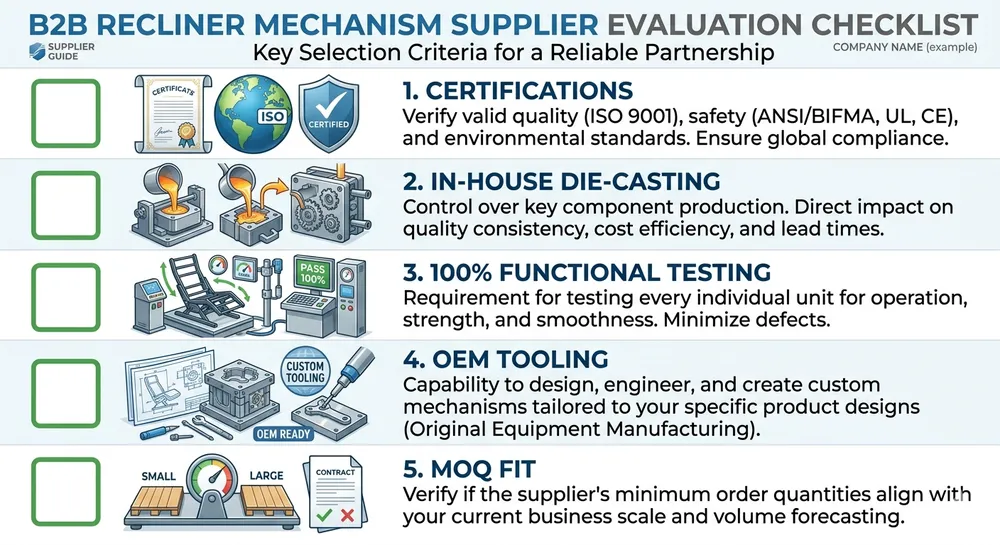
Certifications that travel with the shipment: CE, SGS, and RoHS documentation should ship with the order, not arrive three weeks later after you've chased them. For US importers, RoHS compliance matters if your downstream customers sell into California or EU-adjacent markets. CE matters if you export or supply brands that do. Ask for the actual test reports, not just a certificate number.
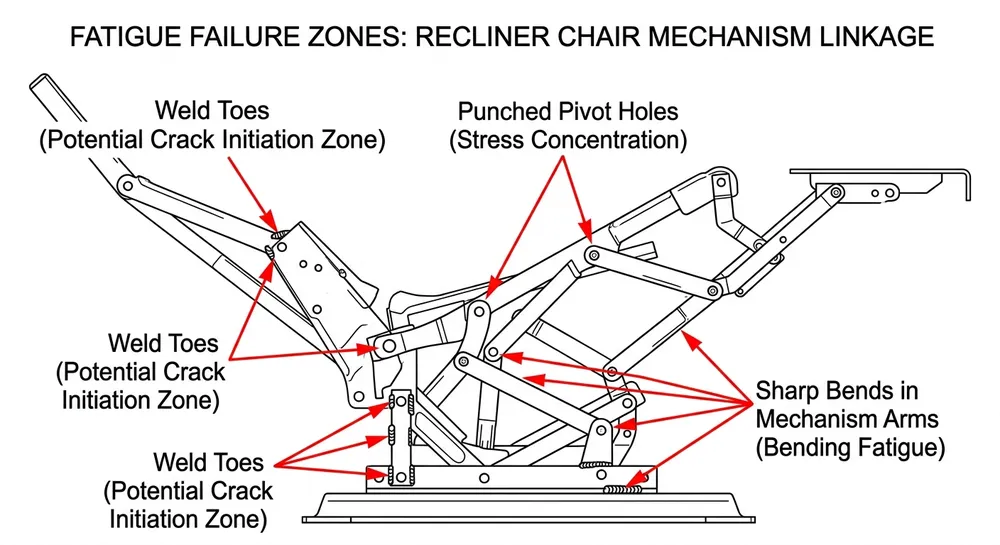
In-house die-casting vs. outsourced: The most common quality failure point in recliner mechanisms is the die-cast components — adjustment knobs, pivot collars, decorative covers. Factories that outsource die-casting to third-party foundries have no direct control over dimensional consistency or surface finish on those parts. When a batch comes back with loose-feeling knobs or inconsistent plating, the factory is negotiating with their supplier while your container sits. Ask directly: do you cast in-house or buy from a foundry?
100% functional testing vs. AQL sampling: AQL sampling at standard levels passes batches with a statistically acceptable defect rate. For mechanisms, "acceptable" defects mean sticky tilt locks and misaligned mounting holes in your customer's furniture. 100% functional testing before shipment is the only standard that eliminates that risk at the source.
OEM tooling ownership and lead time: If you need a custom mechanism — different spring rate, modified mounting pattern, branded adjustment knob — the question is whether the factory builds tooling in-house or sends it to a third-party tooling shop. In-house tooling means faster sample iterations. Third-party tooling means your sample revision timeline depends on someone else's schedule.
MOQ and volume fit: Standard catalog mechanisms from Chinese factories typically run 500–1,000 units minimum. OEM/ODM projects with new tooling run higher, depending on tooling amortization. Domestic distributors often have no MOQ on stocked items but price accordingly. Know your order cadence before you optimize for MOQ.
The 10 Suppliers: A Sourcing Landscape
1. Leggett & Platt — Carthage, Missouri, USA
Leggett & Platt is the largest US-based manufacturer of furniture components, including recliner mechanisms and motion hardware. Their Furniture Products segment supplies major US furniture brands directly. For importers, L&P is typically not a direct option — they supply OEM to furniture manufacturers at scale, not to importers buying mechanisms for resale. Pricing reflects their domestic cost structure. If your customer base requires "Made in USA" components or you're supplying a brand with L&P as a specified supplier, they're the reference point. For cost-sensitive import programs, they're the ceiling, not the floor.
Supplier type: Domestic manufacturer | MOQ: OEM contract volumes | OEM: Yes | Certifications: BIFMA, internal standards
—
2. Ashley Furniture Industries — Arcadia, Wisconsin, USA
Ashley is primarily a furniture manufacturer and retailer, not a mechanism supplier — but they're relevant here because they manufacture their own recliner mechanisms in-house for their production lines and are one of the few vertically integrated US furniture operations at scale. They don't sell mechanisms as a standalone product. They appear on this list because importers sometimes encounter Ashley-spec mechanisms in the secondary market or through contract manufacturing arrangements. If you're trying to match an Ashley mechanism spec for a compatible product line, their engineering specs are the reference.
Supplier type: Vertically integrated manufacturer (not a mechanism supplier) | Relevance: Spec reference only
—
3. Seatcraft / Octane Seating — USA
Seatcraft is a US-based home theater and recliner seating brand that sources mechanisms from Asian manufacturers and assembles or imports finished product. They're not a mechanism supplier. They appear in searches because their product line is mechanism-heavy and they're visible in the US market. Useful as a market reference for what mechanism specs US consumers are buying — not a sourcing channel for mechanisms themselves.
Supplier type: Importer/brand | Relevance: Market reference
—
4. Hettich — Germany / US distribution
Hettich is a German furniture hardware manufacturer with strong US distribution through their North American subsidiary. Their core product range is cabinet hardware, drawer systems, and hinges — not recliner mechanisms specifically. They appear in broad furniture hardware searches and have US warehouse stock. For recliner mechanism sourcing, Hettich is adjacent rather than central — worth knowing if you're consolidating furniture hardware suppliers, but not a primary recliner mechanism source.
Supplier type: European manufacturer with US distribution | MOQ: Varies by SKU | Certifications: ISO 9001, CE
—
5. Blum — Austria / US distribution
Julius Blum GmbH is a precision furniture hardware manufacturer — lift systems, hinge systems, drawer runners — with a significant US presence through their Stanley, NC facility. Like Hettich, their product range doesn't cover recliner mechanisms directly. They're included here because they represent the quality benchmark for precision furniture hardware and are a useful reference point for buyers evaluating mechanism tolerances and cycle-life standards. If a supplier claims their mechanisms meet "European hardware standards," Blum's published cycle-life specs are the benchmark to check against.
Supplier type: European manufacturer with US operations | Relevance: Quality benchmark reference
—
6. Foshan Nanhai Oulang Hardware Co., Ltd. — Foshan, China
Oulang is a Foshan-based furniture hardware manufacturer with recliner mechanism products in their catalog. They appear on Alibaba and Global Sources with mechanism listings. Based on available information, they operate as a manufacturer rather than a pure trading company, though their product range spans general furniture hardware beyond mechanisms. Certification documentation and OEM capability should be verified directly before ordering. Typical of mid-tier Foshan hardware factories: competitive pricing, broad catalog, variable QC consistency depending on SKU.
Supplier type: Chinese manufacturer (general hardware) | MOQ: ~500–1,000 units | OEM: Reported | Certifications: Verify directly
—
7. Foshan Shunde Longhua Furniture Machinery Co., Ltd. — Foshan, China
Longhua is primarily a furniture machinery manufacturer — the equipment used to make furniture, not the mechanisms inside it. They appear in mechanism-adjacent searches due to their Foshan location and furniture industry positioning. Not a recliner mechanism supplier. Included here to flag a common search result confusion: machinery manufacturers and mechanism manufacturers share search real estate in this category, and conflating them wastes sourcing time.
Supplier type: Furniture machinery manufacturer | Relevance: Not a mechanism supplier — flag for search disambiguation
—
8. Guangdong Kaidi Furniture Hardware Co., Ltd. — Guangdong, China
Kaidi is a Guangdong-based furniture hardware manufacturer with recliner and sofa mechanism products. They supply to domestic Chinese furniture manufacturers and export to Southeast Asian markets. Their product range includes recliner linkages and sofa bed mechanisms. Export documentation and certification status for US market compliance should be confirmed directly — their primary market focus appears to be domestic and regional rather than North American compliance-heavy channels.
Supplier type: Chinese manufacturer | MOQ: ~500 units | OEM: Reported | Certifications: Verify for US market compliance
—
9. Zhongshan Lecong Hardware Co., Ltd. — Guangdong, China
Lecong operates in the Guangdong furniture hardware cluster with recliner mechanism and sofa hardware products. They have export history to multiple markets. As with most mid-tier Guangdong hardware factories, the key verification questions are around in-house manufacturing depth (stamping, die-casting, surface treatment) versus assembly-only operations, and whether compliance documentation is current and market-specific. Buyers sourcing from this tier should request factory audit reports and current test certificates before committing to a container order.
Supplier type: Chinese manufacturer | MOQ: ~500–1,000 units | OEM: Reported | Certifications: Verify directly
—
10. MVMHardware (Foshan Jinruida Import And Export Co., Ltd.) — Guangdong, China
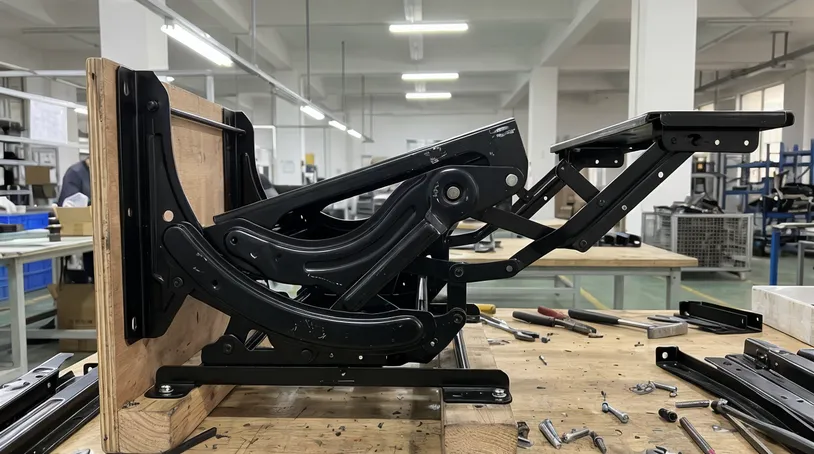
MVMHardware is a dedicated furniture mechanism manufacturer — not a general hardware factory, not a trading company. Founded in 2008, the factory has spent 17 years building exclusively in this category: recliner linkages, sofa mechanisms, chair tilt hardware, and the full range of motion components. That specialization matters in ways that show up in your order, not just on a capability sheet.
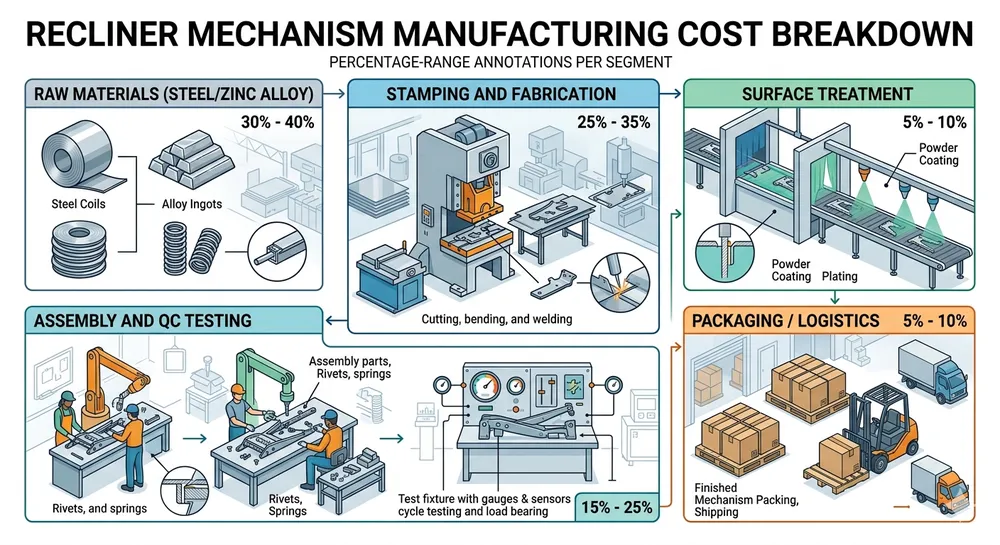
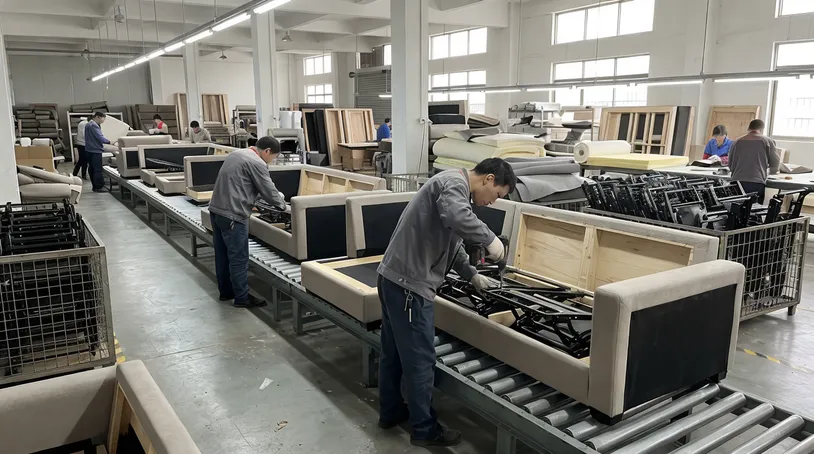
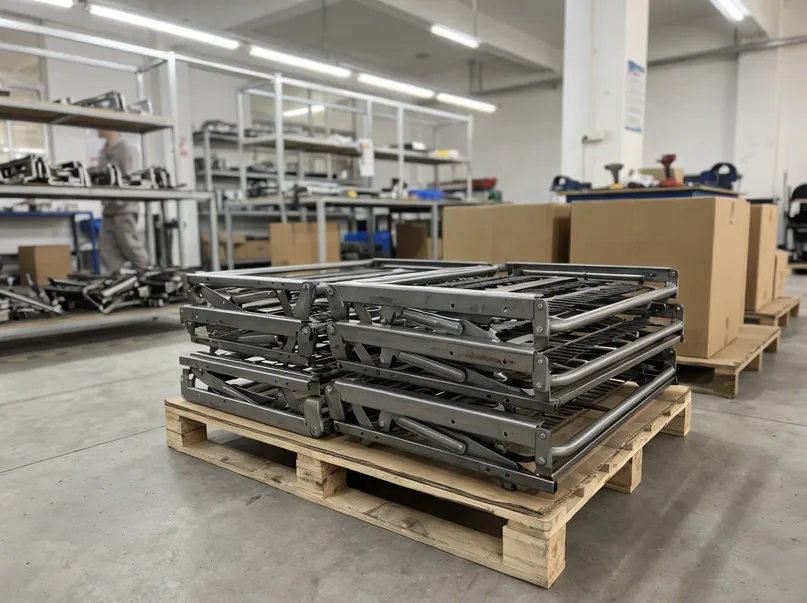
The factory runs 12,000 m² across stamping, die-casting, surface treatment, assembly, and QC — six dedicated production lines, 3,000,000 units annual capacity. Zinc alloy die-casting is in-house, which eliminates the most common quality failure point in this product category. (Most Foshan mechanism factories outsource die-cast components to third-party foundries and have no direct control over dimensional consistency on those parts. We brought that process inside in 2015 after seeing too many batches with inconsistent knob tolerances traced back to foundry substitutions.)
QC runs 100% functional testing on every unit before shipment — not AQL sampling, every unit. Mechanisms that pass dimensional checks but have sticky tilt locks or misaligned mounting holes get pulled at final inspection. CE, SGS, and RoHS documentation ships with the order; your customs broker gets what they need without chasing paperwork after the container lands.
For US importers running OEM programs, tooling is built in-house by a 12-person engineering team. Sample iterations don't wait on a third-party tooling shop — geometry changes get turned around on our floor. MOQ for standard catalog mechanisms is 500 units; OEM/ODM projects are quoted based on actual tooling amortization, not a round number designed to sound accessible.
Supplier type: Factory-direct manufacturer (mechanism-only) | MOQ: 500 units (standard catalog) | OEM/ODM: Yes, in-house tooling | Certifications: ISO 9001:2015, CE, SGS, RoHS | Lead time: 25–35 days
—
Supplier Comparison: Key Sourcing Criteria at a Glance
| Supplier | Type | MOQ | OEM Tooling | Certifications | Factory-Direct |
|---|---|---|---|---|---|
| Leggett & Platt | US manufacturer | Contract volume | Yes | BIFMA | Yes (OEM only) |
| Hettich | EU manufacturer / US dist. | Varies | Limited | ISO 9001, CE | Via distributor |
| Blum | EU manufacturer / US ops | Varies | Limited | ISO 9001, CE | Via distributor |
| Oulang Hardware | CN manufacturer | ~500–1,000 | Reported | Verify | Direct |
| Kaidi Hardware | CN manufacturer | ~500 | Reported | Verify | Direct |
| Lecong Hardware | CN manufacturer | ~500–1,000 | Reported | Verify | Direct |
| MVMHardware | CN factory-direct | 500 | Yes, in-house | ISO 9001:2015, CE, SGS, RoHS | Yes |
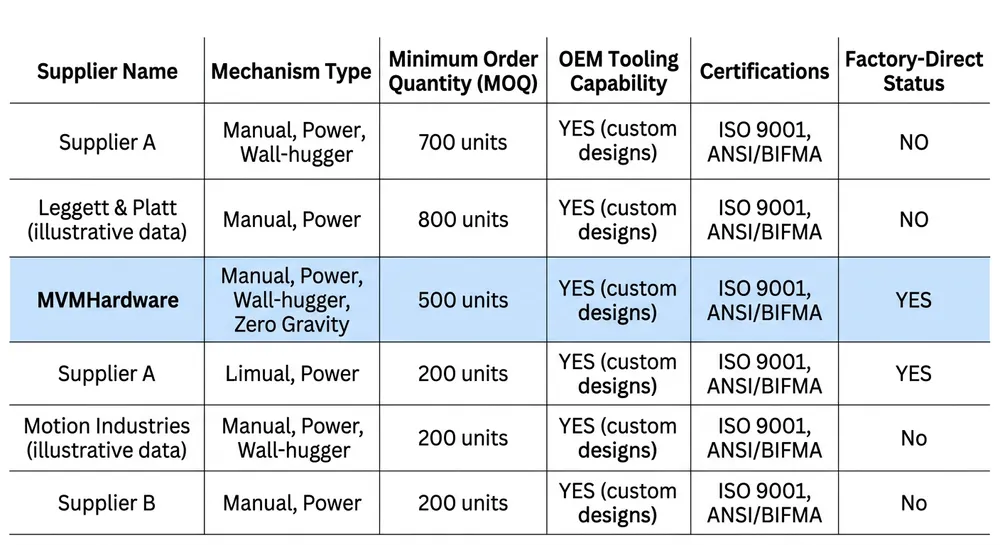
The Cost of the Distribution Layer — When It's Worth It and When It Isn't
Domestic distributors and trading companies exist because they solve real problems. If you need 200 units of a standard recliner mechanism in three weeks to fulfill an urgent order, a US warehouse stock position is worth the premium. If you're replacing a failed batch and can't wait 30 days for ocean freight, local inventory is the right answer. Emergency replenishment, small fill-in orders, and compliance-timing situations all favor the local distribution model.
The math changes at repeat volume. A furniture importer running 1,000–5,000 units per order on a quarterly cadence is paying the distribution premium on every single order — and that premium compounds. At 1,000 units of a mid-grade recliner mechanism, the factory-direct price difference typically covers ocean freight and leaves 15–25% margin improvement on the table. At 3,000 units, the economics are harder to ignore.
The other cost of the distribution layer is specification control. When you buy through a distributor, you're buying their SKU — their spring rate, their mounting pattern, their surface finish. If your furniture design needs a modified mechanism, you're either redesigning around their catalog or going back to the factory anyway. Importers building branded furniture lines or supplying private-label programs eventually hit this ceiling.
(We see this pattern regularly: a buyer starts with a domestic distributor for speed and convenience, runs two or three orders, then contacts us when they need a custom mounting pattern or a different tilt resistance for a specific market. The transition to factory-direct usually happens when the product line matures enough to justify the volume commitment.)
Vetting a Chinese Mechanism Factory Before Your First Container
The gap between a factory's Alibaba profile and their actual production capability is real and worth closing before you commit to a 40HQ container. A few verification steps that cost nothing but time:
Request a factory audit report or third-party inspection certificate. SGS, Bureau Veritas, and Intertek all conduct factory audits in Guangdong. A factory that has been audited recently will have the report. One that hasn't will offer to arrange one — which tells you something.
Ask for the actual CE and RoHS test reports, not just the certificate. A certificate number is easy to produce. The underlying test report from an accredited lab shows the specific product tested, the test date, and the pass/fail results. If the report is more than two years old or covers a different product than what you're ordering, ask for current documentation.
Request a sample order before the container. Standard practice, but worth stating: a 10–20 unit sample order run through your own QC process tells you more than any factory visit. Test the tilt range, the lock engagement, the cycle feel. Load-test to your own spec. The sample is your contract reference point.
Clarify the manufacturing scope. Ask directly: do you stamp your own mechanism plates, or do you buy blanks? Do you die-cast in-house, or source from a foundry? Do you do surface treatment on-site? The answers tell you how much of the quality chain the factory actually controls — and where the risk sits if something goes wrong.
For a deeper look at the full Recliner & Sofa Mechanism product range and what to specify for different market segments, that category page covers the mechanism types, motion configurations, and load ratings relevant to US import programs.
Which Sourcing Route Fits Your Program
The right supplier depends on your order profile, not on a ranking.
Local distributor or domestic stock: Right for urgent small orders, emergency replenishment, and situations where lead time matters more than unit cost. Expect to pay 40–70% above factory price for that convenience.
Chinese trading company: Lower price than domestic distribution, but you're still paying a markup layer and you have no direct relationship with the factory. QC issues get filtered through the trading company, which means slower resolution and less leverage. Useful for one-off orders where you don't need ongoing supplier development.
Factory-direct from a general hardware manufacturer: Competitive pricing, but verify manufacturing depth carefully. General hardware factories that added mechanisms to their catalog may not have the process control or engineering depth for consistent quality at repeat volume.
Factory-direct from a mechanism-specialist manufacturer: The right model for importers running repeat-volume programs, OEM product lines, or compliance-sensitive supply chains. Higher upfront vetting effort, but the economics and quality consistency improve with every order.
If your program is at the stage where you're placing 500+ units per order on a recurring basis, or you need OEM tooling for a custom mechanism, the factory-direct route is worth the transition cost. For an OEM recliner mechanism program with in-house tooling and compliance documentation, the sourcing conversation starts with your spec — not a catalog.
Frequently Asked Questions
What certifications should a recliner mechanism supplier have for US import?
For US import, the minimum documentation you should request is RoHS compliance (required if your downstream customers sell into California or EU-adjacent markets) and SGS or equivalent third-party test reports covering the specific mechanism you're ordering. CE certification is required if you export to Europe or supply brands that do. ISO 9001:2015 covers the quality management system — it tells you the factory has documented processes, not that every unit is tested. Ask for the actual test reports, not just certificate numbers.
What is a realistic MOQ for factory-direct recliner mechanisms from China?
Standard catalog mechanisms from established Chinese factories typically run 500–1,000 units minimum. OEM/ODM projects with new tooling run higher — the MOQ is driven by tooling amortization, and a factory quoting you a flat 500-unit MOQ on a custom mechanism without explaining the tooling cost structure is either absorbing the tooling cost (unlikely) or building it into the unit price (common). Get the tooling cost and unit price separated in your quote.
How do I tell if a Chinese supplier is a factory or a trading company?
Ask for their business license (营业执照) and check the registered business scope — a factory will list manufacturing activities. Ask for photos of their production floor with equipment visible, not just finished product shots. Request the factory audit report from SGS, BV, or Intertek. Trading companies can produce polished catalogs and fast responses; they can't produce a factory audit report for a facility they don't own. If they offer to "arrange" an audit rather than provide an existing one, that's your answer.
What lead time should I plan for factory-direct recliner mechanisms?
Standard catalog items from a Chinese mechanism factory run 25–35 days from order confirmation and deposit. OEM/ODM projects with new tooling run longer — plan for tooling fabrication (typically 15–20 days), sample approval, and then production. The most common delay is spec changes after production starts. Lock your specification before placing the order; changes mid-production reset the timeline and add cost for both sides.
What's the difference between AQL sampling and 100% functional testing?
AQL (Acceptable Quality Level) sampling tests a statistically representative sample from a batch and accepts the batch if the defect rate falls below a threshold. At standard AQL 2.5, a batch of 1,000 units passes if fewer than 21 sampled units fail — meaning up to 20 defective units can ship in a passing batch. For recliner mechanisms, those defects are sticky tilt locks and misaligned mounting holes in your customer's furniture. 100% functional testing tests every unit before packing — no defective unit passes, regardless of batch statistics.
—
Ready to compare factory-direct pricing against your current supplier? Send your mechanism spec, motion type, and target volume to Request Quote — we'll come back with a specific quote and the compliance documentation your customs broker needs, not a generic price sheet.
“`