Most quality problems with chair mechanisms don't show up at the port. They show up six months later, when your customer's chair starts clicking, the tilt locks up, or the gas lift drops under load. By then you've already cleared customs, paid your freight, and distributed the batch.
The standards that prevent this aren't complicated — but they're easy to skip when you're moving fast through sampling. This article walks through what actually matters in chair mechanism quality, what the specs mean in practice, and what to check before you commit to a production run.
—
What "chair mechanism quality" actually covers
A chair mechanism is a load-bearing assembly. It handles dynamic stress every time someone sits, reclines, adjusts height, or shifts weight. Quality isn't a single number — it's a combination of material grade, dimensional tolerance, surface treatment, and cycle-life performance working together.
When we talk about chair mechanism quality at the factory level, we're covering four things:
- Structural integrity: Can the mechanism carry rated load without deformation?
- Cycle life: How many tilt/recline/lift cycles before functional failure?
- Surface durability: Does the finish hold up to sweat, humidity, and handling?
- Dimensional consistency: Are the mounting holes, travel ranges, and clearances repeatable batch to batch?
A mechanism that passes on one of these and fails on another will still generate warranty claims. The spec sheet needs to address all four.
—
The core specs that determine sourcing risk
Here's where most importers get into trouble: they evaluate mechanisms by price and appearance, not by the underlying specs that determine field performance. The table below covers the parameters worth asking about before sampling.
| Parameter | Typical market range | What to specify |
|---|---|---|
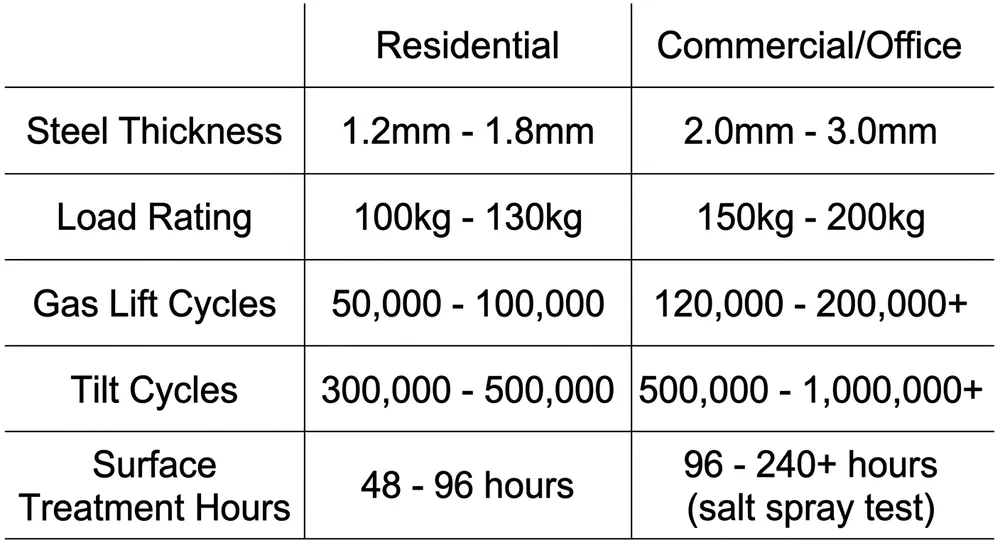
| Steel body thickness | 1.2 mm – 2.5 mm | ≥ 1.8 mm for commercial/office use |
| Tilt mechanism load rating | 100 kg – 150 kg | ≥ 120 kg for standard office; ≥ 150 kg for heavy-duty |
| Gas lift cycle life | 50,000 – 100,000+ cycles | ≥ 80,000 cycles for commercial accounts |
| Tilt cycle life | 50,000 – 200,000 cycles | ≥ 100,000 cycles for office/contract |
| Surface treatment | Zinc plate, powder coat, nickel plate | Specify salt spray hours: ≥ 200 hrs minimum |
| Mounting hole tolerance | ±0.3 mm – ±0.8 mm | ±0.5 mm or tighter for OEM fit |
(The gas lift cycle spec is the one most often omitted from supplier quotes. Ask for it explicitly — a supplier who can't provide it hasn't tested it.)
The steel thickness spec matters more than most buyers realize. At 1.2 mm, a tilt plate will handle light residential use but will fatigue under daily commercial loading. We run our standard office mechanisms at 1.8 mm body steel and step up to 2.0–2.2 mm for heavy-duty configurations. The difference in material cost is small; the difference in warranty exposure is not.

—
Load testing and cycle life: what the numbers mean for your market
A 100,000-cycle tilt test sounds like a lot until you do the math. An office worker who reclines 20 times per day hits 100,000 cycles in about 14 years. That's a reasonable service life for a commercial chair. A mechanism rated at 50,000 cycles gets you 7 years under the same use pattern — acceptable for budget residential, marginal for anything you're selling into corporate or hospitality accounts.
The relevant standard for most export markets is BIFMA X5.1 (North America) or EN 1335 (Europe). These define minimum load and cycle requirements for office seating. If your target market is North America or Europe, your mechanism supplier should be able to confirm which standard their testing references.
| Standard | Market | Key test scope |
|---|---|---|
| BIFMA X5.1 | North America | Seating load, tilt durability, stability |
| EN 1335-3 | Europe | Static load, fatigue, stability |
| GB/T 14774 | China domestic | Seating strength and durability |
| ANSI/BIFMA X5.11 | North America | Large occupant seating (≥ 135 kg) |
We test to BIFMA X5.1 and EN 1335 for our export mechanisms. For buyers targeting the Middle East or Southeast Asia, we typically recommend BIFMA as the baseline since it's widely recognized and accepted by commercial end-users in those regions even without a formal local mandate.
One thing worth knowing: passing a standard test doesn't automatically mean the mechanism is right for your specific application. A mechanism that passes EN 1335 at 110 kg may still be marginal if your downstream customer is selling into a heavy-duty segment. Spec to your actual use case, not just to the minimum standard.
—
Surface treatment: the spec that protects your coastal and humid-market accounts
Surface finish on chair mechanisms is a corrosion and adhesion problem, not an aesthetic one. A mechanism with inadequate surface treatment will rust at weld seams, blister at edges, and generate customer complaints within 12–18 months in humid or coastal environments.
The three treatments you'll encounter:
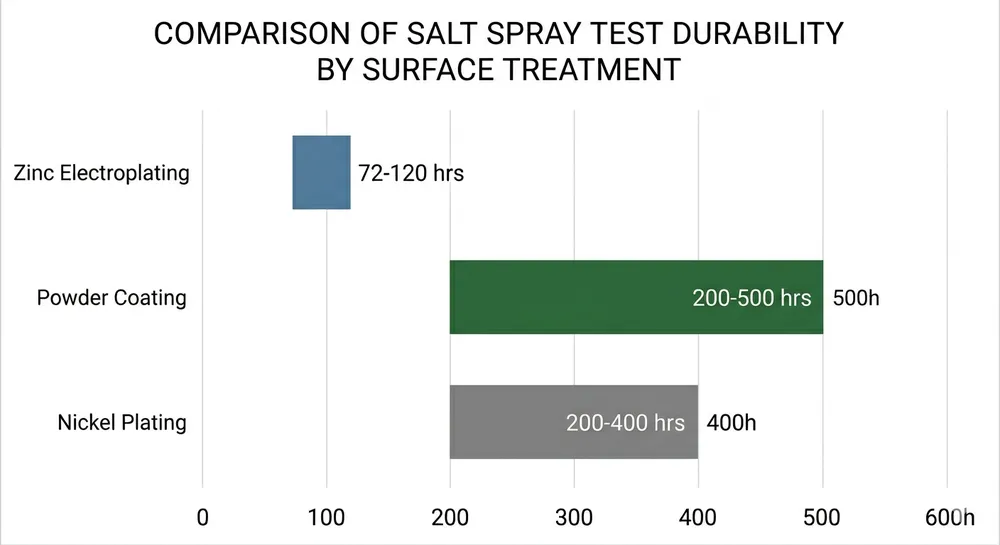
Zinc electroplating: Fast, cost-effective, adequate for dry indoor environments. Salt spray performance typically 72–120 hours. Not suitable for coastal accounts or high-humidity warehousing.
Powder coating: Better corrosion resistance than zinc plate when applied correctly. We run our powder line at 60–80 μm thickness — below 50 μm and you start seeing edge coverage failures. Salt spray performance at proper thickness: 200–500 hours depending on pre-treatment.
Nickel plating: Higher corrosion resistance and a cleaner visual finish. Used on exposed components where appearance matters. Salt spray performance: 200–400 hours. Adds cost, so we typically apply it selectively to visible parts rather than the full mechanism body.
The pre-treatment step is where most surface failures originate. Phosphate pre-treatment before powder coating is standard practice — without it, adhesion at weld seams is inconsistent and you'll see blistering within a year. We added a dedicated phosphate bath in 2017 after seeing adhesion failures on a batch destined for a Southeast Asian distributor. The fix was straightforward; the lesson was that skipping pre-treatment to save a few minutes per batch is a false economy.
When you're sampling, ask for the salt spray test report. A supplier who tests properly will have it. The report should state the treatment type, thickness, pre-treatment process, and hours to first corrosion. If the report only says "passed" without the hours, it's not a useful document.
—
Dimensional consistency: why batch-to-batch tolerance matters more than the sample
Your sample looks perfect. The mounting holes align, the travel range is smooth, the finish is clean. Then your production batch arrives and 8% of units have mounting holes 1.2 mm off-center, which means your assembly line has to hand-fit every chair.
This is a tolerance control problem, and it's more common than it should be. The sample was made carefully. The production batch was made at speed.
The parameters to lock down before production:
- Mounting hole position tolerance: ±0.5 mm is workable for most OEM assembly. Tighter if your chair base has close-fit hardware.
- Tilt travel range: Specify the degree range and the stop positions. A mechanism that tilts 5° further than spec will feel wrong to the end user and may not pass your QC.
- Gas lift stroke: Specify minimum and maximum height adjustment range. Variation here affects ergonomic compliance claims.
- Thread engagement depth: For any threaded fastener interface, specify minimum engagement. Under-engagement is a field failure waiting to happen.
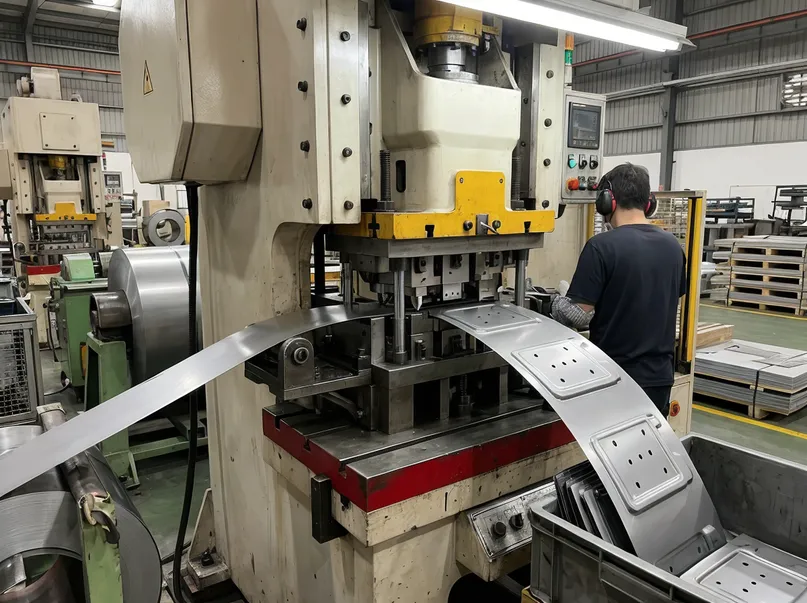
We use progressive die stamping for our mechanism plates, which holds hole position to ±0.3 mm across a production run. That's tighter than most buyers specify, but it means your assembly line doesn't slow down fitting mechanisms to chairs. (The tooling investment to get there is real — it's one reason we don't compete on the lowest price tier.)
Ask your supplier for a dimensional inspection report from a recent production batch, not just from the sample. The sample tells you what they can make. The batch report tells you what they actually make.
—
The sourcing trap: what gets skipped when price is the only filter
The most common quality failure pattern we see from new importers: they sample a mechanism that looks and feels good, approve it based on the sample, and place a production order without locking down the specs in writing. The supplier ships to their standard, which may not match what the sample represented.
Three things that get skipped most often:
1. No written spec sheet attached to the PO. The purchase order says "chair tilt mechanism, 500 units" with a price. It doesn't say steel thickness, load rating, cycle life, surface treatment spec, or dimensional tolerances. The supplier ships what they normally make. If that's not what you sampled, you have no recourse.
2. No pre-shipment inspection against spec. A third-party inspection (SGS, Bureau Veritas, or similar) against a written spec sheet catches batch deviations before the container loads. Skipping this to save $300 on inspection fees is a poor trade when a non-conforming batch costs you $15,000 in returns and re-sourcing.
3. Accepting a test report without reading it. Suppliers will provide test reports. Some are from accredited labs; some are internal. Check whether the report references the actual standard (BIFMA X5.1, EN 1335), states the test load and cycle count, and was issued within the last 12 months. A 3-year-old test report on a mechanism that may have changed production tooling since then is not useful documentation.
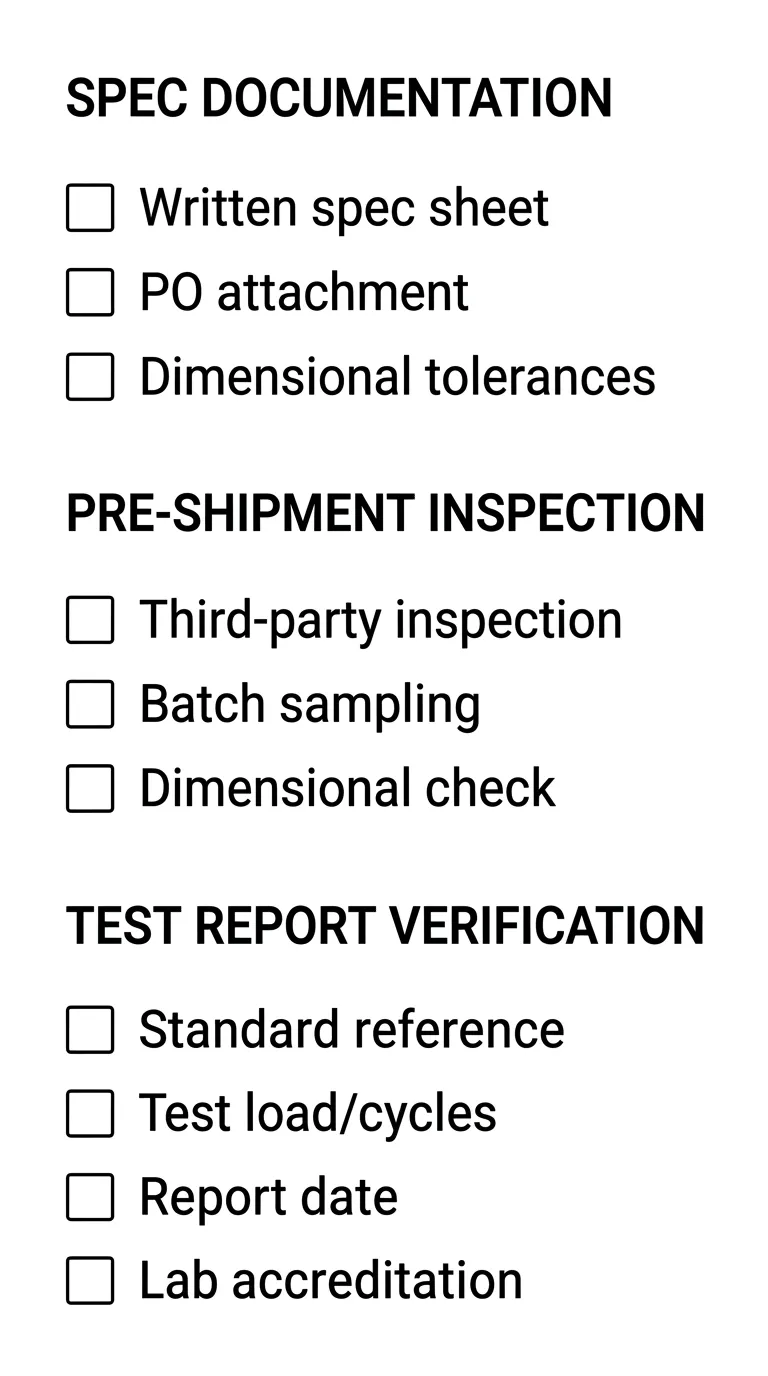
We attach a full spec sheet to every production order and provide 100% functional testing results before shipment. That's not a selling point — it's the minimum that makes sense when you're shipping mechanisms that go into products your customers will use daily for years.
—
What to request at the RFQ stage
Before you sample, get these documents from any supplier you're seriously evaluating:
- Material certificate for the steel used in mechanism plates (confirms grade and thickness)
- Load test report referencing BIFMA X5.1 or EN 1335 (confirms rated load and cycle life)
- Salt spray test report for the surface treatment (confirms hours and pre-treatment process)
- Dimensional inspection report from a recent production batch (not just the sample)
- ISO 9001 certificate (confirms a documented QC system is in place)
A supplier who can provide all five without hesitation has a production process worth sampling. A supplier who can provide two or three and is vague about the rest is telling you something about how they manage quality.
We hold ISO 9001:2015, CE, SGS, and RoHS certifications, and we can provide all five document types for our standard chair mechanism range. If you're evaluating us against other suppliers, use this list as your baseline comparison.
—
Matching the spec to your market segment
Not every market needs the same spec. Over-specifying adds cost without adding value; under-specifying creates warranty exposure. Here's a practical starting point:
| Market segment | Recommended spec tier |
|---|---|
| Residential / e-commerce | 1.2–1.5 mm steel, 80 kg load, 50,000 tilt cycles, zinc plate |
| Mid-market office | 1.8 mm steel, 120 kg load, 100,000 tilt cycles, powder coat ≥ 200 hr salt spray |
| Commercial / contract | 2.0 mm steel, 150 kg load, 150,000+ tilt cycles, powder coat ≥ 300 hr salt spray |
| Heavy-duty / 24-hour use | 2.2 mm steel, 150 kg+ load, 200,000+ tilt cycles, BIFMA X5.11 compliance |
| Coastal / humid markets | Any tier above + nickel plate on exposed parts, ≥ 300 hr salt spray minimum |
The residential tier is fine for what it is — a cost-optimized mechanism for price-sensitive channels. The problem is when residential-spec mechanisms end up in commercial applications because the buyer didn't specify otherwise. That's where the field failures come from.
If you're building a product line that spans multiple segments, it's worth having two or three mechanism SKUs at different spec tiers rather than trying to find one mechanism that covers everything. We supply buyers who do exactly this — a base SKU for their value line and a heavier-spec SKU for their commercial line, both sourced from the same factory so the documentation and QC process is consistent.
—
FAQ
What is the minimum steel thickness I should specify for an office chair mechanism?
For standard office use with a 120 kg load rating, 1.8 mm cold-rolled steel on the main tilt plate is the practical minimum. Below that, you're in residential territory and the fatigue life under daily commercial loading becomes marginal. For heavy-duty or 24-hour-use applications, move to 2.0–2.2 mm.
Does a CE mark on a chair mechanism mean it meets EN 1335?
Not automatically. CE marking on furniture hardware typically covers the Machinery Directive or RoHS compliance, not seating performance standards. EN 1335 compliance requires specific load and cycle testing — ask for the EN 1335 test report separately. The two documents are different.
How do I verify a supplier's test report is real?
Check three things: the issuing lab name (search it — accredited labs are listed in national databases), the standard referenced (it should cite the specific clause, not just the standard number), and the test date. If the report is more than 2 years old or doesn't reference a specific standard clause, request a current one.
What's the difference between a gas lift cycle test and a tilt mechanism cycle test?
They test different components. The gas lift cycle test measures how many times the height adjustment mechanism can be actuated before pressure loss or failure. The tilt cycle test measures how many recline/return cycles the tilt mechanism handles before fatigue or functional failure. Both specs matter; they're not interchangeable.
Can I source mechanisms at different spec tiers from the same factory?
Yes, and it's often the better approach. Consistent documentation, QC process, and supplier relationship across your product line reduces sourcing complexity. The spec difference is in the material and tooling, not in the factory's process discipline.
—
If you're ready to sample or want to compare specs against what you're currently sourcing, request a quote with your target load rating, market segment, and annual volume — we'll come back with a spec sheet and pricing for the configuration that fits your application.