Pick the wrong mechanism and you'll know it six months after the container lands — warranty claims, failed audits, or a product that simply doesn't move the way your customer expected. The mechanism is the one component your end-user interacts with every single time they sit down, and it's the one component most buyers under-specify at the RFQ stage.
This guide covers the main chair mechanism types we manufacture and supply, what separates them technically, and how to match mechanism spec to your target market segment.

—
Tilt mechanism: the baseline spec and where it earns its margin
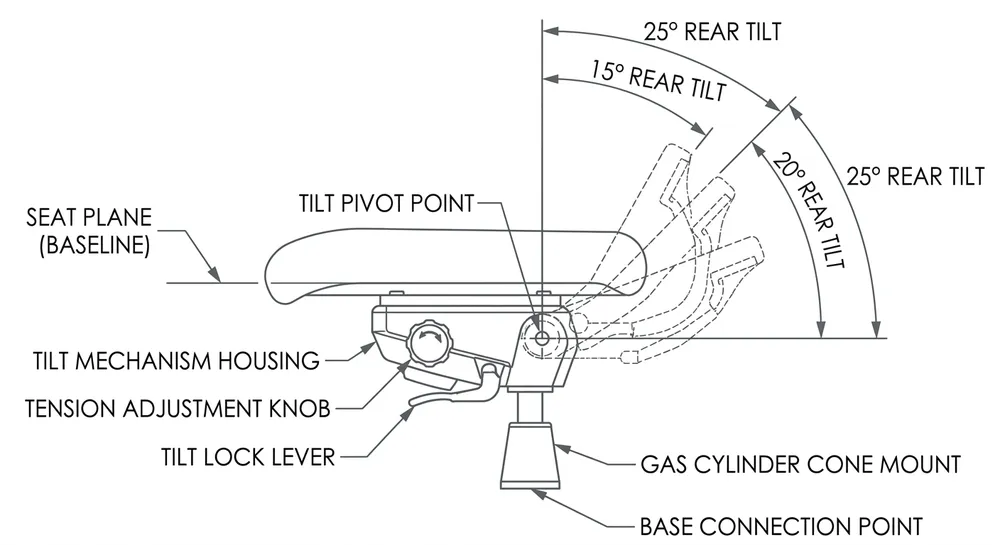
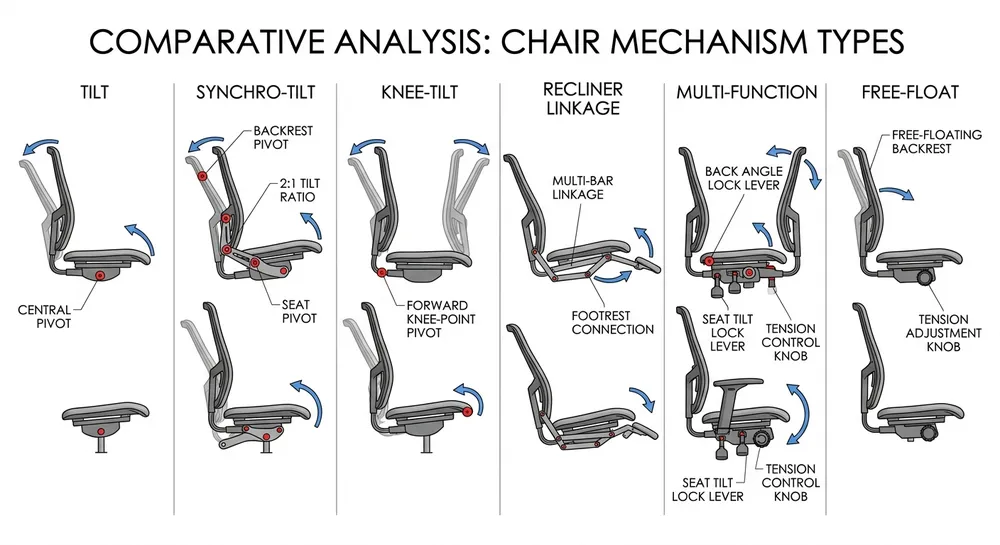
The standard tilt mechanism — sometimes called a basic tilt or single-pivot tilt — rotates the entire seat-and-back unit around a single pivot point located near the front of the seat pan. It's the most common mechanism in entry-level and mid-range task chairs, and it's the one most buyers have sourced before.
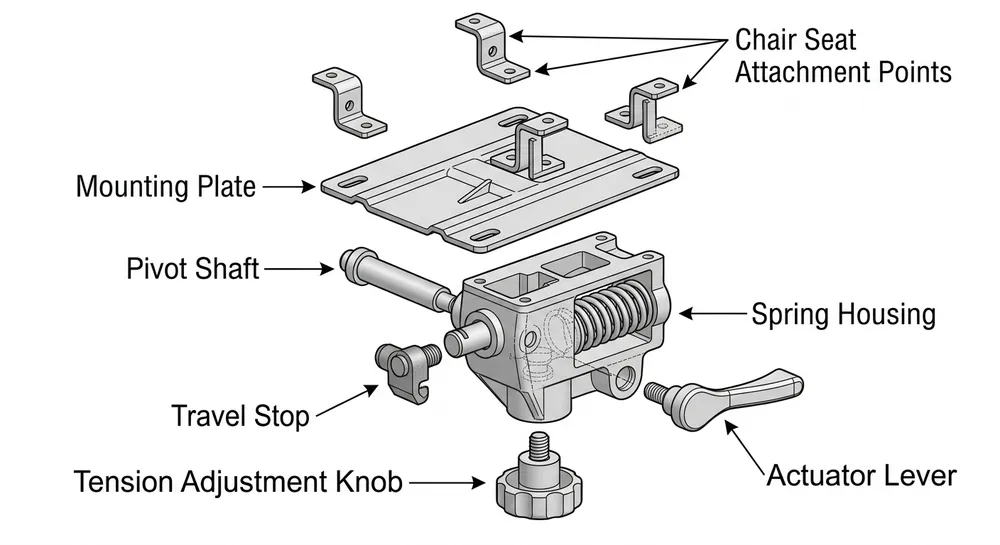
What matters at the sourcing level: tilt tension adjustment range, the number of tilt lock positions, and the load rating. We run our standard tilt mechanisms to a 120 kg static load rating with a 100,000-cycle test before shipment. The tension spring is the component that fails earliest in cheaper versions — we use a cold-coiled spring with consistent wire diameter tolerance (±0.1 mm) because inconsistent spring wire is the main cause of tension drift after 6–12 months of use.
The commercial case for stocking tilt mechanisms is straightforward: they're the volume SKU in office, education, and light commercial seating. Your buyers in the mid-market office furniture segment will specify this mechanism more than any other. Margin comes from surface finish and aesthetic differentiation, not from mechanism complexity — so your sourcing priority here is cycle-life consistency across batches, not feature count.
(We've seen buyers switch suppliers after one bad batch where tilt tension varied noticeably unit-to-unit. That's a spring wire tolerance problem, not an assembly problem — worth asking your supplier about their spring sourcing.)
—
Synchro-tilt mechanism: the spec that justifies a price step-up
The synchro-tilt mechanism links seat and back movement through a ratio — typically 2:1 or 3:1 — so the backrest reclines further than the seat tilts. The result is that the user's thighs stay closer to horizontal during recline, which reduces pressure behind the knee.
From a manufacturing standpoint, synchro-tilt is more complex than standard tilt: the linkage geometry requires tighter tolerances on the pivot pin holes (we hold ±0.05 mm on the main pivot bore), and the synchronization ratio is set by the relative arm lengths in the linkage. Get that geometry wrong and the ratio drifts, which means the chair moves differently at the start and end of a production run.
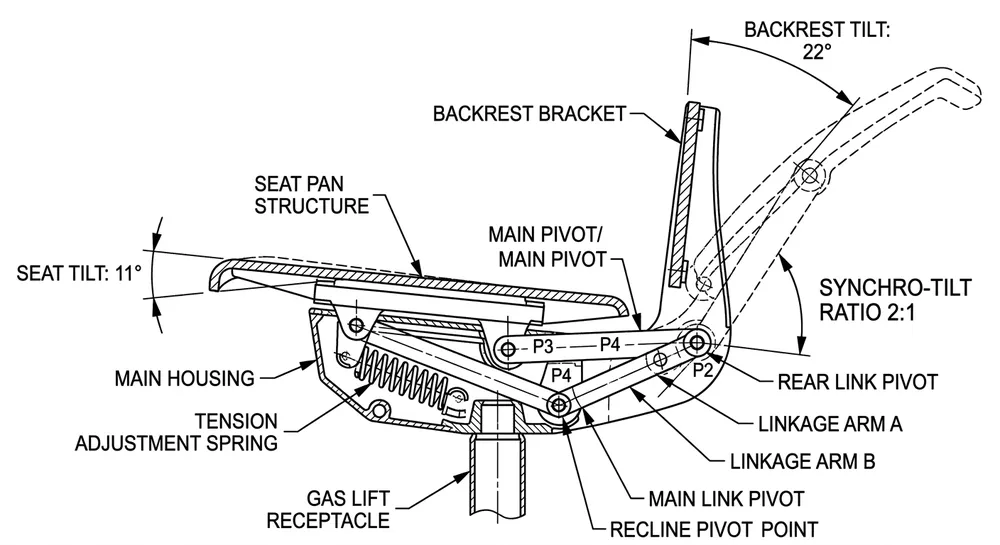
For your market: synchro-tilt is the standard spec in mid-to-upper office seating — the segment where your buyers are selling chairs at $300–600 retail. It's the mechanism that lets you move off the commodity shelf. Ergonomic office furniture distributors, contract furniture dealers, and corporate procurement channels all expect synchro-tilt at this price point. If you're building a product line for that segment, this is the mechanism to anchor it around.
We supply synchro-tilt mechanisms in both zinc alloy die-cast and stamped steel configurations. Die-cast gives you tighter tolerances and a cleaner aesthetic on exposed components; stamped steel is lighter and better for flat-pack logistics. Most of our European buyers land on die-cast for the premium line and stamped for the volume line.
—
Knee-tilt mechanism: the ergonomic upsell with a specific buyer profile
The knee-tilt mechanism places the pivot point directly under the user's knees rather than under the seat pan center. This keeps the front edge of the seat stationary during recline — the back tilts, the rear of the seat rises slightly, but the front stays put. Users who recline frequently find this more comfortable because there's no forward slide on the seat.
Technically, knee-tilt requires a more forward pivot placement and a longer backrest bracket arm. The load path through the mechanism changes compared to standard tilt, which means the bracket-to-base connection needs to be sized accordingly. We reinforce the front pivot housing on our knee-tilt units because that's where stress concentrates during aggressive recline under load.
The buyer profile for knee-tilt is specific: executive seating, high-end task chairs, and any product positioned around ergonomic credentials. It's not a volume mechanism — it's a margin mechanism. Your customers buying knee-tilt chairs are paying for the ergonomic story, and the mechanism has to deliver it consistently. One chair in a batch that rocks differently from the others is a problem in this segment in a way it isn't in the entry-level market.
—
Multi-function mechanism: configurability as a commercial feature
Multi-function mechanisms add independent seat angle adjustment to the synchro-tilt base — the user can tilt the seat pan forward or backward independently of the backrest. Some configurations also include seat depth adjustment integrated into the mechanism housing.
This is the mechanism category where we see the most variation in what buyers actually need. Some want a true multi-function with four or five adjustment points; others want a simplified two-function that's easier to explain to end-users and cheaper to produce. We've tooled both, and the honest answer is that the simpler version outsells the complex one in most markets outside Scandinavia and Germany, where buyers have trained their customers to use every adjustment.
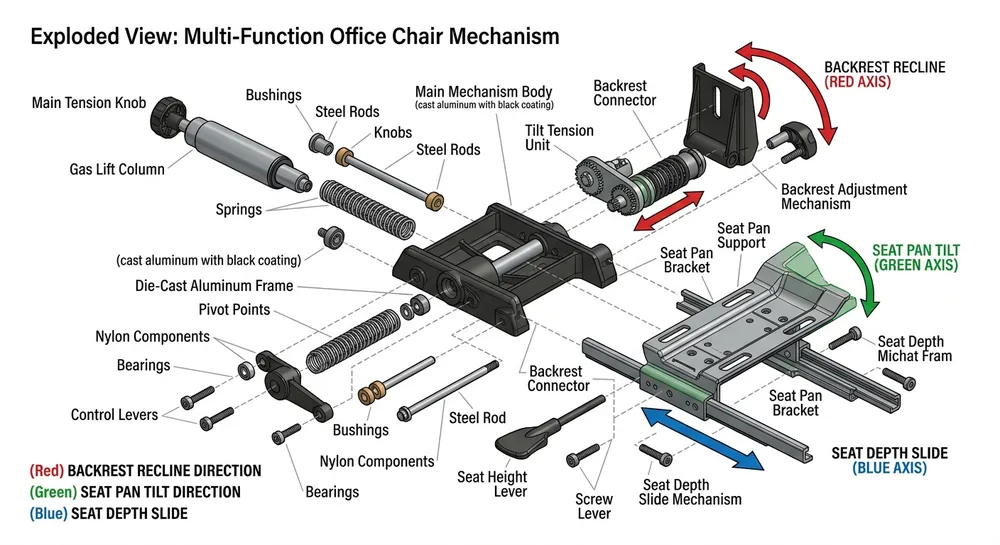
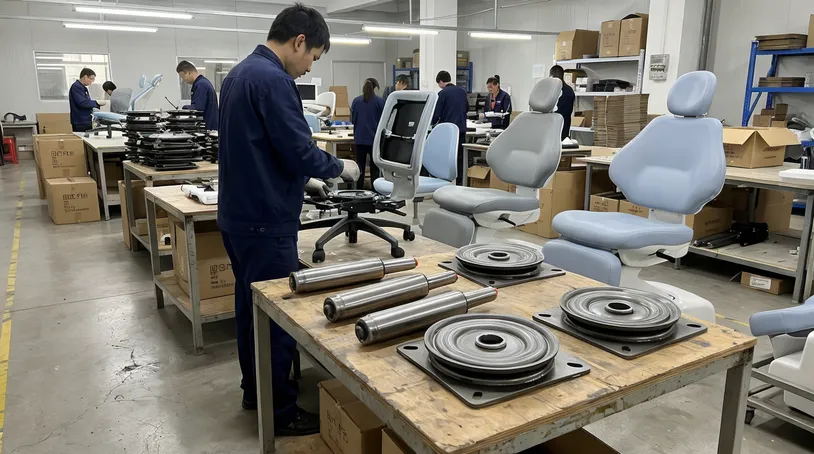
For sourcing: multi-function mechanisms have more moving parts and more adjustment interfaces, which means more QC checkpoints. We run functional testing on every adjustment axis before shipment — not just the tilt function. If you're sourcing multi-function and your supplier only tests tilt lock, you'll find the seat angle adjuster failing in the field.
—
Recliner linkage mechanism: a different product category, different sourcing logic
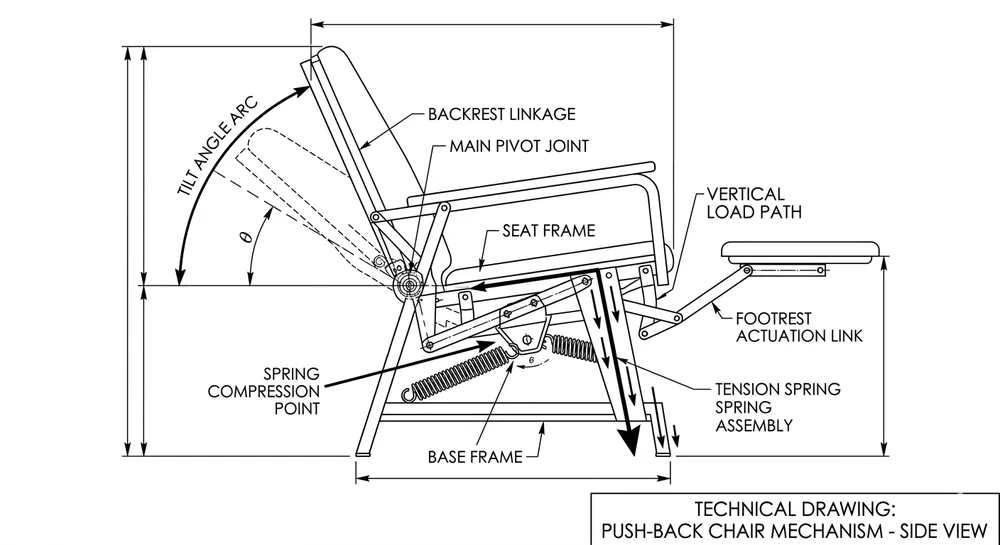
Recliner mechanisms for lounge chairs and sofas operate on different geometry than office chair tilt mechanisms. The recline angle is larger (typically 110–150° from upright), the load path runs through a different linkage, and the cycle-life requirement is lower — residential recliners are tested to 25,000–50,000 cycles versus 100,000+ for commercial office mechanisms.
We manufacture recliner linkages as a separate product line from our office chair mechanisms. The steel gauge is heavier (we run 2.0–2.5 mm cold-rolled steel on the main linkage arms versus 1.2–1.5 mm on office mechanisms), the pivot pins are larger diameter, and the spring configuration is different. Buyers who try to source both from the same mechanism spec are usually making a mistake — the applications are different enough that a single spec doesn't serve both well.
| Mechanism Type | Typical Recline Range | Cycle Life Requirement | Primary Application |
|---|---|---|---|
| Standard tilt | 15–20° | 100,000 cycles | Entry/mid office seating |
| Synchro-tilt | 20–30° | 100,000 cycles | Mid/upper office seating |
| Knee-tilt | 20–30° | 100,000 cycles | Executive/ergonomic seating |
| Multi-function | 20–30° | 100,000 cycles | Premium ergonomic seating |
| Recliner linkage | 110–150° | 25,000–50,000 cycles | Lounge/residential seating |
(The cycle life gap between office and residential is real and matters for warranty planning — if you're selling into contract hospitality or healthcare, confirm which standard your supplier is testing to.)
—
What the spec sheet doesn't tell you: sourcing criteria that separate batches
Load rating and cycle life are the two numbers every supplier will quote. They're necessary but not sufficient. Here's what we check internally that most buyers don't ask about until they've had a problem:
Spring wire tolerance. Tilt tension consistency across a batch depends on spring wire diameter consistency. We source spring wire with ±0.1 mm diameter tolerance and test tension on a sample from every production run. Batches with loose spring wire tolerance feel different unit-to-unit — your end-users notice even if your incoming inspection doesn't catch it.
Pivot pin fit. The clearance between pivot pin and bore determines how much play develops over the mechanism's life. Too tight and the mechanism stiffens; too loose and it develops rattle within months. We hold H7/h6 fit on main pivot interfaces — that's a standard engineering fit that any supplier should be able to confirm in writing.
Surface treatment on internal components. Zinc plating on internal steel parts is standard. The question is thickness and adhesion. We specify 8–12 μm zinc on internal mechanism components and run salt spray testing on production samples. Mechanisms that rust internally don't fail immediately — they stiffen gradually, which is harder to catch under warranty.
Weld quality on bracket arms. The backrest bracket arm is the highest-stress weld in most mechanisms. We use MIG welding with 100% visual inspection and periodic destructive testing on weld cross-sections. A bracket arm weld that looks fine visually can have incomplete penetration — that's the failure mode that shows up at 60,000 cycles, not at incoming inspection.
If you're evaluating a new mechanism supplier, ask for the test report, not just the spec sheet. A load rating on a spec sheet is a claim; a test report with date, sample size, and failure mode data is evidence.
—
Matching mechanism type to your target market segment
The right mechanism for your product line depends on where your buyers are selling, not just on the chair's price point. Here's how we see the segments:
Office furniture distributors (mid-market): Synchro-tilt is the core SKU. Standard tilt for the entry line. Volume matters more than feature count — your buyers need consistent batches, not the most complex mechanism available.
Contract furniture for corporate projects: Synchro-tilt and multi-function, with documentation. Corporate procurement increasingly requires test reports and compliance documentation (BIFMA, EN 1335, or equivalent). If your supplier can't provide test documentation, you're exposed on large project bids.
Executive and ergonomic seating brands: Knee-tilt and multi-function. These buyers are selling on ergonomic credentials, so the mechanism has to perform consistently and the adjustment interfaces have to feel precise. Die-cast components over stamped steel for the exposed parts.
Hospitality and lounge seating: Recliner linkages, sized for the specific recline angle and load requirement. Confirm cycle life spec against the application — a hotel lobby chair gets used differently than a residential recliner.
E-commerce and direct-to-consumer brands: Standard tilt and synchro-tilt, with flat-pack compatibility. KD (knock-down) packaging reduces freight cost significantly on ocean shipments — mechanisms that can be shipped disassembled and assembled at destination are worth specifying if your buyer is cost-sensitive on landed cost.
—
Specification comparison: key parameters by mechanism type
| Mechanism Type | Pivot Location | Seat Movement | Complexity | Typical Steel Gauge | Die-Cast Option |
|---|---|---|---|---|---|
| Standard tilt | Mid-seat | Full seat tilts | Low | 1.2–1.5 mm | No |
| Synchro-tilt | Rear-seat | Seat + back linked | Medium | 1.2–1.5 mm | Yes |
| Knee-tilt | Under knees | Back tilts, front fixed | Medium | 1.5–2.0 mm | Yes |
| Multi-function | Rear-seat | Independent seat + back | High | 1.5–2.0 mm | Yes |
| Recliner linkage | Variable | Full recline 110–150° | Medium-High | 2.0–2.5 mm | No |
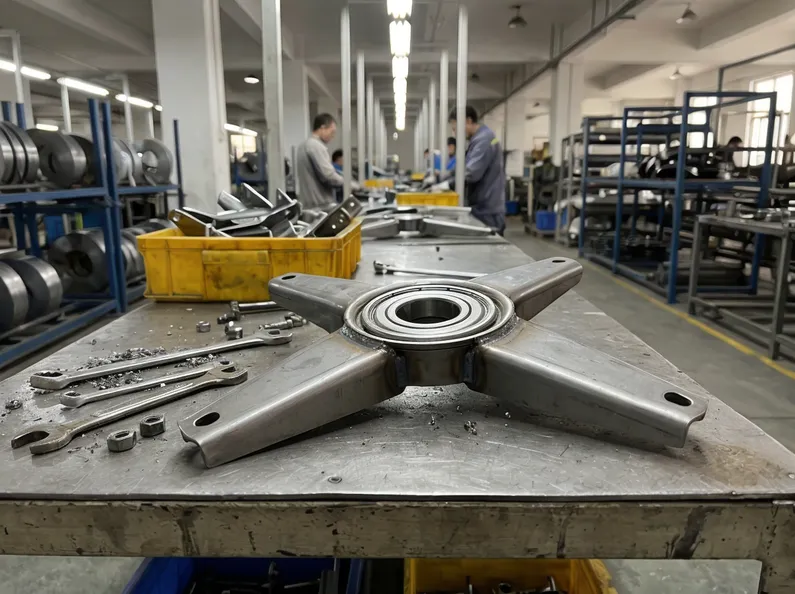
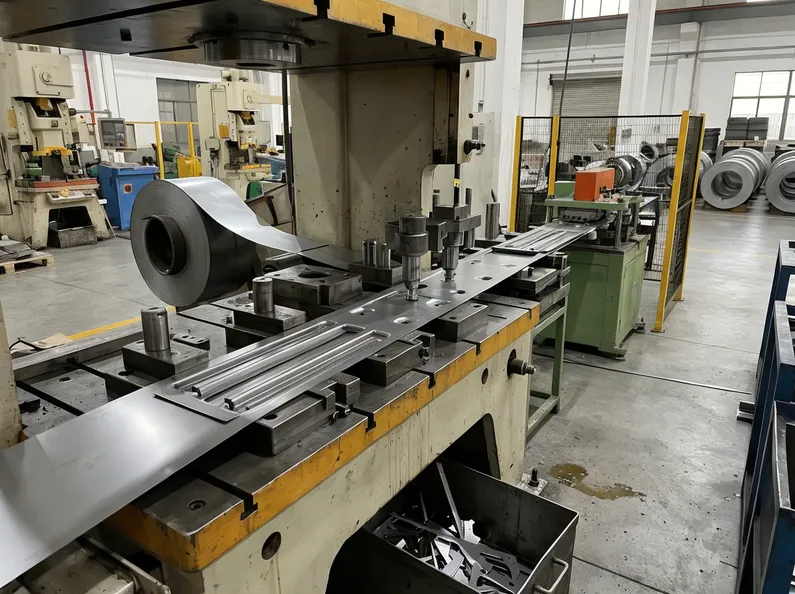
We manufacture all five types across our 6 production lines in Guangdong. Standard MOQ is 500 units for catalog mechanisms; OEM configurations with custom geometry or surface finish are available with tooling support from our in-house engineering team.
—
Common sourcing mistakes and how to avoid them
Over-specifying for the market. A multi-function mechanism in a $150 retail chair is a cost problem, not a feature. Match mechanism complexity to the price point your buyer is selling at — the end-user won't use the extra adjustments, and you'll pay for them in unit cost and assembly time.
Under-specifying cycle life for the application. Residential-grade mechanisms (25,000 cycles) in commercial office chairs is the most common failure pattern we see when buyers switch to a cheaper supplier. The chairs pass incoming inspection and fail in the field at 18–24 months.
Ignoring surface treatment on internal parts. Buyers inspect what they can see. Internal zinc plating and spring coating aren't visible, but they determine whether the mechanism still feels the same at year three as it did at delivery.
Skipping the sample stage on new configurations. We tell every new buyer the same thing: run a 10–20 unit sample order before committing to volume, especially on OEM configurations. The sample stage is where geometry issues, tension calibration, and finish inconsistencies surface — not after 2,000 units are on the water.
For a full overview of our chair mechanism range — including standard catalog specs, OEM tooling options, and current lead times — the product category page has the detail. If you have a specific mechanism type, load rating, or surface finish requirement, the fastest path is to send us your specs directly and we'll come back with a configuration recommendation and quote.
—
FAQ: chair mechanism types
What is the difference between a tilt mechanism and a synchro-tilt mechanism?
A standard tilt mechanism rotates the entire seat-and-back unit around a single pivot, so the seat angle and back angle change together at the same rate. A synchro-tilt mechanism links seat and back through a ratio (typically 2:1 or 3:1), so the back reclines further than the seat tilts. The practical result is that the user's thighs stay closer to horizontal during recline, reducing pressure behind the knee. For sourcing purposes, synchro-tilt is more complex to manufacture and commands a higher unit price — it's the right spec for mid-to-upper office seating, not for entry-level volume product.
What cycle life should I specify for commercial office chair mechanisms?
100,000 cycles is the standard for commercial office seating, aligned with BIFMA X5.1 and EN 1335 test protocols. Residential-grade mechanisms are typically tested to 25,000–50,000 cycles. If your buyer is selling into contract office, hospitality, or any commercial environment, confirm that your supplier's test reports show 100,000-cycle results — not just a load rating claim on a spec sheet.
What load rating do office chair mechanisms need to meet?
Most commercial office chair mechanisms are rated to 120–150 kg static load. The relevant standard depends on your target market: BIFMA X5.1 for North America, EN 1335 for Europe. Load rating alone isn't sufficient — ask for the full test report including fatigue cycle results, because a mechanism can pass static load and still fail at 40,000 cycles under dynamic loading.
Can the same mechanism be used for both office chairs and lounge recliners?
No. Office chair mechanisms are designed for 15–30° tilt ranges and 100,000-cycle life. Recliner linkages operate at 110–150° recline angles with different load paths and different steel gauges. Using an office mechanism in a recliner application will result in premature failure — the geometry and material spec are simply different products.
What is the minimum order quantity for custom chair mechanism configurations?
For standard catalog mechanisms, our MOQ is 500 units. For OEM configurations — custom geometry, non-standard surface finish, or integrated features — MOQ depends on tooling requirements. We support OEM tooling in-house, so the tooling cost and amortization schedule is part of the initial quote. Most OEM buyers start with a tooling investment and a 1,000–2,000 unit first production run.