

Lift Chair Mechanism
Rise-assist hardware built for accessibility seating that has to work every time.
Stamped steel construction, 100% functional testing before shipment, OEM/ODM tooling supported. Factory-direct from Guangdong, China.

Product Overview
What a Lift Chair Mechanism Is — and Where It Sits in the Product Line
A lift chair mechanism is the rise-assist assembly that tilts the seat forward and upward to help the occupant transition from seated to standing. It's distinct from a hydraulic chair mechanism (which adjusts seat height via gas cylinder) and from a standard tilt mechanism (which reclines the backrest). The lift mechanism's job is a single, specific motion: controlled forward-seat elevation under load, either through spring-assist or an electric actuator drive.
Within our chair mechanism line, the lift mechanism occupies the accessibility and mobility seating segment — a different commercial channel from standard office or task chair hardware. Your downstream customers are medical equipment distributors, home healthcare retailers, senior living furniture suppliers, and contract furnishers specifying accessible seating for public spaces.
The mechanism is the functional core of the product; if it fails or feels unreliable, the chair fails commercially regardless of how the upholstery looks.

Spring-Assist
Mechanically simpler, lower unit cost. Suited for lighter-duty residential and semi-commercial applications.
Actuator-Compatible
Designed for powered-lift configuration. Required for medical and heavy-duty accessibility segments.
Engineering Data
Technical Specifications
Industry-typical parameters for our lift chair mechanism line. Contact us for exact drawings and configuration-specific data sheets.
| Parameter |
Spring-Assist Configuration
|
Actuator-Compatible Configuration
|
|---|---|---|
| Base material | Cold-rolled steel (SPCC/Q235) | Cold-rolled steel (SPCC/Q235) |
| Plate thickness | 2.0 mm – 2.5 mm | 2.5 mm – 3.0 mm |
| Rated load capacity | 120 kg – 150 kg | 150 kg – 200 kg |
| Lift angle range | 12° – 18° forward tilt | 12° – 20° forward tilt |
| Actuator mounting | N/A | Standard 6mm pin, dual-bracket mount |
| Seat mounting pattern | Standard 4-hole, 180mm × 280mm typical | Standard 4-hole, 180mm × 280mm typical |
| Surface treatment | Zinc plating or powder coat (black standard) | Zinc plating or powder coat (black standard) |
| Cycle life (tested) | 60,000 cycles at rated load | 80,000 cycles at rated load |
| Operating temperature | -10°C to 60°C | -10°C to 60°C |
| Certifications | CE, SGS, RoHS | CE, SGS, RoHS |
Actuator Compatibility Note
For North American & European Buyers
The actuator-compatible frame is the configuration most North American and European buyers specify for powered lift chairs. The 6mm pin dual-bracket mount is compatible with the major linear actuator brands your chair assembly line is likely already using.
We've had buyers send us their existing actuator spec and we confirm fit before they commit to a production order — worth doing if you're switching suppliers mid-model-run.

Engineering Detail
Structural Design: Why the Pivot Geometry Matters for Your Returns Rate
The lift mechanism's pivot point placement determines the motion arc — how the seat moves as it rises. Get the geometry wrong and the occupant slides forward during lift rather than being carried upward. That's a safety issue that generates returns, warranty claims, and in regulated markets, potential liability exposure for your distribution business.
We design the pivot geometry on our lift mechanisms to produce a controlled forward-and-upward arc that keeps the occupant's center of gravity over the seat throughout the motion. The seat front rises while the rear lifts at a slightly lower rate, which is the motion profile that allows a standing transfer without the occupant needing to push themselves off the seat.
This isn't a feature we describe in marketing language — it's a specific angular relationship between the pivot pin location, the seat mounting plate geometry, and the spring or actuator attachment point that we've refined across multiple tooling iterations.

Progressive Die Stamping
Structural platform stamped from Q235 cold-rolled steel on progressive dies, holding ±0.15mm on all critical dimensions — pivot pin holes, actuator mounting brackets, and seat mounting pattern. Your assembly line uses fixed jigs without per-piece adjustment.
Batch-to-Batch Consistency
Dimensional variation stays within the range your upholstery and frame suppliers are building to. CNC-drilled individual plates drift 0.3–0.5mm between batches — progressive die stamping eliminates that failure mode and the assembly-line rejections that follow.
Weld Penetration Verification
Load-bearing welds at the pivot bracket and actuator mount go through MIG welding with penetration depth verification. Insufficient weld penetration at the tilt pivot is the most common structural failure mode in competitor mechanisms. We test representative units to 80,000 cycles at rated load before each batch ships.
Why This Matters for Your Returns Rate
The tilt pivot is the highest-stress point on a lift mechanism under cyclic load. Insufficient weld penetration at that joint is the most common structural failure mode we see in competitor mechanisms that come through our lab. Geometry and weld quality at this joint directly determine your warranty claim rate.
Buyer Segments
Market Segments Where Lift Chair Mechanisms Generate Recurring Revenue
Four distinct buyer channels source lift chair mechanisms for different end-use requirements. Understanding the sourcing criteria for each segment determines which mechanism configuration and MOQ structure fits your business model.
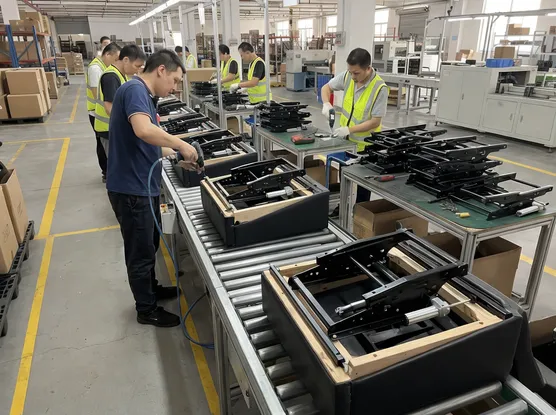
Powered Lift Chair OEM Manufacturing
Furniture manufacturers producing powered lift chairs for the North American and European markets are the highest-volume buyers of actuator-compatible lift mechanisms. A mid-size lift chair manufacturer running 3–5 chair models typically sources 2–3 mechanism configurations — different load ratings and lift angles for different chair frame sizes.
Orders run 2,000–10,000 units per configuration per year, with reorder cycles tied to production schedules rather than seasonal demand. Mechanism consistency across production runs is the sourcing criterion that matters most — your assembly line is built around a fixed mounting pattern, and a supplier who drifts on dimensions between orders costs you more in rework than you save on unit price.
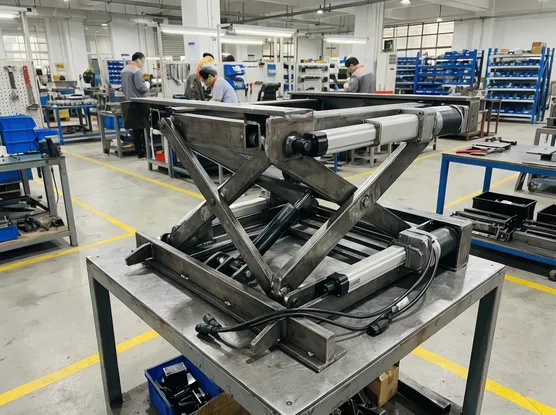
Medical & Rehabilitation Equipment
Lift chairs specified for post-surgical recovery, bariatric seating, and rehabilitation environments require higher load ratings (150–200 kg) and longer cycle life than residential models. The actuator-compatible configuration at 3.0mm plate thickness and 80,000-cycle testing is the spec range this segment requires.
Medical equipment distributors in North America and Europe typically carry 2–4 lift chair SKUs targeting different patient weight ranges and mobility levels — the mechanism spec is what differentiates the product tiers and justifies the price ladder. CE documentation and SGS test reports ship with every order, which is what your compliance team needs for medical device adjacent product registration in EU markets.

Senior Living & Assisted Care Furniture
Contract furnishers specifying seating for senior living communities, assisted care facilities, and memory care units order lift chairs in project quantities — typically 50–500 units per facility, with repeat orders as facilities expand or replace aging inventory.
This segment prioritizes reliability and low maintenance over feature count. Spring-assist configurations at 120–150 kg load rating cover the majority of this demand. The commercial value for your distribution business is the repeat cycle: senior living facilities replace seating on 5–7 year cycles, and a facility that had a good experience with your product line reorders from the same supplier.

Home Healthcare Retail & E-Commerce
Home healthcare retailers and e-commerce sellers — including Amazon and Wayfair channel operators — source lift chair mechanisms as components for DIY-assembly lift chairs or as replacement parts for existing chair models. This channel is more price-sensitive than the medical segment but has higher order frequency and lower MOQ requirements.
Spring-assist mechanisms at the 500-unit MOQ entry point work well for this channel. Several buyers in this segment start with a 500-unit trial order on a single configuration, then expand to 3–4 SKUs once they've validated the mechanism with their customer base — the trial order path is the standard entry for this channel.
Configuration & Sourcing
Customization Options for Your Chair Frame and Market Requirements
Lift chair mechanisms are almost never sourced off-the-shelf without some configuration adjustment — your chair frame geometry, target load rating, and market compliance requirements will drive at least one or two specification changes from our standard catalog.
Seat Mounting Pattern
Standard 4-hole pattern at 180mm × 280mm covers most chair frame designs. We can modify hole spacing, add mounting slots, or change to a 6-hole pattern for frames requiring additional attachment points.
Load Rating
Plate thickness and spring rate (or actuator bracket reinforcement) determine load rating. Moving from 150 kg to 200 kg rated capacity means stepping up plate thickness and reinforcing the pivot bracket.
Lift Angle
Standard range is 12°–20°. Angles outside this range require pivot geometry changes that affect the motion arc. We review your chair frame dimensions and occupant transfer requirements before committing to a non-standard angle.
Surface Treatment
Zinc plating is standard. Powder coat in black or custom RAL colors is available on runs over 500 units. For buyers supplying into humid or coastal markets, powder coat over zinc plating passes 500-hour salt spray at 60–80μm film thickness.
Private Label & Packaging
OEM packaging with your brand name and product labeling is available. Retail-ready packaging for e-commerce channels — including Amazon FBA-compliant carton sizing and labeling — can be arranged as part of the order specification.
Volume & Tooling Investment
MOQ for standard configurations is 500 units. Custom tooling modifications are quoted based on scope — minor die modifications are typically low-cost; new pivot geometry requires new tooling investment amortized into the unit price over an agreed volume.
We'll confirm fit and quote the configuration — including any die modification scope and unit price delta for load rating or surface treatment changes.
Regulatory & Documentation
Compliance and Certification for Your Target Markets
All certification documentation ships with the order. Your customs broker and compliance team get what they need without follow-up requests.
CE Marking
Covers European market requirements for mechanical safety. SGS third-party testing provides the audit trail your compliance team needs for product registration and customs clearance.
RoHS Documentation
Confirms restricted substance compliance — relevant for EU market entry and for buyers whose downstream customers require it. Increasingly required in North American retail channels as well.
FDA & HCPCS Support Documentation
We can provide material safety documentation and test reports to support your FDA 510(k) pre-submission or HCPCS classification process. Lift chairs sold through the medical channel often require supplier documentation as part of the device file — we have the paperwork ready.
BIFMA-Equivalent Testing
BIFMA-equivalent load and cycle testing is our standard QC protocol for all chair mechanisms, including lift mechanisms. If your market or retail channel requires formal BIFMA certification, we can arrange third-party BIFMA testing through our SGS relationship.
We can arrange third-party BIFMA testing through our SGS relationship and prepare the full documentation package your compliance team requires.
Assembly & Fit
Installation Fit and Assembly Compatibility
Lift chair mechanisms integrate into the chair frame at three connection points: the seat mounting plate (top), the base frame attachment (bottom), and the actuator or spring anchor (rear). Getting all three right before you commit to a production order is the step that prevents assembly line problems.

Three Critical Connection Points
-
1Seat Mounting Plate (Top)Drilling pattern must align with your seat pan specification.
-
2Base Frame Attachment (Bottom)Geometry must match your chair frame weldment dimensions.
-
3Actuator / Spring Anchor (Rear)Stroke length and bracket position must be compatible with your powered or spring configuration.
We Recommend a Sample Order First
2–5 units before production quantities
Sampling specifically to verify fit prevents assembly line problems before they reach a 2,000-unit production run. Verify all four points on sample units:
- Seat mounting pattern alignment with your seat pan drilling
- Base frame attachment geometry against your chair frame weldment
- Actuator stroke length and mounting bracket compatibility (powered configurations)
- Lift angle and motion arc against your upholstery and armrest clearances
Most Common First-Order Fit Issue
The most common fit issue on first orders is actuator stroke length — buyers specify the mechanism correctly but their existing actuator has a different stroke than the bracket geometry assumes. We can adjust the bracket position to accommodate different stroke lengths, but it is easier to catch in sampling than in a 2,000-unit production run.
Designing a New Frame Around Our Mechanism?
For buyers designing a new chair frame around our mechanism, we provide CAD drawings with all critical dimensions so your frame designer can build to the mechanism rather than the other way around.
Sourcing Guidance
Frequently Asked Questions — Lift Chair Mechanism Sourcing
Decision-support answers for buyers evaluating lift chair mechanism configurations, load ratings, certifications, and production terms.
What is the difference between a spring-assist and a powered lift chair mechanism?
A spring-assist lift mechanism uses a calibrated spring to offset the occupant's weight, making it easier for them to push up from the seat — the user still initiates and controls the motion. A powered lift mechanism uses an electric linear actuator to drive the seat through the full lift arc with a button press, requiring no physical effort from the occupant.
- Lower cost, mechanically simpler
- User initiates and controls motion
- Suitable for senior living and home healthcare
- Full lift arc with button press — no physical effort
- Required for limited upper body strength or mobility impairment
- Standard for medical and rehabilitation segment; higher retail price point and margin
What load rating do I need for a bariatric lift chair?
Bariatric applications typically require 180–200 kg rated capacity with a safety factor of 1.5× applied during testing — meaning the mechanism is load-tested to 270–300 kg. Our actuator-compatible configuration at 3.0mm plate thickness covers this range.
If you are targeting the bariatric segment specifically, tell us your target rated capacity and we will confirm the plate thickness and weld specification required.
Can the lift mechanism be integrated with a recliner function?
Yes, but it requires a combined mechanism assembly rather than a standalone lift mechanism. The lift-recline combination is a separate product configuration — the lift function and recline function share a common base plate but operate independently.
We produce combined lift-recline assemblies. Contact us with your functional requirements and we will quote the configuration.
What is the MOQ and lead time for standard lift chair mechanisms?
What certifications do your lift chair mechanisms carry?
CE, SGS, and RoHS documentation ships with every order. ISO 9001:2015 governs our quality management system. For North American medical channel requirements, we can provide material safety and test documentation to support your product registration process. BIFMA third-party testing is available on request through our SGS relationship.
Related Chair Mechanisms
If the lift chair mechanism doesn't match your application, these are the configurations most commonly evaluated alongside it:
Gas-spring height adjustment for standard office and task chairs. Different function from lift assist — this adjusts seat height, not rise angle.
Multi-function unit combining height, tilt, and seat-depth adjustment. For buyers building configurable seating rather than dedicated lift chairs.
Single-lever tilt and height control for task seating. Lower cost than a lift mechanism; suited for standard office applications where rise assist isn't required.
Multi-axis adjustment for premium task seating. The mechanism that supports $300+ retail pricing in the ergonomic segment.
Not sure which configuration fits your chair design? Send us your frame drawings or a reference sample — we'll recommend the right mechanism and quote it.
Get a Quote for Lift Chair Mechanisms
Most buyers in this category start with a sample order to verify fit against their chair frame before committing to production quantities. We ship samples within 7–10 days of order confirmation.
If you're already past the sampling stage, send us your target configuration — load rating, lift angle, mounting pattern, surface treatment, and annual volume — and we'll come back with a production quote and lead time.
If you're building a new lift chair line and need mechanism recommendations, tell us your target retail price point, end-use segment (residential, medical, contract), and any compliance requirements for your market. We'll suggest the configuration based on what's working for our existing buyers in that segment.