

Ergonomic Chair Mechanism
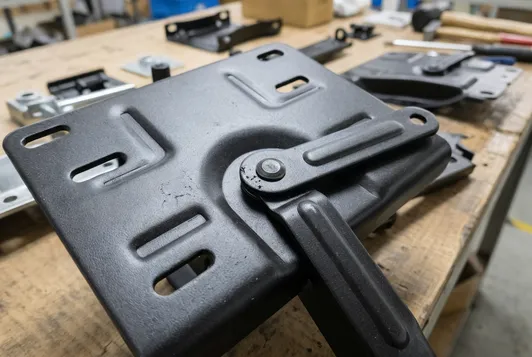
Full-featured ergonomic chair mechanism combining synchro tilt, seat slide, and lumbar support integration in a single assembly. Designed for premium and commercial ergonomic seating. Every unit 100% functionally tested. OEM/ODM tooling supported with in-house die-casting and progressive stamping.

Product Overview
What This Mechanism Is and Where It Sits in the Line
The ergonomic chair mechanism is the top-tier unit in our chair mechanism catalog — a multi-axis assembly that combines synchro-tilt, independent seat slide, and integrated lumbar support mounting in a single mechanism plate. It's the mechanism that separates a $400+ ergonomic task chair from a $150 standard office chair, and the component your downstream customers are actually paying for when they buy premium seating.
Where a standard tilt mechanism moves the seat and backrest as one unit, and a basic synchro-tilt adds a fixed seat-to-backrest ratio, the ergonomic mechanism adds a third axis: the seat pan slides forward independently as the user reclines, maintaining thigh support through the full recline arc. The lumbar bracket mounting point is integrated into the backrest arm rather than bolted on as an afterthought, which means the lumbar support moves with the backrest geometry instead of staying fixed while the back moves around it.
We produce this mechanism on the same progressive die stamping lines as the rest of our chair hardware, but the plate geometry is more complex — more pivot points, more stamped slots for adjustment range, tighter tolerances on the synchro cam profile. The tooling investment is higher, and the assembly time per unit is longer. That's the honest trade-off. What you get in return is a mechanism that justifies a premium retail price point and generates fewer warranty claims than cheaper alternatives that approximate the same feature set with looser tolerances.

Mechanism Tier Comparison
Engineering Data
Technical Specifications
Specifications shown are industry-standard values for this mechanism type. Actual specifications may vary by configuration. Contact us for detailed product data sheets and drawings.
Certifications
The Synchro-Tilt and Seat Slide Mechanism: How the Commercial Value Works
The synchro cam is the precision component that makes or breaks an ergonomic mechanism. It's a zinc alloy die-cast part that controls the ratio between seat and backrest movement — when it's dimensionally consistent, the tilt feels smooth and predictable across the full angle range. When it's not, the mechanism has a notchy, uneven feel that your downstream customers notice immediately and that generates warranty returns.
In-House Die-Casting Since 2015
Full process control — no third-party foundry variability
Most mechanism factories in this region outsource their die-cast components to third-party foundries, which means they have no control over shot parameters, cooling cycle, or dimensional consistency batch-to-batch. We brought die-casting inside in 2015 specifically because outsourced cams were the leading source of quality complaints on synchro mechanisms — loose feel, inconsistent tilt ratio, surface finish variation.
Controlling the process on our floor means the cam geometry holds to ±0.1 mm across a production run, and the tilt feel your customer experiences on unit 1 is the same as unit 5,000.

Seat Slide Rail: Progressive Die Stamping
The seat slide rail is stamped from the same cold-rolled steel coil as the mechanism plate, in the same progressive die press stroke. The slide channel and the plate mounting geometry are cut simultaneously, so the alignment between the two is a function of the die geometry, not operator assembly.
Assembly line impact: Consistent slide travel means your seat pan installation is a repeatable operation, not a per-unit adjustment.
We've had buyers send us competitor mechanisms for comparison testing. The most common failure mode we see is the seat slide binding at the end of its travel range — usually caused by a stamped channel that's slightly out of square. Progressive die stamping eliminates that variable.
Cycle Life and Load Testing: What 100,000 Cycles Actually Means for Your Business
We test ergonomic mechanisms to 100,000 cycles at rated load — the upper end of our chair mechanism test range, and the threshold that covers 5–7 years of heavy commercial use in an 8-hour daily office environment. This isn't a marketing figure; it's the test result that determines whether a batch ships or gets reworked.
Full tilt range cycles at rated load — upper end of our mechanism test range.
Heavy commercial use in an 8-hour daily office environment.
Rated load applied in static testing to verify structural margin on plate and pivot assembly.
X5.1 equivalent procedures for tilt lock, seat slide travel, and structural integrity.
Test Protocol: What Gets Checked
-
Full tilt range cycling under rated load with periodic checks
-
Tilt lock engagement verification at intervals
-
Seat slide travel consistency across the test run
-
Structural integrity at pivot joints under cyclic and static load
-
1.5× rated load static test on plate and pivot assembly

What the 100,000-Cycle Rating Means for Your Business
Your downstream customers — office furniture dealers, corporate procurement buyers, contract furniture specifiers — can write this mechanism into projects with a 5-year warranty without exposure.
The mechanisms that generate warranty claims in the field are almost always ones that were tested to 50,000 cycles and deployed in environments that needed 80,000. Specifying the higher cycle life upfront is cheaper than managing returns.
The 100,000-cycle threshold is the test result that determines whether a batch ships or gets reworked — not a specification target applied selectively to samples.
Buyer Segments
Market Segments: Where This Mechanism Generates Margin
The ergonomic mechanism serves four distinct buyer segments — each with different order sizes, margin profiles, and purchase logic. Understanding which segment you're selling into determines how you position the mechanism's features.

Premium Office and Task Seating
The ergonomic task chair market is the primary volume driver for this mechanism. Corporate procurement buyers at mid-to-large companies are specifying ergonomic seating for entire offices — 50 to 500 chairs per project, with repeat orders as headcount grows or leases turn over.
The mechanism spec is what allows your chair to be positioned at the $350–$600 retail tier rather than the $150 commodity tier. If you're manufacturing or importing an ergonomic chair line, the mechanism cost is a fraction of the retail price difference it enables.

Contract and Hospitality Seating
Hotel business centers, conference facilities, and co-working spaces are buying ergonomic task chairs in volume — 20 to 200 units per property, with portfolio-level purchasing across multiple locations. These buyers prioritize durability and consistent appearance over maximum adjustability.
The 100,000-cycle rating and consistent powder coat finish across a batch are the specs that win this business. Contract hospitality has been one of the faster-growing segments for our ergonomic mechanism over the past three years — worth building into your product line if you're targeting that channel.

Health and Professional Services
Medical offices, dental practices, law firms, and financial services firms buy ergonomic seating on a different logic than corporate procurement: they're buying for specific users who spend the entire workday seated, and they're willing to pay for the mechanism features that reduce physical strain.
Orders are smaller — 10 to 50 units — but the margin per unit is higher and the reorder cycle is predictable. If you're distributing into professional services, the ergonomic mechanism's lumbar integration and multi-position lock are the features your sales team can demonstrate and justify at a premium price point.

OEM Chair Manufacturers
If you're manufacturing chairs rather than importing finished product, the ergonomic mechanism is the component that defines your premium SKU. We supply OEM chair manufacturers across Europe, North America, and Southeast Asia who build their own chair frames and source the mechanism as a bought-in component.
Standard mounting patterns fit most frame geometries; custom hole patterns are available for proprietary frame designs with a 500-unit minimum.
OEM & ODM
Customization Options for Your Chair Line
The ergonomic mechanism ships in a standard configuration that fits the majority of task chair frames. For buyers building proprietary chair lines or targeting specific market requirements, we support the following customization options.
| Customization | Options | MOQ Impact |
|---|---|---|
| Synchro ratio | 1:2 (standard) or 1:3 | No MOQ change for 1:3 |
| Tilt angle range | Standard 22° or extended to 25° | No MOQ change |
| Seat slide travel | 40 mm (standard) or 60 mm extended | No MOQ change |
| Mounting hole pattern | Standard 4-hole/6-hole or custom pattern | Custom pattern: 500-unit min. |
| Surface finish | Black powder coat (standard), silver, or custom RAL color | Custom RAL: 500-unit min. |
| Lumbar bracket style | Standard integrated mount or custom bracket geometry | Custom bracket: tooling required |
| Tilt lock positions | 3-position (standard) or 5-position | 5-position: confirm availability |
| Private label | Branded packaging, mechanism labeling | Discuss with sales |
OEM/ODM Engineering Development
OEM/ODM development — modified mechanism geometry, custom cam profiles, integrated features not in the standard catalog — is handled by our 12-person engineering team. Tooling is built in-house, so sample iterations run faster than working through a third-party tool shop.
Send us your chair frame drawings or a reference mechanism and we'll assess feasibility and quote tooling cost.
Send Drawings for OEM Assessment
Buyer Guidance
Frequently Asked Questions
What is the difference between the ergonomic chair mechanism and the synchro chair mechanism in your catalog?
The synchro mechanism provides synchronized seat-and-backrest tilt at a fixed ratio — that's its primary function. The ergonomic mechanism adds two features on top of synchro-tilt: an independent seat slide that moves the seat pan forward as the user reclines, and an integrated lumbar bracket mounting point built into the backrest arm. If your chair design includes a lumbar support and you want the seat to maintain thigh contact through the full recline arc, you need the ergonomic mechanism. If you're building a mid-range task chair where synchro-tilt is the main selling point and lumbar is a separate add-on, the synchro mechanism is the more cost-efficient choice.
What cycle life should I specify for an ergonomic chair going into commercial office environments?
For standard commercial office use (8 hours daily, single-shift), 60,000 cycles covers 3–5 years. For high-use environments — call centers, co-working spaces, 24/7 operations — specify 100,000 cycles. Our ergonomic mechanism is tested to 100,000 cycles as standard, which is why we recommend it for any commercial application where the chair will see heavy daily use. Specifying the higher cycle life upfront is cheaper than managing warranty returns from chairs that were under-specified for their actual use environment.
Can the mounting hole pattern be customized for a proprietary chair frame?
Yes. Custom mounting patterns are available at 500-unit minimum order quantities. Send us your frame drawing with the required hole pattern and we'll confirm feasibility and quote. Standard 4-hole and 6-hole patterns fit the majority of task chair frames without modification — if you're unsure whether your frame is compatible, send us the drawing and we'll check it against our standard pattern before you commit to a custom tooling run.
What is the MOQ for the ergonomic chair mechanism, and can I mix it with other mechanism types?
Standard MOQ is 500 units for the ergonomic mechanism. You can mix mechanism types in a single order — different types run on dedicated lines in parallel, so mixing doesn't extend your lead time. For new buyers, we recommend starting with a 2–5 unit sample order to verify fit with your chair frame and test the mechanism function before committing to production quantities.
Does the ergonomic mechanism support third-party lumbar support components, or only MVMHardware lumbar hardware?
The integrated lumbar bracket mounting point is designed to accept standard backrest bracket geometries. Most third-party lumbar support components that use a standard bracket interface will mount correctly. If you're using a proprietary lumbar design, send us the bracket drawing — we can confirm compatibility or modify the mounting point geometry as part of an OEM arrangement.
What certifications does this mechanism carry, and what documentation ships with the order?
CE marking and SGS test reports ship as standard. RoHS compliance documentation is included. ISO 9001:2015 covers the quality management system. If your market requires EN 1335 or BIFMA X5.1 formal certification, we can arrange third-party testing through our existing SGS relationship — discuss this during quoting so it's factored into the timeline.
Get Started
Source the Ergonomic Chair Mechanism from MVMHardware
If you're building or importing a premium ergonomic chair line, send us your chair frame drawings or a reference mechanism — our engineering team will confirm compatibility, recommend the right configuration, and send back a detailed quote with CAD drawings. Most new buyers start with a 2–5 unit sample to test fit and function against their own frames before committing to production quantities.
If you're evaluating mechanism options across the ergonomic tier, the synchro chair mechanism is the step below this unit — synchro-tilt without seat slide or integrated lumbar mounting, at a lower unit cost. For the full chair mechanism range, view all chair mechanisms.