

Hydraulic Chair Mechanism
Gas lift height adjustment — pre-configured for standard cylinders, 100% functionally tested before shipment.
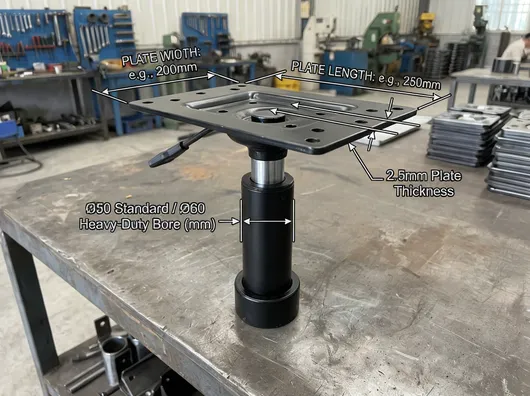
Smooth single-lever height actuation, 80–150kg load capacity, compatible with Ø50mm and Ø60mm cylinder bores. OEM mounting patterns and private-label options available from 500 units.

Product Overview
What the Hydraulic Chair Mechanism Does — and Where It Sits in Your Product Line
The hydraulic chair mechanism is the assembly that connects the seat plate to the gas lift cylinder and controls height adjustment. When your end user pulls the lever, the mechanism releases the gas spring, the cylinder extends or compresses, and the seat moves. When they release the lever, the mechanism locks the cylinder at the new height.
That's the complete function — and the quality of that function is what determines whether your chair generates warranty claims or repeat orders.
We supply the mechanism plate pre-configured for standard gas lift cylinder diameters — Ø50mm and Ø60mm bores, which cover the overwhelming majority of cylinders in the market. The plate geometry includes the lever bracket, cylinder collar, and seat mounting pattern as a single stamped-and-welded assembly. You receive a complete, tested unit ready to drop into your chair frame.
Request a quote for hydraulic chair mechanisms
Where This Mechanism Sits in Our Chair Mechanism Line
The hydraulic unit is the standard height-adjustment mechanism. Here's how it relates to adjacent products in the line.
Standard choice for office task chairs, mid-range executive seating, and any application where smooth, tool-free height adjustment is a baseline feature requirement.
Alternative height-adjustment configuration for specialized lift applications within the same product group.
If your chair line needs tilt or recline in addition to height adjustment, this unit combines both functions in a single assembly.
Engineering Data
Technical Specifications
Specifications shown are standard production values. Contact us for exact data sheets, custom configurations, or non-standard cylinder bore requirements.
Specifications shown are standard production values. Contact us for exact data sheets, custom configurations, or non-standard cylinder bore requirements.
Non-standard cylinder bores, custom mounting patterns, or private-label options available from 500 units.
Get a Quote with Your ConfigHow We Stamp and Assemble This Mechanism — and Why the Process Details Matter for Your Order
Progressive Die Stamping
The mechanism plate is stamped from cold-rolled steel coil on progressive dies — the cylinder collar, lever bracket mounting points, and seat mounting holes are all cut in a single press pass. Every plate in a 10,000-unit run has the same hole pattern to ±0.15mm. If you're running a fixed jig on your chair assembly line, you won't be adjusting per piece.
Steel Gauge Options
Standard-duty applications use 2.0mm SPCC. For heavier load ratings or institutional markets where chairs take more abuse, the 2.5mm Q235 option delivers better yield strength at the lever bracket — the point that sees the most stress during height adjustment. Most buyers don't need the 2.5mm spec for standard office seating, but if you're building for call centers or 24/7 environments, it's worth the small unit cost difference.
MIG Weld & Penetration Verification
The lever bracket is MIG-welded to the plate. We verify weld penetration depth on every batch — not just bead appearance. The lever pivot is the highest-stress joint on this mechanism, and insufficient penetration is the failure mode we see most often in competitor units that come through our lab.
Phosphate Pre-Treatment & Surface Finishing
After welding, every assembly goes through phosphate pre-treatment before surface finishing. This is what keeps zinc plating adhesion consistent across the full batch — not a cosmetic step.

Final Assembly & 100% Functional Testing
Final assembly runs on a dedicated line. Each completed mechanism is functionally tested before packaging — not sampled. Every unit.
(not sampled)
Tolerance
Seat Rigidity
What this means for your assembly line: Consistent ±0.15mm hole patterns across a full production run mean your jigs stay fixed. You're not adjusting per piece or absorbing variance in your downstream assembly process.
Market Segments Where This Mechanism Drives Volume

Contract Office Furniture Manufacturing
Office task chairs are the highest-volume application for hydraulic chair mechanisms globally. If you're manufacturing or importing mid-range task seating ($80–$250 retail), the hydraulic mechanism is a line-item spec on every chair.
Contract furniture manufacturers typically run 3–5 chair models with the same mechanism SKU across the line — consistent mounting patterns and cylinder compatibility mean your assembly line doesn't need to reconfigure between models. We hold the same ±0.15mm tolerance across production runs, so your jigs stay fixed.

Ergonomic Seating Importers
The ergonomic segment has pushed hydraulic mechanism demand upward over the past several years. Height adjustment is the baseline feature that separates an ergonomic chair from a fixed-height stool — buyers in this segment specify it as non-negotiable.
If you're importing ergonomic chairs for North American or European distribution, CE marking and RoHS compliance documentation ship with every order, so your compliance team isn't chasing paperwork before the container clears customs.

Hospitality & Institutional Procurement
Hotels, conference centers, and institutional buyers (universities, government offices) purchase task and conference seating in volume — 200 to 1,000+ units per order, often on annual procurement cycles. These buyers prioritize mechanism reliability over feature count.
A hydraulic mechanism that fails in a hotel conference room generates a service call and a warranty claim; one that runs 60,000+ cycles without issue generates a reorder. We test to that threshold on every production run.

Furniture Hardware Distributors
If you're stocking chair mechanism inventory for downstream furniture manufacturers or repair channels, the hydraulic mechanism is one of the five highest-velocity SKUs in the category — alongside standard tilt, synchro, swivel, and folding.
It moves consistently because height adjustment is a universal feature requirement across price tiers. The reorder frequency is predictable, making it a reliable core stocking SKU if you're building a chair mechanism distribution line.
Configure Your Order
Customization Options and Limitations
Standard production runs at 500 units MOQ. Within that, the following customization options are available without tooling investment.
| Customization | Options | MOQ Impact |
|---|---|---|
| Cylinder bore | Ø50mm or Ø60mm | No change |
| Plate thickness | 2.0mm or 2.5mm | No change |
| Mounting hole pattern | 4-hole standard, 6-hole, or custom spacing | Custom pattern: 500-unit min |
| Lever type | Paddle lever or side-pull | No change |
| Surface finish | Zinc plating, nickel plating, powder coat (black/silver) | No change |
| Custom RAL color (powder coat) | Any RAL | 500-unit minimum |
| Private-label packaging | Your brand on packaging and components | 500-unit minimum |
Custom Plate Geometry
Non-standard dimensions, integrated features, or modified lever bracket positions require tooling. We cut tooling in-house, so sample iterations run faster than working through a third-party tool shop. First sample typically arrives in 25–35 days from drawing approval.
What Can't Be Customized Without Significant Tooling
The cylinder collar diameter outside of the two standard bores, and the lever actuation direction (left vs. right pull is a tooling change, not an assembly change). If you need either of these, contact us early in your development cycle — we'll work through the feasibility and tooling cost before you commit.
We'll come back with a feasibility assessment and quote.
Standards & Documentation
Compliance and Certification for Your Target Markets
The hydraulic chair mechanism ships with CE marking and SGS test documentation as standard. RoHS compliance is confirmed on all components — no restricted substances in the steel, zinc alloy, or surface treatment materials. ISO 9001:2015 governs the QC system that produced it.
BIFMA X5.1
BIFMA X5.1 is the relevant standard for office seating mechanisms in the US market. Our cycle life testing follows BIFMA-equivalent protocols — 60,000 cycles at rated load.
If your customer or retailer requires a formal BIFMA test report rather than an equivalent-protocol result, we can arrange third-party testing through our SGS relationship. Flag this requirement at the quoting stage.
EN 1335
EN 1335 (office furniture — office work chairs) covers the performance requirements your downstream customers will reference. CE marking on our mechanisms addresses the relevant directives.
If you need EN 1335 test reports for a specific retail or contract tender, we can arrange this — it's a request we handle regularly for European distributors.
Material safety documentation (RoHS, REACH) is available on request for buyers whose markets require it at the product level.
Start Sourcing Hydraulic Chair Mechanisms
Sample Order First
Evaluate against your current supplier or a competitor quote with a sample order of 2–5 units, shipped within 7–10 days of confirmation. Test the lever action, check the mounting pattern against your chair frame, and verify the cylinder bore fit before committing to production volume.
Send Your Specs Directly
If you already have specs — cylinder bore, load rating, mounting pattern, target quantity — send them directly and we'll turn around a detailed quote with lead time and packaging confirmation.
Not Sure Which Unit Fits?
Not sure whether the hydraulic mechanism or a combined tilt-and-height unit fits your chair line better? Send us your chair design or target retail price point — we'll recommend the configuration that protects your margin and matches your assembly process.
Contact Us Directly
Request a Quote
Ready to move forward? Send your specs or request a sample order. We'll respond with a detailed quote, lead time, and packaging confirmation.