

Rocking Chair Mechanism
Smooth continuous rocking with optional locking positions, built for lounge and leisure seating lines. Stamped cold-rolled steel construction, 100% functionally tested before shipment.
OEM/ODM tooling supported. Exported to North America, Europe, the Middle East, and beyond.

Product Overview
What This Mechanism Does — and Where It Fits Your Product Line
The rocking chair mechanism delivers continuous, arc-based rocking motion controlled by spring tension rather than a fixed pivot. Unlike a standard tilt mechanism — which locks the seat and backrest into a reclined position — the rocking mechanism allows free, continuous oscillation through the full arc range. Optional locking positions let the end user stop the chair at a neutral or reclined angle when they want a stationary seat.
This is the mechanism that goes into lounge chairs, leisure recliners, nursery rockers, and outdoor seating where the rocking motion itself is the product feature. It's a distinct market segment from office task seating — your buyers are furniture retailers, hospitality importers, and residential furniture brands, not contract office dealers. That distinction matters for how you position it in your catalog and what margin structure you can support.
The rocking chair mechanism sits alongside the Rocker Chair Mechanism in our catalog. The difference: the rocking mechanism here is designed for upholstered lounge and leisure seating with a broader arc range and spring-tension adjustment; the rocker mechanism is a simplified version for casual and residential applications with a fixed arc. If you're building a premium lounge or nursery line, this is the unit. If you need a lower-cost option for basic residential seating, the rocker variant is worth comparing.

Rocking Chair Mechanism
Continuous arc-based oscillation with spring-tension adjustment. Broader arc range. Optional lock positions. For upholstered lounge, leisure recliners, nursery rockers.
Tilt Mechanism
Locks seat and backrest into a reclined position. No continuous oscillation. Designed for office task seating and ergonomic chairs — a different market segment entirely.
Rocker Chair Mechanism
Simplified version with fixed arc. Lower cost. For casual and basic residential seating. Compare this if you need a budget option — not the premium lounge or nursery line.
Engineering Data
Technical Specifications
Industry-standard values for this mechanism type. Actual specifications may vary by configuration — contact us for detailed product data sheets and drawings.
Specifications shown are industry-standard values for this mechanism type. Contact us for exact product data sheets, CAD drawings, and configuration options.

Spring Tension Adjustment — Why It Matters for Your Downstream Customers
The spring tension adjustment lets the end user tune rocking resistance to their body weight without tools — a quarter-turn on the tension bolt. A 60 kg user and a 100 kg user experience the same chair very differently without it. This feature reduces after-sale complaints significantly on lounge seating. It's a detail worth calling out in your product listings.
Manufacturing Process
How We Build It — Process Details That Affect Your Order Quality
Every production decision below has a direct downstream effect on your assembly line, your return rate, or your end customer's experience.
Stamping & Dimensional Tolerances
The seat mounting plate and paired rocker arms are stamped from cold-rolled steel coil on progressive dies. Plate geometry, mounting holes, and spring anchor points are all cut in a single press pass — dimensional consistency holds across your entire production run.
Tolerance: ±0.15mm
Your chair frame jigs require no adjustment between batches.
Weld Quality & Joint Integrity
Rocker arms carry the full dynamic load of every rocking cycle — bending stress runs through the arm-to-plate joint on each pass. We MIG-weld these joints with verified penetration depth, not just bead appearance.
The most common failure mode in competitor mechanisms is weld cracking at this joint after 15,000–20,000 cycles. Insufficient penetration is almost always the cause — it looks fine on the surface but there's no structural bond underneath.
A sample from every production batch is pull-tested before the run ships.
Spring Rate Options
Spring selection involves a trade-off that's easy to get wrong: stiffer gives a more controlled, premium feel but narrows the effective weight range. Softer feels more fluid but can feel unstable under heavier users.
General Lounge Seating
60–100 kg user range. Residential & hospitality standard.
Oversized & Outdoor Seating
80–130 kg range. Recommended for North American market where oversized seating is a larger share of the product mix.
Surface Treatment
Standard production runs zinc plating — the right call for a mechanism inside an upholstered chair where corrosion exposure is low and dimensional tolerance on plated surfaces matters for assembly fit.
Standard: Zinc Plating
Indoor upholstered applications. Preserves dimensional tolerance for assembly fit.
Option: Powder Coat
60–80μm over phosphate pre-treatment wash. Passes 500-hour salt spray. For patio rockers, covered porch seating, outdoor terraces. Specify at order time — it's a line changeover, not a post-production add.
Who Buys This Mechanism
Market Segments Where This Mechanism Generates Repeat Orders
Four distinct buyer categories consistently reorder. Each has different volume patterns, specification priorities, and downstream requirements.
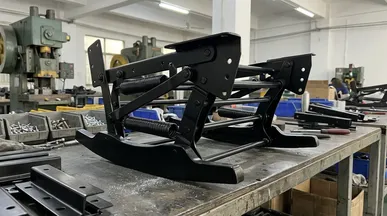
Residential Lounge & Leisure Furniture
The largest volume segment. Manufacturers and importers building upholstered lounge chairs, accent chairs, and nursery rockers need consistent mechanism supply across their SKU range. A mid-range residential lounge chair retails at $200–$500 — the mechanism is a $15–$30 component that determines whether the chair gets returned or reordered.
Typical run: 500–2,000 units/SKU/season
Samples ship within 7–10 days to verify fit before production commitment.
Reorders tied to retail sell-through
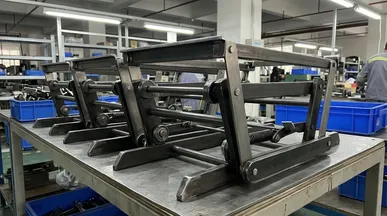
Nursery & Baby Furniture
High-margin, specification-sensitive segment. Parents buying a $300–$600 nursing chair are paying for the rocking feel — smooth, quiet, consistent motion is the product. Mechanism noise (creaking, clicking) is the leading cause of returns in this category.
All pivot contact surfaces ground and deburred before assembly
Dry lubricant applied to spring and pivot points at final assembly. Added after a nursery buyer in Germany flagged creaking complaints on a competitor mechanism.
CE documentation & RoHS compliance ship standard
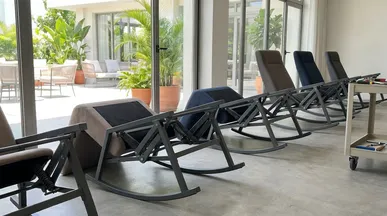
Hospitality & Boutique Hotel Seating
Hotels and resort properties specify lounge seating for lobbies, guest rooms, and outdoor terraces. Hospitality procurement runs on project cycles — a single hotel fit-out can be 50–200 lounge chairs, with repeat orders as properties expand or refresh.
60,000-cycle test threshold
Covers heavier-use hospitality patterns. Guests don't treat hotel furniture the way they treat their own.
Outdoor terraces: specify powder-coat surface treatment
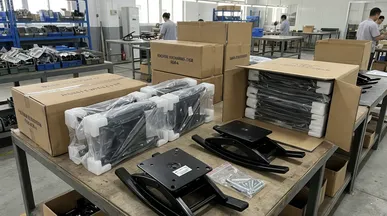
E-Commerce & Direct-to-Consumer Furniture Brands
DTC brands selling through Amazon, Wayfair, or their own stores need mechanisms that survive the full logistics chain — warehouse handling, parcel shipping, and customer self-assembly — without arriving damaged or generating assembly complaints.
Packed: individual poly bags, foam corner protection
Carton dimensions sized for standard pallet configurations. 4-hole seat plate with labeled orientation — straightforward end-user installation with basic tools.
Assembly experience directly affects review scores & return rate
Customization Options for OEM Buyers
The rocking chair mechanism is one of the more customization-friendly products in our chair hardware line, because the core geometry directly affects the finished chair's proportions and feel. Here's what we can modify and what the practical limits are.
Mounting Plate Geometry
Standard 4-hole pattern covers most chair frame designs. We can modify hole spacing, plate dimensions, and add integrated features — cable routing slots, upholstery attachment points — for OEM runs.
3–4 weeks from drawing approval to first sample
Rocker Arm Length
Longer arms increase the arc radius — a slower, more sweeping rocking motion. Shorter arms produce a tighter, quicker arc. Arm length is the single biggest variable in how the finished chair feels.
Send a reference chair or describe the arc behavior you're targeting — we'll spec the arm geometry.
Spring Rate
Two standard rates available off-the-shelf: medium and heavy. Custom spring rates are available for runs over 1,000 units — below that threshold, spring tooling cost doesn't amortize sensibly.
Medium / Heavy — off-the-shelf. Custom rates: 1,000+ units MOQ.
Surface Finish
Three finish options to match your product tier and visibility requirements.
Private Label
Mechanism components can be marked with your brand or model number. Packaging can be white-label or custom-printed.
500 units minimum for custom-printed packaging.
What Can't Be Customized
The fundamental rocking motion geometry — arc-based spring rocking vs. pivot-based — is a different mechanism type, not a configuration change. If you need a fundamentally different motion character, we'd discuss that as an ODM development project.
Standard configurations: 500 units. OEM tooling projects: MOQ depends on tooling amortization — we'll give you the honest number based on your spec.
Compliance and Certification for Your Target Markets
The rocking chair mechanism ships with CE marking and SGS test documentation as standard. Our quality management system is ISO 9001:2015 certified, governing incoming material inspection, in-process checks, and 100% outgoing functional testing.
North American Buyers
BIFMA X5.1 is the relevant standard for seating mechanisms in the US market. Our cycle life testing follows BIFMA-equivalent protocols at 60,000+ cycles.
If your customer or retail channel requires a formal BIFMA test report, we can arrange third-party testing through our SGS relationship. Flag this at the quoting stage.
European Buyers
EN 1335 covers office seating, but lounge and leisure seating mechanisms fall under general product safety directives. CE marking covers this.
We've handled compliance paperwork for buyers across 40+ countries. Our senior export coordinator knows what each market typically needs — let us know your channel requirements.
Material Compliance Details
Uses trivalent chromium passivation — no hexavalent chromium. Meets EU REACH and RoHS requirements.
Low-VOC formulations used across all powder coat color runs.
Complete material declarations available on request for any compliance documentation requirement.
Logistics & Costing
Packaging, Container Loading, and Landed Cost
Export Packaging
Mechanisms are individually poly-bagged and packed in standardized export cartons. Carton dimensions are optimized for 40HQ container loading — pallet configurations are pre-worked so your freight forwarder isn't improvising.
40HQ Container Loading
Typical 40HQ loading for rocking chair mechanisms runs approximately 3,000–4,000 units depending on configuration. Rocker arm length affects carton size and final unit count per container.
Freight Weight & Cube
Rocking mechanisms are heavier than simple tilt mechanisms due to the rocker arm assembly. Factor approximately 2.5–3.5 kg per unit (packaged) into your freight calculation. Exact carton weights and dimensions available at quoting stage.
DTC & E-Commerce Buyers
- Retail-ready inner cartons with product photography and assembly instructions included
- White-label and custom-print packaging available for runs over 500 units
- Amazon FBA-ready labeling — send FNSKU labels and we apply them before packing
Landed Cost Variables
For buyers calculating landed cost, weight and cube are the two variables that matter most for freight. Key inputs for your freight forwarder:
Buyer FAQ
Frequently Asked Questions
What is the difference between a rocking chair mechanism and a rocker chair mechanism?
The rocking chair mechanism in this listing is designed for upholstered lounge and leisure seating — it has a broader arc range, spring-tension adjustment for user weight, and optional locking positions. The Rocker Chair Mechanism is a simplified version for casual and residential applications with a fixed arc and no tension adjustment. If you're building a premium lounge, nursery, or hospitality seating line, the rocking mechanism is the right spec. If you need a lower-cost option for basic residential seating, the rocker variant is worth comparing. Send us your target retail price point and we'll recommend which fits your margin structure.
What cycle life does this mechanism achieve, and what does that mean for warranty exposure?
We test to 60,000+ cycles at rated load using a BIFMA X5.1 equivalent protocol. For a lounge chair used 2–3 hours daily, 60,000 cycles represents roughly 8–10 years of normal use. For nursery rockers used more intensively, it's still well beyond typical warranty periods. Specifying cycle life in your purchase order — and getting the test report with your shipment — gives you documented evidence if a warranty claim arises downstream.
Can I get this mechanism in a configuration that locks in multiple positions?
Standard production offers free-rocking (no lock) and single-lock (neutral position) configurations. A two-position lock (neutral + reclined) is available as a configuration option — specify at order time. More than two lock positions requires a custom tooling discussion; it's mechanically feasible but adds complexity to the lock mechanism assembly.
What is the MOQ, and can I order samples first?
Standard MOQ is 500 units for catalog configurations. We strongly recommend a sample order before committing to production quantities — 2–5 units to verify fit with your chair frames, test the rocking feel, and confirm the spring rate is right for your target user weight range. Samples ship within 7–10 days of order confirmation.
Does this mechanism work for outdoor seating applications?
The standard zinc-plated configuration is designed for indoor use. For outdoor or semi-outdoor applications (covered patios, resort terraces), specify the powder-coated surface treatment option — 60–80μm over phosphate pre-treatment, rated for 500-hour salt spray. This is a production-line specification, not a post-production upgrade, so it needs to be confirmed at the quoting stage.
What certifications ship with the order?
CE marking, SGS test report, and RoHS compliance documentation ship standard. ISO 9001:2015 quality system documentation is available on request. For BIFMA-certified test reports (North American market), we can arrange third-party testing through SGS — flag this requirement when you request a quote.
Get a Quote for This Rocking Chair Mechanism
How to Start Your Order
Most new buyers start with a sample order — 2–5 units to test fit, rocking feel, and spring rate against their chair frames before committing to production quantities. We ship samples within 7–10 days.
If you already have a chair design in progress, send us your frame drawings or a reference sample. If you're building a new lounge or leisure seating line and need mechanism recommendations, tell us your target retail price tier and end-use segment — we'll suggest the configuration based on what's working for our existing buyers in your region.
Request a Quote
Send frame drawings, reference samples, or your target price tier and segment — we'll respond with a configuration recommendation.
Request a Quote for This Mechanism