

Folding Chair Mechanism
Factory-direct folding chair mechanism — engineered for the cycle loads that event and institutional seating actually sees. Stamped steel fold-flat brackets with 80,000-cycle verified life. Container-load quantities available. OEM mounting patterns and custom finishes supported.

Product Overview
What the Folding Chair Mechanism Does — and Where It Fails in the Market
A folding chair mechanism is a pivot-and-lock bracket assembly that allows a chair frame to collapse flat for stacking or storage, then lock rigid under load when deployed. The mechanism has two jobs: fold reliably without binding, and hold without flex or rattle when someone sits on it.
Most of the quality problems in this product category come from one of two places — the pivot pin wearing loose after repeated fold cycles, or the lock engagement losing positive click and developing play under load.
We've been producing folding mechanisms for over a decade, and the failure mode we see most often in competitor product that comes through our lab is undersized pivot hardware combined with a lock tab that's stamped too thin to maintain spring tension after 10,000–15,000 cycles. That's a problem for event rental companies and institutional buyers who are folding and unfolding these chairs daily.
Request a Spec Sheet
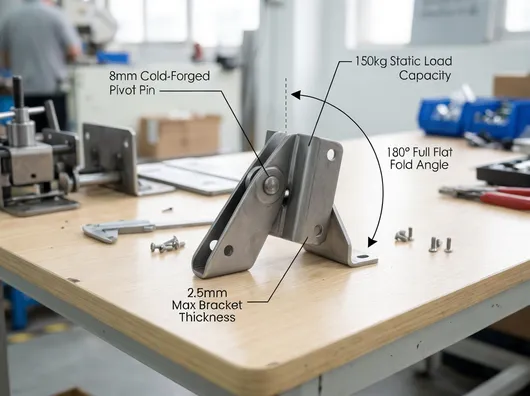
8mm Cold-Forged Pivot
Cold-forged steel pin — not rolled sheet — maintains dimensional integrity across high-cycle loads where undersized hardware fails.
Separate Lock Spring
The lock spring is a separate formed component, not a tab cut from the bracket plate itself — preserving spring tension well past 15,000 cycles.
The Cost Math
The heavier pivot hardware adds roughly 4–6% to the mechanism unit cost. The warranty claim rate difference makes that math easy for event rental companies and institutional buyers cycling chairs daily.
Standard Production Values
Technical Specifications
Standard production specifications for our folding chair mechanism line. Custom configurations — modified fold angles, non-standard mounting patterns, alternative surface treatments — are available; see the customization section below.
Specifications shown are standard production values. Contact us for exact data sheets and drawings for your specific configuration.
Request Data Sheet
Get exact spec sheets and CAD drawings for your specific configuration — including custom fold angles, mounting patterns, and surface treatments.
Request Spec Sheet / CADCycle Life and Load Testing — The Numbers Behind the Spec
80,000 cycles is the figure we publish, and it's a tested number, not a marketing claim. We run accelerated cycle testing on representative units from each production batch — full fold/unfold strokes at rated load, on a motorized test rig that runs continuously. The test protocol follows BIFMA X5.1 equivalent methodology, which is the standard most North American and European institutional buyers reference in their procurement specs.
For context: an event rental company cycling chairs twice daily for events averages roughly 700 cycles per year per chair. At that rate, 80,000 cycles represents over 100 years of service life — the mechanism will outlast the chair frame. For institutional seating in schools or government facilities where chairs are folded and stored daily, the cycle count is higher, but the mechanism still comfortably exceeds a 20-year service horizon.
We also run static load testing at 1.5× rated capacity on every production batch. The 150 kg rated load means we're testing to 225 kg static — that's the structural margin that prevents catastrophic failure in real-world overload situations.
We've had buyers ask us to certify to 120 kg to reduce cost. We don't. The liability exposure for a chair collapse in a school or hotel isn't worth the unit cost saving.

Representative units from every production batch run on the motorized test rig — not just initial qualification samples.
The methodology institutional procurement specs in North America and Europe reference. Test reports available on request.
Static overload testing at 225 kg on every batch ensures the mechanism fails safely — not catastrophically — in real-world overload.
Market Segments — Where Folding Chair Mechanisms Generate Recurring Revenue
The folding mechanism is one of our highest-volume export items, and the demand pattern is consistent across markets. These are the segments where our buyers build repeatable business.
Event Rental and Hospitality
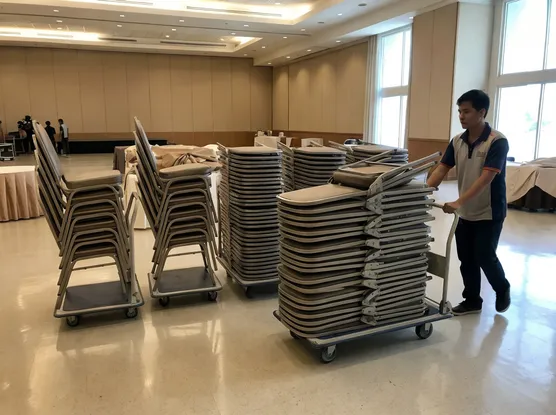
Hotels, conference centers, banquet halls, and event rental companies operate chair fleets of 500 to 5,000+ units. They reorder on a replacement cycle — typically every 3–5 years as mechanisms wear or frames are damaged — and they buy in container loads.
The key spec for this segment is cycle life and fold smoothness: rental staff fold and stack chairs under time pressure, and a mechanism that binds or requires two hands to lock costs labor time at every event setup.
Recurring revenue note: Event rental buyers reorder every 18–24 months as their fleet rotates — making this a reliable revenue stream for distributors who stock this product.
Institutional and Education
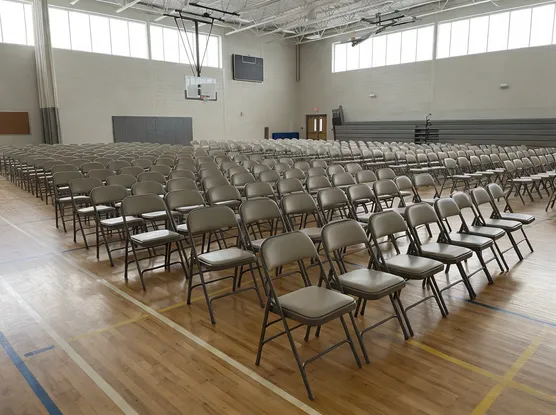
K-12 schools, universities, government offices, and community centers buy folding seating on annual furniture budgets — typically 200 to 1,000 units per institution, with procurement cycles tied to budget years. This segment prioritizes durability and low maintenance over aesthetics.
Heavy-gauge mechanisms with simple lock systems and minimal moving parts are the right spec here. Our 2.5 mm bracket option with zinc plating is the configuration most of our institutional buyers land on — it survives the handling that school environments deliver without requiring maintenance.
Procurement timing: Annual budget cycles mean predictable reorder timing for distributors supplying into education or government sectors.

Religious and Community Facilities
Churches, mosques, community halls, and civic venues are consistent buyers of folding seating — they need chairs that store compactly and deploy quickly for variable-attendance events. Order sizes run 100–500 units, with reorders every 5–8 years.
This segment is price-sensitive but not spec-sensitive — standard configuration mechanisms at competitive landed cost are the right product positioning.

Furniture Manufacturers and OEM Assembly
If you manufacture folding chairs and source mechanisms as a component, the relevant spec is mounting pattern compatibility with your frame geometry and finish consistency across production runs.
Custom mounting patterns are available with OEM tooling. See the customization section.
Manufacturing Process — Why the Bracket Geometry Holds
The folding chair mechanism looks simple. It's a bracket, a pivot, and a lock. The manufacturing decisions that determine whether it holds up over 80,000 cycles are less obvious from the outside.
Progressive Die Stamping — Bracket Plates
Bracket plates are stamped on progressive dies from cold-rolled steel coil — SPCC for standard-duty, Q235 for heavy-load configurations. Progressive die stamping produces the complete plate geometry — mounting holes, pivot bore, and lock tab slot — in a single press stroke.
The relationship between the pivot bore center and the mounting hole pattern is fixed by the die geometry, not by operator setup. On a 10,000-unit run, every bracket is dimensionally identical. Buyers who've sourced from factories using CNC-drilled individual plates know what batch-to-batch variation looks like on their assembly line.
Cold-Forged Pivot Pin
The pivot pin is cold-forged, not rolled from sheet. Cold forging aligns the grain structure of the steel along the pin axis — the direction of the shear load during folding. A rolled or machined pin of the same diameter has lower fatigue resistance under cyclic shear. It's the same reason automotive suspension pins are forged, not machined from bar stock.
We switched to cold-forged pivot hardware in 2017 after seeing fatigue cracking in pins from a previous supplier at around 40,000 cycles. The forged spec has been clean since.
Separate Lock Spring Component
The lock spring is a separate formed component, not a tab cut from the bracket plate. This is the detail that separates mechanisms that maintain positive lock engagement over their service life from those that develop rattle and play after a few thousand cycles.
A tab cut from the bracket plate fatigues at the notch root — the geometry concentrates stress exactly where you don't want it. A separate spring component can be designed with the right cross-section and heat treatment for its specific function, independent of the bracket plate's structural requirements.
Surface Treatment — Zinc and Duplex Systems
Standard production uses zinc plating — corrosion protection without adding dimensional thickness that would affect pivot clearance. For buyers supplying into coastal markets or outdoor applications, we offer powder coat over zinc as a duplex system: zinc for electrochemical protection, powder for barrier protection.
The duplex system passes 800-hour salt spray without corrosion breakthrough. We developed this spec for a buyer supplying beach resort venues in Southeast Asia — single-layer zinc was failing at 18 months in that environment. The duplex system has been running clean for three years.

Customization Options and OEM Support
Standard catalog mechanisms cover most sourcing requirements. When they don't, our tooling capability handles the gap.
| Customization Dimension | Options | MOQ Impact |
|---|---|---|
| Bracket plate thickness | 2.0 mm, 2.5 mm, 3.0 mm | No MOQ change for standard thicknesses |
| Fold angle | 180° flat, 90° partial, custom angle | Custom angle requires tooling — discuss with engineering |
| Mounting hole pattern | Standard 4-hole, 6-hole, custom layout | Custom pattern: OEM tooling, 1,000-unit minimum |
| Load rating | 150 kg standard, 200 kg heavy-duty | Heavy-duty: 500-unit minimum |
| Surface treatment | Zinc plating, powder coat, nickel plating, duplex zinc+powder | No MOQ change for standard finishes |
| Color | Silver zinc (standard), matte black, custom RAL | Custom RAL: 500-unit minimum per color |
| Private label / branding | Laser marking or stamped logo on bracket | 1,000-unit minimum |
| Packaging | Standard export carton, retail-ready, branded carton | Branded packaging: discuss with sales |
OEM Development Cycle
For OEM chair manufacturers who need a mechanism designed around a specific frame geometry, our 12-person engineering team handles the full development cycle: drawing review, tooling design, sample production, and iteration.
Tooling is cut in-house, so sample revisions turn around faster than working through a third-party tool shop. First sample from approved drawings typically takes 20–30 days depending on complexity.
Standard catalog mechanisms ship at 500-unit MOQ. OEM tooling projects have flexible MOQ arrangements based on tooling amortization — we'll give you the honest number based on your spec.

Have a Reference Sample or Frame Drawing?
Send us your frame drawings or a reference sample — engineering will come back with a feasibility assessment and honest MOQ based on your spec.
Quality Assurance
Compliance and Certification
Folding chair mechanisms sold into North American and European markets face compliance requirements at two levels: the mechanism itself, and the finished chair it's installed in.
Mechanism-Level Compliance
- CE marking — standard on all production runs
- SGS third-party testing — independent verification
- ISO 9001:2015 — quality management system
- RoHS compliance — no restricted substances in materials or surface treatments
- Trivalent chromium passivation on zinc plating — no hexavalent chromium, documented for EU and California market requirements
Finished Chair Standards
The relevant standards for seating structural performance are:
- BIFMA X5.1 — North America seating structural performance
- EN 16139 — Europe seating structural performance
Our mechanisms are tested to load and cycle protocols equivalent to these standards. If your downstream customers or procurement specs require specific test reports referencing these standards by name, we can arrange third-party testing through our SGS relationship — discuss this during quoting.
Institutional Buyers: Documentation Requirements
For buyers supplying into institutional markets (schools, government facilities), procurement specs often require documentation of cycle life testing and load ratings. We provide test reports with shipment. If your procurement spec has specific documentation requirements, send them to us before the order — we'll confirm what we can provide rather than discovering gaps after production.
All compliance documentation ships with the order:
Your compliance team gets what they need without follow-up requests. Learn more about our certifications and quality system.
Logistics & Landed Cost
Packaging, Container Loading, and Landed Cost
Folding chair mechanisms ship in standardized export cartons — 50 pairs per carton, cartons sized for efficient 40HQ pallet configuration. We've worked out the loading geometry for the main configurations so your freight forwarder isn't improvising at the warehouse.
Typical 40HQ Container Loading
Loading figures are estimates based on standard carton dimensions. Confirm with your freight forwarder for exact container utilization.
50-Pair Carton Format
For distributors managing inventory turns, the 50-pair carton format allows partial-pallet stocking without breaking bulk.
Retail-Ready Packaging
For e-commerce or retail-channel buyers, retail-ready packaging with product photography and spec labeling is available as part of an OEM arrangement.
Lead Time
Standard catalog mechanisms: 25–35 days from order confirmation and deposit. Mixed orders combining folding mechanisms with other chair mechanism types don't extend lead time — different types run on dedicated lines in parallel.
Buyer Guidance
Frequently Asked Questions — Folding Chair Mechanism Sourcing
What is the standard fold angle for a folding chair mechanism, and can it be customized?
Our standard production is a 180° flat fold — the chair collapses completely flat for stacking. We also produce a 90° partial-fold configuration used in some theater and auditorium seating applications where chairs fold up against a row rather than stacking flat. Custom fold angles outside these two standards require new tooling; our engineering team can assess feasibility from your frame drawings. If you're unsure which fold geometry fits your chair design, send us a sketch or reference photo and we'll advise.
How do I specify the right load rating — 150 kg or 200 kg — for my application?
The 150 kg rating covers standard commercial seating: event rental, hospitality, institutional. The 200 kg heavy-duty option is for applications where overload is likely — outdoor public seating, industrial facilities, or markets where buyers are conservative about structural specs. If your downstream customers are in North America or Northern Europe, the 200 kg spec is worth the modest unit cost premium because it eliminates the structural failure liability entirely. We've had buyers switch from 150 kg to 200 kg after a single warranty claim — the cost difference per unit is small compared to the cost of a claim.
What causes folding chair mechanisms to develop rattle or loose lock engagement over time?
Almost always one of two things: pivot pin wear, or lock spring fatigue. Pivot pin wear happens when the pin is undersized for the cyclic shear load — the bore elongates over time and the pivot develops play. Lock spring fatigue happens when the spring is a tab cut from the bracket plate rather than a separate formed component — the tab fatigues at the notch root and loses spring tension. Our 8mm cold-forged pivot pins and separate lock spring components address both failure modes. If you're evaluating mechanisms from multiple suppliers, ask specifically about pivot pin diameter and whether the lock spring is integral to the bracket or a separate part.
What is the MOQ for folding chair mechanisms, and can I mix with other mechanism types?
Standard MOQ is 500 units per type. You can mix folding mechanisms with other chair mechanism types from our catalog in a single order — different types run on dedicated production lines, so mixing doesn't extend lead time. For new buyers, we recommend a sample order of 2–5 pairs before committing to production quantities, to verify fit with your chair frame and confirm the lock engagement feel meets your standard.
Do your folding chair mechanisms meet BIFMA or EN 16139 standards?
Our mechanisms are tested to load and cycle protocols equivalent to BIFMA X5.1 and EN 16139. If your procurement spec requires test reports that reference these standards by name, we can arrange third-party testing through our SGS relationship. Discuss this requirement during quoting — it affects lead time and adds a testing cost that we'll include in the quote transparently.
Start Sourcing Folding Chair Mechanisms
Most buyers in this category start with a sample order — 2 to 5 pairs — to test fold action, lock engagement, and fit against their chair frames before committing to production quantities. We can ship samples within 7–10 days of order confirmation.
If you're sourcing for a specific project or building inventory for distribution, send us your volume requirements and target configuration. If you're an OEM chair manufacturer who needs a mechanism designed around your frame geometry, send us your drawings — our engineering team will come back with a feasibility assessment and quote.

Explore More
Other chair mechanism types from MVMHardware