You've seen the spec sheet. It says "50,000 cycles." Maybe it says "100,000 cycles." The number sits there with no context — no test standard, no load condition, no failure definition. You're supposed to take it on faith.
That's the problem. Cycle life is one of the most abused numbers in furniture hardware sourcing. Suppliers print whatever sounds competitive, and buyers have no easy way to challenge it. The result: mechanisms that fail at 8,000 cycles get sold as 50,000-cycle product, warranty claims pile up, and the importer absorbs the cost.
This article explains how cycle life numbers are actually generated, which test standards give them meaning, what thresholds you should require by application, and how to tell a credible test report from a number someone typed into a spec sheet.

What "cycle" actually means — and why the definition matters
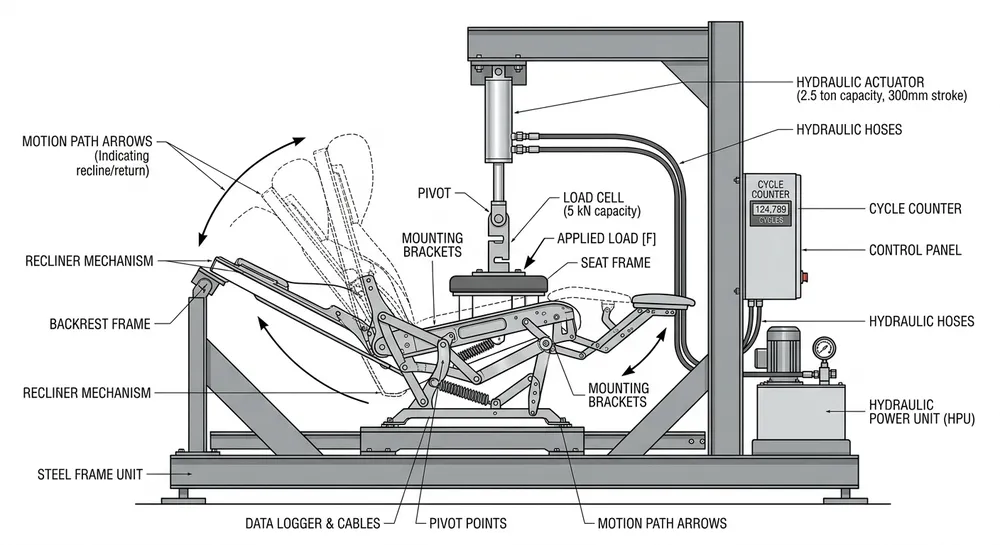
A cycle is one complete motion sequence: from the starting position, through the full range of movement, and back. For a recliner mechanism, that's one recline-and-return. For a chair tilt mechanism, it's one forward-tilt-and-return under load. For a sofa bed linkage, it's one full open-and-close.
The number only has meaning when you know three things:
- Load applied: what weight was on the mechanism during testing (typically expressed in kg or N)
- Range of motion: whether the test ran through the full travel or a partial arc
- Failure definition: what counts as "failed" — complete fracture, measurable play beyond a threshold, surface coating failure, or functional degradation
A supplier who quotes 80,000 cycles without specifying load and failure criteria is giving you a number with no floor. We've seen test reports where "failure" was defined as visible surface wear on the pivot — a standard so loose it inflates cycle counts by 3x compared to a structural integrity definition.
The real-world translation buyers use: divide the cycle count by your expected daily use rate. A residential recliner used 10 times per day reaches 50,000 cycles in about 13.7 years. A hotel lobby chair used 40 times per day reaches the same count in under 3.5 years. Same number, very different service life depending on deployment.
Test standards that give cycle life numbers meaning
Three frameworks come up most often in furniture mechanism sourcing. They're not interchangeable.
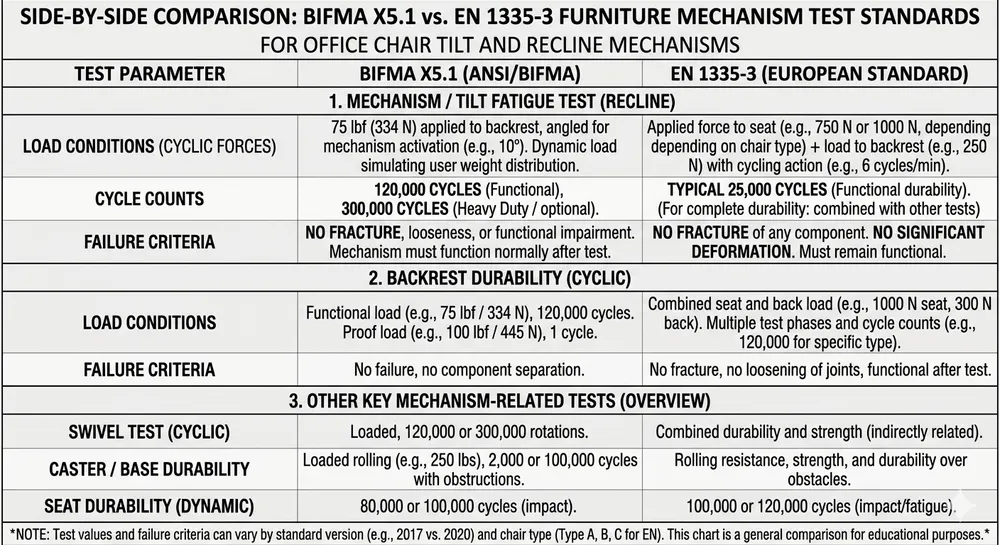
BIFMA X5.1 (Business and Institutional Furniture Manufacturers Association) is the standard most North American commercial buyers reference. It covers office seating and specifies load conditions, cycle counts, and failure criteria for tilt mechanisms, seat-height adjusters, and armrests. If you're supplying contract furniture into the US market, your mechanism supplier should be able to reference BIFMA compliance — not just claim it.
EN 1335 is the European equivalent for office chairs, with similar scope but different load parameters and test sequences. EN 1335 Part 3 covers stability and durability testing. European importers and distributors who sell into commercial channels need mechanisms tested to this standard, not just residential-grade product with a cycle number attached.
Factory internal protocols are what most suppliers actually use for standard product. These vary widely. A well-run factory defines load conditions, cycle speed, and failure criteria in writing, runs tests on production samples from each batch, and keeps records. A less rigorous operation runs a single pre-production test, prints the result on all spec sheets indefinitely, and never retests.
The practical question when evaluating a supplier: ask which standard their cycle life claim references. If the answer is "our internal standard," ask to see the protocol document. If they can't produce one, the number is marketing.
| Standard | Primary market | Scope | Key load reference |
|---|---|---|---|
| BIFMA X5.1 | North America | Office seating mechanisms | Body weight + dynamic load factor |
| EN 1335-3 | Europe | Office chair durability | 110 kg static, defined cycle sequences |
| Factory internal | Varies | Depends on protocol quality | Defined by supplier — must be documented |
| No standard cited | Red flag | Unknown | Unknown |
Residential vs commercial thresholds: the floor is not the same
This is where procurement decisions diverge, and where under-specified product causes the most damage.
For residential applications — recliners, home office chairs, sofa beds — 50,000 cycles is a reasonable minimum for standard mechanisms. At typical home use rates (5–15 cycles per day), that translates to 9–27 years of service life. Most residential buyers don't need more than this, and over-specifying adds cost without adding value to the end customer.
For light commercial applications — hospitality seating, small office environments, retail display furniture — the floor moves up. We'd recommend a minimum of 80,000 cycles for mechanisms in these environments, tested under commercial load conditions (typically 110–120 kg). The use rate is higher, the user population is less careful, and warranty exposure is concentrated: one hotel property might have 200 chairs from the same batch.
For heavy commercial and institutional applications — contract office furniture, healthcare seating, airport or transit environments — 100,000+ cycles under full commercial load is the appropriate threshold. Some contract specifications explicitly require BIFMA or EN 1335 compliance documentation, not just a cycle number. If your buyer is a commercial furniture manufacturer or a large-scale distributor supplying these segments, they need mechanisms that can support that claim in writing.
(We get asked occasionally whether residential-grade mechanisms can be used in light commercial settings to save cost. The honest answer: sometimes, for low-traffic applications. But the risk sits with the importer when a warranty claim comes in, and the cost of a single container return usually exceeds the savings from specifying down.)
| Application segment | Recommended minimum cycle life | Test load reference | Documentation needed |
|---|---|---|---|
| Residential | 50,000 cycles | 90–100 kg | Factory test report |
| Light commercial / hospitality | 80,000 cycles | 110 kg | Factory test report + protocol |
| Contract office / institutional | 100,000+ cycles | 110–120 kg | BIFMA or EN 1335 compliance |
| Healthcare / high-abuse | 150,000+ cycles | Per application spec | Third-party test report |
What actually degrades cycle life — the failure modes worth asking about
Cycle life isn't just a function of how many times a mechanism moves. It's a function of where the mechanism is most likely to fail first. Understanding the failure modes helps you ask better questions during supplier evaluation.
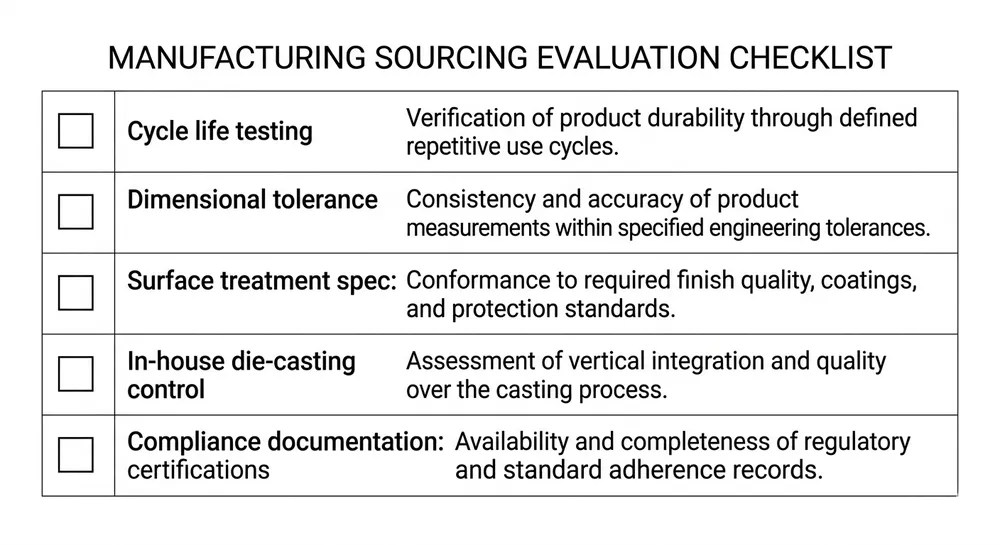
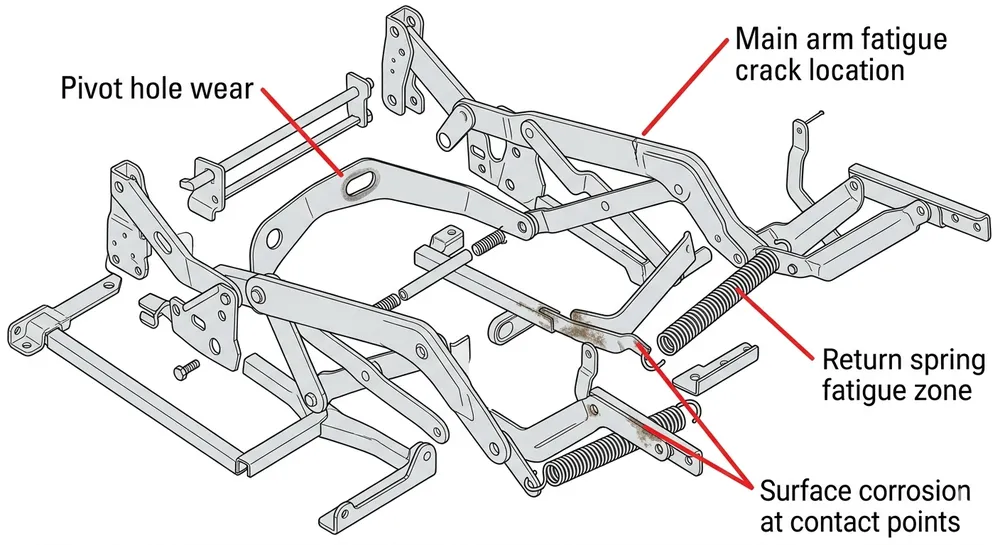
Pivot geometry and die-cast component quality are the most common early failure point in lower-grade mechanisms. The pivot points — where the mechanism's arms rotate against each other — need tight dimensional tolerances to maintain consistent motion through thousands of cycles. When pivot holes are cast with loose tolerances or inconsistent wall thickness, the mechanism develops play early. You feel it as wobble or looseness before any structural failure occurs. In residential product, buyers often accept this as normal wear. In commercial product, it generates warranty claims.
We run in-house zinc alloy die-casting for our pivot components specifically because it gives us control over this dimension. Outsourced castings from lower-tier suppliers often have 0.3–0.5mm more dimensional variation than we'd accept — that gap compounds over cycles. (The difference isn't visible on a spec sheet. It shows up at 15,000 cycles when the mechanism starts to feel loose.)
Material grade at the stamped steel components — the main arms, the seat plate, the back bracket — determines fatigue resistance. Cold-rolled steel at the right gauge and temper handles cyclic stress well. Substituting lighter gauge or lower-grade material to reduce cost is a common shortcut that doesn't show up in a single-sample test but degrades batch-level reliability. We use Q235 and SPCC cold-rolled steel for structural components, with wall thickness specified per load class rather than defaulting to the lightest gauge that passes a single prototype test.
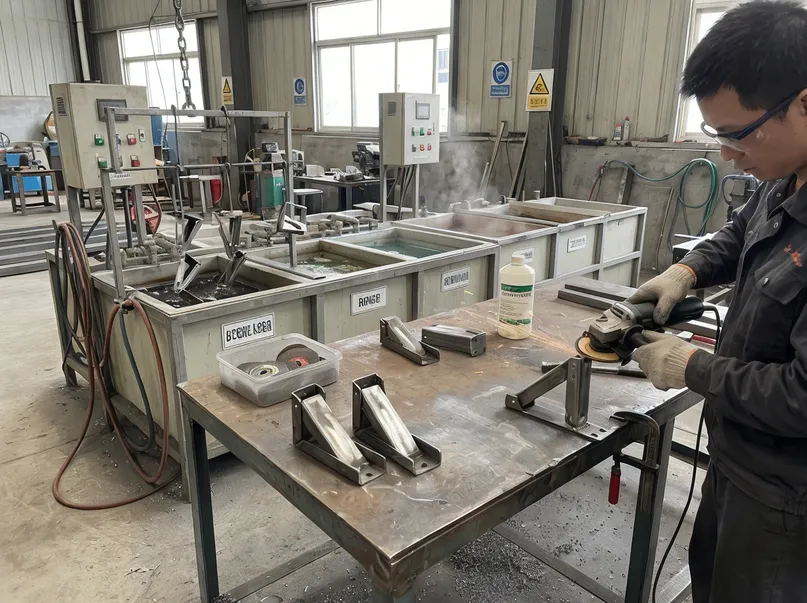
Surface treatment integrity affects cycle life indirectly but meaningfully. Mechanisms with inadequate surface treatment develop corrosion at pivot points, which increases friction, which accelerates wear. Nickel plating, zinc plating, and powder coating all perform differently in this role — the choice matters for the deployment environment. A mechanism going into coastal hospitality furniture needs different surface treatment than one going into a dry-climate residential product. See our notes on surface treatment specification for the full breakdown.
Spring fatigue is the failure mode most buyers don't ask about. The return spring in a tilt or recliner mechanism is under cyclic stress every single cycle. Spring steel grade, wire diameter, and coil geometry all affect how many cycles the spring handles before losing tension or fracturing. A mechanism that passes 50,000 cycles with a fresh spring may not pass 50,000 cycles with a spring that's been in storage for 18 months. We test with production-representative springs, not pre-selected samples.
For a deeper look at how steel vs zinc alloy material choice affects these failure modes, that post covers the trade-offs in more detail.
How to verify supplier cycle life claims before you order
The spec sheet number is the starting point, not the verification. Here's what a credible supplier should be able to provide — and what the absence of each document tells you.
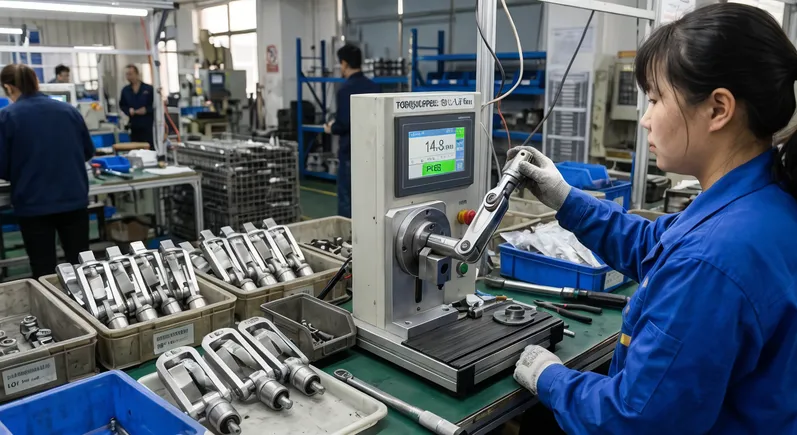
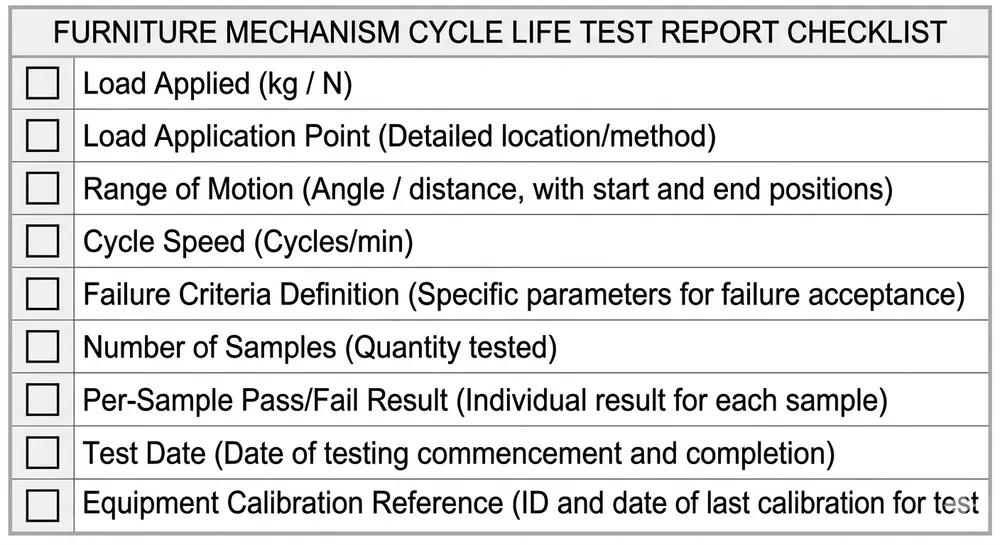
A test report with full test parameters. Not just the cycle count. The report should state: load applied (kg or N), load application point, range of motion tested, cycle speed (cycles per minute), failure criteria, number of samples tested, and pass/fail result for each sample. A report that shows only "50,000 cycles — PASS" with no parameters is not a test report. It's a label.
Batch-level testing records, not just prototype data. Some suppliers run one test on a pre-production sample and apply that result to all future production. Ask whether cycle life testing is performed on production batches or only on initial samples. Batch qualification testing — pulling samples from actual production runs and testing them — is the only way to catch manufacturing drift over time.
The test protocol document. If a supplier uses an internal standard, they should have a written protocol: what equipment is used, how it's calibrated, what the pass criteria are, who signs off. This document exists in any factory that takes testing seriously. If they can't produce it, the testing isn't systematic.
Third-party test reports for commercial-grade claims. For mechanisms going into contract furniture or institutional applications, a factory's own test report may not satisfy your buyer's requirements. SGS, TÜV, Intertek, and Bureau Veritas all offer furniture mechanism cycle life testing. If your downstream customer requires third-party documentation, confirm this with your supplier before ordering — not after.
At MVMHardware, 50,000-cycle load testing is standard batch qualification for our Furniture Motion Mechanism product line. It's not a premium tier or an optional add-on — it's the floor we test every production batch against before shipment. Test reports are available with shipment documentation on request. For commercial-grade specifications requiring 80,000 or 100,000+ cycles, we run extended testing on those batches and can provide the full parameter report.
Reading a cycle life spec sheet: the questions that separate real data from marketing
When you receive a spec sheet or quotation with a cycle life claim, run through these questions before accepting the number:
What load was applied? A 50,000-cycle result at 80 kg is not the same as 50,000 cycles at 110 kg. If the load isn't specified, ask. If the supplier doesn't know, the test wasn't documented properly.
What was the failure criterion? "No structural failure" is a meaningful criterion. "No visible surface defects" is not — it will inflate cycle counts significantly. Ask for the exact definition used.
Was this a prototype test or batch qualification? Prototype tests establish that the design can work. Batch qualification tests establish that your specific production run meets the spec. You want both, but batch qualification is what protects you.
How old is the test data? A test report from 2018 on a mechanism that's been in continuous production since then may not reflect current production quality. Material sourcing changes, tooling wears, process parameters drift. Ask when the most recent batch test was run.
Does the test standard match your market? If you're selling into European commercial channels, a BIFMA-referenced test may not satisfy your buyer's requirements. Confirm the applicable standard before ordering.
These aren't adversarial questions. Any supplier running real tests will answer them without hesitation. The ones who can't are telling you something important.
Frequently asked questions
What does 50,000 cycles mean in real years of use?
It depends entirely on use frequency. At 10 cycles per day (typical residential recliner), 50,000 cycles is about 13.7 years. At 25 cycles per day (light commercial), it's 5.5 years. At 50 cycles per day (busy hospitality or office environment), it's under 3 years. Always translate the cycle count into years using your expected deployment use rate — the raw number alone doesn't tell you whether the mechanism is appropriate for your application.
Can I use a residential-rated mechanism in a commercial project to reduce cost?
For very low-traffic commercial applications — a small private office, a boutique hotel with limited seating — the risk may be acceptable. For any application with consistent daily use by multiple users, the warranty exposure usually outweighs the cost saving. The more important question is whether your downstream buyer's specification requires a minimum cycle life or a specific test standard. If it does, the residential-grade mechanism disqualifies you regardless of the actual failure risk.
What's the difference between BIFMA and EN 1335 for mechanism sourcing?
Both cover office seating durability, but they use different load parameters and test sequences. BIFMA X5.1 is the reference for North American commercial furniture. EN 1335-3 is the European equivalent. A mechanism tested to one standard is not automatically compliant with the other — the load conditions differ enough that you can't assume equivalence. If you supply both markets, confirm which standard applies to each customer's requirements.
How do I know if a supplier's internal test standard is credible?
Ask for the written protocol document. A credible internal standard specifies: test equipment type and calibration schedule, load conditions, cycle speed, failure criteria, sample size per batch, and sign-off procedure. If the supplier can produce this document and it's specific rather than generic, the standard is real. If they describe their testing verbally but can't produce a written protocol, treat the cycle life claim as unverified.
Does surface treatment affect cycle life?
Yes, indirectly. Surface treatment at pivot points affects friction, and friction affects wear rate. Mechanisms with inadequate surface treatment develop corrosion at contact points, which increases friction over time and accelerates pivot wear. For humid or coastal deployment environments, surface treatment specification is a direct input to expected cycle life — not just an aesthetic choice. Nickel plating at pivot contact surfaces outperforms powder coat alone in high-humidity conditions.
What documentation should I request with my order?
At minimum: a cycle life test report with full parameters (load, range, failure criteria, sample count), the test date, and confirmation of whether it's prototype or batch data. For commercial-grade orders, add the test protocol document and — if your buyer requires it — a third-party test report from an accredited lab. If you're ordering from MVMHardware, you can request test documentation as part of your shipment package. Send us your application specs and cycle life requirements and we'll confirm what documentation we can provide with your order.