The material question comes up on almost every RFQ we receive for recliner linkages and sofa bed frames. Buyers ask for "steel" or "zinc alloy" as if the choice is obvious — and then discover mid-production that they specified the wrong one for their market, their price point, or their downstream warranty exposure.
This isn't a close call in every case. But it's also not as simple as "steel is stronger." The real cost of the wrong material shows up in your freight bill, your RMA rate, and your customer's assembly experience — not in a spec sheet comparison.
Here's how we think about it on the factory floor, after 17 years of producing both.
—
What each material actually does in a motion mechanism
Before the comparison, a quick grounding in what these materials are doing inside a Furniture Motion Mechanism.
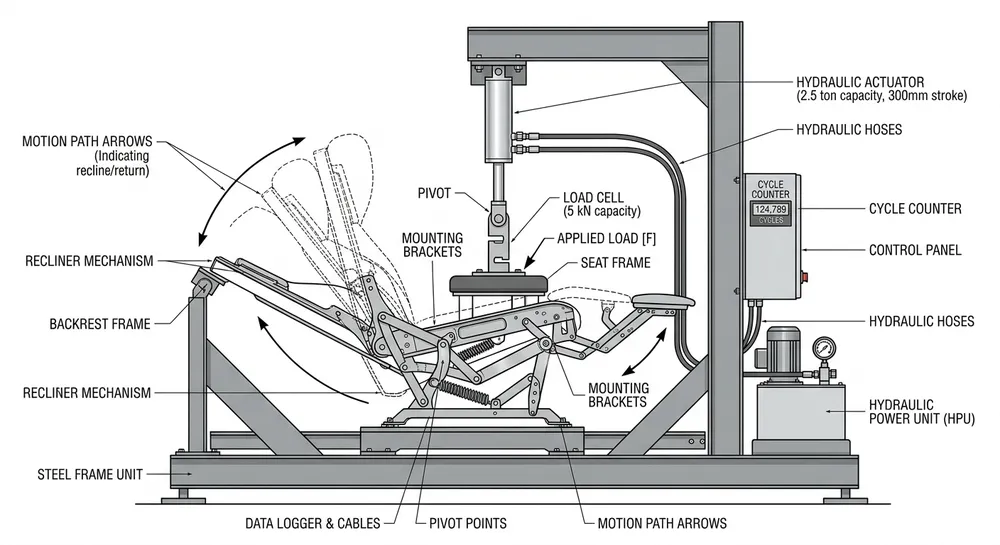
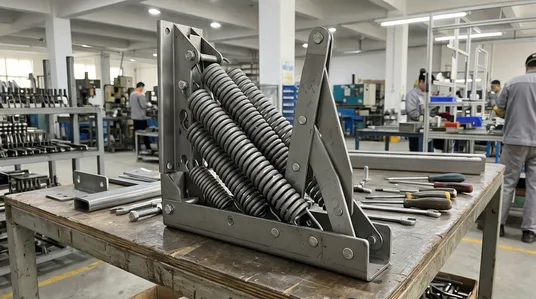
In a recliner linkage or sofa bed frame, the structural members — the bars, brackets, pivot plates, and load-bearing arms — carry cyclic stress. Every time the mechanism moves, those parts flex slightly, absorb impact, and return to position. Over 50,000–100,000 cycles (a reasonable residential service life), the material either holds its geometry or it doesn't.
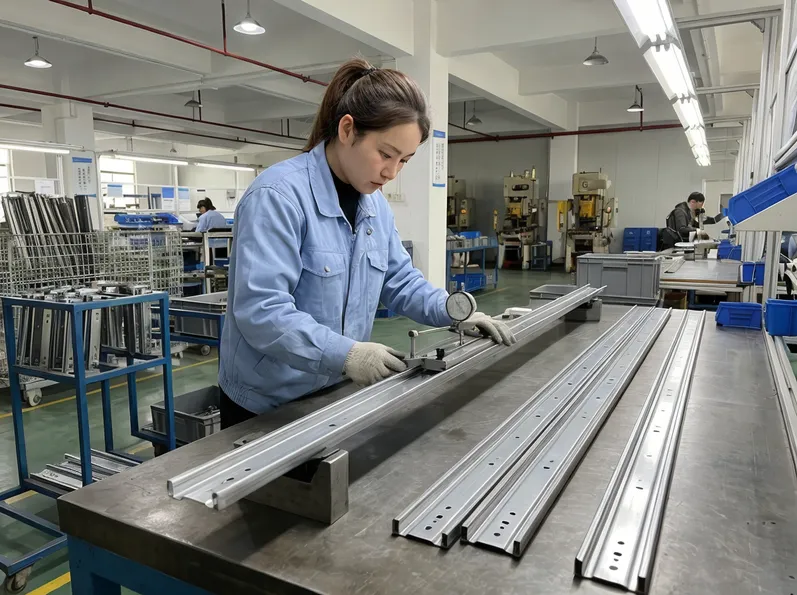
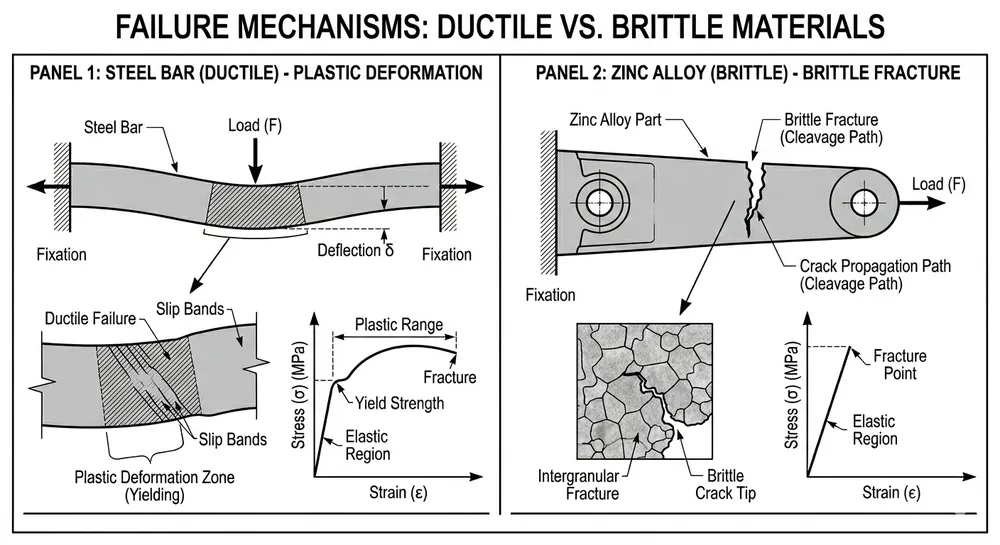
Cold-rolled steel (typically SPCC or equivalent) handles this well. Tensile strength in the 270–410 MPa range, good ductility, and it bends before it fractures — which matters when a mechanism takes an overload hit. We stamp our structural linkage arms from 1.5–2.5mm SPCC depending on the load rating. The thicker gauge costs more in raw material and adds weight, but the cycle life is predictable.
Zinc alloy (most commonly Zamak 3 or Zamak 5 in furniture hardware) is a die-cast material. It fills complex mold geometries that stamped steel can't match, which is why you see it on decorative covers, pivot housings, handle escutcheons, and connector blocks. Tensile strength typically runs 280–330 MPa for Zamak 5 — comparable to mild steel on paper — but the failure mode is different. Zinc alloy is brittle under impact and fatigue. It doesn't bend; it cracks.
That difference in failure mode is the whole story.

—
Where each material belongs: the load map
The mistake we see most often is buyers specifying zinc alloy across an entire mechanism to hit a lower unit price — then getting warranty claims on the pivot arms six months after delivery.
The right approach is a load map: assign materials by function, not by cost target alone.
| Component | Typical Material | Why |
|---|---|---|
| Main linkage arms | Cold-rolled steel 1.5–2.5mm | Cyclic load, must not fracture |
| Pivot plates / brackets | Cold-rolled steel 1.2–2.0mm | Shear stress at rotation points |
| Decorative covers / caps | Zinc alloy (Zamak 3/5) | Complex geometry, no structural load |
| Handle escutcheons | Zinc alloy (Zamak 3/5) | Aesthetic detail, low stress |
| Connector blocks (non-load) | Zinc alloy or nylon | Positioning only |
| Spring anchor plates | Cold-rolled steel 2.0mm+ | High point load from spring tension |
| Locking pawls | Hardened steel or zinc alloy | Depends on locking force spec |
(The locking pawl is the one component where we sometimes debate internally — zinc alloy works fine on light-duty residential mechanisms, but for commercial or high-cycle applications, we default to hardened steel. The failure mode on a zinc pawl under repeated high-force engagement is progressive chipping, which is hard to catch in QC before it becomes a field problem.)
A well-designed mechanism uses both materials where each performs best. A mechanism that's all-steel is heavier and more expensive than it needs to be. A mechanism that over-uses zinc alloy on structural members is a warranty liability.
—
The cost structure: what you're actually paying for
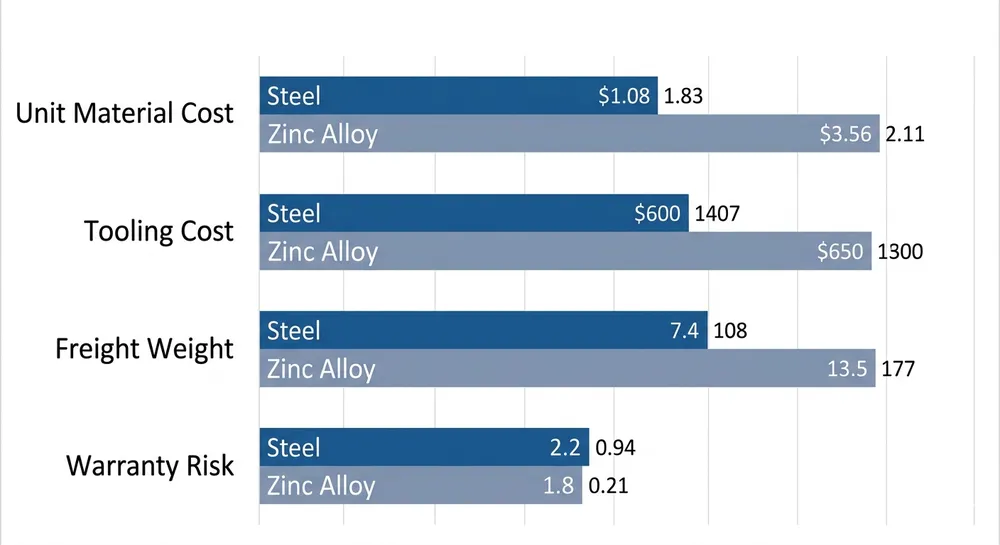
Raw material cost is only part of the picture. The real cost comparison runs across four dimensions.
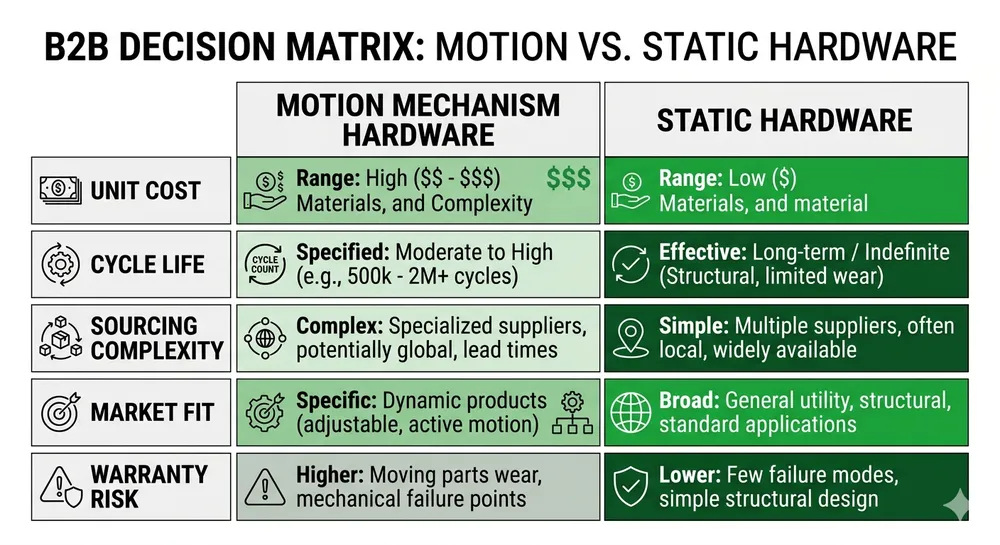
Unit material cost: Zinc alloy die-casting typically costs more per kilogram of finished part than stamped steel, but zinc parts are often lighter and more complex — so the per-part comparison depends on geometry. For simple flat brackets, stamped steel wins on cost. For complex housings with undercuts and integrated features, zinc die-casting is cheaper than machining steel to the same shape.
Tooling cost: Die-casting molds for zinc alloy run higher upfront than progressive stamping dies for steel — typically 30–60% more for comparable complexity. If you're ordering standard mechanisms, this is already amortized. If you're doing OEM tooling, factor it into your landed cost calculation.
Weight and freight: Steel mechanisms run heavier. A full recliner linkage set in all-steel construction might weigh 8–12 kg; a hybrid design with zinc alloy covers and housings can come in 15–20% lighter. On container loads, that difference compounds. We've had buyers in Australia specifically request the hybrid design to reduce freight cost per unit — the material savings on the mechanism paid for itself in shipping.
Warranty and RMA exposure: This is where the calculation flips for buyers who've been burned. A zinc alloy structural arm that fails in the field costs you the return freight, the replacement unit, and the customer relationship. One RMA event on a 500-unit order can erase the margin you saved on material. Steel structural members, specified correctly, don't generate that exposure.
—
Surface finish: where zinc alloy earns its place
One area where zinc alloy genuinely outperforms steel is surface finish quality on visible components.
Die-cast zinc alloy takes chrome plating, nickel plating, and powder coating with a surface smoothness that stamped steel can't match without additional polishing steps. The as-cast surface on a Zamak part is dense and fine-grained — plating adheres uniformly, and the finished part looks premium. This matters for handle hardware, decorative trim, and any mechanism component that's visible to the end user.
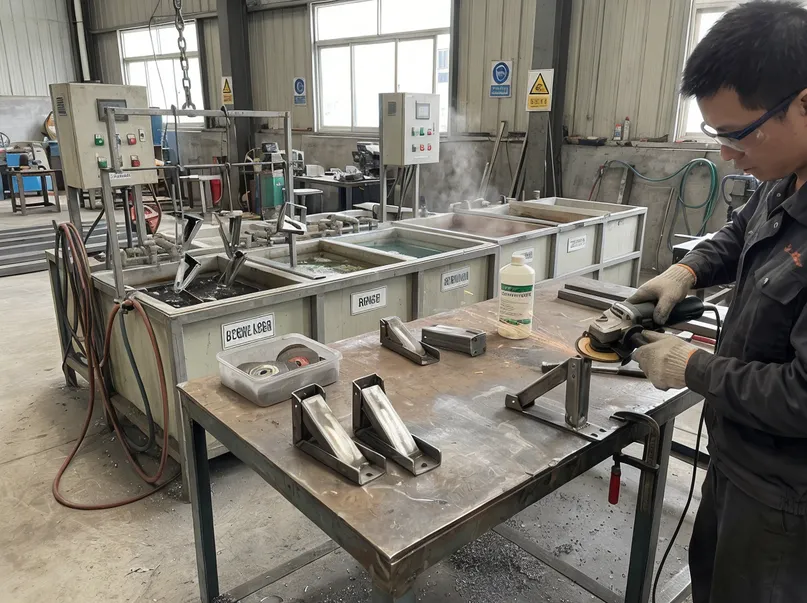
Stamped steel, by contrast, has mill scale, stamping marks, and weld seams that require grinding and pre-treatment before plating. We run phosphate pre-treatment on all our steel parts before powder coat — it's a necessary step, not optional, and it adds process time. The result is durable (our powder-coated steel passes 500-hour salt spray), but it's not the same visual quality as a plated zinc casting on a decorative piece.
If your product targets a mid-to-premium retail price point where the mechanism hardware is partially visible — exposed recliner handles, visible sofa bed latches — zinc alloy on those aesthetic components protects your product's perceived quality. Your downstream retail buyer notices the difference.
—
The sourcing trap: what "zinc alloy" on a spec sheet doesn't tell you
This is where buyers get hurt most often, and it's worth being direct about it.
"Zinc alloy" on a supplier's spec sheet tells you almost nothing useful. The alloy grade matters enormously. Zamak 3 and Zamak 5 are the standard furniture hardware grades — Zamak 5 has higher copper content and better tensile and hardness properties, making it the right choice for any zinc component that sees real stress. Zamak 3 is fine for purely decorative parts.
Below Zamak grade, there's a category of recycled or mixed zinc alloys — sometimes called "pot metal" in the trade — that suppliers use to cut costs. These alloys have inconsistent composition, lower strength, and poor plating adhesion. They look identical to Zamak on a finished part. You won't know the difference until the chrome starts peeling at 18 months or a handle housing cracks under normal use.
What to ask for at RFQ stage:
- Material Test Certificate (MTC) specifying alloy grade (Zamak 3 or Zamak 5, per ASTM B86 or equivalent)
- Hardness report on die-cast parts (Zamak 5 typical Brinell hardness: 91 HB)
- Salt spray test report for plated zinc components (minimum 96 hours for standard indoor furniture; 240+ hours for coastal or humid markets)
- Dimensional inspection report on critical fit dimensions — die-cast parts can have flash and shrinkage variation that affects assembly
We provide all four on request. If a supplier can't produce an MTC for their zinc alloy, the grade is unverified — and that's a sourcing risk you're carrying into your product.
The same discipline applies to steel. "Steel" without a grade spec could be anything from SPCC to recycled scrap. Ask for the mill certificate, confirm the grade, and check the thickness tolerance. On stamped parts, ±0.1mm on thickness is standard; anything looser than that affects the mechanism's fit and cycle performance.
—
How the material choice affects your market positioning
The material spec you choose isn't just an engineering decision — it shapes which market segments you can sell into profitably.
Value-tier residential furniture: Hybrid design with zinc alloy covers and steel structural members hits the right cost target without sacrificing cycle life. This is the volume segment — high units, moderate margin, low warranty tolerance. Get the structural steel right and use zinc alloy only on non-load parts.
Mid-to-premium residential and contract furniture: Full steel construction on structural members, zinc alloy or solid brass on visible hardware. Buyers in this segment can absorb a higher mechanism cost because the furniture retail price supports it. The warranty exposure from a mechanism failure is also higher — a $1,200 sofa returned because of a broken linkage arm is a different problem than a $300 sofa.
Commercial and hospitality: Hotels, senior living facilities, and commercial seating specify mechanisms for 100,000+ cycle life. All-steel structural construction, hardened steel on locking components, and surface treatments rated for high-humidity environments. Zinc alloy has no place in the structural members here. (We've had hospitality buyers ask us to remove zinc alloy entirely from the BOM — they've been burned before and won't go back.)
Export markets with humidity exposure: Southeast Asia, the Middle East, coastal Australia — these markets punish inadequate surface treatment on both steel and zinc. For steel, we run zinc plating or powder coat with phosphate pre-treatment. For zinc alloy decorative parts, we specify nickel undercoat before chrome to prevent corrosion creep under the plating. Skipping the undercoat saves $0.15 per part and costs you the account when the chrome bubbles at 12 months.
—
What to verify before you place the order
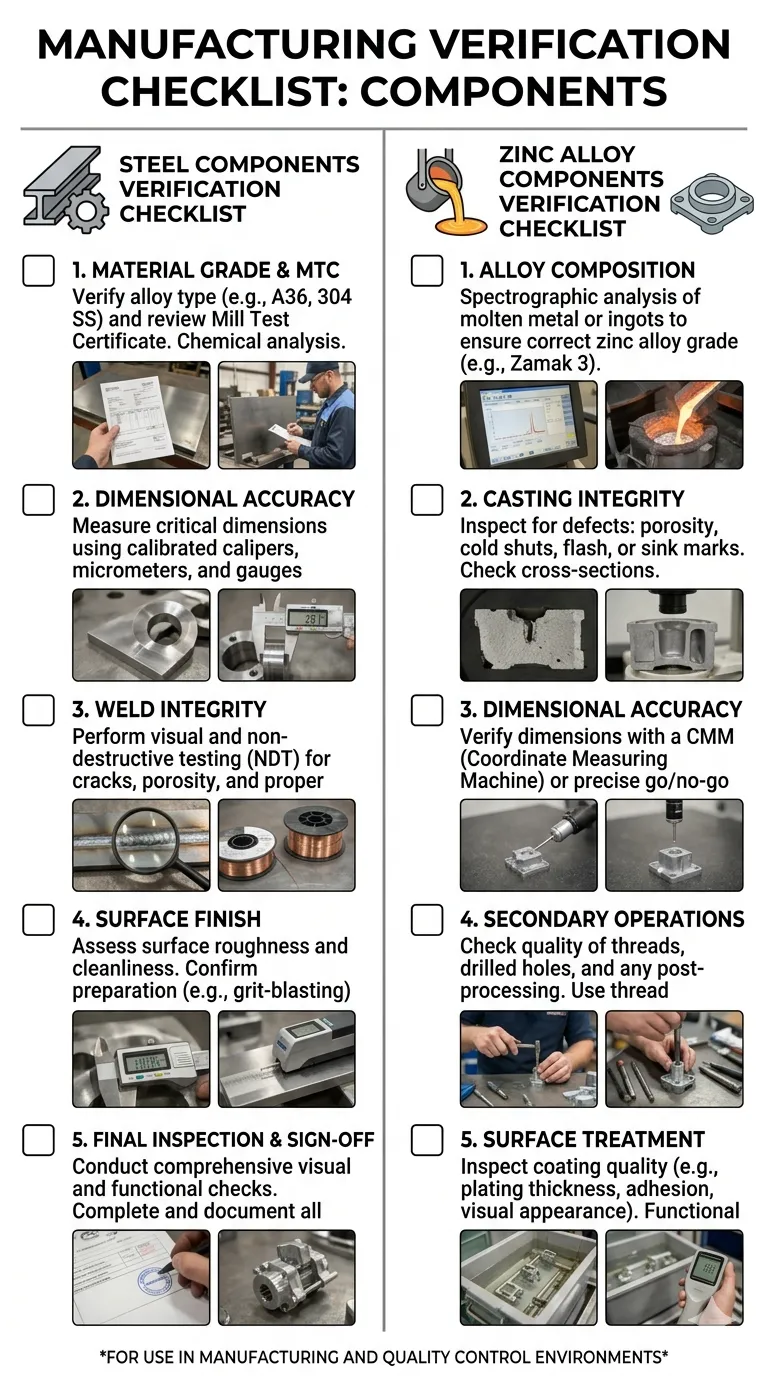
A quick sourcing checklist for mechanism material verification:
For steel components:
- Mill certificate confirming grade (SPCC, Q235, or equivalent)
- Thickness tolerance report (target ±0.1mm)
- Surface treatment spec: coating type, thickness (powder coat 60–80μm), and salt spray rating
- Load cycle test report if available (50,000 cycles minimum for residential)
For zinc alloy components:
- MTC confirming Zamak 3 or Zamak 5 grade
- Hardness report
- Plating adhesion test (cross-cut adhesion per ISO 2409 or equivalent)
- Salt spray report matched to your target market's humidity exposure
For the complete mechanism:
- Functional test report: full cycle test at rated load
- Dimensional inspection on critical assembly interfaces
- Packaging spec: confirm parts are protected against transit damage that could cause zinc alloy fracture
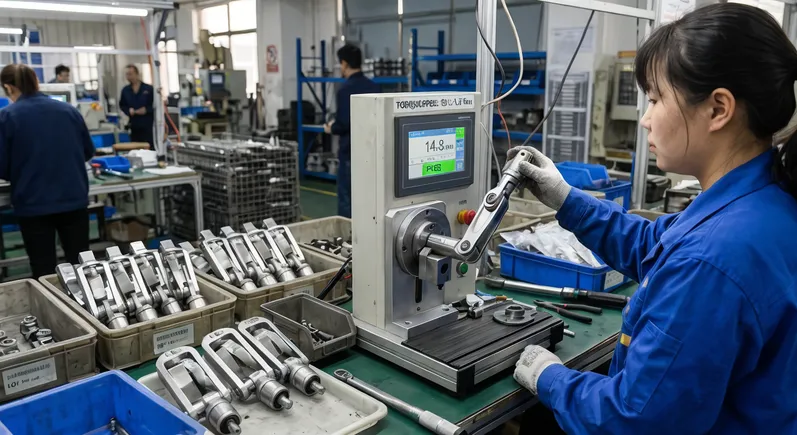
We run 100% functional testing on every mechanism before shipment — every unit cycles through its full range of motion under load before it goes into the carton. That catches assembly defects and material failures that slip through incoming inspection on individual parts.
—
Frequently asked questions
Can I specify zinc alloy for the main linkage arms to reduce cost?
We'd advise against it for any mechanism rated above light residential use. The issue isn't tensile strength on paper — Zamak 5 is close to mild steel there — it's fatigue behavior under cyclic load. Zinc alloy accumulates micro-cracks at stress concentrations over repeated cycles in a way that cold-rolled steel doesn't. The failure is sudden and hard to predict. For linkage arms, the cost difference between steel and zinc alloy is small relative to the warranty risk you're taking on.
What's the minimum order quantity for a custom material specification?
For standard mechanisms with our existing tooling, MOQ is 500 units and we can adjust the material spec within the design envelope — gauge thickness, alloy grade, surface treatment. For OEM tooling with a new die-cast zinc component, the tooling investment typically requires a 1,000–2,000 unit commitment to amortize. We'll give you the honest number when you send the drawing.
Does zinc alloy affect the mechanism's weight rating?
Yes, indirectly. The weight rating is determined by the weakest structural member. If zinc alloy is used on a load-bearing component, the rating is limited by that component's fatigue life, not its static strength. A mechanism with a 150 kg static load rating can still fail prematurely if a zinc alloy arm is cycling at 80% of its fatigue limit. Always confirm which components are structural and what material they're made from — not just the headline load rating.
How do I compare mechanisms from different suppliers when the material specs aren't disclosed?
Request a BOM (bill of materials) with material grade for each component. If a supplier won't provide it, that's informative. Ask specifically: "What alloy grade is the main linkage arm? What is the steel gauge on the pivot bracket?" Vague answers ("high-quality steel," "premium zinc alloy") mean the supplier either doesn't know or doesn't want you to know. Both are problems.
What surface treatment is right for humid export markets?
For steel structural members going to Southeast Asia or coastal markets: zinc plating plus powder coat, or hot-dip galvanizing on heavy structural parts. For zinc alloy decorative components: nickel undercoat before chrome plating, minimum 96-hour salt spray. We've tested both configurations extensively for our Gulf and Southeast Asia buyers — the nickel undercoat step is non-negotiable for coastal environments.
—
Making the call: a direct recommendation
If you're sourcing a Furniture Motion Mechanism and need to decide on material spec, here's the short version:
Use cold-rolled steel on every structural member that carries cyclic load — linkage arms, pivot brackets, spring anchors, locking pawls in high-cycle applications. Specify the gauge based on your load rating and cycle life target, and confirm the surface treatment matches your target market's humidity exposure.
Use zinc alloy where geometry complexity or surface finish quality justifies it — decorative covers, handle housings, connector blocks with no structural load. Confirm Zamak 5 grade for any zinc component that sees stress, and request the MTC.
The hybrid approach — steel structure, zinc alloy aesthetics — is what most well-designed mechanisms use. It's not a compromise; it's the right engineering answer. The all-zinc mechanism that looks cheaper on the unit price quote is usually more expensive when you account for warranty exposure and freight weight.
If you're evaluating a new mechanism supplier or reviewing your current BOM for a product refresh, send us the spec sheet or a photo of what you're currently sourcing. We'll tell you where the material choices look right and where we'd change them — and give you a quote on the alternative. Request a quote here.