Most content on chair mechanism repair is written for the end user with a screwdriver. This isn't that.
If you're importing, distributing, or manufacturing chairs and you're seeing field returns — tilt locks that won't hold, springs that go soft after six months, mechanisms that corrode in coastal warehouses — the repair conversation is the wrong conversation. By the time a mechanism fails in the field, the decision that caused it was made months earlier, at the spec or sourcing stage.
This article maps the five most common chair mechanism failure patterns to the upstream manufacturing decisions that produce them. The goal isn't to teach you how to fix a broken mechanism. It's to help you source one that doesn't break.

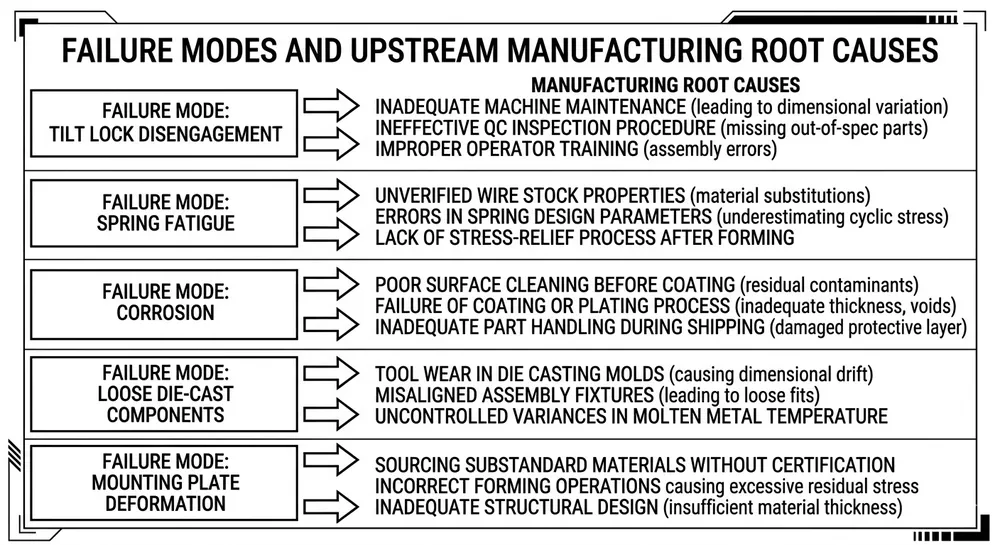
The Five Failure Patterns — and What's Actually Causing Them
1. Tilt Lock Disengagement
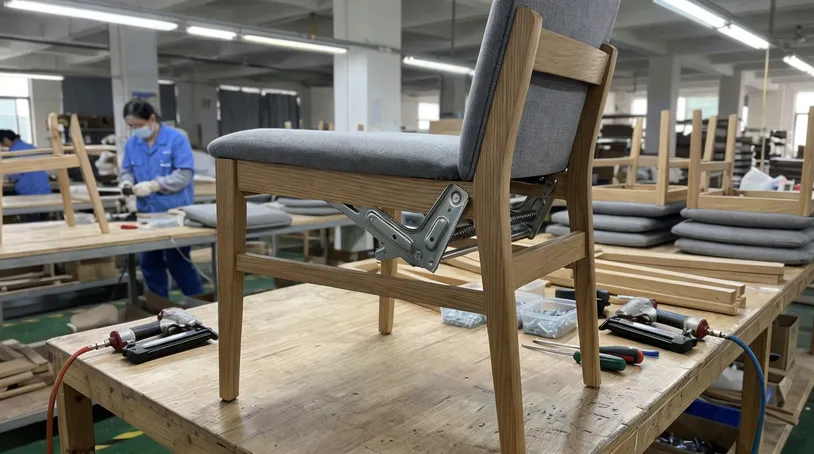
The lock engages but won't hold under load, or releases on its own during use. End users report the chair "giving way" when they lean back.
What it looks like in the field: The tilt lock clicks into position but slips under body weight. Sometimes it holds for weeks before failing; sometimes it fails immediately on heavier users.
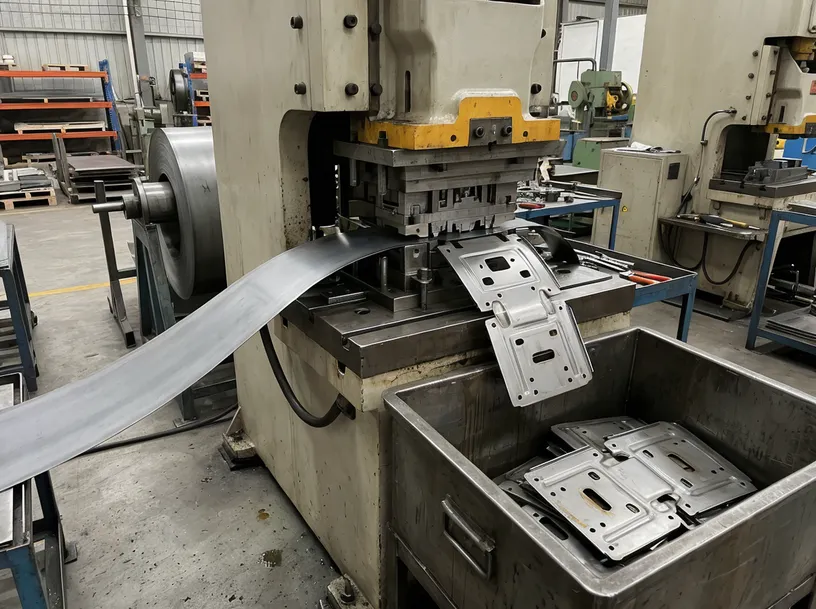
The real cause: Stamping tolerance drift on the lock plate or ratchet engagement surface. When the locking geometry is formed to ±0.3mm or looser, the engagement depth is inconsistent across a batch. Some units hold fine; others are marginal from day one. The failure shows up in the field rather than at QC because it's load-dependent — a functional check without weight applied won't catch it.
The fix at the sourcing level: require stamping tolerances of ±0.15mm or tighter on lock-engagement components, and ask whether the supplier runs loaded functional testing, not just assembly checks. We test tilt lock engagement under rated load as part of standard outgoing inspection — it's the only way to catch marginal units before they ship.
2. Spring Fatigue and Tilt Resistance Loss
The chair tilts too easily after a few months of use. The tilt tension adjustment no longer holds its setting.
What it looks like in the field: Users report the chair feels "broken in" — loose, unresponsive. The tension knob turns but doesn't change anything meaningful.
The real cause: Undersized or incorrectly rated tilt springs. Spring rate selection is one of the more consequential spec decisions in mechanism design, and it's one that gets cut on price. A spring wound to a lower rate costs less material and less forming time. It also loses its set faster under repeated compression cycles, especially if the wire diameter or coil geometry wasn't matched to the expected load range.
The secondary cause is cycle life. A spring that's never been tested beyond 10,000 cycles will behave differently than one qualified to 50,000. We run 50,000-cycle load testing on chair mechanisms as standard batch qualification — not as a premium option. That's the floor for commercial office chair certification in most markets, and it's the number you should be asking any supplier to confirm before you place an order.
(We've seen mechanisms from other sources that look identical on paper but use springs wound 15–20% lighter. The difference isn't visible on inspection. It shows up at month four.)
3. Corrosion on Surface-Treated Components
Rust or white oxidation appearing on mechanism plates, springs, or adjustment hardware — sometimes within months of delivery, particularly in coastal or humid markets.
What it looks like in the field: Surface rust on the mechanism body, white powder on zinc-plated components, or coating delamination at weld seams. Customers in Florida, Southeast Asia, or the Middle East see this faster than buyers in dry inland markets.
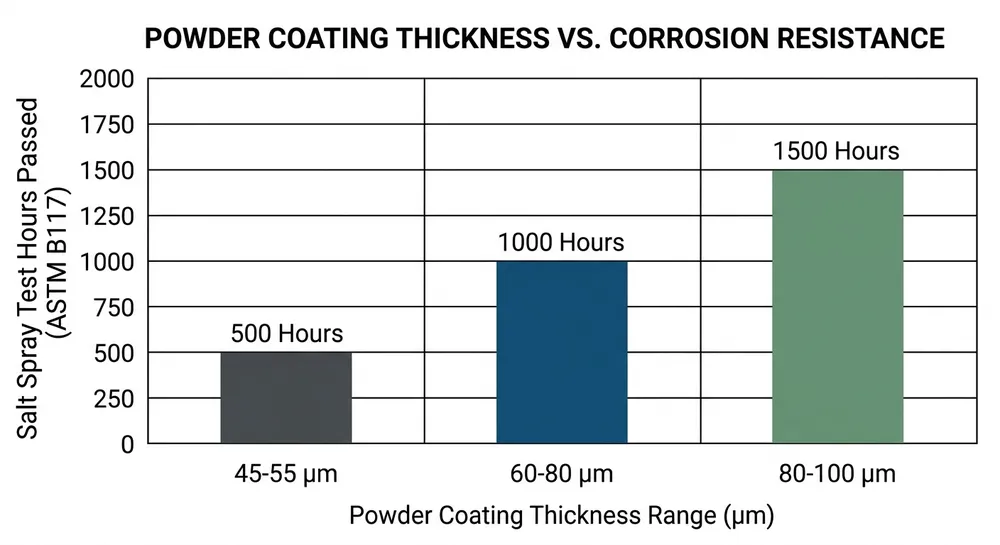
The real cause: Coating thickness below the threshold for salt spray resistance, or coating applied over inadequately prepared surfaces. Powder coating at 45–55μm will pass a basic visual check but fail in humid or coastal environments within a season. The spec that holds up is 60–80μm with proper surface pre-treatment — phosphate or zinc phosphate conversion coating before powder application.
Weld seams are the specific failure point. Powder coat adhesion at weld seams is the most common defect in this product type. If the weld isn't ground and pre-treated before coating, the coating lifts at the seam edge first, and corrosion starts there. Our line grinds and re-treats every weld before the powder stage — it adds time, but it's the difference between a 500-hour salt spray pass and a 200-hour failure.
For buyers supplying coastal markets: specify 500-hour salt spray resistance explicitly in your purchase order. Don't assume it's standard. Many suppliers will meet whatever spec you write down; they just won't volunteer the higher spec if you don't ask.
4. Loose or Cracked Die-Cast Components
Tilt tension knobs that feel loose or rattle, adjustment collars that crack under normal use, decorative covers that don't seat properly.
What it looks like in the field: The tension knob spins without resistance, or develops visible play within weeks. In worse cases, the knob or collar cracks at the thread engagement point.
The real cause: Die-cast dimensional inconsistency or wall thickness below structural minimums. Most mechanism factories outsource their die-cast components to third-party foundries. That means they have no direct control over alloy composition, injection pressure, or cooling cycle — the three variables that determine whether a zinc alloy part holds its dimensions and structural integrity across a batch.
Dimensional inconsistency in die-cast knobs is the leading cause of the "loose knob" complaint. When the thread engagement geometry varies batch-to-batch, some units fit tightly and others have perceptible play from day one. Cracking at the thread root usually means wall thickness was reduced to save material, or the alloy was diluted with recycled content beyond the point where tensile strength is reliable.
We brought die-casting in-house in 2015 specifically because outsourced die-cast components were the most common source of quality complaints we couldn't control. When a buyer sends back a sample saying the tilt knob feels loose or the finish is inconsistent, nine times out of ten the root cause is the die-cast component. Owning that process means we own the fix — we can adjust the tool, the alloy spec, or the cooling cycle without waiting on a third-party foundry.
When evaluating suppliers, ask directly: is die-casting done in-house or outsourced? If outsourced, ask for the foundry's material certification and dimensional inspection records. Most suppliers won't have them.
5. Mounting Plate Deformation Under Load
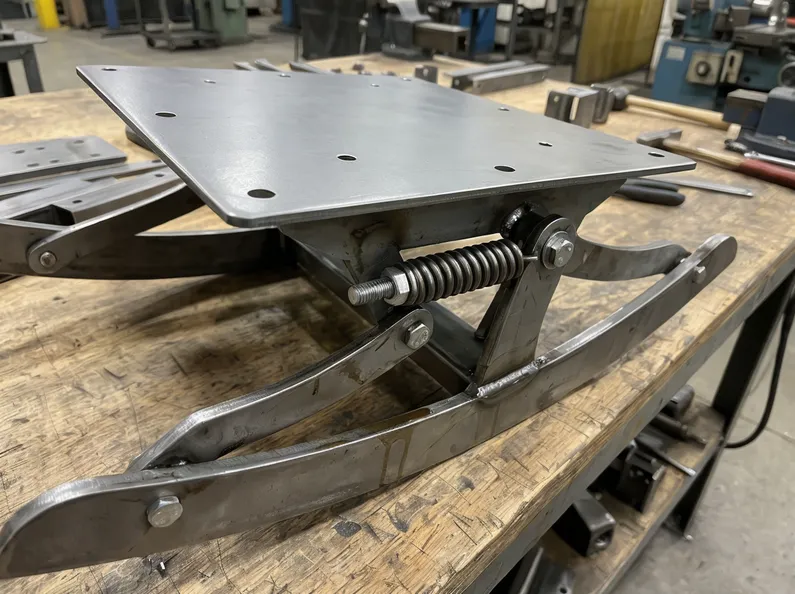
The mechanism mounting plate bends or cracks at the seat attachment points, causing the mechanism to shift position or the chair to become unstable.
What it looks like in the field: The chair develops a lean or wobble. The mechanism feels solid when tested by hand but shifts under a seated user. In severe cases, the mounting plate cracks at the bolt hole.
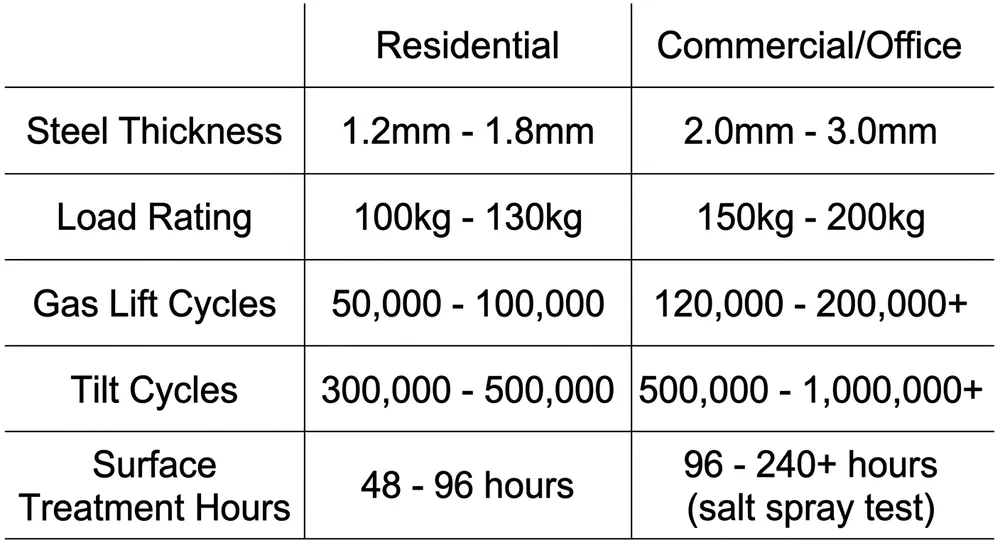
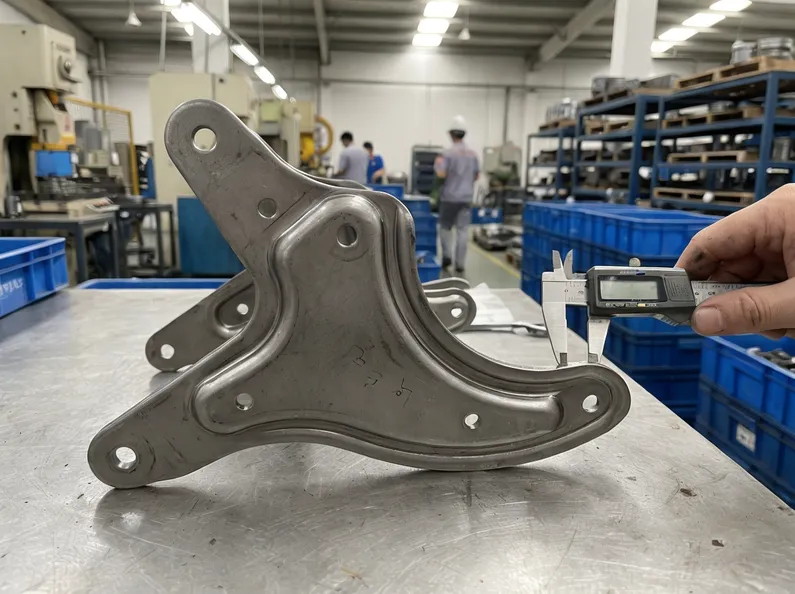
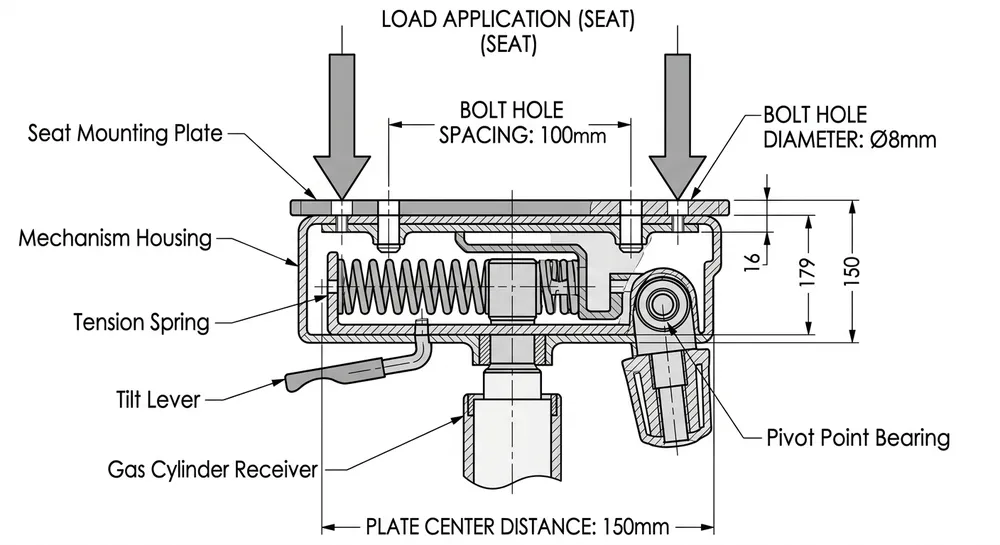
The real cause: Undersized plate thickness or incorrect steel grade for the load rating. Mounting plates are a cost-reduction target — going from 3.0mm to 2.5mm cold-rolled steel saves material on every unit. At low load ratings it may be fine. At 120kg dynamic load ratings, the thinner plate will deform over time, especially if the stamping tolerance on the bolt hole pattern is loose enough that load concentrates unevenly.
The secondary cause is cycle life testing that doesn't include the mounting plate in the load path. Some suppliers test the tilt mechanism in isolation — spring, lock, pivot — without applying load through the mounting plate. A mechanism can pass that test and still have a plate that deforms under real use conditions.
Specify plate thickness and steel grade in your purchase order. For standard commercial office chairs, 2.5–3.0mm SPCC cold-rolled steel is the working range; for heavy-duty or 24-hour-use applications, 3.0mm minimum with reinforced bolt hole flanges. Ask whether cycle life testing is done with the full assembly under load, not just the tilt mechanism in isolation.
Root Cause Summary: What Each Failure Maps To
| Failure Pattern | Root Cause | Spec to Require |
|---|---|---|
| Tilt lock disengagement | Stamping tolerance drift on lock geometry | ±0.15mm on lock-engagement components; loaded functional test |
| Spring fatigue / tension loss | Undersized spring rate; insufficient cycle life testing | Spring rate matched to load range; 50,000-cycle qualification minimum |
| Corrosion on surface-treated parts | Coating below 60μm; inadequate weld pre-treatment | 60–80μm powder coat; 500-hour salt spray; weld pre-treatment confirmed |
| Loose / cracked die-cast components | Outsourced die-casting with no dimensional control | In-house die-casting or foundry certification; dimensional inspection records |
| Mounting plate deformation | Undersized plate thickness; incomplete load path in testing | 2.5–3.0mm SPCC minimum; full-assembly cycle life test |
What a Repair-Resistant Mechanism Looks Like: The Supplier Evaluation Checklist
The five failure patterns above share a common thread: they're all preventable at the sourcing stage. Here's what to verify before you place an order.
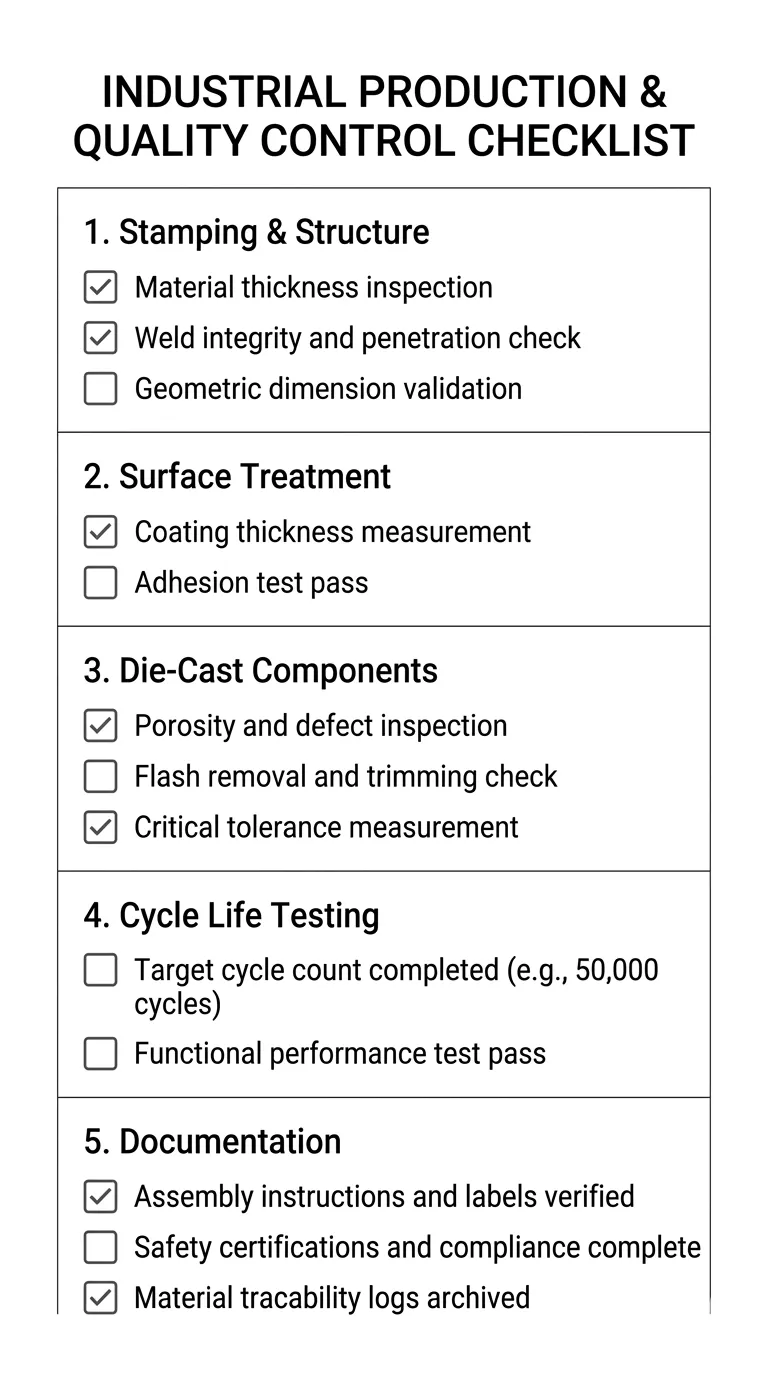
Stamping and structural specs:
- Stamping tolerance on lock-engagement and pivot components: ±0.15mm or tighter
- Mounting plate thickness: 2.5mm minimum for standard use, 3.0mm for heavy-duty
- Steel grade documentation: SPCC or equivalent, with mill certification available
Surface treatment:
- Powder coating thickness: 60–80μm confirmed by film thickness measurement
- Salt spray rating: 500 hours minimum, documented test report available
- Weld pre-treatment: confirm grinding and phosphate conversion before coating
Die-cast components:
- Ask whether die-casting is in-house or outsourced
- If outsourced: request foundry material certification and dimensional inspection records
- Check for visible parting line flash or surface porosity on sample knobs — both indicate process control issues
Cycle life and functional testing:
- Minimum 50,000-cycle load test for commercial office chair qualification
- Confirm testing is done on full assembly under rated load, not tilt mechanism in isolation
- Outgoing inspection method: 100% functional test or sampling? (Sampling misses batch-level defects)
Documentation:
- CE declaration of conformity for European market buyers
- SGS or equivalent third-party test reports
- RoHS compliance documentation if your downstream customers require it
(A note on sampling inspection: a 5% AQL sampling plan on a 5,000-unit order means roughly 200 units are checked. If a defect rate is 3%, you'll statistically miss it. 100% functional outgoing inspection is the only method that catches sticky locks and misaligned mounts before they reach your container.)
How to Evaluate a Supplier's QC Process Before You Order
Asking for certifications is a start. The more useful questions go one level deeper.
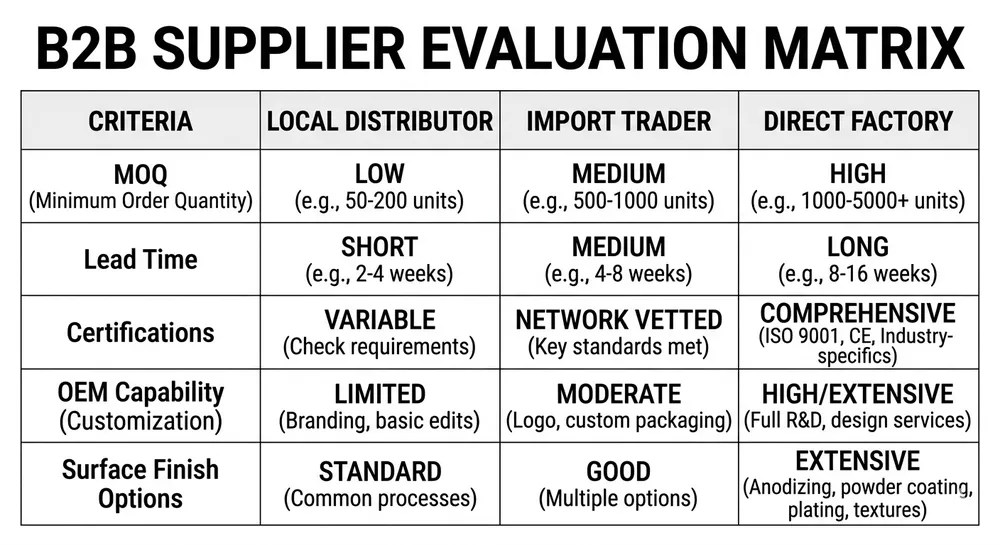
Ask about the outgoing inspection method. "We do 100% inspection" and "we do AQL sampling" are not equivalent. For mechanisms, where a functional defect (sticky lock, misaligned mount) won't show up in a dimensional check, sampling inspection misses real problems. Ask specifically: is functional testing done on every unit, or on a sample?
Ask where die-casting happens. In-house or outsourced? If outsourced, the supplier has limited visibility into dimensional consistency batch-to-batch. This is the single most common source of knob and collar complaints, and most suppliers won't raise it unless you ask.
Ask for a cycle life test report, not just a certification. A CE mark tells you the product was tested at some point. A cycle life test report tells you what load, how many cycles, and whether the full assembly was in the load path. Request the actual test report, not just the certificate.
Ask about coating thickness measurement. "We powder coat all mechanisms" is not a spec. Ask for the film thickness range they hold and whether they measure it per batch. If they can't give you a number, the coating thickness isn't being controlled.
Request a sample before committing to volume. Test the tilt lock under your own body weight. Check the knob for play. Look at the weld seams under good light. A sample order of 2–5 units will surface most of the failure patterns above before you're committed to a container.
When Replacement Is the Right Call
Some mechanisms are worth repairing in the field. Most aren't — and knowing the difference saves your service team time and your customers frustration.
Replace, don't repair, when:
- The tilt lock has failed on multiple units from the same batch. A single failure can be a defective unit; multiple failures from the same batch indicate a systematic spec problem. Repairing individual units doesn't fix the batch.
- Corrosion has reached the spring or pivot components. Surface rust on the mechanism body is cosmetic. Rust on the spring coils or pivot pin means the structural integrity of those components is compromised. A corroded spring will fail again.
- The mounting plate has deformed. A bent mounting plate can't be straightened to original tolerance in the field. The geometry change affects load distribution at the bolt holes, and the plate will continue to deform under use.
- Die-cast components have cracked. Zinc alloy cracks don't repair cleanly. A cracked tilt knob or adjustment collar needs replacement, not adhesive.
When field repair is reasonable:
- A single unit with a sticky tilt lock caused by debris or misalignment — not a batch pattern
- A loose fastener at the seat plate attachment
- A gas cylinder that's lost pressure (this is a separate component from the mechanism itself)
If you're seeing the same failure pattern across multiple units from a single order, the repair conversation is the wrong frame. The right conversation is with your supplier about the spec decision that produced the failure — or with a different supplier who controls that spec.
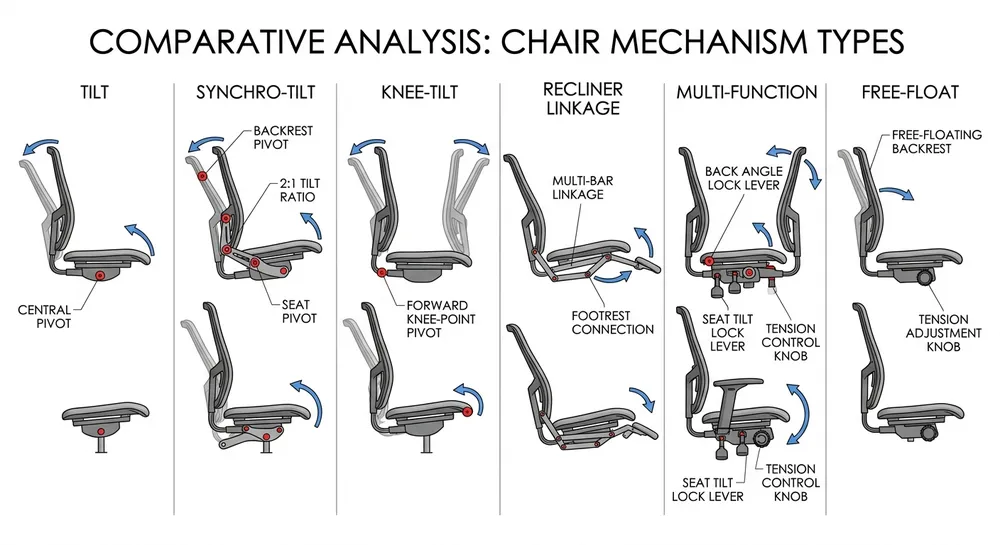
For buyers evaluating chair mechanism types for a new product line, the failure patterns above are worth mapping against your target market before you finalize the spec. A mechanism that's adequate for light residential use will generate returns in a commercial office environment. The chair mechanism quality standards that apply to your market should drive the spec conversation with any supplier you're evaluating.
If your current return rate on Chair Mechanism products is higher than it should be, the fix is usually upstream. Send us your current mechanism spec or a sample reference — we'll identify where the failure risk sits and quote a replacement that addresses it at the source. Request Quote
FAQ
What cycle life rating should I require for commercial office chair mechanisms?
50,000 cycles is the minimum for standard commercial office chair certification in most markets. For 24-hour-use environments (call centers, healthcare, hospitality), specify 100,000 cycles and confirm the test was run on the full assembly under rated load. The cycle count on a certificate is only meaningful if the test conditions match your actual use case.
How do I tell if a mechanism failure is a sourcing problem or a user abuse problem?
Pattern is the indicator. A single failure in a batch of 500 is likely a defective unit. Five failures with the same failure mode — same component, same location — is a batch-level spec problem. Document the failure mode and location on every return. If the pattern repeats, the cause is upstream.
Is in-house die-casting actually better than outsourced?
For dimensional consistency, yes. The variables that determine whether a zinc alloy part holds its geometry — alloy composition, injection pressure, cooling cycle, tool condition — are only controllable if you own the process. Outsourced die-casting means the mechanism factory is dependent on a foundry's process discipline, which they can't audit on every batch. It's not that outsourced die-casting is always bad; it's that the mechanism supplier has no direct lever to pull when a batch comes back with dimensional drift.
What documentation should ship with a mechanism order for European market compliance?
CE declaration of conformity, SGS test report, and RoHS compliance documentation. For buyers whose downstream customers have additional requirements (REACH, specific EN standards), request the full test report rather than just the certificate — the report shows what was tested and under what conditions.