

Synchro Chair Mechanism
Precision-engineered synchro chair mechanism — 1:2 and 1:3 tilt ratios, stamped to ±0.15mm, 100% functionally tested before shipment. The mechanism that separates ergonomic task chairs from commodity seating. Factory-direct from a dedicated manufacturer with 17 years in motion hardware.

Mechanism Function
What the Synchro Mechanism Does — and Why It Commands a Price Premium
A synchro chair mechanism moves the seat and backrest at a fixed ratio — typically 1:2 or 1:3 — so the backrest reclines further and faster than the seat tilts. The result: the user's feet stay closer to the floor during recline, the lumbar support tracks the spine through the motion arc, and the chair feels like it's responding to the body rather than fighting it.
That mechanical behavior is the feature that justifies a $300–$600 retail price point on an ergonomic task chair versus a $100 basic tilt. Your downstream customers aren't paying for the label — they're paying for the motion quality, and the motion quality lives entirely in the mechanism. A synchro unit with sloppy pivot tolerances or a spring rate that's off by 15% will feel cheap regardless of what the chair looks like. That's the part we control.
We produce synchro mechanisms on dedicated lines — two of our six production lines run chair hardware, and synchro is one of the highest-volume types on those lines. The tooling has been refined over multiple production generations. When you order from us, you're not getting a mechanism we adapted from a standard tilt platform. The synchro geometry, pivot placement, and spring anchor points are purpose-designed for synchronized motion.

A synchro unit with sloppy pivot tolerances or a spring rate that's off by 15% will feel cheap regardless of what the chair looks like. The $300–$600 retail premium lives entirely in the mechanism — not the upholstery or the label.
Engineering Data
Technical Specifications
Specifications shown are standard production values. Actual parameters may vary by configuration. Contact us for detailed drawings and data sheets.
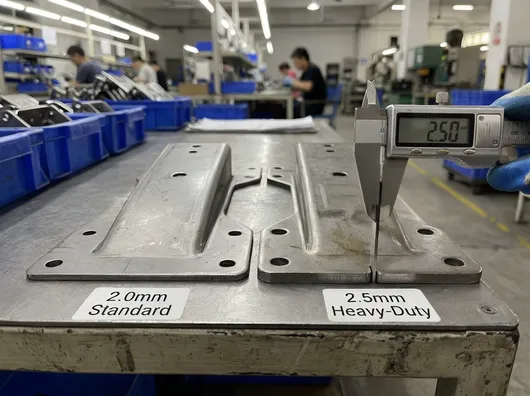
The 2.0 mm plate suits standard commercial office applications. The 2.5 mm option is for heavy-duty or 24/7-use environments. We've had buyers spec the lighter plate to save on unit cost for a high-use call center application — the warranty claims came back. The 2.5 mm option costs more per unit but costs less over the product's life.
Synchro Ratio Selection: 1:2 vs. 1:3 and What It Means for Your Market
This is the decision most buyers get wrong when they first source synchro mechanisms, so it's worth being direct about it.
Task & Mid-to-Premium Office
For every 1° the seat tilts, the backrest moves 2°. The motion feels natural and controlled. This is the ratio that covers the broadest range of ergonomic seating applications.
- Standard configuration for mid-to-premium task chairs
- Broadest range of ergonomic seating applications
- Highest stocked volume — fastest lead times
- Contract office market standard
Executive & Premium Residential
The backrest moves more aggressively relative to the seat. Suits chairs designed for extended recline — executive chairs, lounge-work hybrids, or any application where the end user spends time leaning back.
- Executive chairs and lounge-work hybrids
- More dramatic motion — a differentiator in premium lines
- Premium residential segment positioning
- Available from standard tooling — no custom development
Sourcing Guidance
If you're building a task chair line for the contract office market, start with 1:2. If you're targeting the executive or premium residential segment, 1:3 gives you a motion story to sell. We can supply both from standard tooling — no custom development required.
B2B Market Intelligence
Where Synchro Mechanisms Generate Margin: Market Segments
Three distinct buyer profiles drive the majority of synchro mechanism volume. Understanding which segment you're in determines the spec, volume, and documentation requirements that matter most to your order.
Contract Office Furniture Manufacturing
Office furniture manufacturers running mid-to-premium task chair lines are the core buyers for synchro mechanisms. A typical contract manufacturer sources 3,000–15,000 synchro units per year across 2–4 chair models.
Batch consistency is non-negotiable — your assembly line runs on fixed jigs, and if mounting hole patterns drift between orders, your line stops. We hold ±0.15mm on stamped plates across a full production run, so your jigs work on unit 10,000 the same as unit 1.
The synchro mechanism is also the component your sales team uses to justify the price step-up from a $150 task chair to a $350 ergonomic chair. We can provide technical documentation and motion diagrams to support your sales materials.


Ergonomic Seating Importers and Distributors
If you're importing finished ergonomic chairs or building a private-label seating line, the synchro mechanism is the spec that determines where your product sits in the market.
Distributors who've switched from standard tilt to synchro mechanisms in their house-brand chairs consistently report 20–30% higher retail sell-through at the same price point — the motion quality is perceptible to end users in a showroom test.
Clean Product Line Architecture
- Entry-level chairs → standard tilt
- Mid-range → synchro mechanism
- Premium → synchro + seat slide + forward tilt
OEM Chair Manufacturers in Southeast Asia and Eastern Europe
We supply a significant volume of synchro mechanisms to chair manufacturers in Vietnam, Poland, and Turkey who produce for European and North American brands.
These buyers need a mechanism supplier who can hold consistent quality across multiple production years — their brand customers audit the finished chair, and mechanism performance is part of that audit.
Our ISO 9001:2015 system and SGS certification give their compliance teams the documentation they need without a factory visit.
This segment has grown substantially over the past five years — regional chair manufacturing has expanded as brands diversify away from single-country supply chains, and they need mechanism suppliers who can serve multiple factory locations with consistent product.

Customization Options for OEM and Private-Label Programs
The synchro mechanism is one of our most frequently customized products — ergonomic chair brands have specific motion feel requirements, and the mechanism is where those requirements live.
| Customization Dimension | Options | MOQ Impact |
|---|---|---|
| Synchro ratio | 1:2 (standard), 1:3, custom ratios | Custom ratio requires tooling review |
| Tilt angle range | Adjustable within design envelope | No MOQ impact on standard range |
| Seat slide integration | With or without seat-slide function | Standard catalog option, no tooling required |
| Forward tilt option | +5° forward tilt position | Available as configured option |
| Mounting pattern | Standard 4-hole, 6-hole, custom | Custom pattern requires tooling modification |
| Gas lift bore | Ø50 mm, Ø60 mm | Standard catalog, no MOQ impact |
| Load rating | 120 kg standard, 150 kg heavy-duty | Heavy-duty uses thicker plate stock |
| Surface finish | Zinc plating, nickel plating, powder coat (any RAL) | Custom RAL: 500-unit minimum per color |
| Branding | Private-label packaging, branded components | Part of OEM arrangement |
| Lock positions | 3-position standard, up to 5-position | Tooling modification for non-standard counts |
OEM Engineering Support
For custom synchro ratios, non-standard mounting geometry, or integrated features not in the table above, our 12-person engineering team handles tooling design in-house. First sample typically comes back in 25–35 days from drawing approval. We flag any geometry that creates manufacturing problems before we cut tooling, not after.
MOQ Structure
Standard catalog synchro mechanisms: 500-unit MOQ. OEM tooling projects: MOQ based on tooling amortization — we'll give you the honest number during quoting.
Send us your chair drawings or a reference mechanism — we'll come back with a configuration recommendation and quote.

Compliance and Certification for Your Target Market
The synchro chair mechanism ships with CE marking and SGS test documentation as standard. Here's what's covered for each major market.
CE Marking
Included as standard with every shipment. SGS test documentation provided.
RoHS Compliance
Documentation included for EU and California markets. No hexavalent chromium — trivalent chromium passivation on zinc-plated components.
North America
Material and HTS classification documentation provided for your customs broker. BIFMA X5.1 equivalent testing is part of our standard QC protocol. Formal BIFMA certification through an accredited lab available via our SGS relationship.
ISO 9001:2015
Governs the quality management system. Factory audits, QMS documentation, and corrective action procedures supported for buyers with supplier qualification requirements.
Logistics & Landed Cost
Packaging, Container Loading, and Landed Cost
Export Carton Sizing
Standardized export cartons sized for 40HQ container efficiency. Pallet configurations are pre-engineered for the synchro line — your freight forwarder isn't improvising at the warehouse.
Container Loading Density
Typical 40HQ loading runs 2,000–3,000 units depending on configuration. Seat-slide units are slightly larger and will affect the upper end of that range.
Transit Protection
Mechanisms are individually wrapped and packed with foam inserts to prevent surface damage in transit. Finish integrity is maintained through the full shipping cycle.
OEM & Retail-Ready Packaging
For buyers whose downstream customers receive product in the manufacturer's carton, we produce retail-ready packaging as part of an OEM arrangement — branded cartons, multilingual assembly instructions, barcode labeling.
Amazon FBA & E-Commerce Ready
We configure packaging for direct-to-warehouse receiving, including FNSKU labeling and poly-bag requirements. The mechanism ships as a component — no assembly required at the fulfillment center. FBA prep is straightforward.
Buyer Guidance
Frequently Asked Questions — Synchro Chair Mechanism Sourcing
What is the difference between a 1:2 and 1:3 synchro ratio, and which should I specify?
The ratio describes how far the backrest moves relative to the seat. At 1:2, a 6° seat tilt produces 12° of backrest recline — the standard for commercial ergonomic task chairs, covering the broadest range of office applications. At 1:3, the same 6° seat tilt produces 18° of backrest recline — a more pronounced reclining feel suited to executive chairs or lounge-work hybrids where extended recline is part of the product's value proposition. For a task chair line targeting the contract office market, specify 1:2. For a premium executive or residential line, 1:3 gives you a differentiated motion story.
How does a synchro mechanism differ from a standard tilt mechanism?
A standard tilt pivots the seat and backrest as a single rigid unit — the whole chair rocks from a single pivot point. A synchro mechanism uses two pivot points and a linkage that moves the seat and backrest at different rates. The practical difference: during recline on a synchro chair, the user's feet stay closer to the floor and the lumbar support tracks the spine through the motion arc. That's the mechanical basis for the ergonomic premium. See our full chair mechanism line for a comparison of all tilt types.
What cycle life should I specify for commercial office use versus 24/7 environments?
For standard commercial office use (8 hours/day, single user), 60,000 cycles covers 3–5 years of service life. For 24/7 environments — call centers, control rooms, shared workstations — specify 100,000 cycles. We produce both configurations from standard tooling; the difference is plate gauge and pivot hardware. Specifying cycle life in your purchase order protects you from warranty claims downstream.
Can the synchro mechanism be integrated with seat-slide and forward-tilt functions?
Yes. Seat-slide integration is a standard catalog option — no tooling modification required. Forward tilt (+5° forward seat angle) is available as a configured option. Combining synchro tilt, seat slide, and forward tilt in a single mechanism is what we supply for full ergonomic chair platforms. If you need all three functions, tell us your target retail price point and we'll spec the configuration that protects your margin.
What is the MOQ, and can I order samples before committing to production quantities?
Standard synchro mechanisms start at 500 units. Sample orders (2–5 units) are available before production commitment — most new buyers use samples to verify fit with their chair frames and test motion feel before placing a bulk order. We can ship samples within 7–10 days of order confirmation.
Do your synchro mechanisms meet BIFMA or EN 1335 standards?
Our standard QC protocol uses BIFMA X5.1 equivalent load and cycle testing. For formal BIFMA or EN 1335 certification through an accredited lab, we can arrange third-party testing through our SGS relationship. If your brand customer or retail partner requires specific certification documentation, tell us during quoting — we'll confirm what's available and what needs to be arranged.
Factory Direct
Get a Quote for Synchro Chair Mechanisms
Most buyers in this category start with a sample order — 2–5 units to test fit with your chair frames and verify motion feel before committing to production quantities. We can ship samples within 7–10 days.
If you already know your configuration — ratio, load rating, mounting pattern, surface finish — send us the specs and we'll come back with a production quote. If you're still working out the mechanism spec for a new chair line, send us your target retail price point and end-use segment. We'll recommend the synchro configuration that fits your margin structure and suggest whether seat-slide or forward-tilt integration makes sense for your market.
Sample Order Path
- 1 Order 2–5 units to test fit with your chair frames
- 2 Verify motion feel and tilt ratio against your target end-use segment
- 3 Confirm mounting pattern, load rating, and surface finish
- 4 Submit production specs for a firm landed-cost quote
What to Include in Your RFQ
- Synchro ratio (1:2 or 1:3)
- Load rating requirement
- Mounting pattern / plate dimensions
- Surface finish preference
- Target retail price point and end-use segment
- Seat-slide or forward-tilt integration (if applicable)
- Destination port and target MOQ