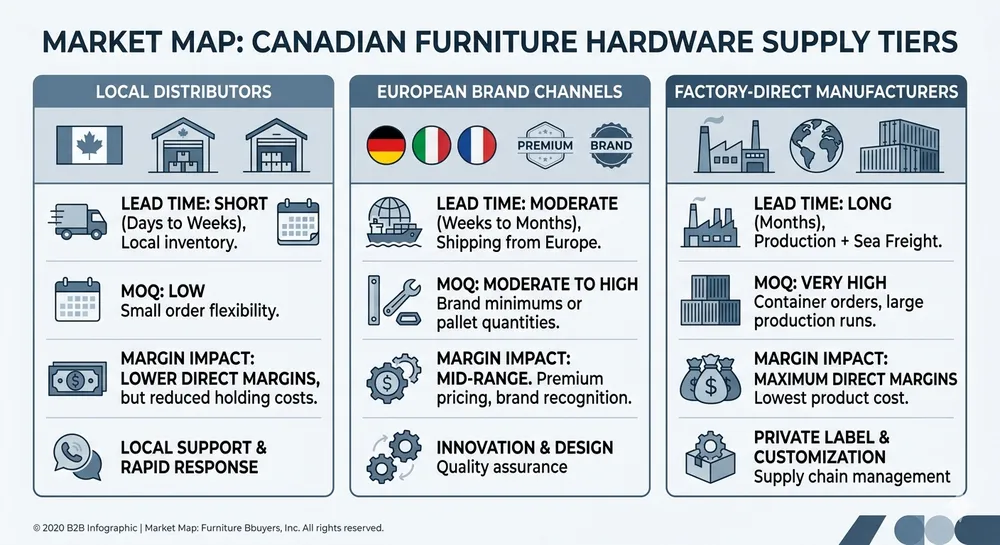
The Canadian furniture hardware market runs on a distribution model that works well — until it doesn't. Local distributors carry stock, speak your language, and can ship next-day on standard SKUs. That convenience is real and worth paying for in the right situations. But if you're importing furniture or building a private-label line, the same distribution layer that gives you speed also compresses your margin on every unit, every reorder, every season.
This article maps the serious suppliers available to Canadian furniture importers — from the European brands that dominate the premium segment to the domestic distributors that keep production lines moving, to the factory-direct route that changes the landed-cost math at volume. The goal isn't to hand you a ranked list and call it research. The goal is to help you understand what each supplier model actually delivers, where it fits your procurement calendar, and where it starts costing you more than it should.

What Serious Buyers Evaluate Before Choosing a Hinge Supplier
Before walking through the supplier landscape, it's worth being explicit about the criteria that separate a reliable hinge supplier from one that creates problems downstream. These are the dimensions that matter when you're buying to resell or deploy at scale — not when you're buying a single box of hinges for a renovation.
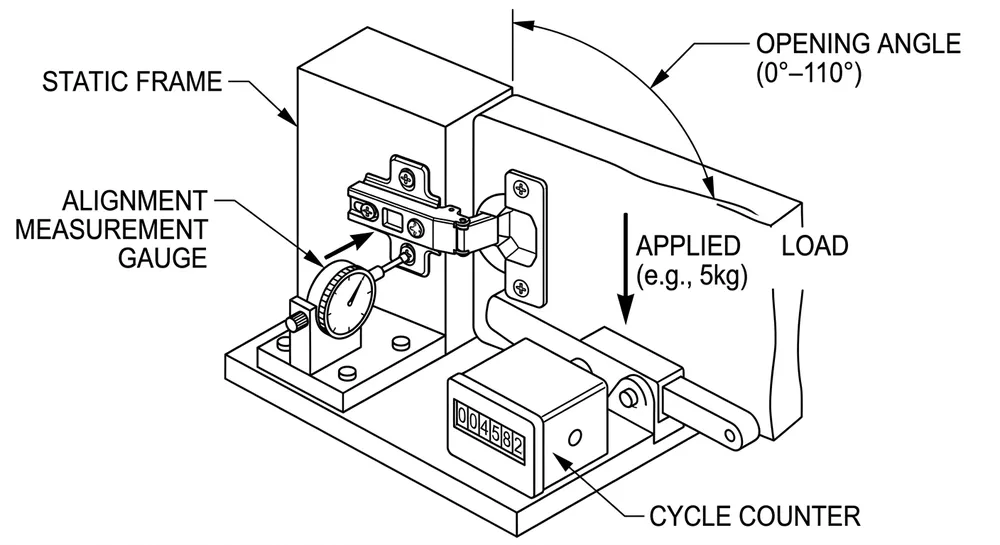
Cycle life and load rating are the first filter. A soft-close concealed hinge rated for 80,000 cycles is not the same product as one rated for 50,000, even if they look identical in a catalog photo. For furniture going into commercial hospitality, student housing, or multi-family residential — segments where cabinet doors get opened hundreds of times a week — cycle life determines your warranty exposure. Ask for the test standard and the test report, not just the number.
Surface finish consistency across batches is where most low-cost suppliers fail at volume. Nickel plating that passes inspection on a sample order can drift in color and adhesion by the third container if the supplier doesn't run a controlled electroplating line. If your furniture line has a consistent finish language — matte black, brushed nickel, satin chrome — your hinge supplier needs to hold that finish to a tolerance your end customer won't notice. (We run our plating lines with bath chemistry checks every four hours for this reason — color drift is invisible until it's sitting next to last season's product on a showroom floor.)
MOQ flexibility against your actual order pattern matters more than the headline MOQ number. A supplier with a 1,000-unit MOQ per SKU is fine if you're running a standard 32mm European hinge across your whole line. It becomes a problem if you're managing 12 SKUs with different overlay specs and finish requirements. Ask how MOQ is calculated — per SKU, per finish, or per order total — before you assume the number works for your business.
OEM and private-label capability separates commodity distributors from manufacturing partners. If you're building a branded furniture line, you need a supplier who can engrave your logo on the hinge arm, pack in your branded box, and hold your tooling on file for repeat runs. Most distributors can't do this. Most factories can.
Certifications and compliance documentation are non-negotiable for Canadian retail and commercial channels. CARB compliance, RoHS, and CE documentation are increasingly required by major Canadian retailers and commercial project specifiers. A supplier who can't produce these on request creates compliance risk that lands on your desk, not theirs.
The Local Distribution Tier: Speed and Familiarity at a Price
Richelieu Hardware
Richelieu (richelieu.com) is the dominant furniture hardware distributor in Canada, with distribution centers across the country and a catalog that covers virtually every hinge type a furniture manufacturer or importer would need. Their strength is availability — standard European concealed hinges, soft-close mechanisms, and overlay variants are typically in stock and shippable within days. For production runs that need emergency replenishment or small-batch top-ups, Richelieu is the practical answer.
The trade-off is margin. Richelieu operates as a distributor, not a manufacturer, so their pricing reflects a full distribution markup on top of the factory cost. For buyers running high-volume repeat orders on standard SKUs, that markup compounds across every reorder. Private-label or custom-finish options are limited — you're buying from their catalog, not specifying to your requirements.
Häfele Canada
Häfele (hafele.com/ca) brings German engineering standards and a deep product range to the Canadian market, with particular strength in architectural hardware and integrated furniture systems. Their hinge portfolio covers standard concealed hinges through to heavy-duty door systems for commercial cabinetry. Häfele's technical support is genuinely useful — their application engineers understand furniture construction, not just catalog numbers.
For importers building premium furniture lines where the Häfele brand name adds specification value, the relationship makes sense. For buyers who need the hardware performance without the brand premium, the same underlying specifications are available at lower landed cost through direct manufacturing channels.
The European Brand Tier: Engineering Credibility with Distribution Overhead
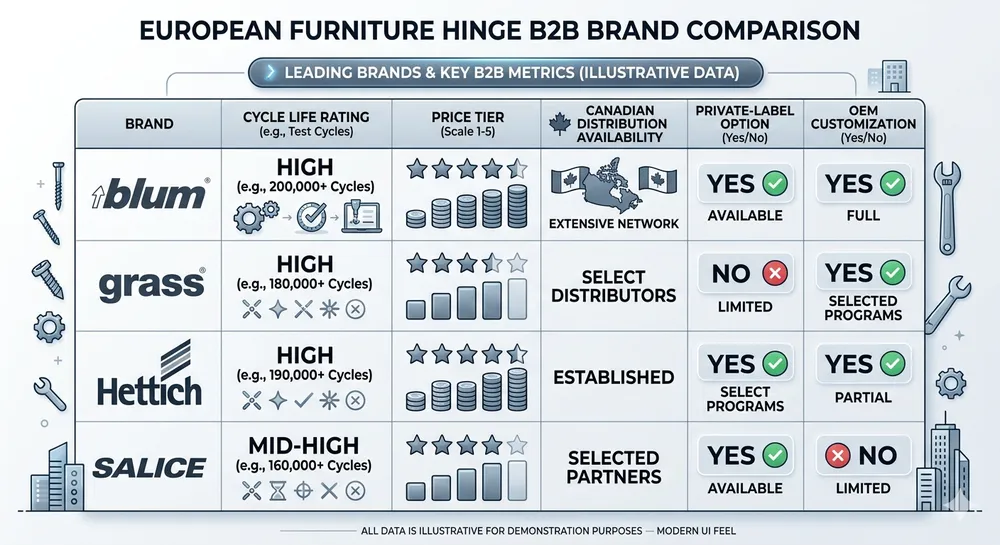
Blum
Blum (blum.com) is the benchmark for soft-close hinge engineering in the North American market. Their CLIP top BLUMOTION system is specified by name in commercial furniture projects, and their cycle-life ratings — 200,000 cycles on their top-tier hinges — are the standard against which other manufacturers are measured. Canadian distribution is well-established through authorized dealers.
The reality for importers: Blum's pricing reflects their brand position. You're paying for the engineering, the brand recognition, and the distribution infrastructure. For furniture lines where "Blum hardware" is a selling point to your end customer, that premium is recoverable. For furniture lines where the hinge is invisible and the buyer cares about function, not brand, the premium is pure margin compression.
Grass
Grass (grass.at) is an Austrian manufacturer with strong North American distribution, known particularly for their TIOMOS hinge series and Nova Pro drawer systems. Their hinge engineering is competitive with Blum at a slightly lower price point, which makes them a common alternative specification in commercial furniture projects. Canadian importers who need European-standard soft-close performance without the full Blum premium often land on Grass.
Hettich
Hettich (hettich.com) covers the full range of furniture hardware from hinges to drawer systems to sliding door fittings, with North American distribution and a strong presence in the mid-market furniture segment. Their InnoTech drawer system and Sensys hinge line are well-regarded in the trade. For importers building mid-range furniture lines that need reliable European hardware without the top-tier brand premium, Hettich is a practical specification.
Salice
Salice (salice.com) is an Italian manufacturer with a long history in concealed hinge engineering — they hold several foundational patents in the category. Their North American distribution covers Canada, and their hinge range includes standard concealed hinges, heavy-duty variants for thick doors, and specialty hinges for glass and aluminum frame applications. For furniture lines targeting the design-conscious segment where Italian provenance matters, Salice carries specification weight.
The Asian Manufacturer Tier: Engineering Depth Without the European Premium
King Slide
King Slide (kingslide.com) is a Taiwan-based manufacturer with genuine engineering depth — they're not a trading company rebranding commodity hardware. Their slide and hinge products are specified in commercial furniture projects across North America, and their quality control infrastructure is closer to the European tier than to the commodity end of the Asian market. Canadian distribution exists through authorized channels. For buyers who need Asian manufacturing economics with documented quality systems, King Slide is a credible option.
Sugatsune
Sugatsune (sugatsune.com) is a Japanese precision hardware manufacturer with a strong reputation in architectural and high-end furniture hardware. Their hinge and door system products are engineered to tight tolerances and carry the quality consistency you'd expect from Japanese manufacturing. North American distribution is established. The price point is closer to the European tier than to commodity Asian hardware — you're paying for Japanese precision, not just Asian manufacturing cost.
Hardware Resources
Hardware Resources (hardwareresources.com) is a US-based manufacturer and distributor with Canadian market reach, covering cabinet hardware, hinges, and furniture fittings. Their product range is broad and their pricing is competitive for the North American market. For Canadian importers who need a single-source supplier for a wide range of cabinet hardware with reliable North American logistics, Hardware Resources is worth evaluating alongside the European brands.
The Cost of the Distribution Layer
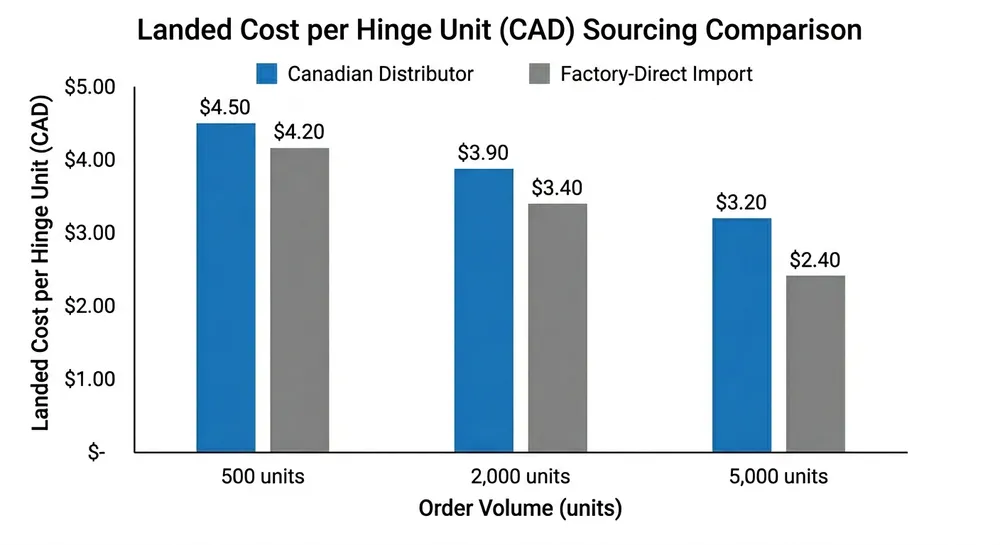
Here's the math that most importers don't run explicitly until they're deep into a product line. A standard soft-close concealed hinge from a European brand through Canadian distribution typically lands at CAD $2.50–$4.50 per unit at importer pricing, depending on volume and brand tier. The same functional specification — 100,000-cycle soft-close, 35mm cup, full overlay, nickel finish — sourced factory-direct from a certified Chinese manufacturer lands at USD $0.45–$0.85 per unit FOB, which translates to roughly CAD $0.80–$1.40 landed after freight and duties on a full container.
On a furniture line with 4 hinges per cabinet door and 8 doors per unit, that's 32 hinges per furniture piece. At a CAD $2.00 per-unit difference, that's CAD $64 per furniture piece in hardware cost alone. On a 500-unit container order, that's CAD $32,000 in margin that either goes to your bottom line or gets absorbed by the distribution chain.
The local distribution premium is not irrational — you're paying for inventory availability, logistics infrastructure, and the ability to reorder 50 units on a Tuesday. That has real value when your production schedule can't wait for a 45-day ocean freight cycle. The question is whether you're paying that premium on every unit, including the 80% of your volume that runs on predictable reorder cycles where factory-direct timing is entirely manageable.
MVMHardware: Factory-Direct from the Source
We're a furniture mechanism manufacturer in Guangdong, China — Foshan Jinruida Import And Export Co., Ltd., operating as MVMHardware. We've been making motion hardware since 2008, and door hinge mechanisms are a core part of what we produce. Our 12,000 m² facility runs 6 dedicated production lines with an annual capacity of 3,000,000 units. We ship to North America, Europe, the Middle East, Southeast Asia, and Australia — Canadian importers are a segment we understand well.
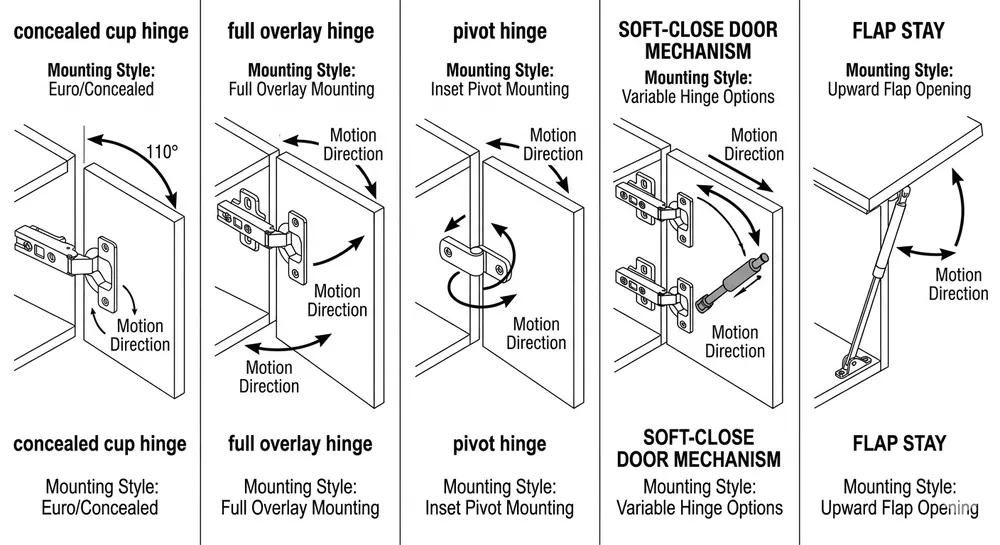
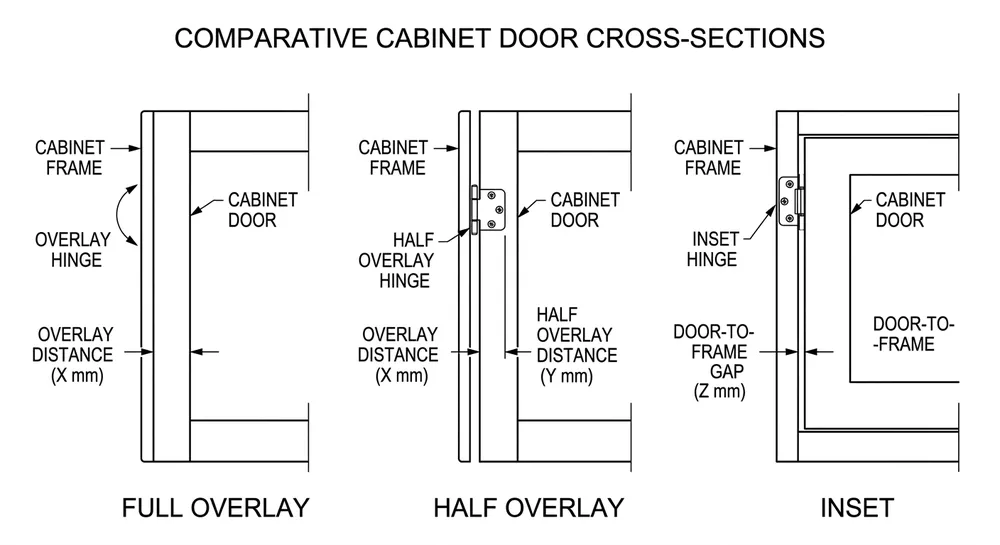
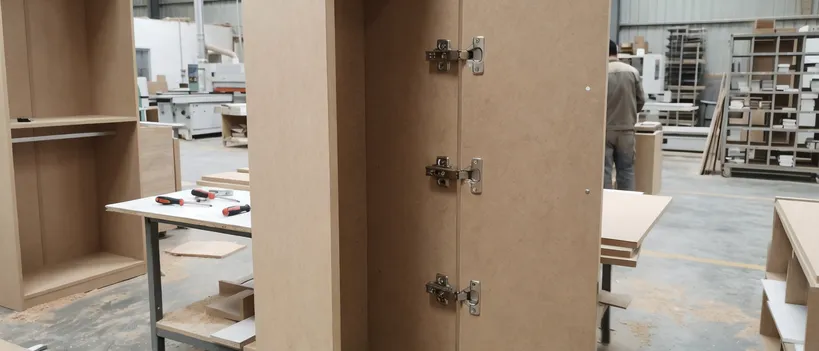
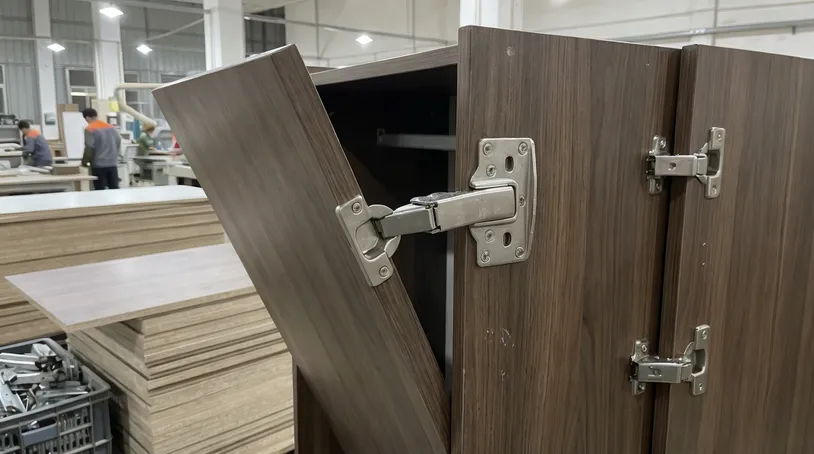
What we make is relevant here: concealed cabinet hinges, soft-close mechanisms, overlay and inset variants, heavy-duty door hinges for furniture applications, and the full range of Door & Hinge Furniture Mechanism components that go into cabinet, wardrobe, and storage furniture. We don't make the furniture — we make the hardware that determines whether the furniture works the way it's supposed to.
Our in-house R&D team of 12+ engineers focuses specifically on motion hardware. That's not a general engineering team that also handles hinges — it's a team that has spent years on hinge geometry, soft-close damper calibration, cup-to-arm tolerance stacking, and the surface finish variables that determine whether a nickel-plated hinge looks consistent across a 10,000-unit production run. (The most common failure mode we see in commodity hinges is damper oil migration at temperature extremes — we redesigned our damper seal in 2021 specifically for North American climate ranges, where warehouses in Alberta see temperature swings that Chinese domestic-market products aren't tested for.)
Our quality system runs 100% functional testing and load-cycle verification before shipment — not sampling, not AQL spot checks on the final container. Every hinge mechanism is cycled before it leaves the line. ISO 9001:2015, CE, SGS, and RoHS certifications are current and available with documentation. For Canadian importers who need compliance paperwork for retail channel requirements, we can provide the full documentation package with each shipment.
MOQ starts at 500 units for standard mechanisms — low enough for a trial order on a new SKU, high enough that we're talking to serious buyers, not one-off purchasers. OEM and ODM tooling support is available for buyers who want their own branding, custom dimensions, or proprietary finish specifications. We've run private-label programs for North American furniture brands where the hinge carries their logo and ships in their branded packaging — the tooling investment is recoverable within 2–3 container orders at typical furniture importer volumes.
Surface treatment lines include nickel plating, zinc plating, and powder coating — all in-house, all on controlled lines. If your furniture line runs a specific finish that needs to match across hinges, drawer slides, and other hardware, we can hold that finish specification across product categories because we're running the same treatment line for all of them.
Choosing the Right Sourcing Route for Your Business
The honest answer is that most Canadian furniture importers should be running a hybrid sourcing model — not choosing between local distribution and factory-direct as an either/or decision.
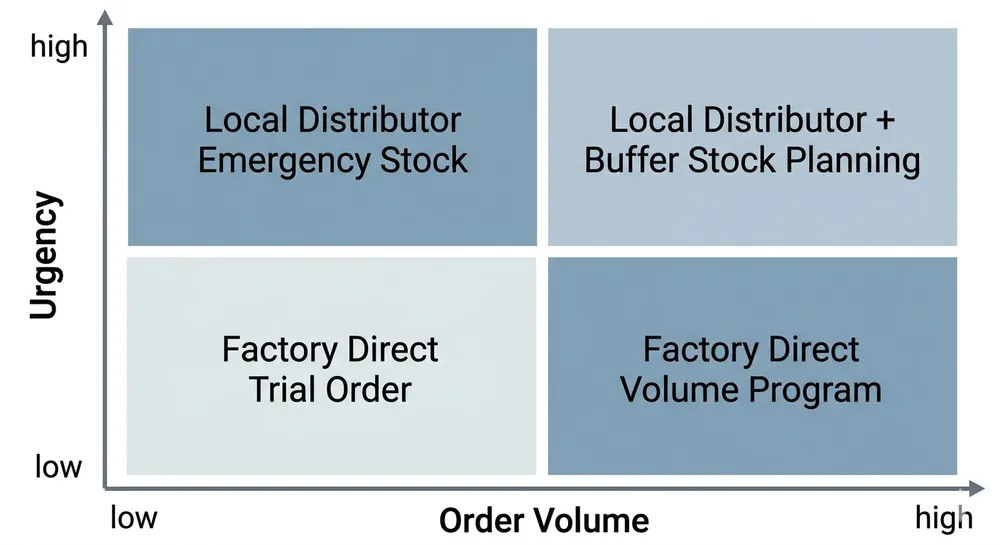
Use local distribution when:
- You need stock within 5 business days for a production run that can't wait
- Your order is under 200 units and doesn't justify the freight economics of a direct import
- You're specifying a named European brand (Blum, Grass, Hettich) because your end customer or project specifier requires it by name
- You're in a compliance-sensitive project where local distributor documentation is faster than import paperwork
Use factory-direct import when:
- You're running a planned production cycle with 60+ days of lead time in your procurement calendar
- Your order volume is 500 units or more per SKU, or 2,000+ units across a mixed order
- You need OEM branding, custom dimensions, or a finish specification that isn't available off the shelf
- You're building a private-label furniture line where hardware cost is a meaningful component of your margin structure
- You've had quality consistency issues with your current supplier and need a manufacturer who can show you the QC process, not just the certificate
The hybrid model that works for most importers: maintain a 60–90 day buffer stock of your highest-velocity standard SKUs through a local distributor for emergency replenishment, and run your planned volume procurement factory-direct. The buffer stock cost is a small insurance premium against production disruption. The factory-direct volume program is where you recover the margin.
Supplier Evaluation Checklist Before You Commit
Before finalizing any hinge supplier relationship — local or factory-direct — run through these criteria:
- Cycle life documentation: Ask for the test report, not just the rated number. What standard was used? What was the test load?
- Batch consistency records: Can they show finish consistency data across multiple production batches? Color delta measurements, plating thickness records?
- Compliance documentation: CE, RoHS, CARB — current certificates with issue dates, not scanned copies from three years ago
- MOQ structure: Per SKU or per order? What happens when you need a small top-up between main orders?
- OEM capability: Do they own their tooling, or are they reselling someone else's mold? Can they hold your tooling on file between runs?
- Communication and response time: A supplier who takes 72 hours to answer a technical question during the sales process will take longer during a production problem
- Sample policy: Can you get production-representative samples, not pre-production showpieces? The sample should come off the same line as your order
For factory-direct sourcing specifically, add:
- Factory audit availability: Will they accept a third-party audit or a video factory tour?
- Shipment documentation package: Can they provide a complete documentation set (packing list, commercial invoice, certificate of origin, compliance certs) in the format your customs broker needs?
- Payment terms and trade finance: What terms are available at what order volumes?
If you're evaluating MVMHardware alongside other factory-direct options, we're comfortable with all of the above. Send us your current specification — hinge type, overlay, finish, cycle life requirement, and target volume — and we'll send back a detailed quote with test reports and a sample shipment timeline. You can reach us through the Request Quote page or directly at [email protected].
Frequently Asked Questions
What is the minimum order quantity for factory-direct door hinges shipped to Canada? For standard concealed cabinet hinges, our MOQ is 500 units per SKU. Mixed orders combining multiple SKUs can be structured with lower per-SKU quantities when the total order value justifies the production run. For custom OEM specifications with tooling, MOQ is typically 1,000–2,000 units depending on the complexity of the tooling.
How do I verify that a Chinese hinge manufacturer meets Canadian retail compliance requirements? The key certifications to request are CE (for mechanical safety), RoHS (for restricted substances — required by most major Canadian retailers), and SGS or Bureau Veritas test reports for cycle life and load ratings. CARB compliance documentation is relevant if your furniture will be sold in California or to retailers with CARB-aligned purchasing policies. Ask for current certificates with issue dates — not scanned copies — and verify the certificate number against the issuing body's online registry where possible.
What's the realistic landed cost difference between European-brand hinges through Canadian distribution and factory-direct Chinese hinges? For a standard 35mm soft-close concealed hinge in nickel finish, Canadian distributor pricing typically runs CAD $2.50–$4.50 per unit at importer volumes. Factory-direct from a certified Chinese manufacturer runs USD $0.45–$0.85 FOB, landing at roughly CAD $0.80–$1.40 after ocean freight and duties on a full container. The gap narrows on small orders where freight cost per unit is higher, and widens on full-container volume where freight amortizes efficiently.
Can a factory-direct supplier handle OEM branding for a private-label furniture hardware line? Yes — this is a standard service for manufacturers with in-house tooling capability. OEM programs typically cover logo engraving on the hinge arm, custom packaging with your branding, and proprietary finish specifications. The tooling investment (typically USD $800–$2,500 depending on complexity) is a one-time cost that stays on file for repeat runs. Most importers recover the tooling cost within the first 1–2 container orders through the per-unit margin improvement.
What lead time should I plan for factory-direct hinge orders to Canada? Production lead time for standard specifications is typically 25–35 days from order confirmation. Ocean freight from Guangdong to Vancouver or Toronto adds 18–25 days depending on routing and port congestion. Total door-to-door lead time is typically 45–60 days. Plan your procurement calendar with a 60-day buffer and you'll rarely be in a position where you need emergency local stock.
“`