The wrong hinge spec doesn't fail at the showroom. It fails six months after your customer's cabinets are installed — when the door sags, the overlay gaps, or the finish blisters in a coastal kitchen. By then you're managing warranty claims, replacement shipments, and a conversation with your buyer about why the hardware didn't hold up.
Hinge selection looks simple from the outside. It isn't. The parameters that matter — overlay type, opening angle, load rating, cycle life, surface finish — interact with each other and with the end application in ways that aren't obvious from a catalog page. This guide walks through each one, explains what the numbers actually mean for commercial use, and tells you what to confirm with your supplier before the order is locked.
We've been manufacturing hinge furniture mechanisms since 2008. What follows is how we think about specification when a buyer sends us a brief.

Overlay Type: The Spec That Determines Everything Downstream
Overlay type is the first decision, and it has to be right before anything else matters. Get it wrong and the arm length, cup bore position, and mounting plate geometry are all wrong — you can't fix overlay with adjustment screws.
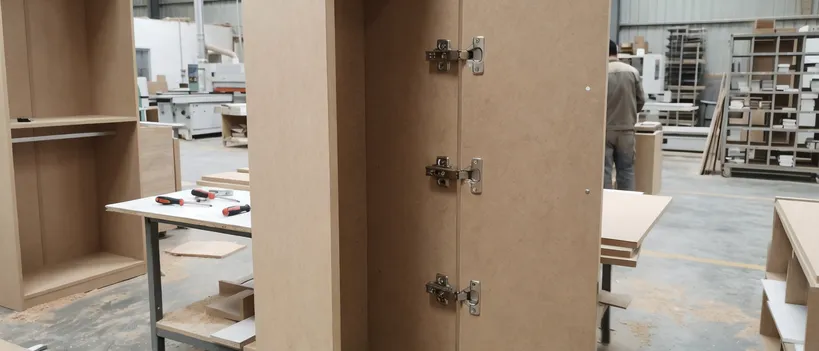
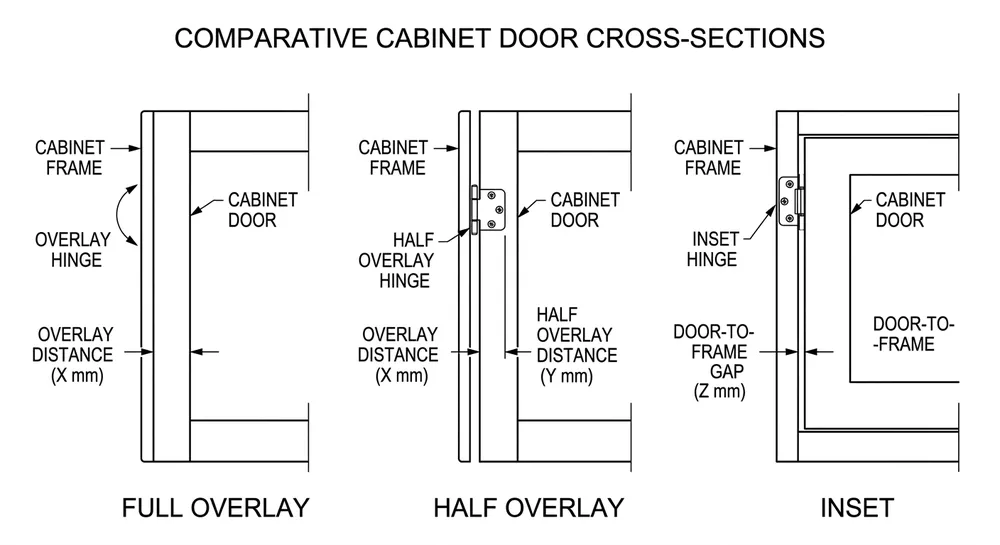
The three configurations are full overlay, half overlay, and inset. Full overlay is the most common in flat-pack and RTA furniture: the door covers the full face frame or panel edge, leaving a small reveal gap. Half overlay is used on shared panels where two doors meet — each door covers half the panel thickness. Inset sits flush inside the frame opening, which requires tighter tolerances on both the cabinet carcass and the hinge itself.
For buyers supplying into the RTA or flat-pack segment, full overlay is the default. Half overlay becomes relevant when your customer's cabinet line uses shared center stiles. Inset is a premium configuration — it's more forgiving of hinge quality variation in the wrong direction, meaning dimensional inconsistency shows immediately as a visible gap or bind.
(We see inset hinge orders go wrong more often than full overlay, not because inset is harder to manufacture, but because buyers sometimes spec inset without confirming their cabinet manufacturer's carcass tolerances. The hinge can be perfect and still look wrong if the opening isn't square.)
| Overlay Type | Typical Application | Key Spec to Confirm |
|---|---|---|
| Full overlay | RTA, flat-pack, standard kitchen cabinets | Cup bore diameter, arm length, reveal gap |
| Half overlay | Shared panel / center stile cabinets | Arm length matches panel thickness |
| Inset | Frameless premium cabinetry | Carcass tolerance, hinge dimensional precision |
Opening Angle: Match the Application, Not the Maximum
Hinge manufacturers list opening angle as a selling point. 110°, 120°, 165°, 180° — bigger numbers look better in a catalog. In practice, the right opening angle is the one that fits the installation, and over-specifying it costs you money without adding value.
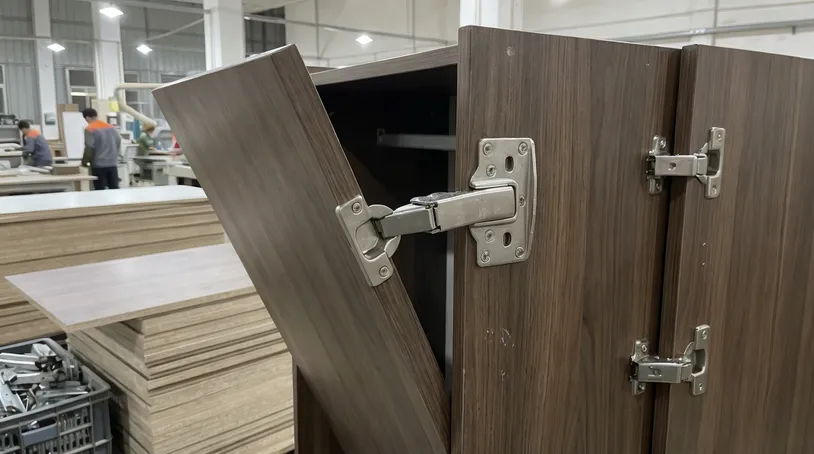
Standard kitchen and wardrobe applications work fine at 110°. The door opens far enough to access the interior without hitting adjacent walls or appliances in typical room layouts. 120° is useful for corner cabinet solutions where the door needs to clear the adjacent cabinet face. 165° and 180° are for specific applications: tall pantry doors in open-plan kitchens, display cabinet doors that need to lie flat against the wall, or commercial furniture where full access matters operationally.
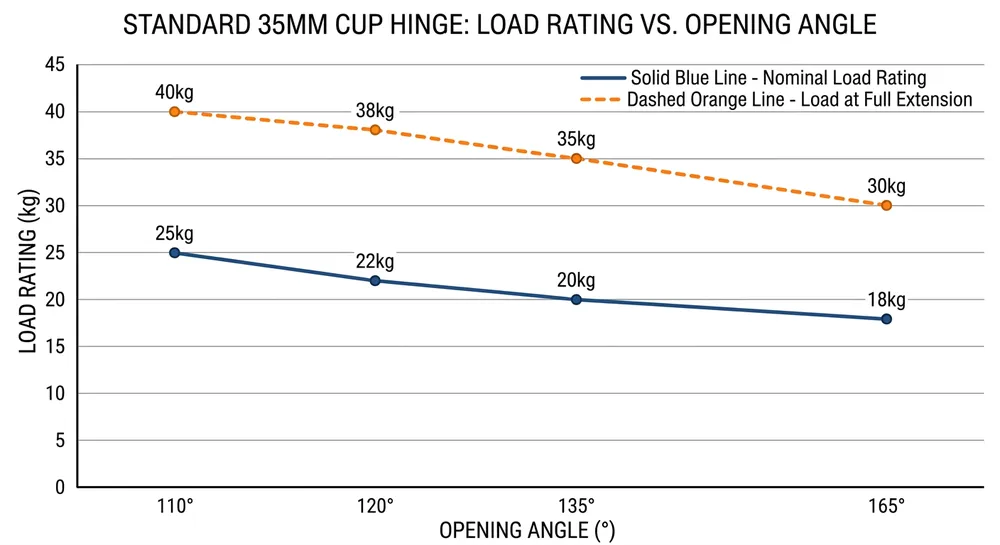
The mechanical trade-off is real. Higher opening angles require a longer arm geometry or a multi-link mechanism, which adds material, increases the hinge's closed height, and in some configurations reduces the load rating at full extension. A 165° hinge carrying a heavy door is working harder at full open than a 110° hinge in the same position.
For most cabinet door applications in the 400–800mm height range with standard 18mm panel construction, 110° is the right spec. If your buyer's product line includes corner units or display cases, add 120° as a second SKU. Don't default to the highest angle available — it adds cost and can create installation problems in tight spaces.
Load Rating and Cycle Life: The Numbers That Separate Commercial from Residential Spec
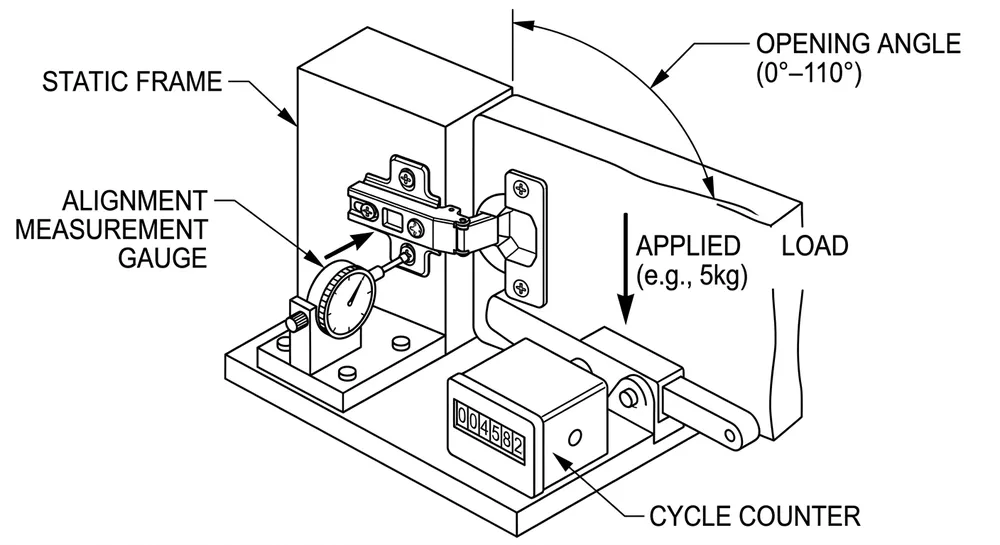
These two parameters are where most catalog-level buying guides stop short. Load rating tells you how much weight the hinge can carry. Cycle life tells you how many open-close operations it survives before performance degrades. Both matter, and they interact.
Load rating is typically expressed in kilograms per hinge pair. Standard residential cabinet hinges are rated for doors up to 15–20 kg per pair. Commercial applications — hotel room furniture, office storage, retail display units — need higher ratings, typically 25–40 kg per pair, because the doors are heavier (solid wood or thick MDF construction) and the use frequency is higher.
The number to ask for is the rated load at the specified opening angle, not just the nominal rating. A hinge rated at 30 kg at 90° may be rated lower at 120° due to the moment arm geometry. If your buyer's product uses heavy doors that open wide, confirm both figures.
Cycle life is where residential and commercial specs diverge most sharply. A residential kitchen cabinet opens and closes maybe 10–20 times per day. At that rate, a 50,000-cycle hinge lasts roughly 7–14 years. A hotel wardrobe or office storage unit in a busy environment can see 50–100 cycles per day — the same hinge lasts 1–3 years. Commercial furniture for hospitality, healthcare, or education needs 100,000-cycle minimum specification, and high-traffic applications should be spec'd at 150,000+ cycles.
We run 100% functional testing on every hinge before shipment, and batch qualification includes load-cycle verification. The cycle life figure on our spec sheets is the tested floor, not a marketing estimate. (We've had buyers come to us after a competitor's hinges failed at 30,000 cycles on a hotel project — the catalog said 80,000. The difference is whether the supplier actually runs the test or just prints the number.)
| Application | Recommended Load Rating | Recommended Cycle Life |
|---|---|---|
| Residential kitchen / wardrobe | 15–20 kg/pair | 50,000 cycles |
| Mid-range hospitality / office | 25–30 kg/pair | 80,000–100,000 cycles |
| High-traffic commercial | 35–40 kg/pair | 150,000+ cycles |
| Heavy solid-wood doors | 40+ kg/pair | Confirm per door weight |
For buyers sourcing for the hospitality or commercial office segment, the cycle life spec is a direct risk-reduction tool. A hinge failure in a hotel room generates a maintenance call, a guest complaint, and a warranty claim against your product. Specifying correctly at the sourcing stage is cheaper than managing that chain.
Surface Finish Selection by Environment: Where Spec Errors Show Up in the Field
Surface finish on a furniture hinge is not a cosmetic decision. It's a corrosion protection decision, and the right choice depends on where the furniture ends up.
We run three finish lines in-house: powder coating, nickel plating, and zinc plating. Each has a different corrosion resistance profile and a different dimensional impact on the hinge.
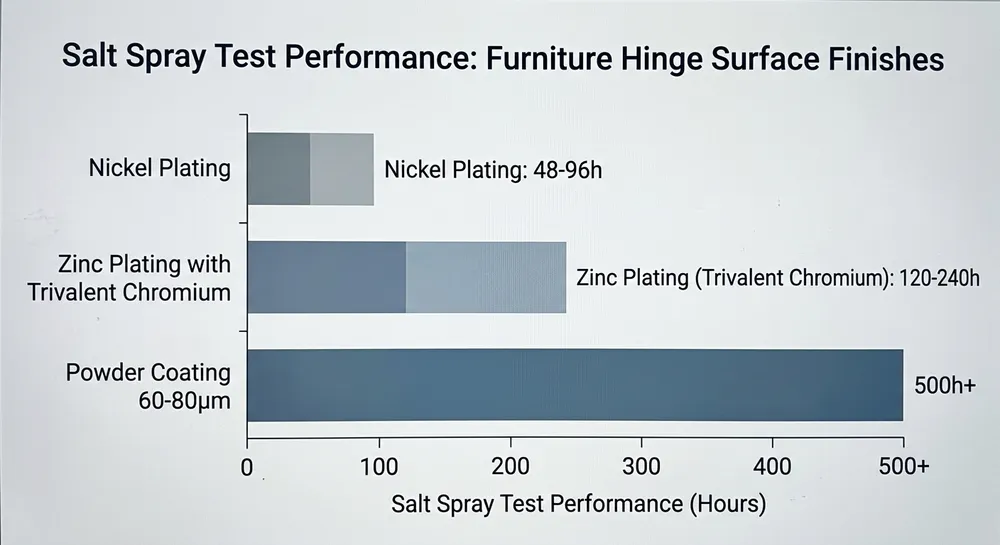
Nickel plating is the standard for interior furniture in dry environments. It gives a clean, consistent appearance, holds tight dimensional tolerances (the plating layer is thin — typically 5–10μm — so it doesn't affect fit on tight-clearance assemblies), and passes standard 48-hour salt spray without issue. For most European and North American residential furniture, nickel-plated hinges are the right call.
Zinc plating with trivalent chromium passivation offers better corrosion resistance than standard nickel at a similar cost point. We converted our zinc line to trivalent chromium passivation several years ago — hexavalent chromium is restricted under RoHS and REACH, and buyers supplying into the EU need the documentation to prove it. Zinc-plated hinges are a good choice for kitchen environments where humidity is elevated but not extreme.
Powder coating is the right choice for outdoor furniture hardware, coastal market products, and any application where the hinge will see sustained humidity or salt air. Our powder line runs at 60–80μm film thickness, which passes 500-hour salt spray testing. The trade-off is dimensional: 60–80μm of coating adds measurable thickness to the hinge body and cup, which can affect fit in tight-tolerance installations. For powder-coated hinges, confirm the finished dimensions, not the pre-coat dimensions.
(We learned the hard way that 45–55μm powder coat isn't enough for coastal markets. We ran thinner for a period to reduce material cost. The salt spray results on shipments to Gulf and Southeast Asian buyers told us that was the wrong trade-off. We moved back to 60–80μm and haven't had a corrosion complaint since.)
| Finish | Salt Spray Rating | Best For | Watch Out For |
|---|---|---|---|
| Nickel plating | 48–96 hours | Dry interior, EU/NA residential | Not for coastal or high-humidity |
| Zinc + trivalent Cr | 120–240 hours | Kitchen, moderate humidity | Confirm RoHS documentation |
| Powder coat (60–80μm) | 500+ hours | Coastal, outdoor, high-humidity | Dimensional tolerance after coating |
For buyers supplying into the Middle East, Southeast Asia, or coastal North American markets, surface finish is a sourcing decision that directly affects your warranty claim rate. Specify it explicitly — don't leave it as "standard finish" on the RFQ.
OEM vs Catalog Hinges: When Standard Specs Work and When Custom Tooling Pays Off
Most buyers start with catalog hinges, and for most applications that's the right call. Standard 35mm cup hinges in full overlay, 110° opening, nickel finish cover the majority of residential and mid-range commercial cabinet applications. If your product line fits those parameters, there's no reason to pay for custom tooling.
Custom tooling makes sense in three situations.
First, when your door geometry doesn't fit standard cup bore positions. Some furniture designs use thinner panels, unusual overlay distances, or integrated soft-close requirements that standard hinge geometry can't accommodate cleanly. Forcing a standard hinge into a non-standard application creates visible gaps, binding, or adjustment limitations that your end customer will notice.
Second, when your brand requires a specific aesthetic. Concealed hinges, colored hinges, or hinges with custom arm profiles are OEM territory. We can develop the tooling in-house, which means faster sample iterations — a geometry change on a sample doesn't require going back to a third-party tooling shop and waiting three weeks for a revised tool.
Third, when your volume justifies the tooling investment. OEM tooling has an upfront cost that amortizes over production volume. For buyers ordering 5,000+ units per SKU annually, the per-unit cost of an OEM hinge is often lower than catalog pricing, and you get a spec that's locked to your product rather than a commodity item any competitor can source.
Our engineering team is 12 people working exclusively on mechanism hardware. When we take on an OEM hinge project, we review the brief for manufacturability before committing to tooling — if your spec has a geometry that will cause production problems or dimensional inconsistency, we'll tell you before the tool is cut, not after the first sample run.
MOQ for standard catalog hinges is 500 units. OEM tooling projects are quoted based on the spec — we give you the honest tooling amortization number, not a round figure.
For buyers evaluating the full Door & Hinge Furniture Mechanism range, the catalog covers the standard configurations. If your brief falls outside those parameters, the OEM path is worth a conversation before you commit to a spec.
The Sourcing Checklist: What to Confirm Before You Lock the Order
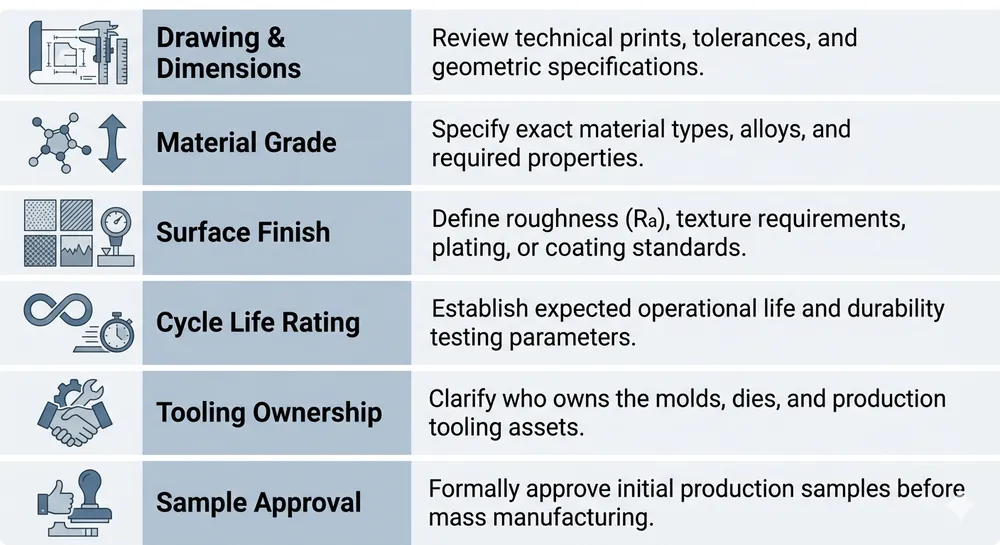
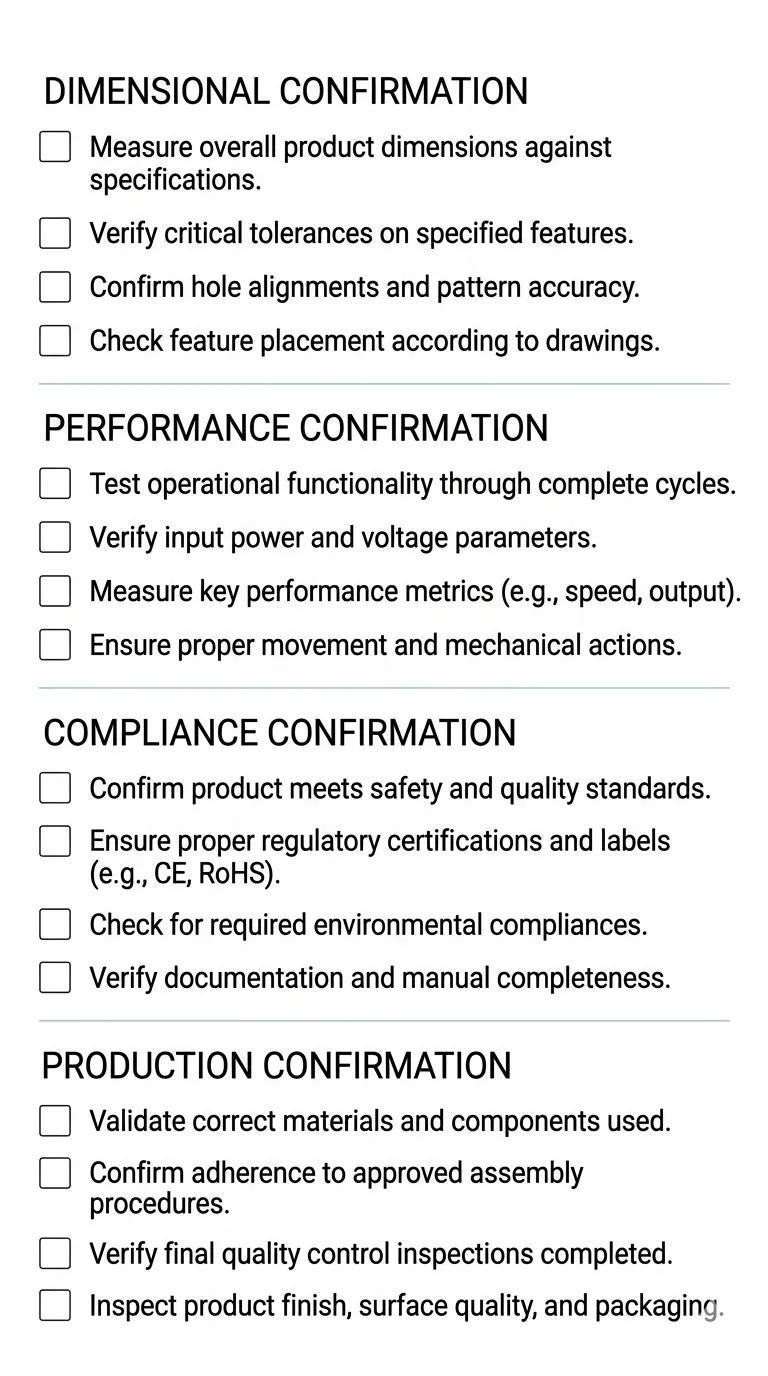
Hinge specification errors are almost always preventable. They happen when buyers treat the RFQ as a price exercise rather than a spec confirmation exercise. Here's what to confirm with your supplier before the order is placed.
Dimensional confirmation:
- Cup bore diameter and depth (standard is 35mm diameter, but confirm)
- Arm length matched to your overlay distance
- Mounting hole pattern and screw size
- Finished dimensions after surface treatment (critical for powder-coated hinges)
Performance confirmation:
- Load rating at your specified opening angle (not just nominal)
- Cycle life test standard and tested value (ask for the test report, not just the spec sheet number)
- Soft-close damper specification if integrated (damping force range, temperature stability)
Compliance confirmation:
- Surface finish RoHS documentation if supplying into EU or California
- CE declaration of conformity for European market
- SGS or third-party test reports if your buyer requires third-party verification
Production confirmation:
- Stamping tolerance on structural components (our standard is ±0.15mm on mechanism plates and brackets)
- Die-cast component dimensional consistency (adjustment components are a common failure point when die-casting is outsourced — confirm whether your supplier controls this in-house)
- 100% functional testing or sampling protocol before shipment
The last point matters more than most buyers realize. A supplier running sampling inspection on outgoing product will ship a statistically predictable defect rate. A supplier running 100% functional testing catches every unit that passes dimensional checks but fails operationally — sticky adjustment, misaligned mounting, damper that doesn't engage. We run 100% functional on every hinge before packing. That's not a special arrangement; it's the standard process.
For buyers who want to go deeper on quality standards and what to look for in a hinge mechanism supplier, the furniture hinge mechanism quality guide covers the inspection and documentation side in more detail.
Frequently Asked Questions
What is the standard cup bore size for furniture hinges, and does it vary by overlay type?
The industry standard cup bore is 35mm diameter at 13mm depth. This is consistent across full overlay, half overlay, and inset configurations — the overlay type changes the arm length and mounting plate geometry, not the cup bore. Some European manufacturers use 26mm cup bores for thin-door applications (doors under 16mm), but 35mm is the global default for 18mm panel construction. If you're sourcing hinges for a product line that uses non-standard panel thickness, confirm the cup bore spec explicitly.
How do I interpret cycle life specs — is 50,000 cycles enough for commercial furniture?
For residential use, yes. For commercial, it depends on traffic. A hotel wardrobe in a busy property can see 50–100 open-close cycles per day. At 50 cycles/day, a 50,000-cycle hinge lasts under three years. Commercial furniture for hospitality, healthcare, or education should be spec'd at 100,000 cycles minimum. High-traffic applications — gym lockers, school storage, retail display — should go to 150,000+. Ask your supplier for the actual test report, not just the printed spec.
Does powder coating affect hinge fit and function?
Yes, and it's worth confirming before you finalize the spec. Powder coating at 60–80μm adds measurable thickness to the hinge body, cup exterior, and arm surfaces. On standard full overlay installations with normal clearances, this is not a problem. On inset configurations or tight-tolerance assemblies, the post-coat dimensions need to be confirmed against your cabinet carcass tolerances. Always request finished dimensions on powder-coated hinges, not pre-coat dimensions.
What certifications should I require from a hinge mechanism supplier for EU market entry?
At minimum: CE declaration of conformity and RoHS compliance documentation. If your buyer requires third-party verification, SGS test reports cover both performance and material compliance. For buyers supplying into Germany or Scandinavia specifically, some retail chains require additional documentation — confirm with your importer what their compliance checklist looks like before you finalize the supplier selection. ISO 9001:2015 certification on the supplier's quality management system is a baseline indicator that their QC process is audited, not self-declared.
When does OEM hinge tooling make financial sense versus sourcing from catalog?
The break-even depends on your volume and the tooling cost. As a rough guide: if you're ordering 5,000+ units of a single SKU annually and the catalog spec requires compromises in your product design, OEM tooling is worth evaluating. The per-unit cost advantage at volume typically offsets tooling amortization within 12–18 months. If your volume is below 2,000 units annually, catalog hinges almost always make more financial sense unless the design requirement genuinely can't be met with standard geometry.
—
If your brief includes specific overlay type, opening angle, load rating, target market, and annual volume, send it through our Request Quote page — we'll return a product recommendation or OEM quote with specific specs, not a generic catalog link.