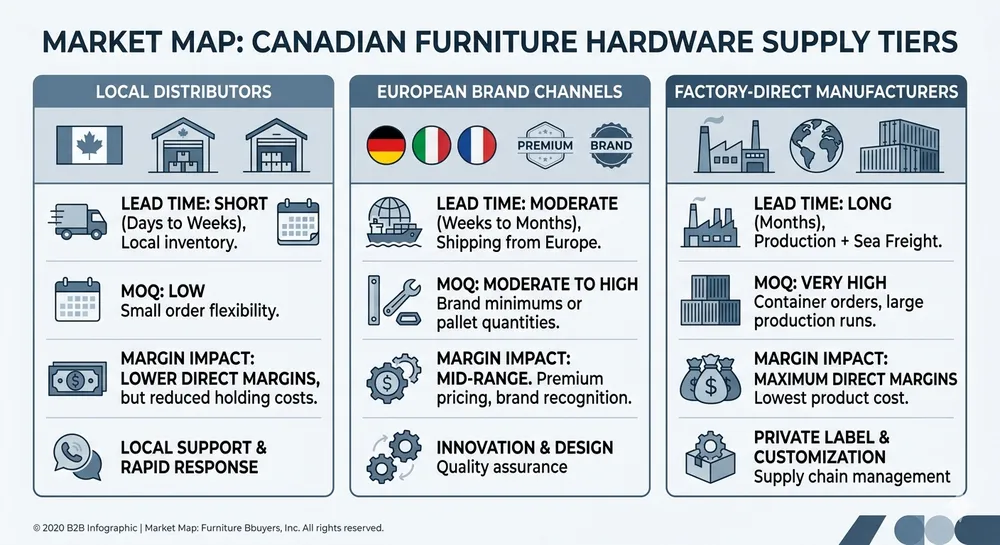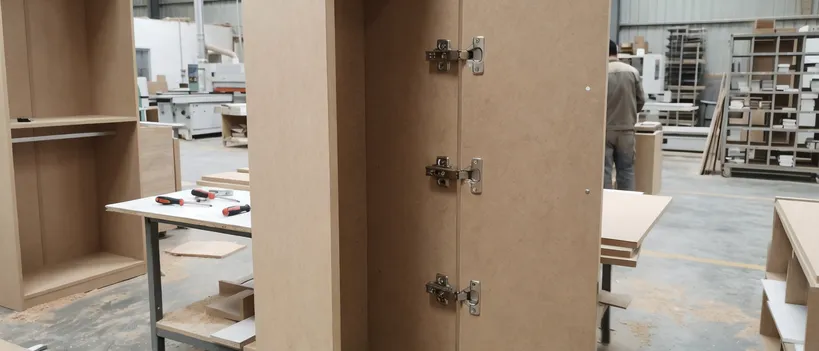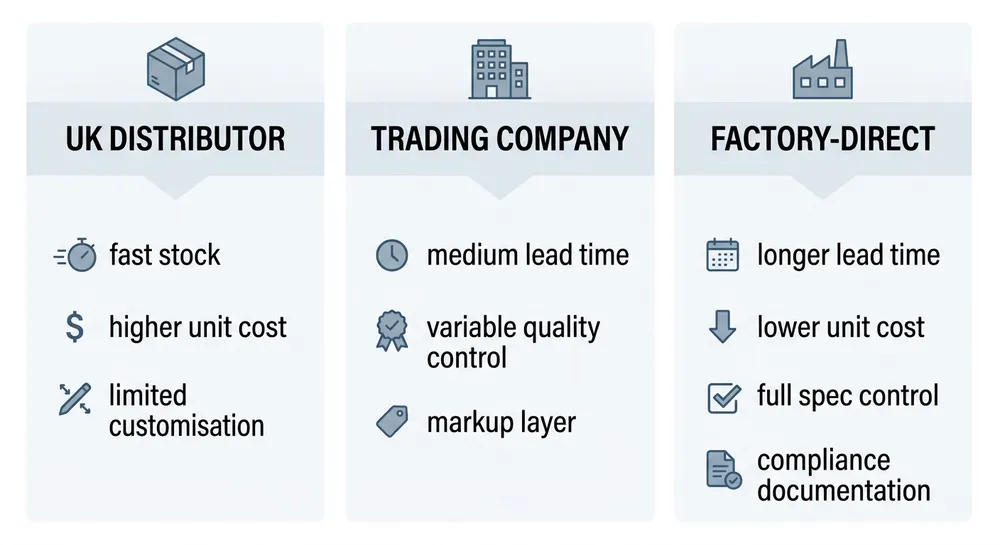
The UK furniture hardware market runs on a layered supply chain. Most buyers sourcing door hinge furniture mechanisms are working through distributors or trading companies — which means they're paying for at least one intermediary margin before the product reaches their warehouse. That's fine when you need stock tomorrow. It's a different calculation when you're placing repeat orders of 2,000+ units and the distributor's lead time is already three weeks.
This shortlist covers the real sourcing landscape: UK-based distributors and stockists who serve the trade, and the factory-direct alternative for buyers whose volume and compliance requirements make direct import worth the planning overhead. The goal isn't to rank suppliers theatrically — it's to help you understand what each sourcing tier actually delivers, where the trade-offs sit, and which route fits your procurement situation.
One framing note before the list: post-Brexit compliance has changed the documentation burden for UK importers. CE marking, RoHS declarations, and UKCA transition awareness are now active sourcing criteria, not afterthoughts. Several suppliers on this list handle that documentation well. Others leave it to the buyer to chase. That distinction matters more than it did five years ago.

How Serious UK Buyers Evaluate Door Hinge Mechanism Suppliers
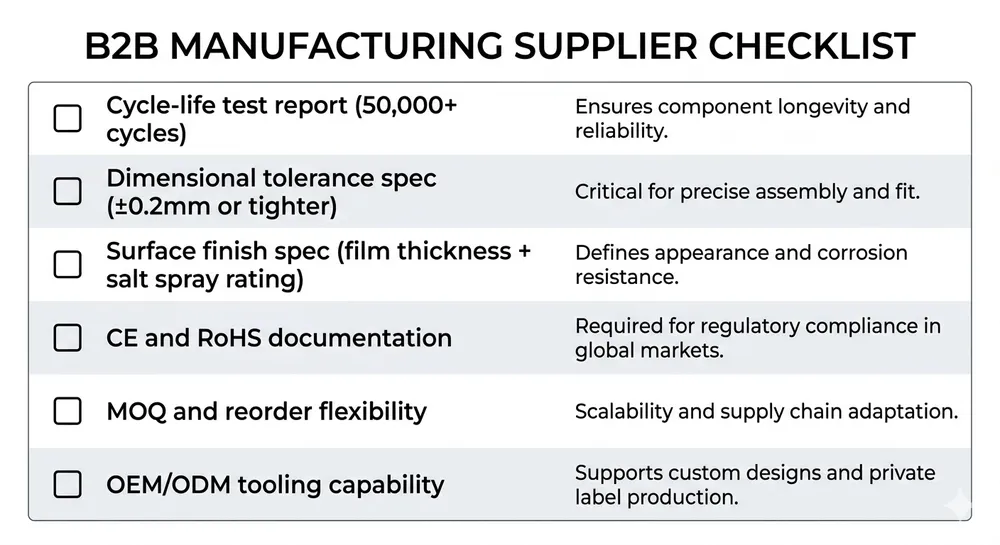
Before the shortlist, the criteria. Buyers who've been burned by a bad hinge batch — sticky pivot action, powder coat flaking at the weld seam, mounting holes out of tolerance — tend to ask sharper questions the second time around. Here's what separates a credible supplier from a catalogue entry:
Cycle-life specification and test evidence. A door hinge mechanism in commercial furniture should be rated to a minimum of 50,000 open/close cycles for standard use; high-traffic applications (hospitality, office, retail fit-out) warrant 80,000–100,000 cycles. Ask for the test report, not just the claim. Most distributors can't provide this — they're passing on what the factory gave them, and many factories don't test to this standard at all.
Dimensional tolerance on the hinge plate and pivot. The most common failure mode we see in returned mechanisms isn't the pivot wearing out — it's the mounting plate stamped out of tolerance, so the door sits crooked from day one. Specify ±0.2mm or tighter on critical dimensions and ask how the supplier verifies it. Progressive die stamping with first-article inspection is the right answer. Manual stamping with visual QC is not.
Surface finish specification, not just finish name. "Powder coated" is not a specification. 60–80μm film thickness, 500-hour salt spray rating, cross-cut adhesion test — that's a specification. UK coastal and high-humidity environments (bathrooms, kitchens, marine applications) will expose thin or poorly adhered coatings within 18 months. Get the spec in writing.
CE and RoHS documentation readiness. Post-Brexit, UK importers need to manage their own compliance documentation. CE declarations of conformity and RoHS substance declarations should ship with the order — not arrive three weeks later after you've chased the supplier twice. If a supplier can't tell you immediately whether their documentation is current, that's a signal.
MOQ and reorder flexibility. A 5,000-unit MOQ from a factory is fine if you're placing annual container orders. It's a problem if you're a furniture manufacturer running 300-unit production batches. Know your volume profile before you shortlist.
OEM/ODM capability. If your product line requires a specific hinge geometry, finish colour, or load rating that doesn't exist in a standard catalogue, you need a supplier with in-house tooling and engineering support. Distributors can't do this. Most trading companies can't either — they'll quote it and then subcontract it to a factory you've never vetted.
The UK Supplier Landscape: Ten Companies Worth Knowing
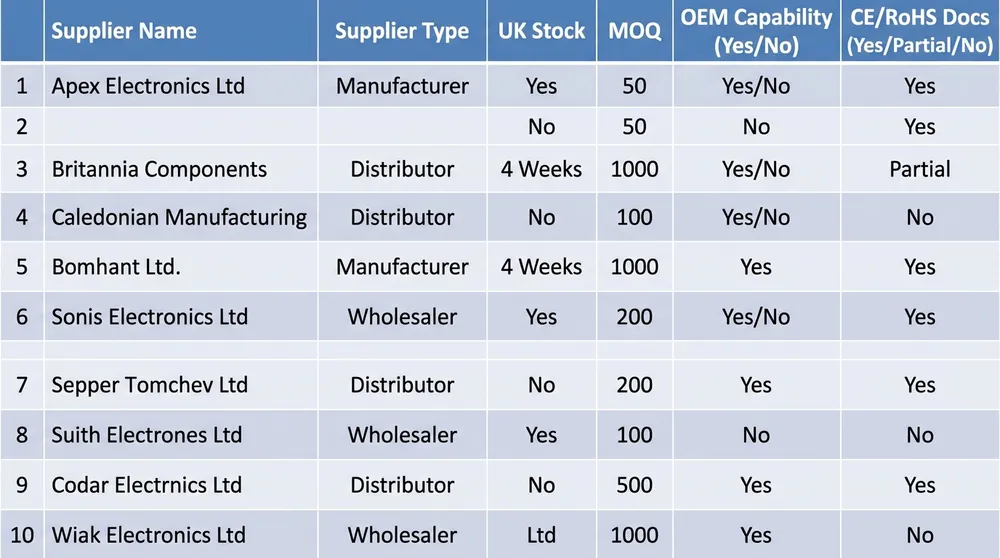
These are real companies operating in or supplying the UK market for door hinge and furniture mechanism hardware. The list spans distributor, specialist importer, and factory-direct tiers — because the right sourcing route depends on your order profile, not on which name appears first in a search result.
—
1. Häfele UK — hafele.co.uk
Supplier type: Distributor / wholesaler
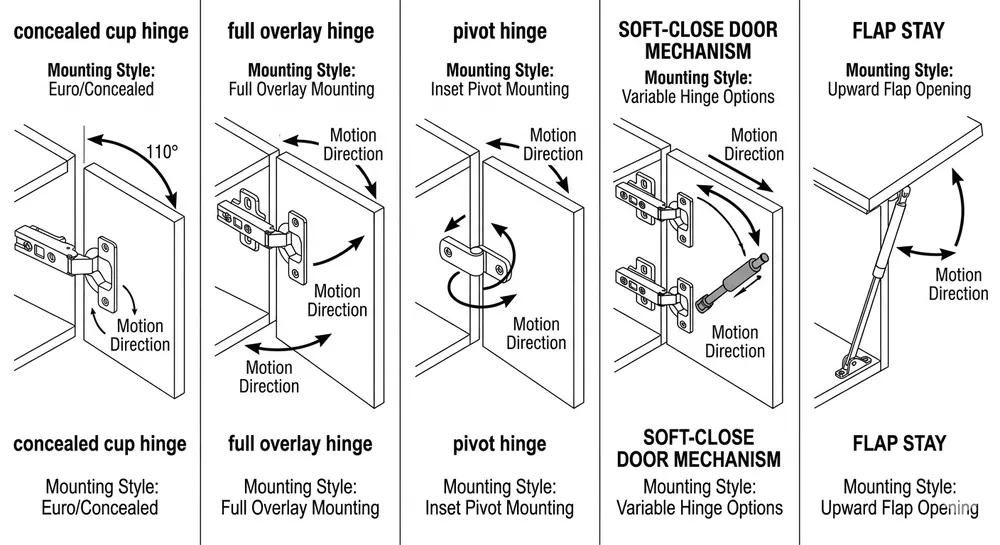
Häfele is the largest furniture hardware distributor operating in the UK market. Their catalogue covers the full range of hinge types — concealed cabinet hinges, door pivot systems, continuous hinges, and furniture mechanism fittings — with stock held in UK warehouses for fast trade delivery. For buyers who need reliable next-day or two-day replenishment on standard SKUs, Häfele is the benchmark.
The trade-off is unit cost and customisation ceiling. Häfele prices reflect a full distribution chain — manufacturer margin, import margin, and distributor margin are all in the price. For standard catalogue items in low-to-mid volumes, that's acceptable. For repeat orders above 1,000 units of a specific hinge spec, the landed cost comparison against factory-direct starts to shift. OEM capability is not available through a distributor relationship.
Best fit: Urgent replenishment, small-batch orders, buyers who need UK-stocked inventory with no import planning overhead.
—
2. Blum UK — blum.com/gb/en
Supplier type: Manufacturer's UK distribution arm
Blum is an Austrian manufacturer with a dedicated UK distribution operation. Their CLIP top and AVENTOS hinge systems are widely specified in kitchen and fitted furniture — if you're supplying into the kitchen furniture trade, Blum is likely already in your supply chain. Their engineering quality is genuine: tight tolerances, consistent finish, and documented cycle-life ratings.
The constraint is product scope. Blum's range is optimised for cabinet and kitchen furniture applications. If your requirement is for door furniture mechanisms — heavier-duty pivot hinges, door stay mechanisms, or architectural door hardware — Blum's catalogue thins out quickly. And like any manufacturer's distribution arm, pricing is set to protect the channel, not to reward volume buyers with factory economics.
Best fit: Kitchen and fitted furniture manufacturers who need Blum-specified components for their product line.
—
3. Hettich UK — hettich.com/en-gb
Supplier type: Manufacturer's UK distribution arm
Hettich is a German furniture fittings manufacturer with strong UK market presence, particularly in sliding door systems, drawer runners, and hinge mechanisms for furniture. Their Sensys and Intermat hinge ranges are well-regarded in the trade for consistent quality and installation reliability.
Similar to Blum, Hettich's UK operation is a distribution channel for their own manufactured range — you're buying at distributor pricing, not factory pricing. Their technical support is solid, and their documentation for CE compliance is generally well-maintained. For buyers whose product specifications align with Hettich's standard range, this is a low-friction sourcing option. For buyers who need custom specifications or non-standard finishes, the conversation ends quickly.
Best fit: Furniture manufacturers whose product specs align with Hettich's standard hinge range and who value German engineering documentation.
—
4. Sugatsune UK — sugatsune.com/en-gb
Supplier type: Japanese manufacturer, UK stockist
Sugatsune is a Japanese precision hardware manufacturer with UK stock availability through their European distribution network. Their door hinge and furniture mechanism range skews toward high-specification architectural and premium furniture applications — soft-close door stays, heavy-duty pivot hinges, and precision-engineered motion hardware.
The quality is real and the tolerances are tight. The price reflects both. Sugatsune is not a volume sourcing option for mid-market furniture — their unit economics work for premium product lines where the hardware specification is a selling point, not a cost line. Lead times on non-stocked items can extend to 4–8 weeks depending on the item.
Best fit: Premium furniture brands and architectural joinery suppliers where hardware specification quality is a product differentiator.
—
5. Simonswerk UK — simonswerk.co.uk
Supplier type: German architectural hinge specialist, UK operation
Simonswerk specialises in architectural door hinges — TECTUS concealed hinges, VARIANT butt hinges, and heavy-duty door pivot systems for commercial and residential applications. Their UK operation serves architectural ironmongery specifiers, joinery manufacturers, and commercial fit-out contractors.
This is a specialist supplier, not a general furniture mechanism source. If your requirement is specifically for architectural-grade door hinges in commercial fit-out or high-specification residential projects, Simonswerk is worth evaluating. If you need furniture mechanism hardware at trade volume, their range doesn't cover it.
Best fit: Architectural joinery and commercial fit-out contractors specifying heavy-duty door hinge systems.
—
6. Carlisle Brass — carlislebrass.co.uk
Supplier type: UK-based architectural hardware supplier
Carlisle Brass is a UK-headquartered supplier of architectural ironmongery and door hardware, including butt hinges, pivot hinges, and door furniture. They supply the trade directly and through distribution, with UK-stocked inventory across a broad range of finishes — satin stainless, polished brass, antique bronze, and others.
Their strength is finish variety and UK stock availability. Their limitation is that they're a hardware supplier, not a mechanism manufacturer — the engineering depth behind their hinge range is limited to what their supply chain provides, and cycle-life documentation is not consistently available across the range. For buyers who need a specific finish for a UK market product line and want UK-stocked inventory, Carlisle Brass is a practical option.
Best fit: UK furniture and joinery businesses needing trade-stocked hinges in specific decorative finishes.
—
7. Zoo Hardware — zoohardware.co.uk
Supplier type: UK trade hardware distributor
Zoo Hardware is a UK trade distributor covering door hardware, hinges, locks, and architectural ironmongery. Their hinge range includes butt hinges, ball-bearing hinges, and pivot hinges across stainless steel and brass finishes, with UK warehouse stock for trade delivery.
Zoo Hardware operates at the trade-supply tier — competitive pricing for standard items, fast UK delivery, and a broad catalogue that suits locksmiths, joiners, and small furniture manufacturers who need reliable stock access without import planning. The ceiling is the same as any distributor: no OEM capability, no custom specifications, and unit pricing that reflects the distribution chain.
Best fit: Trade buyers needing fast UK stock access for standard hinge specifications in moderate volumes.
—
8. Ironmongery Direct — ironmongerydirect.co.uk
Supplier type: UK trade hardware distributor
Ironmongery Direct is a UK-based trade supplier with a large online catalogue covering door hinges, furniture fittings, and architectural hardware. They serve joiners, builders, and furniture manufacturers who need reliable UK stock with next-day delivery options.
Their value proposition is convenience and breadth — a wide SKU range, competitive trade pricing, and fast fulfilment. For buyers who need to fill a gap in a production run or source a standard hinge quickly, Ironmongery Direct is a practical option. For buyers building a repeatable supply chain around a specific hinge specification, the distributor economics and lack of technical depth are limiting factors.
Best fit: Builders, joiners, and small furniture manufacturers needing fast access to standard UK-stocked hinge SKUs.
—
9. Allegion UK — allegion.com/gb/en
Supplier type: Global door hardware manufacturer, UK operations
Allegion is a global security and door hardware manufacturer with UK operations covering door closers, hinges, locks, and access control. Their hinge range is oriented toward commercial door applications — heavy-duty butt hinges, continuous hinges for high-traffic doors, and pivot systems for commercial entrances.
Allegion's strength is in commercial specification projects where the full door hardware package (hinge, closer, lock, access control) is sourced from one supplier. For furniture mechanism hardware specifically, their range is limited. Their pricing reflects a global manufacturer's channel structure — not factory-direct economics.
Best fit: Commercial fit-out and specification projects requiring integrated door hardware packages.
—
10. MVMHardware — mvmhardware.com
Supplier type: Factory-direct manufacturer, Guangdong, China
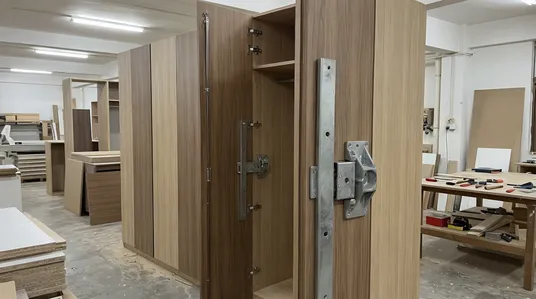
MVMHardware is a dedicated furniture mechanism manufacturer — not a general hardware supplier that added hinges to the catalogue. The factory has been running since 2008, covers 12,000 m², and produces 3,000,000 units annually across six dedicated production lines. Door and hinge mechanisms run on a dedicated line pair, which means your order isn't competing for capacity with chair mechanism or sofa bed runs.
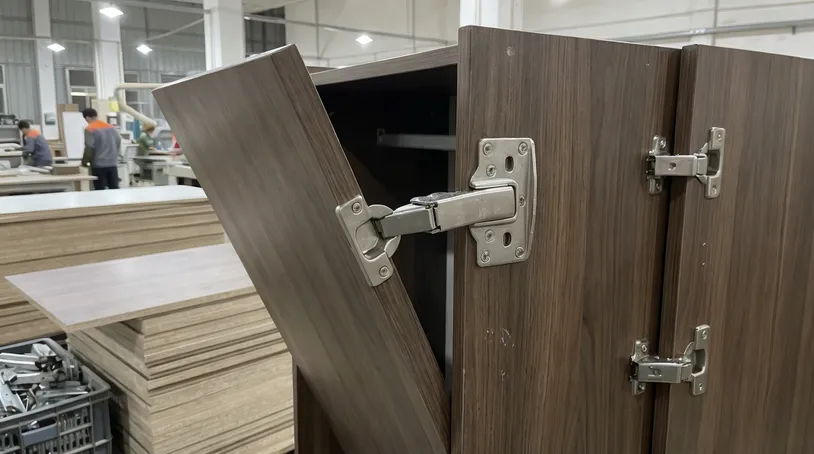
The manufacturing process is worth understanding if you're evaluating factory-direct sourcing seriously. Cold-rolled steel coil feeds progressive die stamping presses producing mechanism plates and brackets to ±0.15mm tolerance. Zinc alloy die-casting is done in-house — this matters because die-cast components (adjustment collars, pivot housings, decorative covers) are where dimensional inconsistency most commonly originates in hinge mechanisms. Most factories in this category outsource die-casting to third-party foundries and have no control over the result. We brought it inside in 2015 specifically because we kept seeing the same failure mode in competitor products and in our own early batches.
Surface treatment runs a full in-house line: powder coating at 60–80μm consistent film thickness, rated to 500-hour salt spray — relevant for UK buyers supplying coastal or high-humidity applications. Nickel and zinc electroplating are available for components where dimensional tolerance after coating is critical. (We ran the powder line thinner for a period to reduce material cost. The salt spray results on coastal-market shipments corrected that decision quickly. We moved back to the 60–80μm spec and haven't revisited it.)
For UK importers, the compliance documentation is ready: CE declaration of conformity, RoHS substance declaration, and SGS audit reports ship with every order. Post-Brexit, that means your customs broker and compliance team get what they need without chasing. UKCA transition documentation is available on request for buyers whose downstream customers require it.
MOQ is 500 units for standard catalogue mechanisms — workable for furniture manufacturers running mid-size production batches. OEM and ODM work is a significant part of the business: 12 engineers working exclusively on mechanism hardware, in-house tooling, and a sample iteration cycle that doesn't depend on a third-party tooling shop. If your product line needs a custom hinge geometry, a specific load rating, or a finish that isn't in the standard catalogue, that conversation starts with a brief, not a catalogue page.
Standard production lead time is 25–35 days from order confirmation. Container planning and export documentation — commercial invoice, packing list, bill of lading, certificate of origin, test reports — are handled by an export coordination team with over a decade of experience shipping to European buyers.
See the full Door & Hinge Furniture Mechanism range, or review our OEM & ODM capabilities if your requirement involves custom specifications.
Best fit: UK furniture importers and manufacturers placing repeat orders of 500+ units who need factory-direct pricing, documented compliance, and OEM capability.
The Real Cost of Distributor Convenience
UK distributors serve a genuine purpose. If you need 50 hinges by Thursday for a joinery job, Häfele or Zoo Hardware is the right answer. No argument there.
The calculation changes when you're running a furniture manufacturing or import business with predictable repeat volume. At 1,000 units per order, the distributor margin — typically 30–50% above factory pricing depending on the product category — is a fixed cost you're absorbing every cycle. At 3,000 units per order, it's a meaningful margin compression. At 10,000 units annually, it's a number worth putting on a spreadsheet.
The other cost is specification control. Distributors sell what they stock. If the standard catalogue hinge is close to what you need but not exactly right — wrong load rating, wrong finish spec, wrong mounting geometry — you either accept the compromise or you go back to the market. A factory-direct relationship means the specification is yours to define from the start.
Post-Brexit compliance adds a third dimension. UK importers are now responsible for their own compliance documentation in a way that wasn't true under EU membership. A distributor who sources from multiple factories across multiple countries may not have consistent CE and RoHS documentation for every SKU in their range. When your downstream customer or a market surveillance authority asks for the declaration of conformity on a specific hinge batch, "we'll check with our supplier" is not a useful answer.
When Local Supply Is the Right Answer
Factory-direct sourcing from China is not the right answer for every situation. Be honest about your procurement profile before you decide.
Local supply makes sense when:
- You need stock within 48–72 hours for a live production run or emergency replacement
- Your order volumes are below 500 units and don't justify import planning overhead
- You're in a project-based business where hinge specifications change frequently and you can't commit to a production run
- Your cash flow doesn't support the payment terms and lead time of a factory-direct order
Factory-direct makes sense when:
- You're placing repeat orders of 500+ units on a predictable cycle
- You need a specific hinge specification that isn't available in distributor stock
- You're building a product line and need OEM or ODM capability
- Compliance documentation is a live requirement for your downstream customers or market
- Landed cost matters to your margin — and at repeat volume, it always does
Most buyers who move to factory-direct sourcing don't abandon their local distributor relationships entirely. They use local stock for urgent small orders and factory-direct for their planned production runs. The two tiers serve different needs.
What Factory-Direct Import Actually Looks Like for UK Buyers
The practical mechanics of sourcing factory-direct from China are less complicated than they appear if you've never done it. Here's what the process looks like from a UK importer's perspective.
Order and payment: Standard terms are 30% deposit on order confirmation, 70% balance before shipment. For established buyers, T/T wire transfer is the norm. Sample orders can be arranged before committing to a production run — most buyers in this category start with a 2–5 unit sample to verify fit, finish, and function against their product requirements.
Production lead time: 25–35 days from deposit receipt for standard catalogue mechanisms. OEM/ODM projects with new tooling run longer — the production schedule is provided milestone by milestone (tooling completion, first sample, sample approval, production start, production completion, QC, shipment).
Shipping and customs: A 40HQ container from Guangdong to a UK port (Felixstowe, Southampton, Tilbury) runs approximately 25–30 days sea freight. Your freight forwarder handles the customs entry; the factory provides the full documentation set. UK import duty on furniture hardware mechanisms (HS Chapter 83) is currently 0–2.7% depending on the specific classification — your customs broker will confirm the applicable rate for your product.
Compliance documentation: CE declaration of conformity, RoHS substance declaration, SGS test reports, and certificate of origin ship with the order. For buyers who need UKCA documentation for the UK domestic market, that's available on request.
Communication: English-language communication, WhatsApp for fast turnaround on technical questions, and an export coordination team that has been managing European shipments for over a decade. The documentation and customs requirements for UK buyers are not new territory.
Sourcing Route Decision Guide
| Your situation | Recommended route |
|---|---|
| Need stock within 72 hours | UK distributor (Häfele, Zoo Hardware, Ironmongery Direct) |
| Standard spec, 50–500 units, no urgency | UK distributor or trading company |
| Repeat orders 500+ units, standard spec | Factory-direct (significant landed cost advantage) |
| Custom spec, OEM/ODM requirement | Factory-direct with engineering capability |
| Premium architectural specification | Simonswerk, Sugatsune |
| Kitchen/fitted furniture, Blum-specified | Blum UK distribution |
| CE/RoHS documentation critical | Factory-direct with documented compliance |
| Commercial door hardware package | Allegion UK |
The honest version of this table: if your volume is above 500 units per order and you're placing orders more than twice a year, the economics of factory-direct sourcing are worth a serious look. The planning overhead is real but finite. The margin improvement compounds every order cycle.
Qualifying a Factory-Direct Supplier: What to Ask Before You Commit
If you're evaluating MVMHardware or any other factory-direct supplier for the first time, these are the questions that separate a credible manufacturer from a trading company presenting as one.
Ask for the factory audit report or ISO certificate with the issuing body's verification contact. A real ISO 9001:2015 certificate has a certificate number you can verify with the issuing certification body. If the supplier can't provide this, the certificate is decorative.
Ask for a cycle-life test report for the specific mechanism you're sourcing. Not a generic product brochure claim — an actual test report with the test standard referenced (EN 1935 for door hinges is the relevant European standard), the number of cycles completed, and the pass/fail criteria. Our standard batch qualification runs 50,000 cycles minimum; mechanisms going to high-use commercial environments are tested higher.
Ask for a sample before committing to a production run. Any credible factory will accommodate a sample order. Use the sample to verify dimensional fit against your product, finish quality, and functional performance. If a factory resists sample orders, that's a signal.
Ask how dimensional tolerance is verified in production. The right answer involves first-article inspection on the stamping line, periodic in-process checks, and documented results. "Our workers check everything" is not a quality system.
Ask specifically about CE and RoHS documentation. Request a copy of the current CE declaration of conformity and ask which test standard it references. For RoHS, ask for the substance declaration and confirm it covers the surface treatment chemistry — hexavalent chromium in plating is the most common RoHS issue in this product category.
Our certifications page has the current documentation available for download. If you need a specific test report for a mechanism in our range, send the product reference and we'll pull it.
Frequently Asked Questions
What is the minimum order quantity for door hinge furniture mechanisms from a Chinese factory?
For standard catalogue mechanisms, 500 units is a workable MOQ with a factory like MVMHardware. Below that, the economics of factory-direct sourcing — import freight, customs clearance, payment terms — don't work in your favour unless you're consolidating multiple SKUs into a single container. For OEM/ODM projects with custom tooling, MOQ depends on tooling amortisation and is quoted on a project basis.
Do Chinese-manufactured door hinge mechanisms meet UK compliance requirements post-Brexit?
CE marking remains valid for UK market entry under the current UKCA transition arrangements (the UK government has extended recognition of CE marking for most product categories). RoHS compliance is a separate requirement — the UK has its own RoHS regulations (UK RoHS) that mirror the EU directive. A factory with current CE and EU RoHS documentation is generally compliant for UK market entry, but confirm with your customs broker for your specific product classification. The key is having the documentation — a CE declaration of conformity and RoHS substance declaration — available at the point of customs entry, not chasing it afterwards.
What surface finish holds up best for door hinge mechanisms in UK coastal or high-humidity environments?
Powder coating at 60–80μm film thickness, rated to 500-hour salt spray, is the right specification for coastal and high-humidity applications. Thinner powder coat (below 50μm) will show adhesion failure within 18–24 months in salt-air environments. Nickel plating is an alternative for components where dimensional tolerance after coating is critical, but it requires RoHS-compliant trivalent chromium passivation — hexavalent chromium passivation is not RoHS compliant. Zinc plating with trivalent passivation is a cost-effective option for interior applications where salt spray performance is less critical.
How do I verify a supplier's cycle-life claims for door hinge mechanisms?
Ask for the test report, not the brochure. The relevant standard for door hinges is EN 1935 (Building hardware — Hinges — Requirements and test methods). A credible test report will reference the standard, state the number of cycles completed, and show the pass/fail criteria. If the supplier quotes a cycle-life figure without a test report to back it, treat it as a marketing claim. For furniture mechanisms specifically, 50,000 cycles is the commercial minimum; high-traffic applications should specify 80,000–100,000 cycles with test evidence.
What's the realistic landed cost difference between UK distributor pricing and factory-direct for door hinge mechanisms?
The gap varies by product and volume, but distributor pricing on furniture hardware typically sits 35–55% above factory-direct pricing at equivalent specification. At 1,000 units per order, that's a meaningful per-unit difference. At 5,000+ units annually, it's a number that justifies the planning overhead of factory-direct sourcing. The calculation should include sea freight (typically £1,500–2,500 for a 40HQ container from China to a UK port), import duty (0–2.7% for most furniture hardware classifications), and customs clearance fees — your freight forwarder can give you current rates. The break-even volume where factory-direct becomes clearly advantageous is usually around 500–1,000 units per order for standard mechanisms.
—
If your volume and specification requirements point toward factory-direct sourcing, the next step is straightforward: send your hinge specification — grade, finish requirement, load rating, order volume, and any OEM requirements — to MVMHardware and we'll come back with a direct factory quote. No trading layer, no distributor markup. The same team that stamped the parts quotes the price.
Request a Quote or review the full Door & Hinge Furniture Mechanism range to start the conversation.
“`