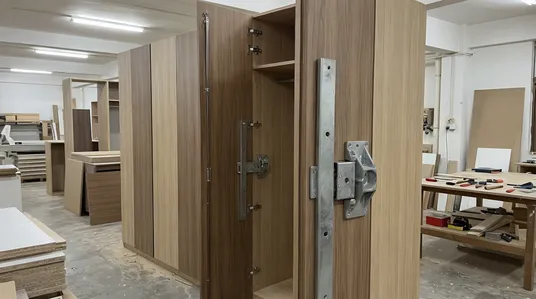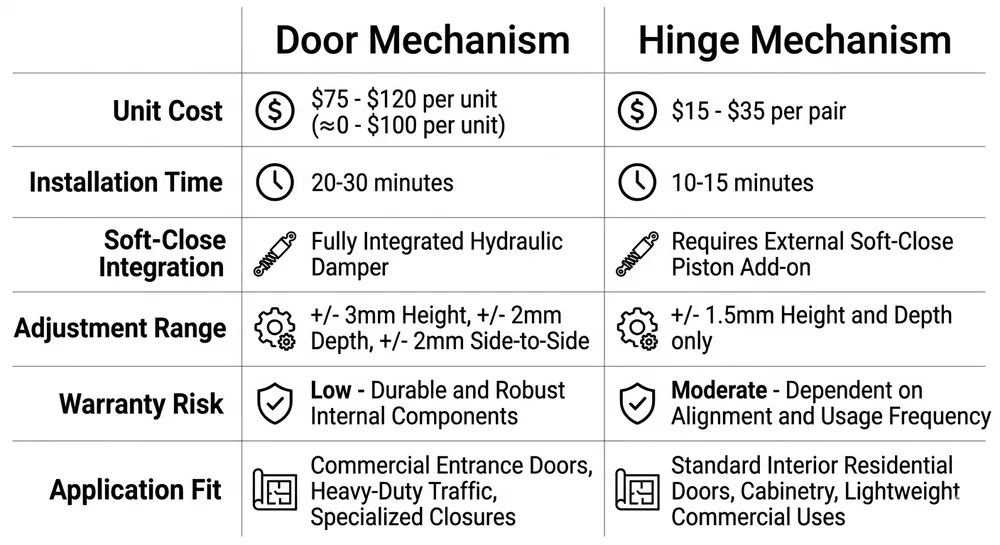
The question lands on our desk regularly: should the cabinet line run with a dedicated door mechanism — the kind with integrated soft-close damping, adjustable arms, and a multi-axis mounting plate — or stick with a conventional hinge mechanism that's been the industry default for decades? Both open and close a cabinet door. That's where the similarity ends.
The real tension isn't technical. It's commercial. Door mechanisms cost more per unit. Hinge mechanisms cost less upfront. But the buyers who've switched to door mechanisms aren't doing it for aesthetics — they're doing it because the downstream math changed. Fewer warranty claims, faster assembly on the line, and a product that holds its retail price point in a market where commodity hinge cabinets are racing to the bottom.
Quick verdict: For mid-to-high-end cabinet lines targeting retail or contract furniture channels, door mechanisms deliver better total cost of ownership despite the higher unit price. For budget cabinet runs, high-volume commodity production, or applications where the door is rarely operated, conventional hinge mechanisms remain the rational choice. The rest of this article shows you exactly where each option wins and loses.
—
What Each Option Actually Is (and What It Isn't)
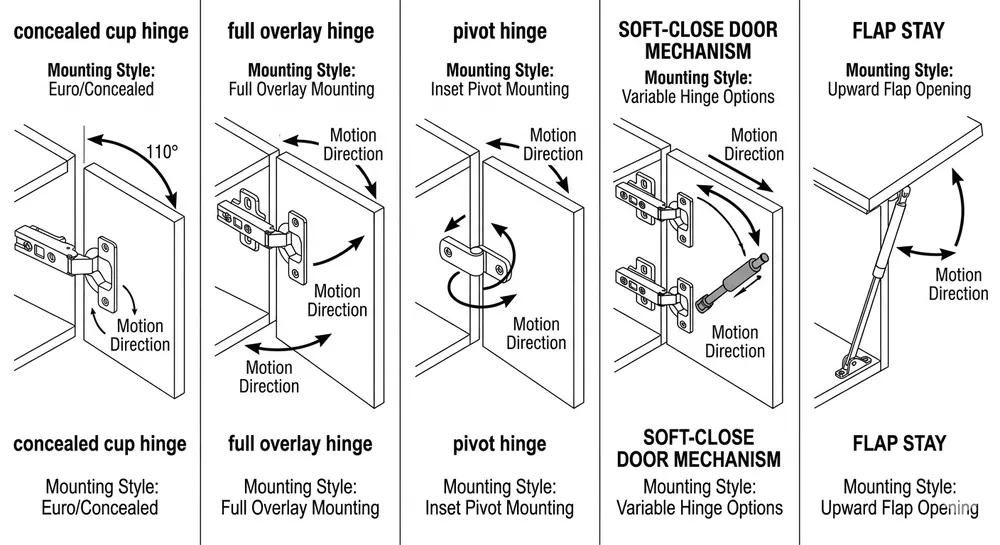
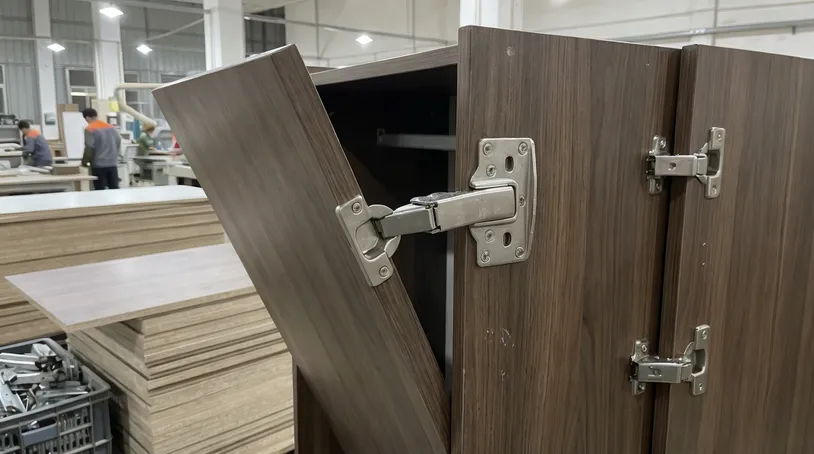
A hinge mechanism in the cabinet context is the traditional cup-and-arm assembly — a stamped steel or zinc alloy cup pressed into a 35mm bore in the door panel, connected via an adjustable arm to a mounting plate on the cabinet body. The motion is purely rotational. Soft-close, if present, is a separate add-on damper clipped onto the arm. Three-way adjustment (height, depth, lateral) is standard on quality hinges. This is the component that ships in the billions annually out of Guangdong and the Yangtze Delta furniture hardware clusters.
A door mechanism — sometimes called a door stay mechanism, flap stay, or integrated door system depending on the application — does more than rotate. It controls the full motion arc: opening resistance, hold-open position, soft-close return, and in some configurations, push-to-open or lift-up actuation. The mechanism integrates what would otherwise be three or four separate components (hinge, damper, stay, and sometimes a latch) into a single assembly. Installation is typically a two-point or four-point screw mount rather than a bore-and-clip system.
(We produce both at MVMHardware — the distinction matters to us because the tooling, the stamping geometry, and the QC checkpoints are completely different between the two. A factory that treats them as interchangeable product lines usually gets one of them wrong.)
—
Head-to-Head: The Dimensions That Actually Affect Your Sourcing Decision

| Dimension | Door Mechanism | Hinge Mechanism |
|---|---|---|
| Unit cost | Higher (integrated assembly) | Lower (commodity component) |
| Soft-close | Built-in, consistent | Add-on damper, variable quality |
| Installation steps | 2–4 screw mounts | Bore + clip + adjust (more steps) |
| Adjustment range | Limited or fixed arc | 3-way: height, depth, lateral |
| Door weight capacity | Typically rated by mechanism spec | Scalable by hinge count |
| Application fit | Lift-up, flap, stay, push-open | Overlay, inset, face-frame swing |
| Replacement complexity | Full mechanism swap | Individual component replacement |
| Warranty claim risk | Lower (integrated, tested) | Higher if damper is separate add-on |
| MOQ sensitivity | Higher (more SKUs per application) | Lower (fewer SKUs cover more cases) |
The table above is the starting point. The numbers that matter to your margin are in the sections below.
—
The Hidden Cost Gap: Where Hinge Mechanisms Lose Ground
Unit price is the number buyers quote in RFQs. Total cost of ownership is the number that shows up in your P&L six months after the container lands.
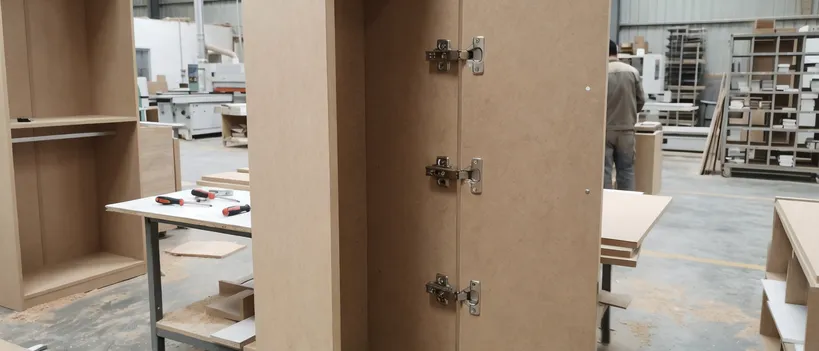
Assembly labor is the first place hinge mechanisms bleed cost. A standard cup hinge installation requires boring the door panel, pressing the cup, clipping the arm, mounting the plate, and then running three-axis adjustment per door. On a 20-door kitchen cabinet set, that's 40 hinges, each requiring individual adjustment after installation. Door mechanisms with fixed-arc geometry and a two-point screw mount cut that adjustment step almost entirely — the mechanism is pre-set at the factory. We've had buyers in the flat-pack furniture segment report 15–20% reduction in assembly time per unit after switching the door hardware from separate-component hinge-plus-damper to integrated door mechanisms. That's not a small number when you're assembling at volume.
Damper failure is the second hidden cost. When a cabinet manufacturer sources hinges and soft-close dampers separately — which is the default for most budget hinge configurations — the damper is almost always the weakest link. Clip-on dampers have a shorter cycle life than integrated damping systems, and they're the first thing that fails in high-use environments. A warranty claim on a soft-close damper sounds minor until you're replacing hardware on 200 units in a hotel room block or a school furniture contract. Integrated door mechanisms eliminate that failure mode because the damping is engineered into the mechanism's motion arc, not bolted on afterward.
Retail price erosion is the third factor, and it's the one most buyers don't model. Commodity hinge cabinets are price-competed to the floor in every major market. If your cabinet line uses the same 35mm cup hinge that every $150 flat-pack unit uses, your product has no hardware story to tell. Door mechanisms — particularly lift-up stays, push-to-open systems, and integrated flap mechanisms — are visible differentiators that support a higher retail price point. Your buyer's customer sees the motion quality and pays for it. That's margin protection, not a feature list.
—
Application Showdown: Which Option Wins in Real Production Scenarios
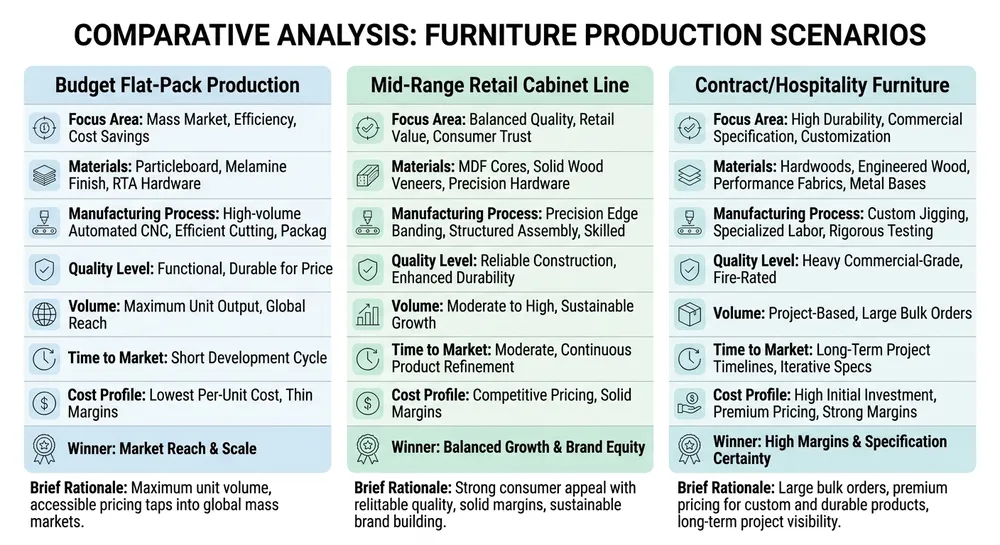
Scenario 1: Budget Flat-Pack Cabinet Production (High Volume, Price-Sensitive)
Winner: Hinge Mechanism
At sub-$200 retail price points, the unit cost difference between a hinge mechanism and an integrated door mechanism is a meaningful percentage of total hardware cost. Buyers in this segment are optimizing for landed cost per unit, not warranty performance. The assembly labor argument still applies, but at the volumes and margins in this segment, the lower unit price of conventional hinges wins. Specify quality hinges with pre-installed dampers (not clip-on) to reduce the damper failure risk — it's a middle path that keeps cost down without the worst warranty exposure.
Scenario 2: Mid-Range Retail Cabinet Line ($400–$1,200 Retail)
Winner: Door Mechanism
This is where the total cost math flips. At mid-range retail, your buyer's customer is comparing motion quality, not just price. Integrated soft-close, push-to-open, and lift-up mechanisms are expected features in this segment — not premiums. If you're sourcing separate hinges and dampers to hit this market, you're adding assembly complexity and warranty risk to compete against manufacturers who've already moved to integrated systems. The unit cost premium on door mechanisms is recoverable in retail price positioning and recovered again in reduced warranty claims. We see this shift clearly in our North American and European order mix — the proportion of integrated door mechanism orders versus standalone hinge orders has moved significantly toward mechanisms in the mid-range cabinet segment over the past several years.
Scenario 3: Contract and Hospitality Furniture (Hotels, Offices, Institutional)
Winner: Door Mechanism, decisively
Contract furniture takes abuse. A hotel room wardrobe gets opened and closed hundreds of times per year by guests who don't treat it gently. An office cabinet in a shared workspace runs similar cycles. In these environments, clip-on damper failure is not a question of if — it's when. Integrated door mechanisms with rated cycle lives (we test our mechanisms to 50,000 cycles as a standard qualification, with contract-spec versions going higher) are the only rational choice for contract furniture buyers who want to avoid service calls and replacement hardware costs in the field. The higher unit cost is a fraction of one service visit.
—
Sourcing Validation: What to Check Before You Place the Order
Both product types have quality traps that aren't visible in a catalog photo or a unit price quote.
For hinge mechanisms, the critical checks are:
- Steel gauge on the arm: Undersized arms flex under load, which means your three-axis adjustment drifts over time. Ask for the arm cross-section spec — 1.5mm cold-rolled steel is the minimum for commercial-grade hinges; budget product often runs thinner.
- Cup material and bore fit: Zinc alloy cups pressed into undersized bores will work loose over time. The bore tolerance should be specified, not assumed.
- Damper cycle rating: If soft-close is part of your spec, get the damper cycle life in writing. Clip-on dampers from unspecified sources are the most common quality substitution in this category. (We've seen buyers receive hinges with dampers that failed within 3,000 cycles — the spec they thought they were buying was 30,000.)
- Surface treatment: Nickel plating on hinges in humid environments (kitchens, bathrooms) needs to be specified to a minimum thickness. Thin plating corrodes at the cup edge first, which is visible and generates warranty claims.
For door mechanisms, the critical checks are:
- Rated door weight: Door mechanisms are load-rated. Exceeding the rated weight causes premature damper wear and motion arc deviation. Get the weight rating confirmed against your actual door panel weight including hardware.
- Cycle life documentation: Ask for the test report, not just the claim. Integrated mechanisms should be tested as a complete assembly, not with the damping component tested separately.
- Mounting plate material: Stamped steel mounting plates on door mechanisms need to be thick enough to resist flex under repeated load. Flex in the mounting plate translates directly into motion quality degradation over time.
- OEM consistency: If you're ordering a mechanism that will be installed across a full cabinet line, batch-to-batch dimensional consistency matters. Ask about the supplier's in-process inspection protocol — specifically whether first-article dimensional checks are run at the stamping stage or only at final assembly.
For both types, request SGS or equivalent third-party test reports if your downstream market requires compliance documentation. CE marking is relevant for European market sales; make sure the certification covers the specific mechanism model you're ordering, not just the supplier's general product range.
—
Cost-Performance Positioning: Where Each Option Sits
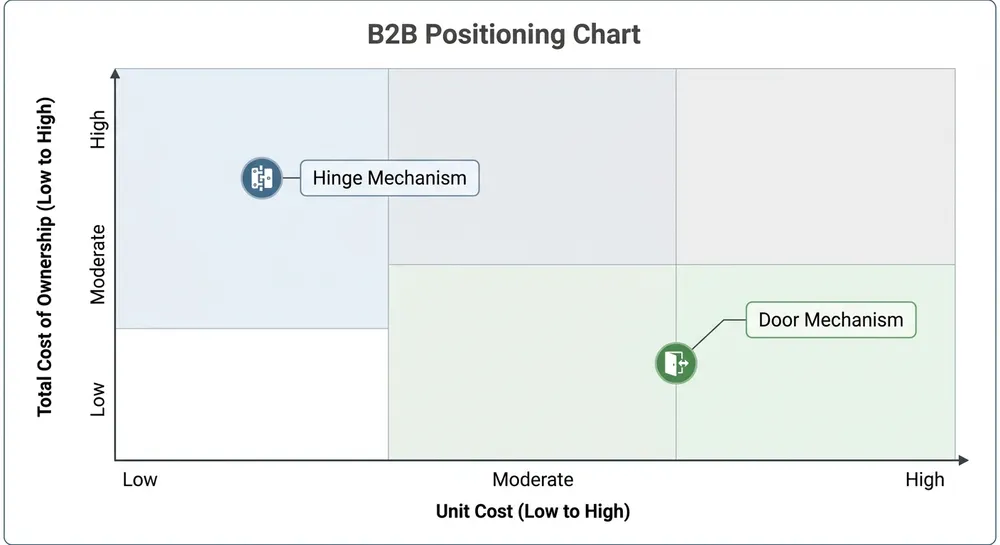
The positioning is straightforward once you account for the full cost stack:
- Hinge mechanism: Low unit cost, but TCO climbs with assembly labor, damper replacement frequency, and warranty exposure in high-use environments.
- Door mechanism: Higher unit cost, but TCO compresses when assembly labor savings, damper elimination, and warranty reduction are factored in — particularly above 10,000 units per year in mid-range or contract applications.
The crossover point depends on your assembly labor rate, your warranty claim rate on current hardware, and your target retail segment. For most cabinet manufacturers sourcing for mid-range or contract channels, the crossover happens well within normal production volumes.
—
What to Include in Your RFQ to Get an Accurate Comparison
Vague RFQs produce vague quotes. If you're comparing door mechanisms against hinge mechanisms for a specific cabinet line, the information that actually determines the right spec — and the right price — is:
- Door panel dimensions and weight — this determines load rating requirements for door mechanisms and hinge count for hinge mechanisms
- Opening arc required — full 110°/170° swing, or a controlled stay position (lift-up, flap, limited-angle)?
- Soft-close requirement — integrated or add-on acceptable?
- Annual volume — affects MOQ, tooling amortization on OEM specs, and unit pricing
- Target market — domestic, export to EU/North America, contract/hospitality? Determines compliance documentation requirements
- Current hardware spec — if you're switching from an existing supplier, send the current sample or drawing so we can match or improve on the spec rather than starting from scratch
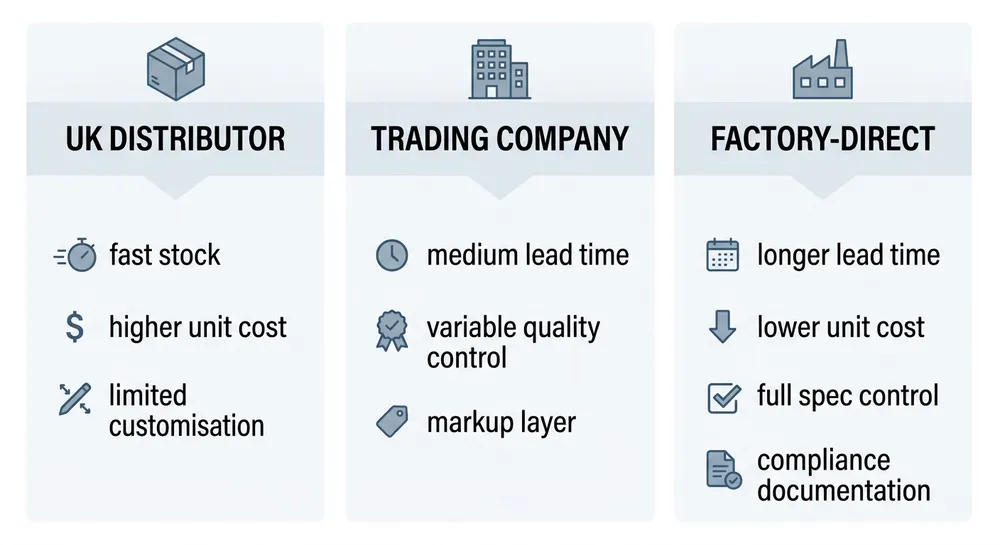
We handle both product types on dedicated lines — door and hinge mechanisms run on the same two production lines in our facility, which means we can quote both options against the same application spec and give you a direct comparison rather than a catalog price list. Our Door & Hinge Furniture Mechanism category covers the full range of what we produce in this segment.
If you're ready to run the numbers on your specific cabinet line, send your specs to /rfq and we'll come back with a side-by-side cost comparison based on your actual volume and application requirements.