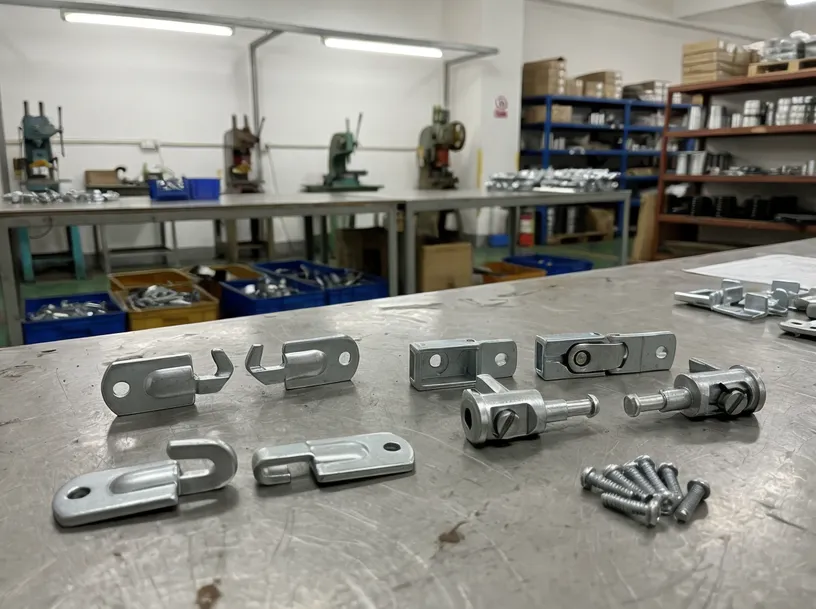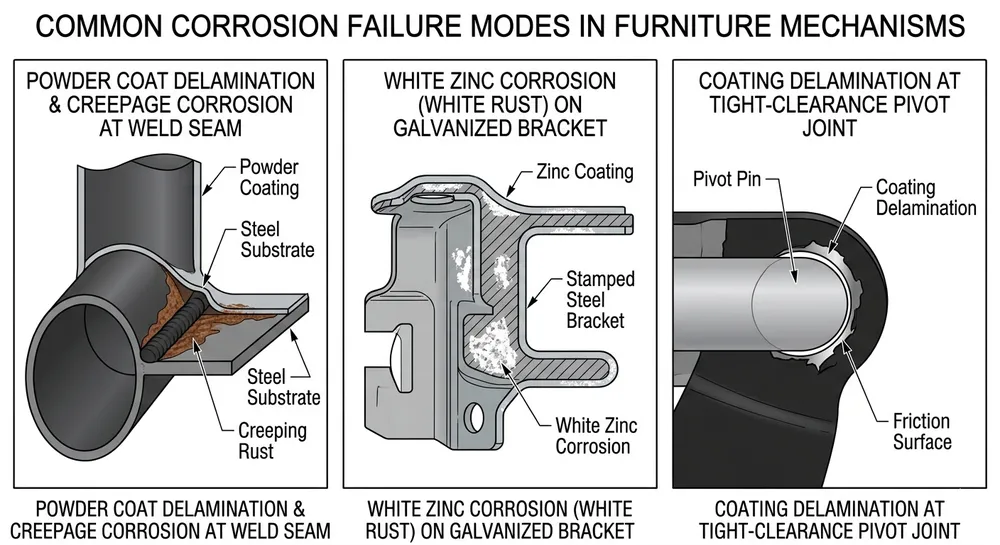
Surface treatment failures on furniture mechanisms don't announce themselves at the factory. They show up six months after delivery — rust blooming under a recliner linkage in a Florida showroom, powder coat flaking off a sofa bed frame returned from a Gulf distributor, a chair tilt mechanism seized by white corrosion in a coastal UK warehouse. By then the RMA is already open, the container is already gone, and the conversation with your supplier is already difficult.
Most of those failures trace back to one of three specification errors: wrong treatment for the substrate, film thickness below the threshold for the target market, or no passivation step on the zinc plating line. None of them are hard to prevent — but you have to specify them explicitly, because a factory running to minimum cost will not volunteer the upgrade.
This guide covers how to write a surface treatment spec that actually protects your furniture motion mechanism orders, which treatment applies to which component type, and what to ask your supplier to prove compliance before the container ships.

Why under-specified coatings fail on motion hardware specifically
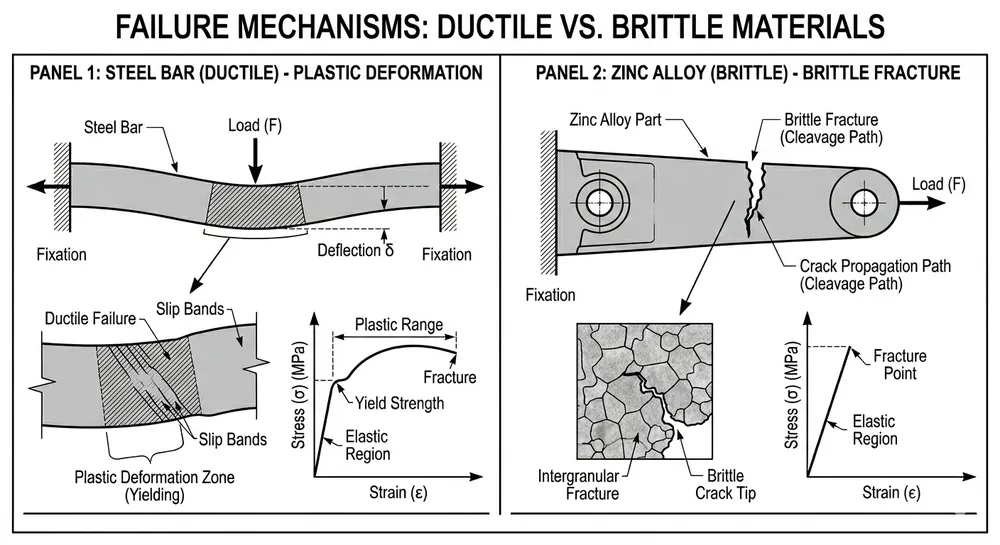
Static furniture hardware — a hinge, a bracket, a fixed leg — sits in one position. A motion mechanism flexes, pivots, and cycles. Every articulation point is a stress concentration, and stress concentrations are where coatings crack first.
The failure mechanism is straightforward: powder coat applied at 45–55μm over a stamped steel recliner linkage looks fine in the factory. Run it through 10,000 flex cycles and the coating at the pivot radius develops micro-cracks. Moisture gets in. The steel underneath hasn't been phosphate-treated because the spec didn't require it. Within a season in a humid climate, you have rust tracking along the crack lines.
We've seen this exact sequence on orders where buyers specified "powder coat, standard" without a thickness floor or a pre-treatment requirement. The coating passed visual inspection at the factory. It failed in the field.
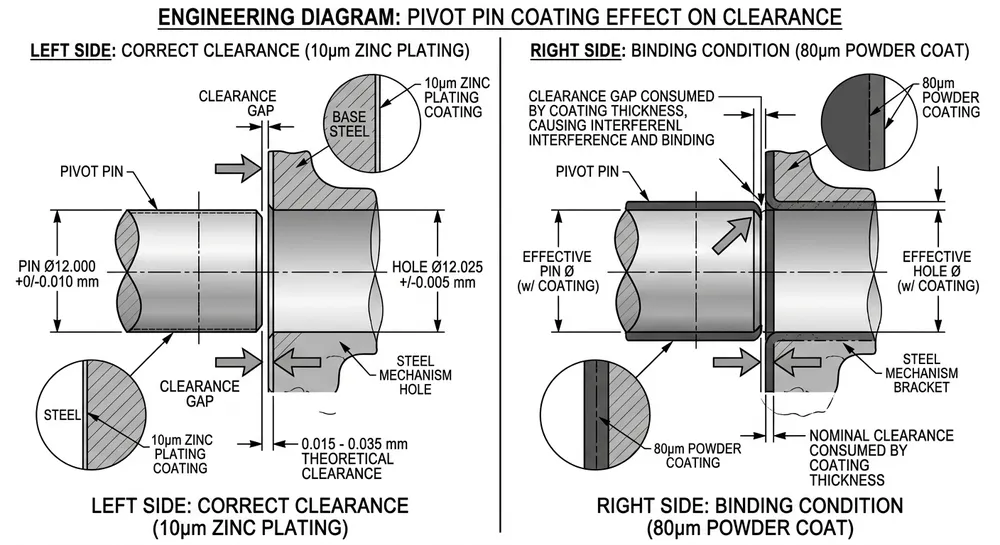
The other failure mode specific to motion hardware is dimensional. Powder coat at 80–100μm on a tight-clearance pivot pin changes the fit. The mechanism binds. The buyer's assembly team files it down, breaks through the coating, and creates a bare metal spot that corrodes faster than if it had never been coated at all. (This is why we run pivot pins and bearing surfaces on a separate spec — typically zinc plating at 8–12μm rather than powder coat — and it's worth asking your supplier whether they do the same.)
The three treatments used on furniture mechanisms and when each applies
Not every component on a mechanism takes the same treatment. The right call depends on substrate material, component geometry, and the corrosion environment the finished furniture will live in.
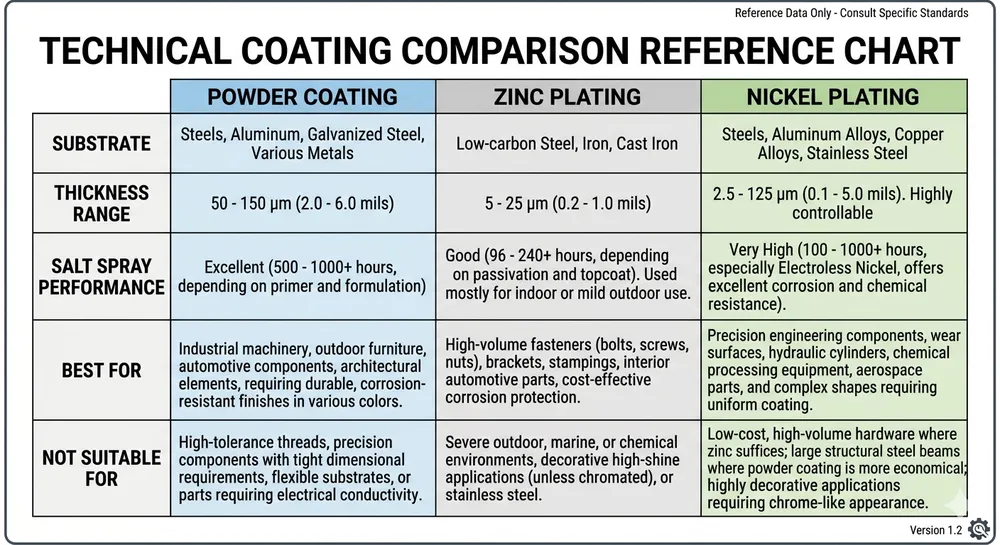
Powder coating: the right choice for structural steel components
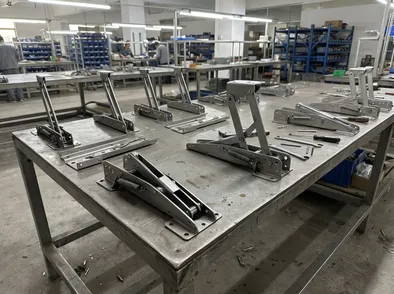
Powder coat is the workhorse finish for stamped steel mechanism bodies — seat plates, back frames, recliner base rails, sofa bed side frames. It gives you color flexibility, good impact resistance, and strong corrosion performance when applied correctly.
The spec that works: 60–80μm dry film thickness, applied over a zinc phosphate pre-treatment, cured at 180–200°C. At this thickness, a properly pre-treated part passes 500-hour neutral salt spray (NSS) per ISO 9227 without red rust. For coastal markets or high-humidity environments (Southeast Asia, Middle East, Florida/Gulf Coast), specify 72–80μm minimum and require the phosphate pre-treatment step explicitly — don't assume it's included.
What goes wrong: factories running to cost will skip the phosphate pre-treatment and drop thickness to 45–55μm. The part looks identical. It won't pass 240-hour salt spray. We learned this the hard way on a coastal-market order early in our export history — three containers of recliner mechanisms with powder coat that started blistering within four months of delivery. We added mandatory phosphate pre-treatment to our standard process after that, and we've held the 60–80μm floor on all structural components since.
Powder coat is not suitable for tight-tolerance pivot pins, threaded fasteners, or die-cast zinc alloy components with complex geometry. On those, the thickness variation and thermal cure process create fit and adhesion problems.
Zinc plating: the right choice for stamped steel fasteners and pivot hardware
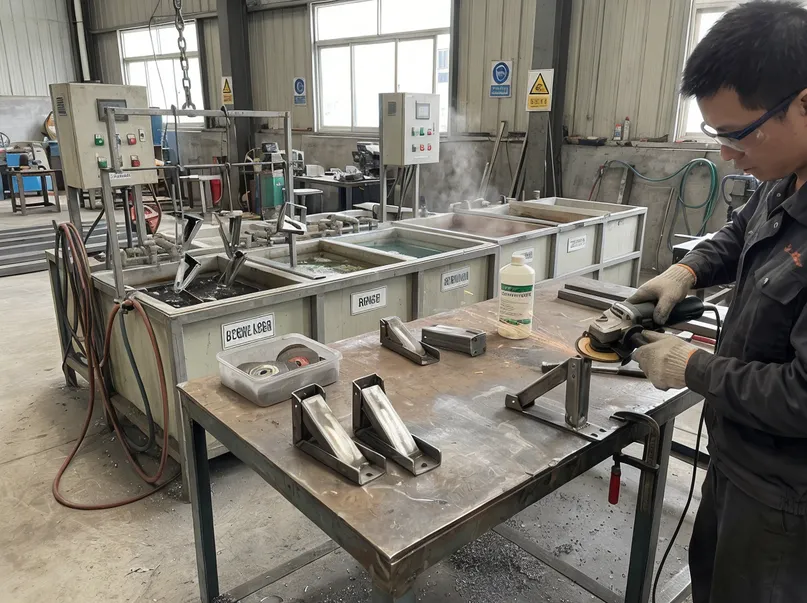
Zinc plating at 8–12μm is the standard finish for bolts, pivot pins, washers, and small stamped brackets where dimensional tolerance matters. The coating is thin enough to preserve fit, provides galvanic protection to the steel substrate, and is fast to apply.
The critical variable is passivation. Bare zinc plating without passivation passes roughly 24–48 hours of salt spray before white rust appears. That's not a corrosion failure in the structural sense — white rust is zinc oxide, not iron oxide — but it looks bad and your buyers' customers will return the product.
Trivalent chromium passivation (the RoHS-compliant replacement for hexavalent chromium) brings a standard zinc-plated part to 96–120 hours salt spray before white rust. For EU and California-bound orders, trivalent passivation is not optional — hexavalent chromium is restricted under RoHS and REACH. Specify it explicitly: "zinc plating, 8–12μm, trivalent chromium passivation, minimum 96-hour NSS per ISO 9227."
Our zinc plating line runs trivalent passivation as standard. We made that switch in 2017 ahead of tightening EU enforcement, and it's simplified compliance documentation for our European buyers considerably.
Nickel plating: for visible components and premium-grade hardware
Nickel plating applies where the mechanism component is partially visible in the finished furniture — exposed pivot hardware on a recliner handle, decorative linkage covers, visible adjustment knobs. It gives a harder, more wear-resistant surface than zinc plating and a finish that reads as premium.
Spec range: 5–10μm electroless nickel or 8–15μm electrolytic nickel over a copper strike, depending on the substrate and the visual requirement. Corrosion performance at this thickness is good — typically 200–300 hours NSS — but nickel plating is not the right choice for high-corrosion environments. For coastal or high-humidity markets, powder coat over steel outperforms nickel plating on structural components.
Nickel plating costs more than zinc plating and significantly more than powder coat. Use it where the buyer's customer will see the hardware, not as a blanket upgrade.
Treatment selection by component type: a working reference
| Component | Substrate | Recommended treatment | Thickness spec | Notes |
|---|---|---|---|---|
| Seat plate / back frame | Stamped steel | Powder coat | 60–80μm | Phosphate pre-treatment required |
| Recliner base rail | Stamped steel | Powder coat | 72–80μm | Higher floor for coastal markets |
| Pivot pins / bolts | Stamped steel | Zinc plating + trivalent passivation | 8–12μm | Dimensional tolerance critical |
| Die-cast zinc alloy body | Zinc alloy | Powder coat or nickel plate | 60–80μm (PC) / 8–15μm (Ni) | No zinc plating on zinc alloy substrate |
| Visible linkage hardware | Steel or zinc alloy | Nickel plating | 8–15μm | Use where end-customer sees the part |
| Springs / torsion bars | Spring steel | Zinc plating + passivation | 5–8μm | Thin coat to preserve spring rate |
One note on die-cast zinc alloy: do not specify zinc plating on a zinc alloy substrate. The adhesion chemistry doesn't work reliably, and you'll get delamination under flex cycling. Powder coat or nickel plate are the correct choices for die-cast components. This is a common spec error we see on RFQs from buyers who are used to specifying steel hardware — the substrate change matters.
How to write a surface treatment spec that a factory can actually execute
A vague spec is an invitation for the factory to make the cheapest decision. "Powder coat, black" tells a supplier almost nothing useful. Here's what a complete surface treatment spec looks like:
For a stamped steel recliner mechanism body: > Surface treatment: powder coat, RAL 9005 matte black, 60–80μm dry film thickness, zinc phosphate pre-treatment, cured 180–200°C / 20 min, minimum 500-hour neutral salt spray per ISO 9227 without red rust.
For pivot pins and fasteners: > Surface treatment: electrolytic zinc plating, 8–12μm, trivalent chromium passivation, minimum 96-hour neutral salt spray per ISO 9227 without white rust.
For visible die-cast zinc alloy hardware: > Surface treatment: powder coat, [color], 60–75μm dry film thickness, chromate conversion pre-treatment, minimum 240-hour neutral salt spray per ISO 9227.
Each spec has four elements: treatment type, thickness range, pre-treatment requirement, and salt spray acceptance threshold. If your current PO spec is missing any of these, you're leaving the decision to the factory floor.
Market-specific salt spray thresholds
The corrosion environment your furniture will live in determines the minimum spec. These are the working thresholds we use when advising buyers on target market requirements:
| Target market | Minimum salt spray (NSS, ISO 9227) | Notes |
|---|---|---|
| Standard indoor (continental US, central EU) | 240 hours, no red rust | Baseline for most residential furniture |
| Coastal / humid (Florida, Gulf Coast, SE Asia) | 500 hours, no red rust | Require phosphate pre-treatment on powder coat |
| Middle East / North Africa | 500 hours, no red rust | High UV + humidity combination; verify UV stability of powder coat color |
| Northern Europe / UK coastal | 500 hours, no red rust | CE-marked products; RoHS compliance on passivation required |
| Contract / commercial furniture | 500–720 hours | Higher cycle count + institutional cleaning products accelerate corrosion |
These aren't regulatory minimums in most cases — they're practical thresholds based on what we've seen fail and what holds up. If your buyer is in a coastal market and your current spec only calls for 240-hour salt spray, you're one humid summer away from warranty claims.
How coating thickness affects dimensional fit on tight-clearance assemblies
This is the specification gap that almost no generic finishing guide covers, and it's where motion mechanism buyers lose money.
A recliner mechanism has pivot points with clearances in the 0.1–0.3mm range. Powder coat at 80μm adds 0.08mm per coated surface — on a pin-in-hole assembly, that's 0.16mm of total clearance consumed. At 100μm, the mechanism may not assemble without force-fitting, which damages the coating at the contact point and creates a bare metal initiation site for corrosion.
The solution is not to reduce coating thickness across the board. The solution is to specify different treatments for different component types — powder coat on the structural body, zinc plating on the pivot hardware — and to call out masking requirements for any surface where coating buildup would affect fit.
When you send us an RFQ for a mechanism with tight-clearance pivot assemblies, we'll flag the dimensional impact in the quote response and specify the masking zones. Not every factory does this proactively. If yours doesn't, ask explicitly: "What is the coating thickness tolerance on pivot pin surfaces, and how do you control fit after coating?"
How to verify compliance before the container ships
Specifying the right treatment is step one. Verifying it before shipment is step two. Here's what to ask for:
Film thickness measurement report Request a batch measurement report using an eddy-current gauge (for non-magnetic coatings on steel) or a magnetic gauge (for powder coat on steel). The report should show measurements at a minimum of five points per part, with min/max/average values. Reject any batch where the minimum reading falls below your specified floor.
Salt spray test report For new suppliers or new product lines, require a salt spray test report per ISO 9227 before the first production run ships. The report should state: test duration, test standard, number of specimens, and pass/fail result. A supplier who can't produce this report for their standard coating process is a supplier who hasn't tested it.
Cross-cut adhesion test For powder coat, request a cross-cut adhesion test per ISO 2409. A result of Gt0 or Gt1 is acceptable. Gt2 or worse means the coating will delaminate under flex cycling — reject the batch.
RoHS compliance documentation For EU and California-bound orders, request written confirmation that the passivation process uses trivalent chromium only. This should be covered in your supplier's RoHS declaration, but verify it explicitly for plated components.
We include salt spray test reports and film thickness measurement data with our standard RFQ response for any order where the buyer specifies a salt spray requirement. If you're currently sourcing from a factory that doesn't offer this documentation, that's worth factoring into your supplier evaluation. See our notes on furniture mechanism materials for how substrate selection interacts with coating performance.
FAQ
What salt spray hours should I specify for furniture mechanisms going to the Middle East?
500-hour NSS per ISO 9227 is the practical minimum for the Gulf market. The combination of high humidity, salt air in coastal cities, and temperature cycling accelerates corrosion faster than continental European or North American indoor environments. For contract or hospitality furniture in the region, 720 hours is a more defensible spec. Require zinc phosphate pre-treatment on all powder-coated steel components and trivalent passivation on all zinc-plated hardware.
Can I use the same surface treatment spec for stamped steel and die-cast zinc alloy components in the same mechanism?
Partially. Powder coat works on both substrates, so a single powder coat spec can cover both — but the pre-treatment chemistry differs. Steel requires zinc phosphate; zinc alloy requires chromate conversion coating. If your spec just says "powder coat, 60–80μm" without specifying pre-treatment, a factory may apply the wrong pre-treatment to the zinc alloy parts and get poor adhesion. Specify pre-treatment by substrate type, or ask your supplier to confirm their pre-treatment process for each material in the assembly.
How do I know if my current supplier is skipping the phosphate pre-treatment step?
The most reliable field check is a cross-cut adhesion test (ISO 2409) on a sample from the batch. Powder coat applied without phosphate pre-treatment typically shows Gt2–Gt3 adhesion failure — the coating lifts cleanly at the cut lines. A properly pre-treated part holds at Gt0–Gt1. You can also request the supplier's pre-treatment process sheet, which should list the phosphate bath chemistry, temperature, and dwell time. If they can't produce it, the step probably isn't being controlled.
Does powder coat thickness affect the mechanism's cycle life?
Indirectly, yes. Excessive thickness at flex points creates stress concentrations that crack under cycling. The bigger risk is at pivot surfaces where coating buildup affects fit — a mechanism that's been force-assembled through a tight coating has damaged coating at the contact point from day one. Specify zinc plating (8–12μm) on pivot pins and bearing surfaces rather than powder coat, and your cycle life numbers will be more consistent.
What's the MOQ for custom color powder coat on furniture mechanisms?
At MVMHardware, custom RAL colors are available on runs of 500 units and above — below that, the powder line changeover cost doesn't make sense for either side. Standard colors (black, white, silver, dark grey) are available at our standard MOQ of 500 units with no color surcharge. If you need a specific RAL match for a branded product line, send us the RAL code with your RFQ and we'll confirm availability and any minimum run requirement.