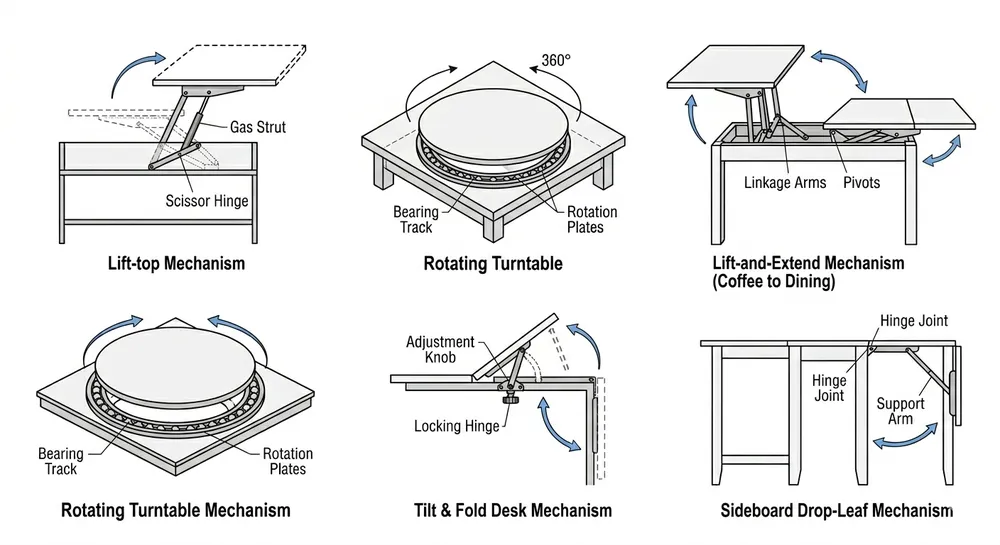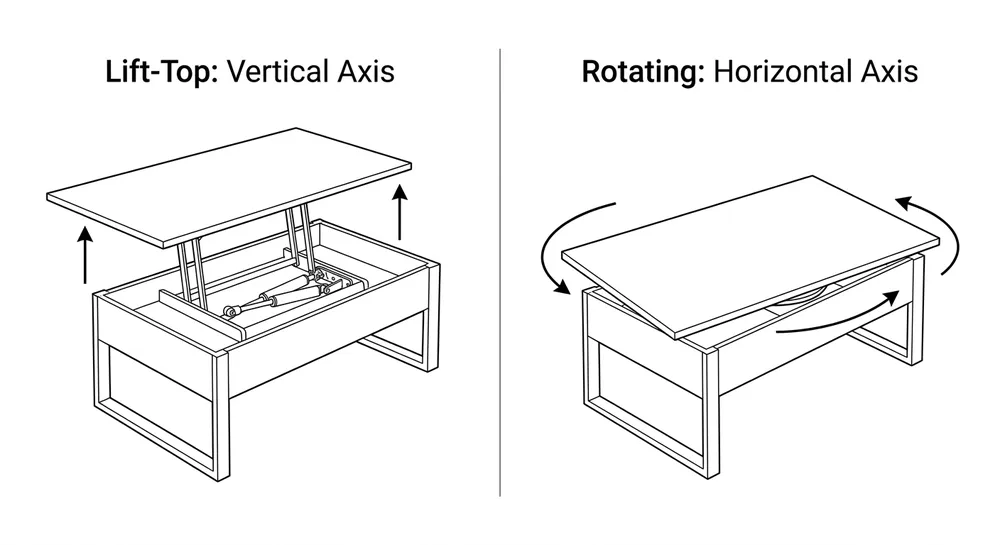
You've narrowed it down to two motion types. The lift-top mechanism raises the surface vertically — gas spring or spring-loaded, the tabletop comes up and locks at working height. The rotating mechanism pivots the surface on a central axis, swinging it from one position to another. Both solve a "the table needs to move" problem. They solve completely different versions of it.
The wrong choice doesn't just affect end-user experience. It affects your BOM cost, your packaging dimensions, your warranty exposure, and whether your product can compete at the price point your market expects. Here's how to read the difference commercially.
Quick verdict: If your product is a storage-access coffee table or height-adjustable occasional table, lift-top is the default — higher perceived value, proven retail demand, manageable cost at volume. If your product is a space-saving dining solution, a convertible serving table, or a lazy-susan-style display unit, rotating is the right motion type. Mixing them up costs you margin or kills the product concept entirely.

Motion Type, Mechanism Anatomy, and What Each One Actually Costs to Build
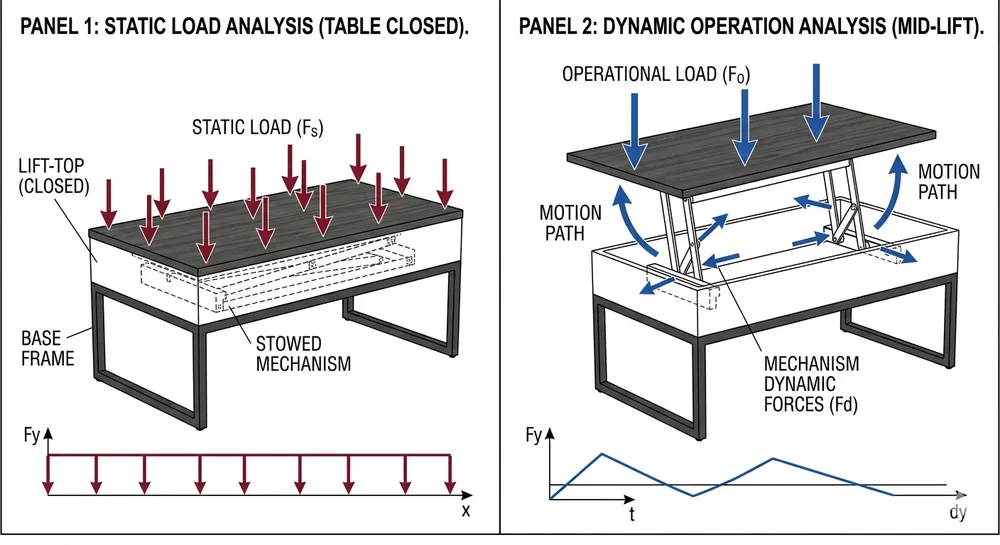
A lift-top mechanism is a four-bar linkage — two pivot arms, a connecting rod, and a spring element (either a gas spring cylinder or a coil spring). When the user pushes the surface forward and up, the linkage geometry converts that motion into a smooth vertical rise. The gas spring variant adds damping so the surface doesn't slam. The coil spring variant is simpler and cheaper but has a narrower weight range before the feel degrades.
We run both configurations on the same stamping lines. The gas spring version uses a 100–150N cylinder, 1.0–1.2mm cold-rolled steel arms, and zinc-plated or powder-coated finish. The coil spring version drops the cylinder cost but requires tighter spring calibration to the tabletop weight — if your furniture partner changes the top material without telling you, the mechanism feel changes. (We've seen this cause warranty complaints on otherwise solid products. It's worth specifying the top weight range in your purchase order.)
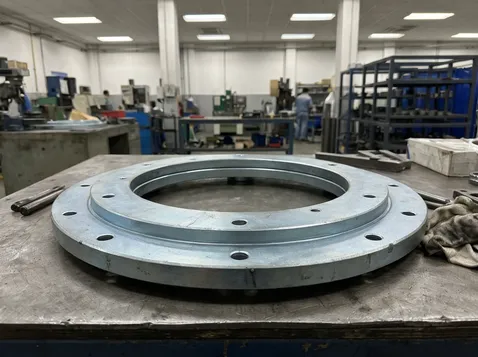
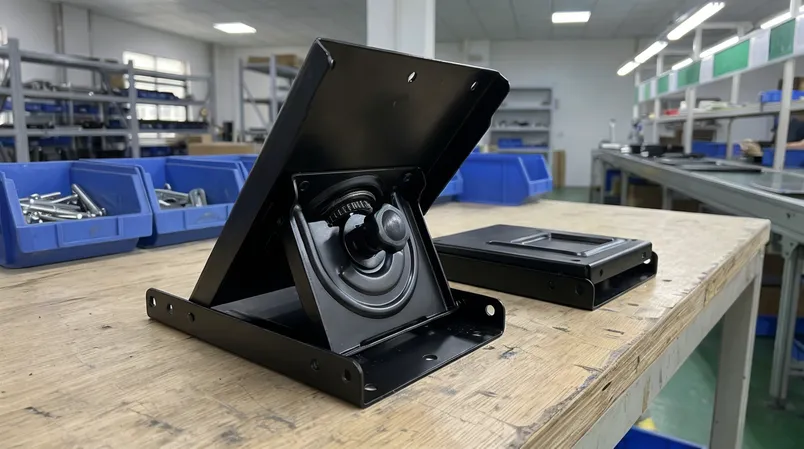
A rotating table mechanism is structurally simpler in one sense — it's a bearing plate, a central pivot post, and a locking detent or friction collar. But the engineering challenge is different: you need smooth rotation under load, zero wobble at the locked position, and a detent that holds reliably without requiring excessive force to release. Cheap rotating mechanisms fail at the bearing — they develop lateral play within 6–12 months of use, and the table surface starts to wobble. We use a double-row ball bearing race on our rotating units specifically to prevent this.
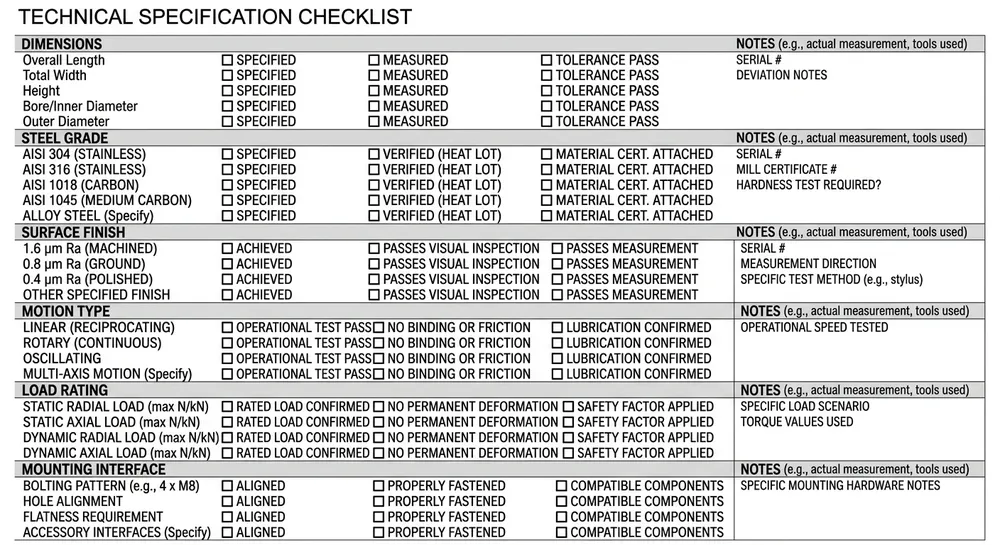
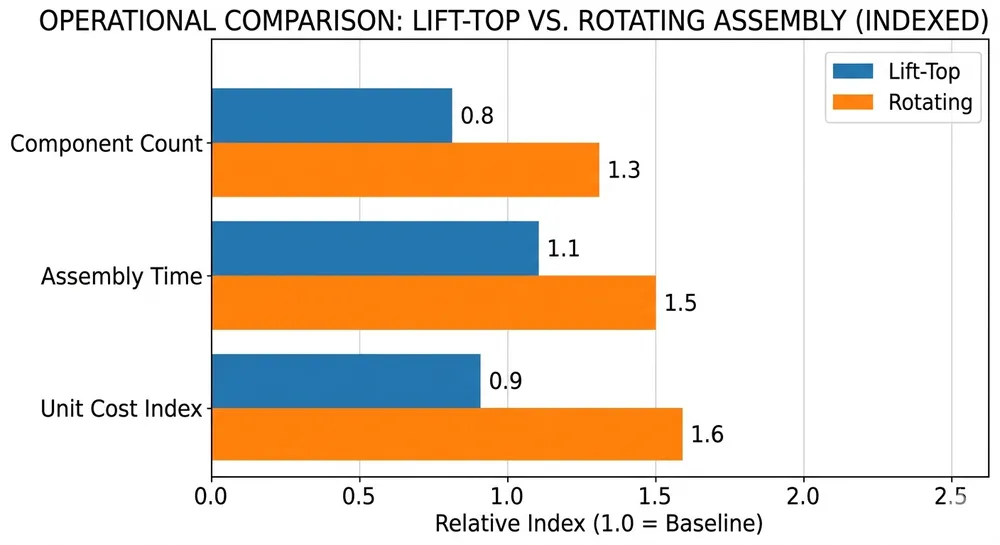
Cost structure differs meaningfully. A mid-spec lift-top mechanism — gas spring, powder-coated, rated for 15–25kg tabletop — runs higher in component count and assembly time than a comparable rotating mechanism. The rotating unit has fewer moving parts, but the bearing and pivot post are the cost drivers, and you can't cut corners there without sacrificing cycle life.
| Dimension | Lift-Top Mechanism | Rotating Mechanism |
|---|---|---|
| Motion axis | Vertical (lift + forward travel) | Horizontal (pivot/rotation) |
| Core components | 4-bar linkage, gas spring or coil spring, pivot pins | Bearing plate, pivot post, detent/lock collar |
| Typical tabletop weight range | 8–30 kg depending on spring spec | 5–20 kg (heavier tops stress the bearing) |
| Assembly complexity | Medium — spring calibration required | Lower — but bearing quality is critical |
| Relative unit cost | Higher | Lower to mid |
| Cycle life (standard spec) | 20,000–30,000 cycles | 15,000–25,000 cycles (bearing-dependent) |
| Packaging footprint | Larger (linkage arms extend) | Compact |
| Surface finish options | Zinc plate, powder coat, nickel plate | Zinc plate, powder coat |
The Hidden Cost the Spec Sheet Won't Show You
The spec sheet shows unit price. It doesn't show what happens downstream when you spec the wrong motion type for your market.
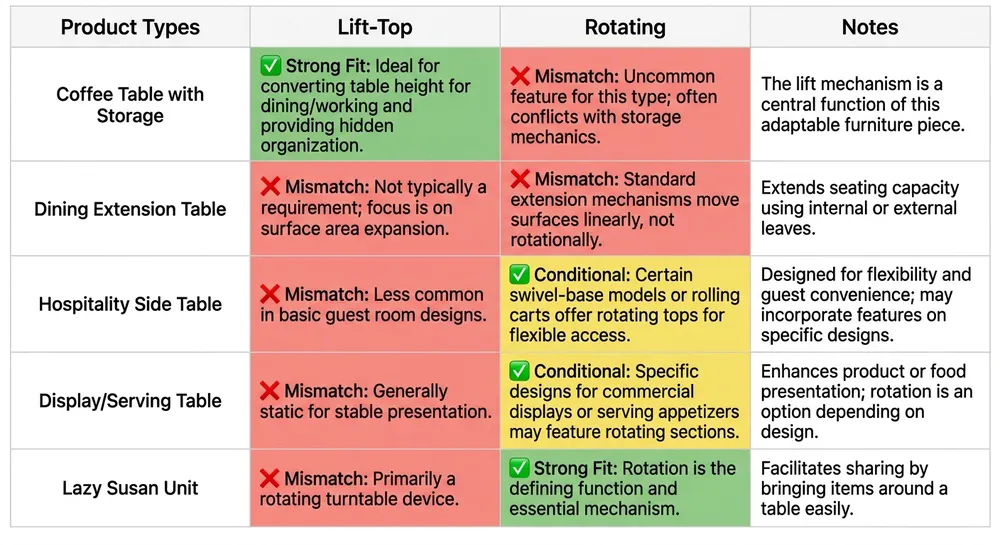
Lift-top in the wrong application: If you put a lift-top mechanism on a product that's primarily a dining or serving solution, you've added cost and complexity your buyer won't pay for. The vertical lift motion doesn't solve the space-conversion problem — it just raises the surface. Your retail price goes up, your margin compresses, and the product sits on the floor because the motion doesn't match the use case.
Rotating in the wrong application: A rotating mechanism on a coffee table that's supposed to provide storage access is a functional mismatch. The surface rotates but doesn't lift — there's no storage cavity access. Buyers return it. Your downstream customer files a warranty claim. You eat the freight both ways.
The more common hidden cost is spring miscalibration on lift-top units. If you're sourcing lift-top mechanisms and your furniture partner changes the tabletop from MDF to solid wood — or adds a glass insert — without updating the spring spec, the mechanism either won't hold position or will feel stiff and jerky. We calibrate spring force to a declared top weight range and document it on the shipment spec sheet. If your current supplier doesn't do this, you're one material change away from a batch of warranty claims.
On rotating mechanisms, the hidden cost is bearing degradation. A single-row bearing saves $0.80–$1.20 per unit at the factory. After 18 months of use, the table wobbles. Your customer's customer complains. Your customer asks for a replacement batch. That $1.00 saving cost you a reorder and a relationship. We switched to double-row bearing races on all rotating units after seeing exactly this failure pattern in returns from one of our European accounts. (The account is still with us — they appreciated that we identified the root cause and fixed it without being asked twice.)
Application Showdown: Which Motion Type Wins in Real Sourcing Scenarios
Scenario 1: Coffee Table with Hidden Storage — Lift-Top Wins
The product is a living room coffee table. The top lifts and slides forward to reveal a storage compartment and create a working surface at sofa height. This is the core lift-top application. The motion type is the product's value proposition — without it, it's just a table.
At this application, lift-top is the only correct answer. The gas spring variant is worth the cost premium because the damped motion is a key part of the perceived quality. Buyers in North America and Europe expect smooth, controlled lift — a coil spring version that bounces or requires two hands to operate will generate returns. Spec the gas spring, declare your top weight, and build the cost into your retail price. The motion is the margin driver here.
Scenario 2: Space-Saving Dining Table for Small Apartments — Rotating Wins
The product is a compact dining table where one section rotates out to extend the usable surface, or a round table where the top rotates to bring a serving section within reach. The value is space conversion and serving convenience — not storage access.
Rotating mechanism is the right call. The lower unit cost fits the price-sensitive small-apartment segment. The simpler mechanism means fewer assembly steps for your furniture partner. The key spec decision is bearing quality — don't let a supplier talk you into a single-row bearing to hit a lower price. The $1 saving will cost you more in after-sales than it saves in procurement.
Scenario 3: Convertible Occasional Table for Hospitality — Evaluate Both
A hotel room side table that needs to convert between a compact bedside position and an extended working surface. This is the scenario where both motion types are genuinely in play, and the decision comes down to your target price point and the hotel's maintenance tolerance.
Lift-top gives you a higher-value product with more perceived engineering — hotels can justify a higher FF&E budget line for it. Rotating gives you a simpler, lower-maintenance unit that housekeeping staff can operate without instruction. If your hospitality buyer is a budget hotel chain, rotating wins on total cost of ownership. If it's a mid-to-upper tier property, lift-top's perceived quality justifies the price.
What to Verify Before You Place the Order
Both mechanism types have sourcing traps. Here's what to check before your RFQ becomes a production problem.
For lift-top mechanisms:
- Spring force rating vs. declared top weight — ask for the calibration spec sheet. If the supplier can't provide one, they're not calibrating to your top weight. That's a warranty risk.
- Linkage arm thickness — 1.0mm is the minimum for standard residential use. Below that, you'll see arm deformation under repeated load. Ask for the steel gauge spec.
- Gas spring end-of-life behavior — a quality gas spring loses pressure gradually and the surface descends slowly. A cheap one fails suddenly. Ask about the cylinder brand or spec.
- Cycle life test documentation — 20,000 cycles minimum for residential, 30,000+ for commercial or hospitality. Ask for the test report, not just the claim.
For rotating mechanisms:
- Bearing type and row count — single-row vs. double-row matters for long-term wobble resistance. Get it in writing.
- Detent force spec — the locking position should hold under a 5kg lateral load without releasing. Ask how they test this.
- Pivot post material — zinc alloy die-cast is standard and acceptable. Plastic pivot posts are a cost-cut that shows up in returns within a year.
- Load rating at full rotation — some rotating mechanisms are rated for static load only. If your product will be used while rotating (serving table, lazy susan), confirm the dynamic load rating.
We document all of these on our shipment spec sheets and can provide test reports for any mechanism in our Table & Surface Mechanism range. ISO 9001:2015 means the documentation exists — it's not something we produce on request and then forget.
Frequently Asked Questions
Can I use a lift-top mechanism on a round table? Yes, but the linkage geometry needs to account for the top's center of gravity shifting as it lifts and travels forward. Round tops with a centered lift mechanism can tip if the spring force isn't calibrated correctly. We've done this configuration — it works, but it requires a custom spring spec and a wider pivot arm spread. Standard rectangular-top lift mechanisms won't transfer directly to a round top without adjustment.
What's the minimum order quantity for custom spring calibration on lift-top units? Our standard MOQ is 500 units for standard mechanisms. Custom spring calibration — where we tune the spring force to your specific declared top weight — is available from 500 units. Below that, the tooling and calibration cost doesn't make sense for either side. If you're in the 200–499 unit range, we can match you to the closest standard spring spec and document the compatible top weight range.
How do I know if a rotating mechanism bearing will last? Ask for the radial play specification after 10,000 cycles. A quality double-row bearing should show less than 0.3mm radial play at that point. If a supplier can't give you a number, they haven't tested it. We run cycle life tests on all bearing assemblies and can share the data.
Lift-top or rotating — which ships more efficiently? Rotating mechanisms are more compact and pack flatter, so you get more units per carton and more cartons per container. Lift-top linkage arms add volume. For high-volume orders where freight cost is a meaningful line item, rotating mechanisms have a container loading advantage of roughly 15–20% more units per container depending on the specific model. Worth factoring into your landed cost calculation if you're ordering 2,000+ units.
What certifications apply to these mechanisms? Both mechanism types in our range carry CE marking and have passed SGS and RoHS testing. For North American buyers, we can provide documentation supporting CARB compliance for the wood components in packaged assemblies. Our facility is ISO 9001:2015 certified — audit reports available on request.
—
The motion type decision is a product architecture decision, not a hardware detail. Get it right before you finalize your furniture design, because changing it after tooling is expensive. If you're between the two options and your target retail price or product category isn't clearly pointing one direction, send us your product brief through our Request Quote page — we'll tell you which configuration protects your margin at your volume. “`