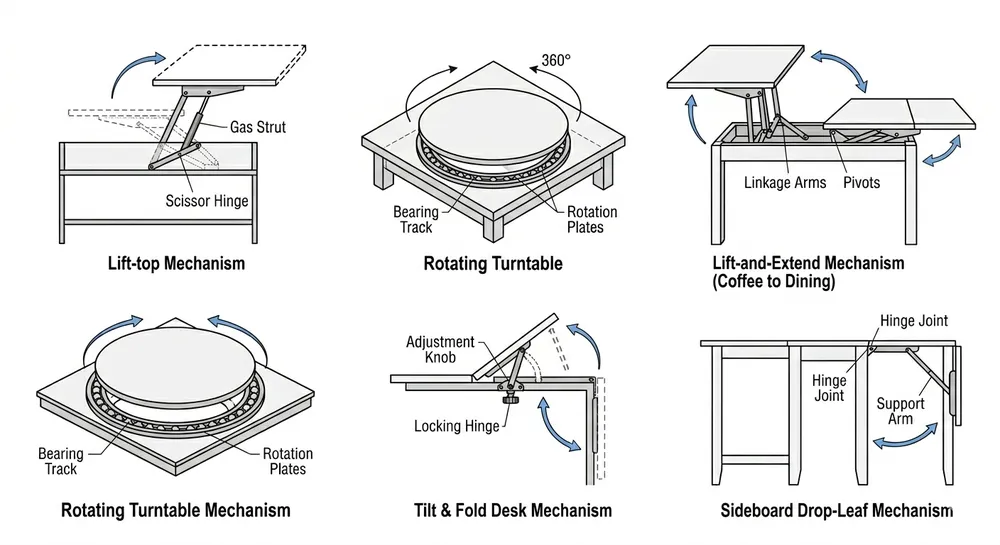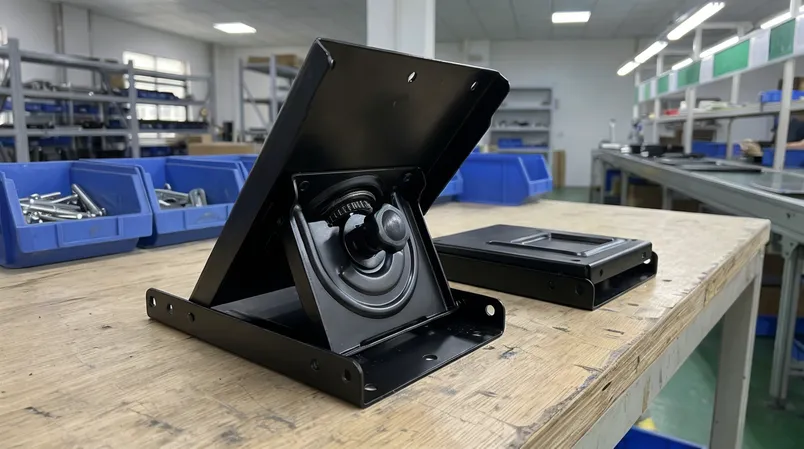
The most common sourcing mistake we see with table mechanisms isn't choosing the wrong style — it's choosing the wrong load rating. A buyer specs a lift-top coffee table mechanism at 25 kg rated load, ships 2,000 units, and six months later gets warranty claims because the mechanism binds under a loaded tabletop. The mechanism wasn't defective. It was underspecified.
Load capacity on a table mechanism isn't a single number. It's a set of conditions — static weight, dynamic force, cycle life, and safety margin — and if you read only one of those numbers off a spec sheet, you're working with incomplete information. This article breaks down what those specs actually mean, how to map them to your furniture application, and what to ask a supplier before you place an order.
—
Static vs. Dynamic Load: The Distinction That Determines Warranty Claims
Every table mechanism spec sheet lists a rated load. What most don't make obvious is whether that number is a static rating, a dynamic rating, or both — and the difference matters more than the number itself.
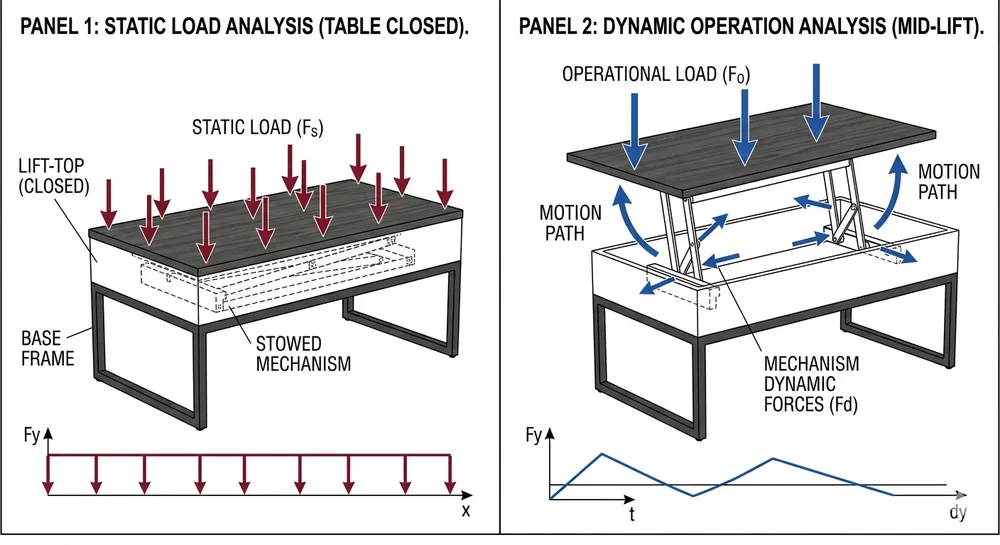
Static load is the weight the mechanism holds at rest. A lift-top table sitting closed with a 15 kg tabletop and a 5 kg decorative item on top is under static load. The mechanism is bearing that weight continuously, without movement.
Dynamic load is the force the mechanism experiences during operation — when the tabletop is being lifted, lowered, or repositioned. Dynamic load is always higher than static load because you're adding acceleration forces, lever arm effects, and the user's applied force to the equation. A mechanism rated at 30 kg static may only be rated at 18–22 kg dynamic, depending on the pivot geometry and spring assist design.
(We've seen buyers source mechanisms based on static rating alone, then discover the mechanism struggles or deforms during the lift cycle. The tabletop weight was within spec — the dynamic load wasn't.)
For furniture applications, the practical rule is: size your mechanism to the dynamic load, not the static load. If your tabletop assembly weighs 20 kg, you want a mechanism with a dynamic rating of at least 20 kg, which typically means a static rating of 30–35 kg depending on the design.

—
What the Spec Sheet Actually Tells You — and What It Doesn't
A typical table mechanism data sheet lists four to six numbers. Here's how to read them as a sourcing professional, not as an end user.
| Spec Field | What It Means | What to Watch For |
|---|---|---|
| Rated load (static) | Max continuous weight at rest | Confirm this is static, not dynamic |
| Rated load (dynamic) | Max weight during operation | Often 60–75% of static rating |
| Safety factor | Ratio of failure load to rated load | 2:1 minimum for residential; 3:1 for commercial |
| Cycle life | Number of open/close cycles before wear | 10,000 cycles = light residential; 50,000+ = commercial |
| Material grade | Steel spec for plates and brackets | Cold-rolled SPCC vs. higher-grade SECC or structural steel |
| Surface treatment | Plating or coating type | Affects corrosion resistance and dimensional tolerance |
The safety factor is the number most buyers skip. A mechanism with a 30 kg rated load and a 2:1 safety factor fails structurally at 60 kg. The same rated load with a 3:1 safety factor fails at 90 kg. For residential furniture, 2:1 is standard. For contract or commercial environments — hotel lobbies, co-working spaces, hospitality — you want 3:1 minimum, which means specifying a higher-grade mechanism even if the tabletop weight is the same.
Cycle life is the other number that separates residential from commercial sourcing. A lift-top coffee table in a private home might see 3–5 cycles per day. At 10,000 cycles, that's roughly 5–7 years of normal use. The same mechanism in a hotel suite or serviced apartment sees 15–20 cycles per day — 10,000 cycles is less than two years. If you're supplying hospitality or contract furniture, spec for 30,000–50,000 cycles minimum.
—
Application Matching: Load Range by Furniture Type
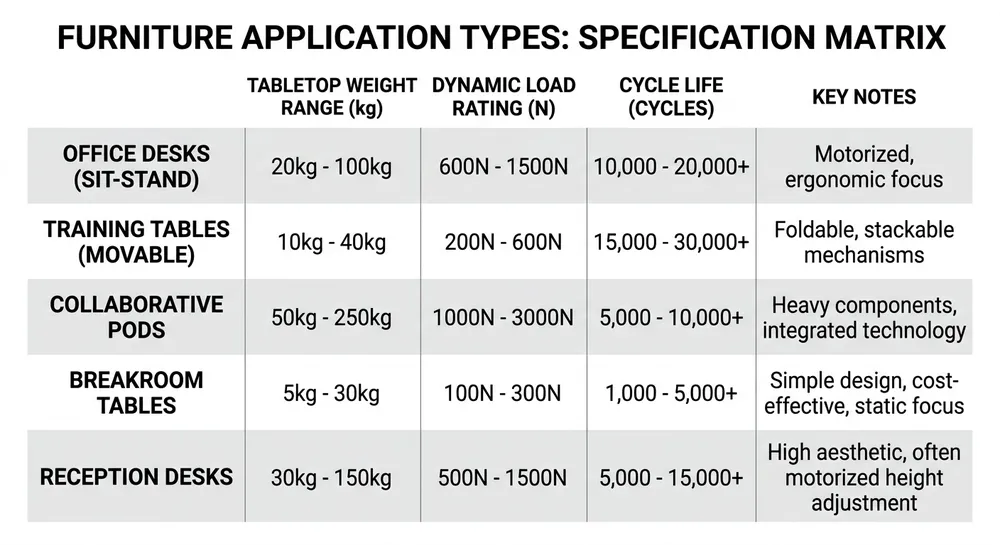
The table below maps common furniture applications to the load and cycle specs we'd recommend before sourcing. These are working ranges based on what we see from buyers in each segment — not minimums to hit, but starting points for your RFQ conversation.
| Application | Typical Tabletop Weight | Recommended Dynamic Rating | Cycle Life Target | Notes |
|---|---|---|---|---|
| Residential lift-top coffee table | 12–20 kg | 20–25 kg | 10,000–15,000 cycles | Spring-assist mechanisms reduce perceived effort |
| Residential dining / extendable table | 18–30 kg | 25–35 kg | 15,000–20,000 cycles | Butterfly or slide mechanisms; check extension load separately |
| Home office height-adjustable | 15–25 kg | 25–30 kg | 20,000–30,000 cycles | Repeated daily adjustment; cycle life matters more here |
| Contract / hospitality furniture | 20–35 kg | 30–40 kg | 30,000–50,000 cycles | Safety factor 3:1; CE compliance typically required |
| Commercial / co-working | 25–40 kg | 35–50 kg | 50,000+ cycles | Specify load-cycle verification documentation |
One thing worth noting: tabletop weight is not just the panel itself. Add the weight of any glass inserts, hardware, decorative items that will sit on the surface, and the weight of the mechanism's own moving components. Buyers who measure only the bare panel consistently underestimate the actual load.
—
How Manufacturing Process Determines Whether the Rated Load Is Real
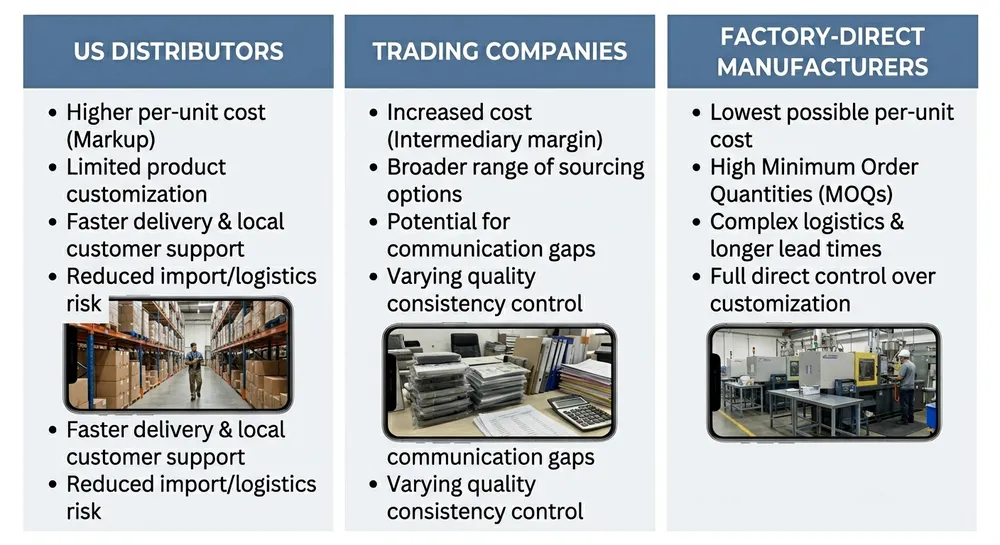
A load rating on a spec sheet is only as reliable as the process that produced the mechanism. This is where factory-direct sourcing makes a practical difference — and where trading companies often can't give you a straight answer.
The load performance of a table mechanism comes down to three process variables: stamping tolerance, weld quality, and die-cast component integrity.
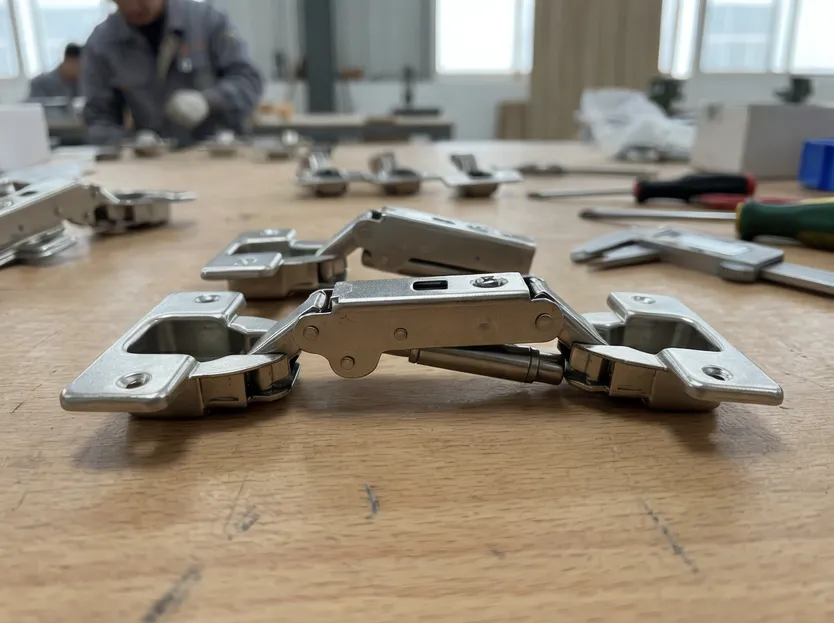
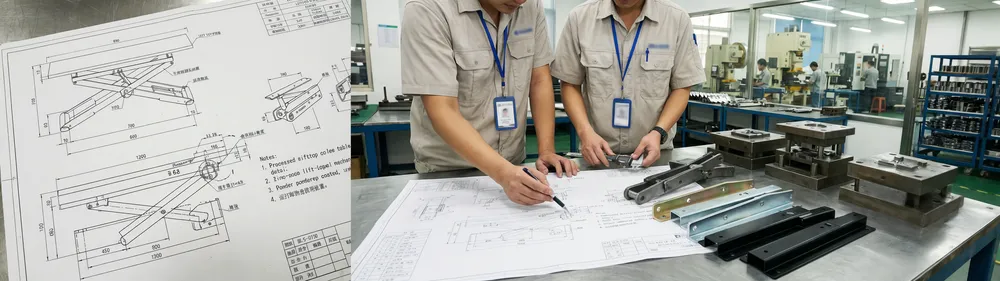
Stamping tolerance affects how precisely the pivot points, bracket holes, and mounting geometry align across a production batch. Our progressive die stamping holds ±0.15mm on mechanism plates and structural brackets. At that tolerance, the pivot geometry is consistent unit to unit — the load distributes across the joint the way the design intended. When tolerance drifts to ±0.3mm or worse (common on lower-cost manual stamping lines), the pivot geometry shifts, load concentrates unevenly on one side of the joint, and the mechanism wears faster than the rated cycle life predicts.
Weld quality on structural joints is the other variable that doesn't show up on a spec sheet. We use MIG welding on load-bearing assemblies — the weld penetration is deeper and more consistent than spot welding, which is fine for light brackets but not for joints that carry dynamic load through a lift cycle. A MIG-welded joint on a 30 kg dynamic-rated mechanism will hold its rated load through 50,000 cycles. A spot-welded joint on the same design may pass initial load testing but show fatigue cracking at 20,000–25,000 cycles. The spec sheet won't tell you which one you're getting unless you ask.
Die-cast component quality matters for the adjustment collars, pivot pins, and locking hardware that are part of most table mechanisms. We bring die-casting in-house specifically because outsourced die-cast components are where dimensional inconsistency hides. A pivot pin that's 0.2mm undersized creates play in the joint — the mechanism feels loose, the load rating degrades over time, and the end user experiences it as a "wobbly" table. That's a warranty claim your customer sends back to you.
The practical implication: when you're evaluating a mechanism supplier, ask specifically about stamping tolerance, weld method on structural joints, and whether die-cast components are produced in-house or sourced externally. A supplier who can answer those questions with specific numbers is a supplier whose load ratings you can trust.
—
The Sourcing Traps That Generate Warranty Claims
Most load-related warranty claims trace back to one of three sourcing decisions made before the order was placed.
Underspecifying the dynamic load. As covered above — sizing to static load and ignoring the dynamic rating is the most common mistake. The mechanism passes your incoming inspection because it holds the tabletop at rest. It fails in the field because the lift cycle exceeds the dynamic rating.
Ignoring cycle life for the actual use environment. A 10,000-cycle mechanism is fine for a residential coffee table. It's a warranty liability in a hotel room or a co-working space. The mechanism spec sheet may not state the intended use environment — that's your job to match before sourcing.
Skipping functional testing documentation. A load rating on a spec sheet is a claim. A load-cycle test report is evidence. Before placing a commercial-volume order, request the functional test report: rated load, test load (should be at safety factor multiple), cycle count, and pass/fail criteria. If a supplier can't provide this, the rating is unverified.
We run 100% functional testing on every unit before shipment — not batch sampling. Every mechanism that leaves our facility has been cycled under load. For commercial-grade orders, we can provide the load-cycle verification documentation your QC team needs. That's not a special request; it's standard practice here.
(One more trap worth mentioning: surface treatment spec. Mechanisms with zinc plating on structural components hold dimensional tolerance better than powder-coated equivalents on tight-clearance pivot assemblies. If your mechanism has a powder-coated pivot pin, confirm the coating thickness spec — excess powder buildup on a pivot creates binding under load that looks like a load capacity failure but is actually a coating spec problem.)
—
What to Include in Your RFQ for an Accurate Load Spec
If you send us — or any mechanism supplier — an RFQ that says "lift-top coffee table mechanism, 500 units," you'll get a quote for a standard catalog item. That may be exactly right, or it may be wrong for your application. Here's what to include to get a spec-matched recommendation:
- Tabletop assembly weight — the full assembly, including glass, hardware, and any items that will sit on the surface permanently
- Tabletop dimensions — length × width, because lever arm length affects the dynamic load calculation
- Use environment — residential, hospitality, commercial, or contract; this determines the cycle life and safety factor target
- Market destination — EU buyers need CE compliance documentation; North American buyers may have specific BIFMA or ANSI references
- Finish requirements — if the mechanism is visible, surface treatment affects both aesthetics and dimensional tolerance
- Volume and reorder pattern — helps us recommend between catalog items (MOQ 500 units) and OEM-tooled options for higher volumes
With those six data points, our engineering team can recommend the correct mechanism grade, confirm the load rating against your application, and quote accurately. Without them, you're getting a catalog price that may or may not fit your product.
Browse our Table & Surface Mechanism range to see the catalog options, or submit an RFQ with your application details and we'll come back with a specific recommendation.
—
Frequently Asked Questions
What is a safe load rating for a lift-top coffee table mechanism?
For a residential lift-top coffee table with a tabletop assembly weighing 15–20 kg, a mechanism with a dynamic rating of 20–25 kg and a static rating of 30–35 kg is the standard working range. If the tabletop includes a glass insert or heavy decorative items, add that weight before specifying. For hospitality or contract use, move up to a 30–35 kg dynamic rating with a 3:1 safety factor.
What is the difference between static and dynamic load rating on a table mechanism?
Static load is the weight the mechanism holds at rest. Dynamic load is the force during the lift or adjustment cycle, which is always higher due to acceleration and lever arm effects. Dynamic ratings are typically 60–75% of static ratings. Always size your mechanism to the dynamic load requirement, not the static load.
How do I know if a supplier's load rating is verified?
Ask for the functional test report: it should show the test load (at the safety factor multiple), cycle count, and pass/fail criteria. A load rating without a test report is an unverified claim. For commercial-volume orders, require this documentation before finalizing the order.
Does stamping tolerance affect load capacity?
Yes, directly. Tighter stamping tolerance — ±0.15mm versus ±0.3mm or worse — means pivot geometry is consistent across the batch, so load distributes as designed. Loose tolerance causes uneven load concentration at joints, which accelerates wear and reduces effective cycle life below the rated figure.
What cycle life should I specify for contract furniture?
For hospitality, co-working, or other high-use commercial environments, specify 30,000–50,000 cycles minimum. A 10,000-cycle mechanism rated for residential use will reach end-of-life in under two years in a hotel room or shared workspace. Cycle life is the spec most often underspecified for commercial applications.