Most sourcing mistakes in this category happen before the RFQ goes out. A buyer specifies "lift-top mechanism" without stating load capacity. Another asks for a "coffee table fitting" without clarifying whether the motion is lift-only or lift-and-extend. The factory quotes what it has. The product ships. The mechanism fails at 8,000 cycles when the market expects 50,000. That's not a quality problem — it's a specification problem that started at the sourcing stage.
This guide maps the five main Table & Surface Mechanism types we produce, with the engineering parameters that actually matter for your sourcing decision: motion arc, load range, cycle life, surface finish options, and the MOQ and tooling implications for each type.

What "table surface mechanism" covers as a sourcing category
The term gets used loosely. In practice, it refers to any hardware assembly that controls the movement of a table or cabinet surface — lifting, rotating, extending, tilting, or folding. The mechanism is the functional core of the furniture piece. Get the type wrong and the furniture doesn't work. Get the spec wrong within the right type and the furniture fails in the field.
We've been producing these mechanisms since 2008. The category splits cleanly into five types, each with its own motion geometry, structural load path, and cycle life expectation. They are not interchangeable, and they don't all require the same sourcing approach.
—
Type 1 — Lift-top mechanism: spring-assisted vertical travel
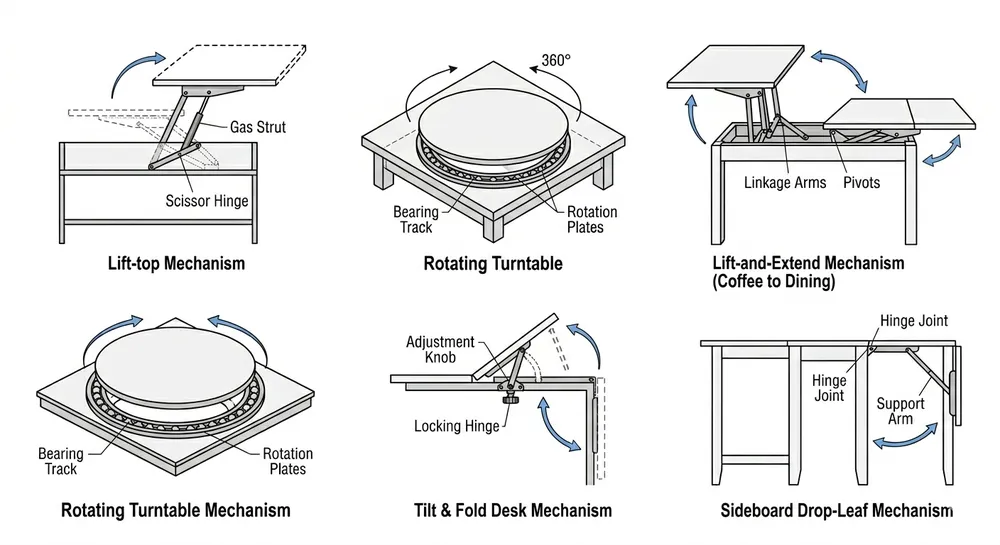
The lift-top furniture mechanism is the most common type we ship to North American and European importers. The surface pivots upward and forward on a parallelogram linkage, typically rising 25–35 cm from the closed position. Spring tension counterbalances the surface weight so the lid stays open without a prop rod.
Key specs to nail before you RFQ:
- Load capacity: standard range is 8–15 kg surface weight. Above 15 kg, the spring pack needs to be upgraded — this affects tooling cost and lead time if you're doing OEM.
- Motion arc: most catalog versions travel 28–32 cm vertical rise. If your furniture design requires a taller rise (e.g., for deep storage access), confirm this before ordering — it's not a field adjustment.
- Cycle life: commercial-grade units are rated 50,000+ open/close cycles. Residential catalog items often run 20,000–30,000. For hospitality or rental furniture, specify commercial grade explicitly.
- Surface finish: zinc plating is standard. Nickel plating is available for EU markets with stricter RoHS compliance requirements on surface chemistry.
(We run lift-top mechanisms on a dedicated stamping and assembly line — the spring calibration is done per batch, not per unit, so if your surface weight sits at the edge of a load range, tell us upfront and we'll calibrate to the heavier end.)
Typical applications: coffee tables with storage, storage ottomans with tray surfaces, bedroom bench lids.
—
Type 2 — Rotating turntable mechanism: full and partial rotation
The rotating table mechanism controls horizontal rotation of a surface — either full 360° or limited-arc partial rotation. The two variants have different bearing configurations and load paths, and they're not substitutable.
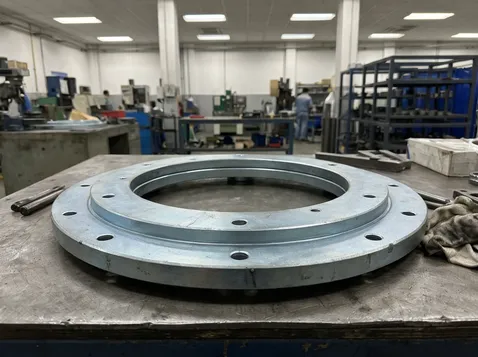
Full 360° rotation uses a ball-bearing race with a continuous ring. Load capacity typically runs 20–80 kg depending on bearing diameter (common sizes: 150 mm, 200 mm, 300 mm). These are the mechanisms behind lazy susans, display turntables, and rotating service trays.
Partial rotation (typically 90°–180° arc) uses a stop-pin or cam-lock system to limit travel. These appear in corner-access furniture, rotating monitor arms integrated into desk surfaces, and some display fixture applications.
Spec parameters that matter:
| Parameter | Full 360° | Partial Arc |
|---|---|---|
| Bearing type | Ball-bearing race | Cam or pin-stop |
| Load range | 20–80 kg | 15–50 kg |
| Rotation smoothness | ±2° wobble tolerance | Defined stop positions |
| Cycle life | 100,000+ | 30,000–80,000 |
| Common finish | Zinc plate, powder coat | Zinc plate |
For display and retail fixture applications, buyers often want a low-profile bearing (under 12 mm height) to minimize the visual gap between the rotating surface and the base. We stock two profile heights — confirm which your furniture design requires.
—
Type 3 — Coffee table lift-and-extend mechanism: the two-motion assembly
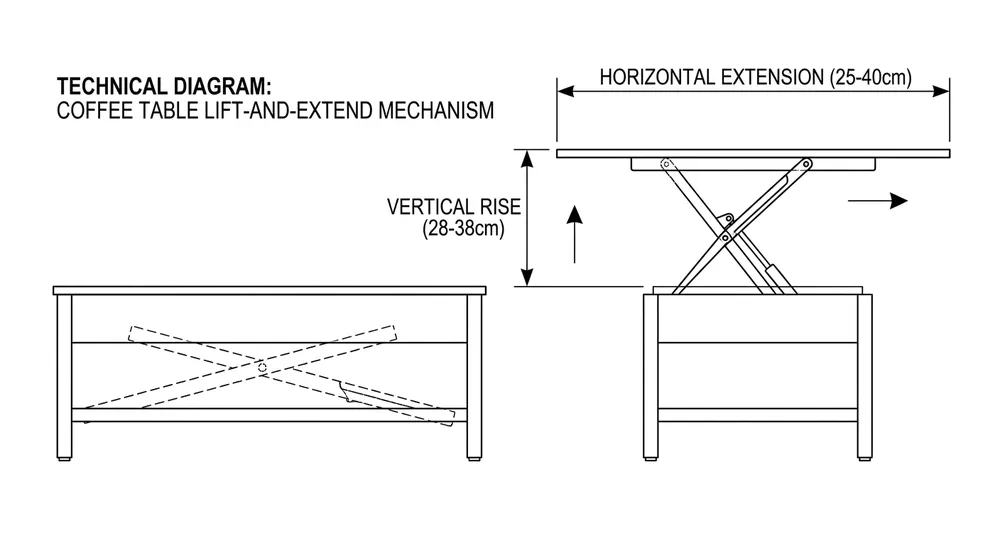
This is the type most often mis-specified. The coffee table mechanism combines a vertical lift with a horizontal extension — the surface rises to dining height and slides toward the user simultaneously. It's a two-axis motion driven by a single linkage assembly, and the geometry has to be matched to the furniture's leg spacing and surface dimensions.
This is not a drop-in part. The mechanism geometry — specifically the horizontal travel distance and the lift height — must be matched to your furniture's internal frame dimensions. We've seen buyers order a standard catalog unit and find the surface hits the sofa arm at full extension because nobody checked the travel envelope against the furniture drawing.
Critical dimensions to confirm before ordering:
- Lift height range: typically 28–38 cm rise from closed position
- Horizontal extension: 25–40 cm forward travel (varies by model)
- Surface weight capacity: 10–20 kg
- Frame width compatibility: the mounting bracket span must match your table's internal rail spacing
Cycle life: 30,000–50,000 cycles for standard residential grade. For contract furniture (hotels, serviced apartments), specify 80,000+ cycle rating — this requires a heavier linkage arm and different spring spec.
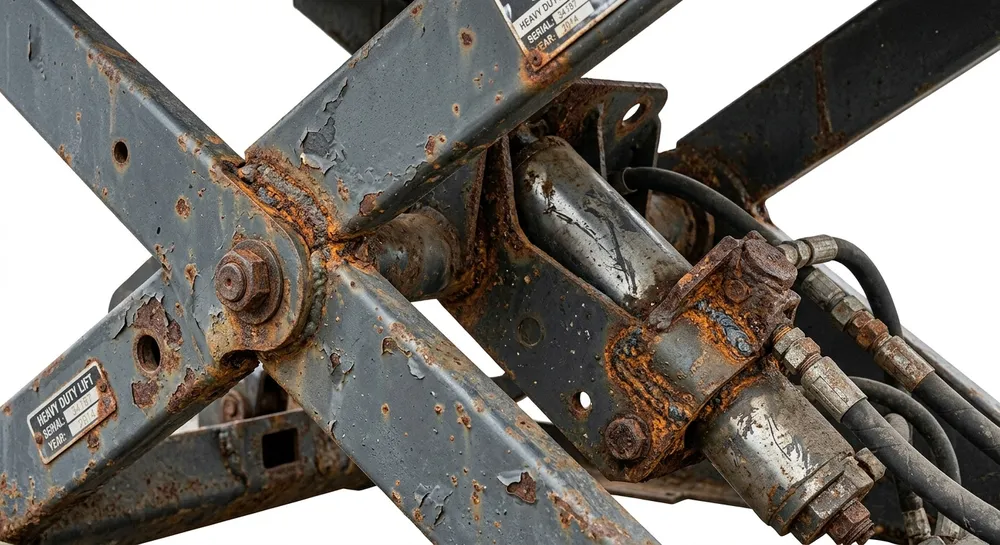
(The most common failure mode we see in returned samples from other suppliers is linkage arm fatigue at the pivot point — usually because the arm cross-section was undersized to save material cost. Our linkage arms are 2.5 mm stamped steel minimum on standard grade, 3.0 mm on commercial grade.)
—
Type 4 — Desk furniture mechanism: tilt, fold, and height-adjust variants
Desk mechanisms cover three distinct motion types that get grouped under one label in most catalogs. They are not the same product.
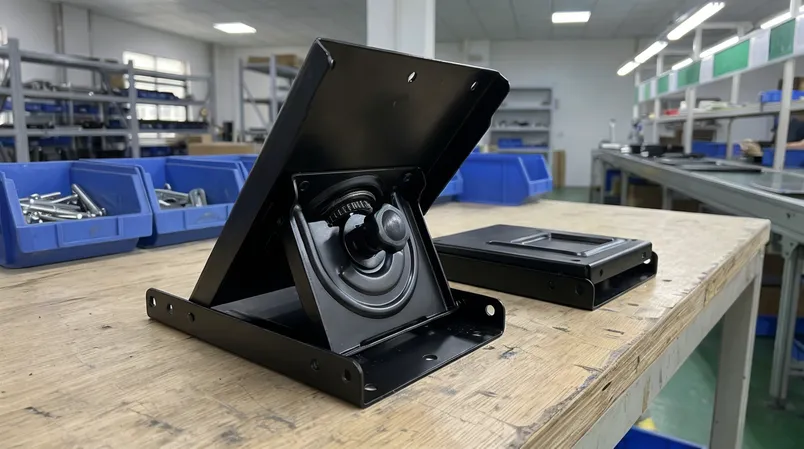
Tilt mechanisms adjust the writing surface angle, typically 0°–45°. Used in drafting tables, architect desks, and adjustable-angle workstations. The load path is a compression force on the tilt bracket — the spec that matters is the maximum surface weight at maximum tilt angle, not just flat-position load.
Fold mechanisms allow the surface to collapse flat for storage or transport. Common in wall-mounted fold-down desks, Murphy bed desk combos, and compact apartment furniture. Hinge load rating and the number of fold cycles are the two numbers to confirm.
Height-adjust mechanisms (manual, not electric) use a gas spring or friction-lock column to set working height. Load capacity here is the column's compression rating — typically 30–80 kg for manual gas-spring variants.
For B2B sourcing, the desk mechanism category matters most for two market segments: contract office furniture (where cycle life and warranty documentation drive the spec) and flat-pack residential furniture (where assembly simplicity and shipping density drive the spec). These two segments often need different mechanism grades even if the motion type is the same.
Surface finish note: desk mechanisms going into EU markets need RoHS-compliant surface treatment. Our standard zinc plating and nickel plating lines both meet RoHS requirements — CE and SGS documentation is available per shipment.
—
Type 5 — Sideboard mechanism: drop-leaf, fold-down, and tambour variants
Sideboard mechanisms control access panels and extending surfaces on cabinet-format furniture. Three variants cover most of the market:
Drop-leaf hinges support a horizontal surface that folds down from a vertical stored position. The hinge must carry the full cantilevered weight of the leaf plus any load placed on it. Typical load ratings: 5–15 kg leaf weight, with a safety factor of 3× for dynamic load (someone leaning on the extended leaf).
Fold-down door mechanisms combine a hinge with a soft-close damper and a stay arm that holds the door horizontal when open. The stay arm load rating is the critical spec — undersized stay arms are the most common failure point in this type.
Tambour mechanisms use a flexible slat panel that rolls into a housing. Less common in export furniture but used in some high-end sideboard and bar cabinet designs. The track geometry and slat material (typically ABS or aluminum) need to be specified together — they're not mix-and-match.
For sideboard mechanisms, cycle life expectations are lower than for table mechanisms (10,000–30,000 cycles is typical for residential grade) but the torque load on hinges is higher because users often apply lateral force when opening. We test hinge assemblies at 1.5× rated load for 15,000 cycles before approving a production batch.
—
Mechanism type comparison: load, motion, and cycle life at a glance
| Mechanism Type | Motion | Load Range | Cycle Life (residential) | Cycle Life (commercial) | Standard Finish |
|---|---|---|---|---|---|
| Lift-top | Vertical pivot + forward | 8–15 kg surface | 20,000–30,000 | 50,000+ | Zinc plate |
| Rotating turntable | 360° or partial arc | 20–80 kg | 100,000+ | 100,000+ | Zinc / powder coat |
| Coffee table lift-extend | Vertical + horizontal | 10–20 kg surface | 30,000–50,000 | 80,000+ | Zinc plate |
| Desk (tilt/fold/height) | Angle / fold / column | 15–80 kg | 20,000–40,000 | 60,000+ | Zinc / nickel plate |
| Sideboard (drop-leaf/tambour) | Hinge / roll | 5–15 kg leaf | 10,000–30,000 | 30,000–50,000 | Zinc plate |
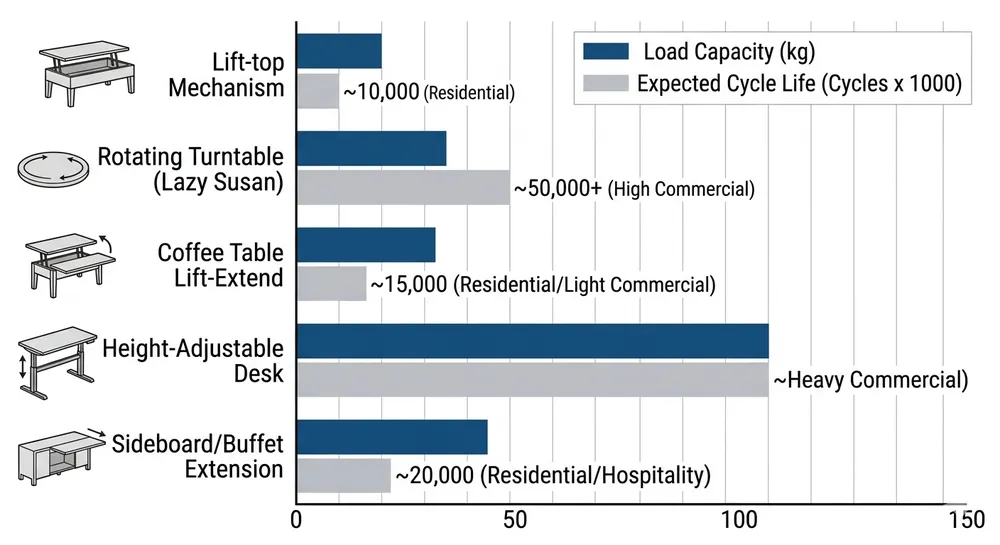
All five types ship with 100% functional testing — every unit is cycled through its full motion range before packing. CE, SGS, and RoHS documentation is available per mechanism type for EU and North American import compliance.
—
Surface finish and its effect on mechanism type selection
Surface finish is not a cosmetic decision at the sourcing stage — it affects corrosion resistance, RoHS compliance, and in some cases the mechanism's motion feel.
Zinc plating is the standard finish across all five types. It provides adequate corrosion protection for indoor furniture in temperate climates and meets basic RoHS requirements.
Nickel plating adds a harder surface layer and better salt-spray resistance. We specify nickel plating for mechanisms going into coastal markets (Southeast Asia, Middle East Gulf region) or for EU buyers who need extended salt-spray test documentation (500+ hours). The plating line adds 3–5 days to production lead time.
Powder coating applies to external-facing components on rotating and desk mechanisms where the hardware is partially visible in the finished furniture. Color matching to RAL standards is available on runs over 500 units.
One thing worth flagging: some buyers specify powder coat on internal linkage components to match a color scheme. We push back on this — powder coat on moving pivot points increases friction and accelerates wear. The right answer is zinc or nickel plate on the mechanism, powder coat on any decorative cover plate if needed.
—
Sourcing decision guide: matching mechanism type to your order
Before you send an RFQ for any table surface mechanism, you need four numbers:
- Motion type — which of the five types matches your furniture design
- Surface or leaf weight — the actual weight the mechanism will carry, not an estimate
- Cycle life requirement — residential (20,000–50,000) or commercial grade (50,000–100,000+)
- Target market — determines surface finish and compliance documentation requirements
MOQ by type: Standard catalog mechanisms run at 500 units MOQ across all five types. OEM tooling (custom dimensions, modified travel range, branded components) starts at 1,000 units with tooling cost quoted separately. For mixed-type orders (e.g., 300 lift-top + 300 coffee table mechanisms), we can combine to meet the 500-unit threshold per SKU — worth discussing if you're building out a new product line.
Tooling implications: Lift-top and coffee table mechanisms have the most OEM customization requests because furniture dimensions vary significantly between brands. Rotating turntable and sideboard mechanisms are more standardized — most buyers source from catalog. Desk mechanisms sit in the middle: the motion type is standard but mounting dimensions often need adjustment.
Lead time: Standard catalog items ship in 25–35 days from order confirmation. OEM tooling orders add 15–25 days for tooling fabrication and first-article approval.
We've shipped to furniture importers across North America, Europe, the Middle East, Southeast Asia, and Australia since 2008. ISO 9001:2015 certified, with CE, SGS, and RoHS documentation available per shipment. If you're building a new SKU or switching suppliers on an existing one, the fastest path to a clean spec is to send us your furniture drawing and target retail market — we'll identify the right mechanism type, confirm the load and cycle spec, and quote from there.
Request a quote for your mechanism type with your load requirement, target market, and annual volume — we'll respond with a specific product recommendation and landed cost estimate.
—
FAQ: table surface mechanism sourcing
What is the difference between a lift-top mechanism and a coffee table mechanism?
A lift-top mechanism raises the surface vertically and pivots it forward — one axis of motion. A coffee table mechanism combines vertical lift with horizontal extension toward the user — two axes driven by a single linkage. They look similar in catalog photos but have completely different geometry and cannot substitute for each other. Confirm which motion your furniture design requires before ordering.
How do I specify cycle life for a table mechanism?
Cycle life is one complete open-and-close sequence. Residential furniture in a typical household sees 3–5 cycles per day, so 30,000 cycles equals roughly 16–27 years of use. Contract furniture (hotels, rental apartments, office common areas) can see 20–50 cycles per day — specify commercial grade (50,000–100,000+ cycles) for these applications. If you're unsure, tell us the end-use environment and we'll recommend the grade.
Do all five mechanism types require different surface finish specifications?
Not necessarily — zinc plating covers most applications. The cases where you need to upgrade: coastal or high-humidity markets (specify nickel plating or ask for extended salt-spray test data), EU markets with strict RoHS documentation requirements (nickel plating with SGS cert), and visible hardware in premium furniture (powder coat on decorative cover plates only, not on moving components).
What documents are available for EU and North American import compliance?
CE declaration of conformity, SGS test reports, and RoHS compliance certificates are available per mechanism type. For North American importers, we can provide ASTM-referenced test data on request. All documentation is issued per production batch and tied to the specific mechanism SKU — not a blanket factory certificate.
What is the MOQ for OEM table surface mechanisms?
Standard catalog mechanisms: 500 units per SKU. OEM with custom dimensions or modified travel range: 1,000 units minimum, with tooling cost quoted separately based on the modification scope. For new product development, we recommend starting with a catalog unit for prototype testing before committing to OEM tooling — it saves 4–6 weeks and lets you validate the motion geometry against your furniture design before locking dimensions. “`