The price difference between an adjustable tilt mechanism and a fixed-plate base mechanism is real — typically 30–60% more per unit depending on configuration. What's less obvious is whether that premium pays for itself downstream, or whether you're adding cost your end market won't reward.
We've shipped both types to buyers across North America, Europe, and the Middle East for over 17 years. The buyers who get this decision right aren't the ones who always choose the cheaper option — they're the ones who match the mechanism type to the commercial context before they place the order. Here's how to do that.
Quick verdict: Fixed mechanisms win on landed cost and supply chain simplicity for commodity seating segments. Adjustable mechanisms win on margin, product differentiation, and warranty claim reduction wherever the end user sits for more than two hours a day. The wrong choice in either direction costs more than the price gap.
—
What Each Mechanism Actually Does at the Component Level
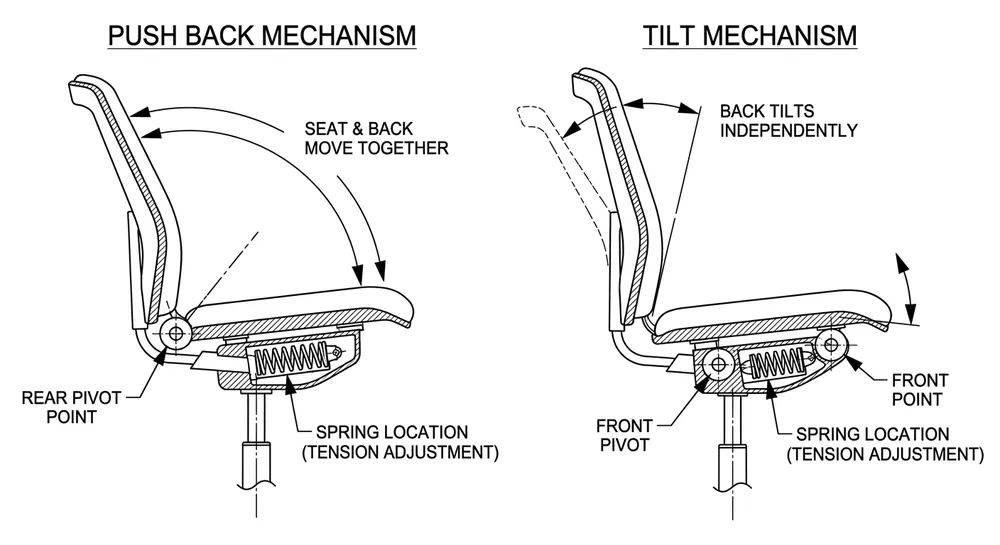
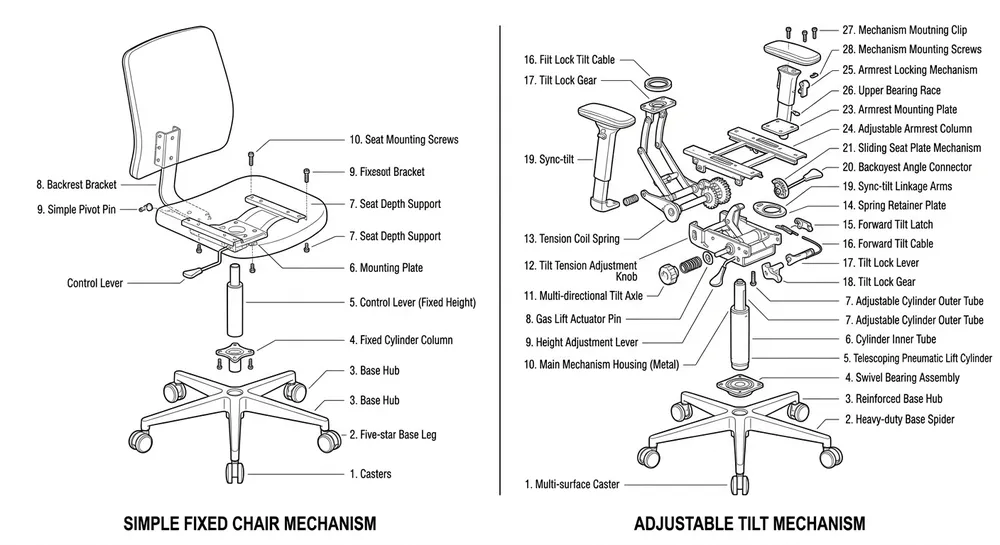
A fixed chair mechanism connects the seat plate to the base with a static mounting — no tilt range, no tension control, no height-adjustment beyond the gas cylinder. The load path is direct and the part count is low. That simplicity is its commercial advantage.
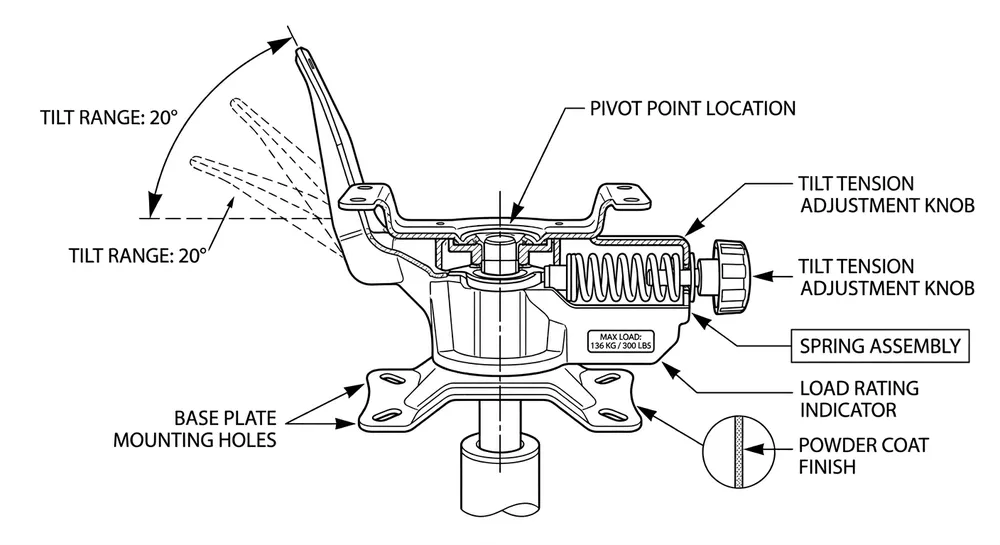
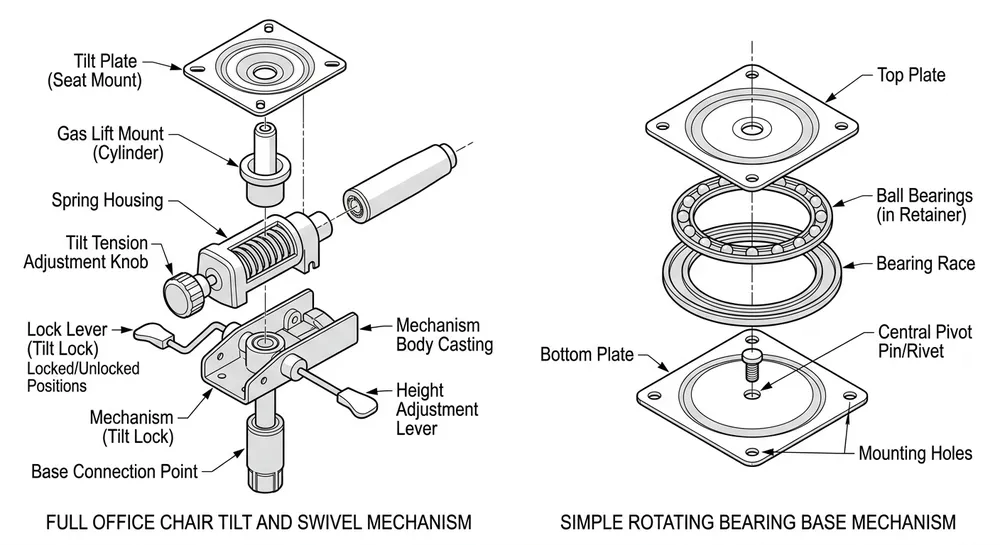
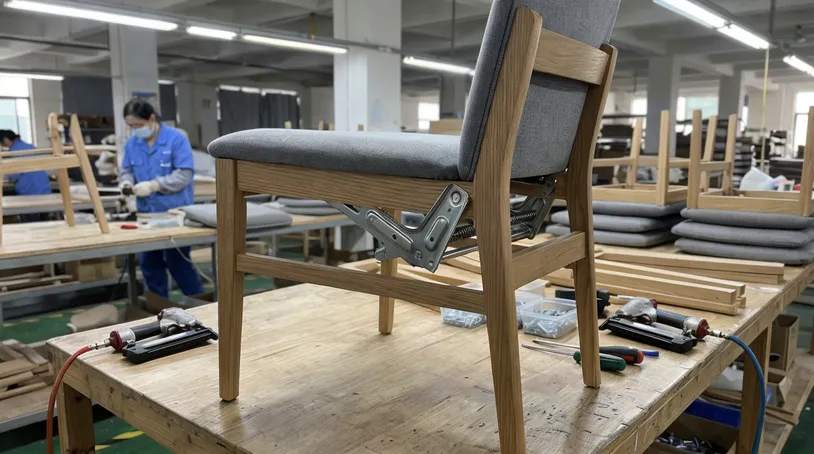
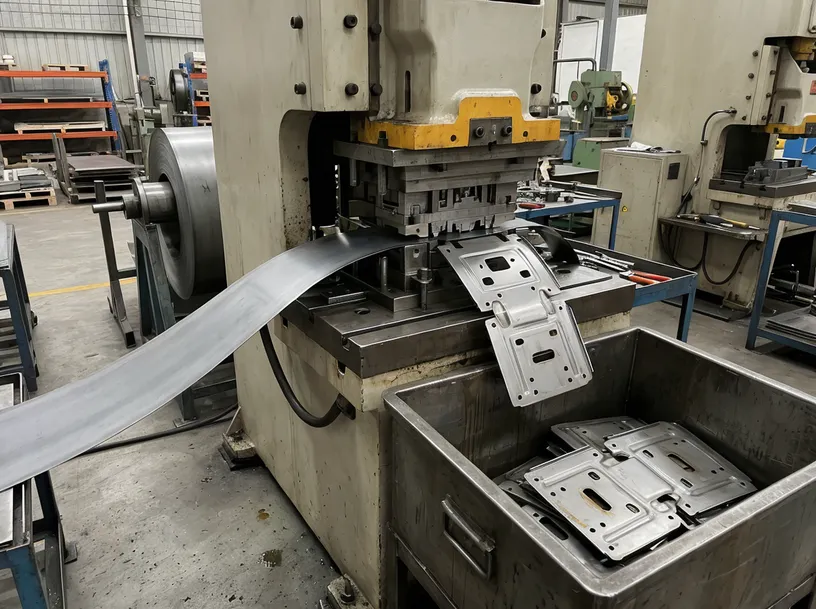
An adjustable mechanism adds at least one — usually two or three — functional layers: tilt range (typically 3°–15° of backward recline), tilt tension adjustment via a knob or lever, and often a tilt-lock position. Higher-spec versions add seat-depth slide, lumbar linkage attachment points, or synchro-tilt geometry where the seat and back move at a fixed ratio. Each added function means more stamped components, more zinc alloy castings, more assembly steps, and more QC checkpoints.
(We run adjustable mechanisms through a 5,000-cycle tilt test before shipment — fixed mechanisms go through a static load test only. The test protocols are different because the failure modes are different.)
The part count difference matters for your supply chain: a fixed mechanism has 8–12 components; a mid-range adjustable mechanism runs 22–35. More components means more sourcing exposure, more assembly labor, and more surface area for quality variation. You're not just buying a more expensive part — you're buying a more complex one.

—
Head-to-Head: The Dimensions That Drive the Commercial Decision
| Dimension | Fixed Mechanism | Adjustable Mechanism |
|---|---|---|
| Unit cost (ex-works) | Baseline | +30–60% |
| Component count | 8–12 parts | 22–35 parts |
| Assembly time | Low | Moderate–High |
| Tilt range | None | 3°–15° typical |
| Tension control | None | Knob or lever |
| Tilt-lock positions | None | 1–3 typical |
| Cycle life (tilt) | N/A | 50,000–100,000 cycles |
| Warranty claim exposure | Low (static failure only) | Higher if spec is wrong |
| End-market price premium | Commodity | Differentiated |
| MOQ sensitivity | Lower risk | Higher tooling investment |
| Container loading efficiency | Higher (simpler KD pack)** | Slightly lower |
| Certifications required | Basic load test | BIFMA / EN 1335 tilt testing |
The certification row is where buyers get surprised. If you're selling into North America or Europe, adjustable mechanisms in commercial seating need to pass BIFMA X5.1 or EN 1335 tilt and stability testing. Fixed mechanisms in the same markets face a simpler load-only certification path. That's not a reason to avoid adjustable — it's a reason to confirm your supplier has the test documentation before you commit to a product line.
—
The Hidden Cost the Price Sheet Doesn't Show
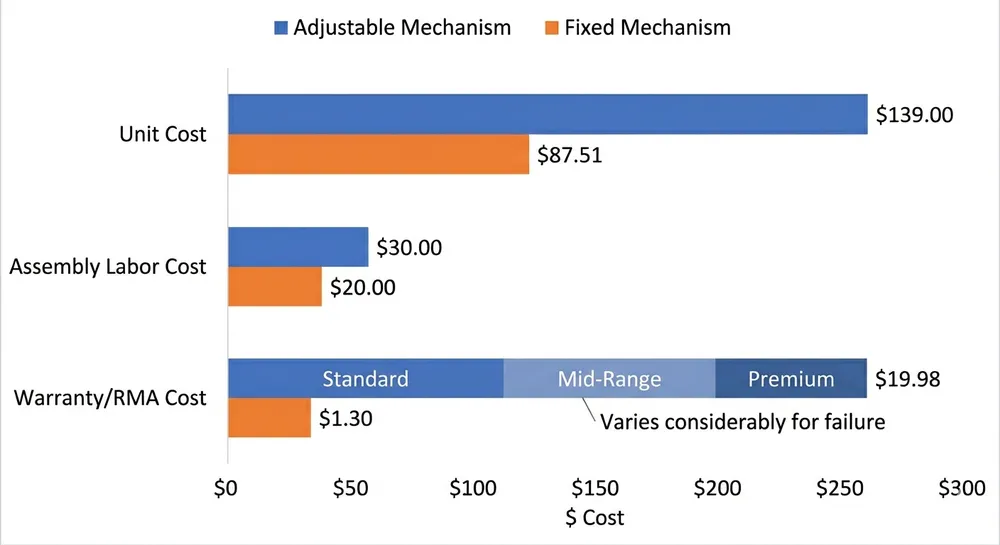
The unit price gap is visible. The downstream cost gap is where buyers lose money quietly.
Warranty claims on under-specified adjustable mechanisms are the most common hidden cost we see. A buyer sources a low-cost adjustable mechanism rated for 80 kg static load and sells it into a contract office furniture line. The tilt tension spring is undersized for heavier users. Six months after delivery, warranty claims start arriving — not catastrophic failures, but creaking, tension loss, and tilt-lock slippage. Each claim costs the buyer in return freight, replacement parts, and customer relationship damage. The mechanism saved $4 per unit. The warranty program cost $18 per unit over 18 months.
Fixed mechanisms have a simpler failure profile: weld integrity, mounting hole wear, and gas cylinder interface fatigue. These are easier to test, easier to specify, and easier to catch in incoming inspection. The failure modes are predictable.
Adjustable mechanisms fail in more ways — spring fatigue, cam wear, lever pivot wear, tilt-lock detent wear — and the failure timing depends heavily on actual use patterns. A mechanism that performs perfectly in a home office used 4 hours a day will show wear in a call center used 10 hours a day. If your buyer is selling into both segments under the same SKU, that's a specification problem, not a quality problem.
(We've had buyers come to us after exactly this situation — one SKU across two very different end markets. The fix is usually a second SKU with a heavier-duty spring pack and reinforced cam, not a different mechanism family entirely. The tooling delta is smaller than most buyers expect.)
Assembly cost at your customer's factory is the other hidden line. Adjustable mechanisms require more assembly steps and more torque-sensitive fastening. If your buyer is a furniture manufacturer doing their own assembly, a more complex mechanism adds labor time per unit. For high-volume lines, that adds up. Fixed mechanisms assemble in roughly half the time.
—
Application Showdown: Which Mechanism Wins Where
Scenario 1: Contract Office Furniture, Mid-Market Price Point
Your buyer is a furniture distributor supplying mid-market office chairs to corporate clients — open-plan offices, co-working spaces, hotel business centers. End users sit 6–8 hours daily. The chairs will be used by people of varying sizes and posture preferences. The buyer's retail price target is $180–$280 per chair.
Winner: Adjustable mechanism.
At this price point, the end buyer expects tilt function. A fixed mechanism in this segment reads as a cost-cut, not a feature — it will hurt your buyer's sell-through. More importantly, the ergonomic liability exposure on fixed seating in prolonged-use commercial environments is real in North American and European markets. The adjustable mechanism's $8–15 unit cost premium disappears against the chair's retail price and the warranty risk reduction it delivers.
Specify a mechanism with at least 3°–12° tilt range, tension adjustment, and a tilt-lock. Confirm EN 1335 or BIFMA X5.1 test reports are available.
Scenario 2: Budget Seating for High-Turnover Environments
Your buyer supplies seating for fast-food restaurants, waiting areas, canteens, and similar high-turnover environments. Chairs are used intermittently, replaced on 3–5 year cycles, and price is the primary purchasing criterion. The buyer's target landed cost is under $25 per chair.
Winner: Fixed mechanism.
Adjustability adds no commercial value here. End users don't adjust chairs in these environments — they sit down and stand up. The tilt function would go unused and the added complexity would only introduce failure modes that don't exist in a fixed design. A well-made fixed mechanism with proper weld integrity and a quality gas cylinder interface will outlast the chair's intended service life in this application.
The fixed mechanism also gives your buyer better container economics — simpler KD packing, higher units per container, lower landed cost per unit.
Scenario 3: Ergonomic or Task Seating, Premium Segment
Your buyer is building a product line targeting ergonomic task chairs — home office, healthcare workstations, or executive seating. Retail price $350+. The buyer wants product differentiation and is willing to invest in mechanism quality.
Winner: Adjustable mechanism, higher-spec configuration.
This is where the adjustable mechanism's full commercial value unlocks. A synchro-tilt mechanism with seat-depth slide and lumbar attachment points gives your buyer genuine product differentiation — features they can put on the spec sheet, photograph for marketing, and use to justify the price premium to their retail or B2B customers.
The mechanism cost is a smaller percentage of total chair cost at this price point, and the margin protection from differentiation is significant. A buyer who can sell a $420 chair instead of a $280 chair because the mechanism spec supports it has recovered the mechanism premium many times over.
(This is also the segment where buyers most often come to us for OEM customization — custom tilt ranges, branded tension knobs, specific lumbar attachment geometry. The tooling investment makes sense here because the per-unit margin supports it.)
—
What to Verify Before You Source Either Option
The mechanism type decision is only half the sourcing equation. The other half is confirming the supplier can actually deliver what the spec requires.
For fixed mechanisms, the critical verification points are:
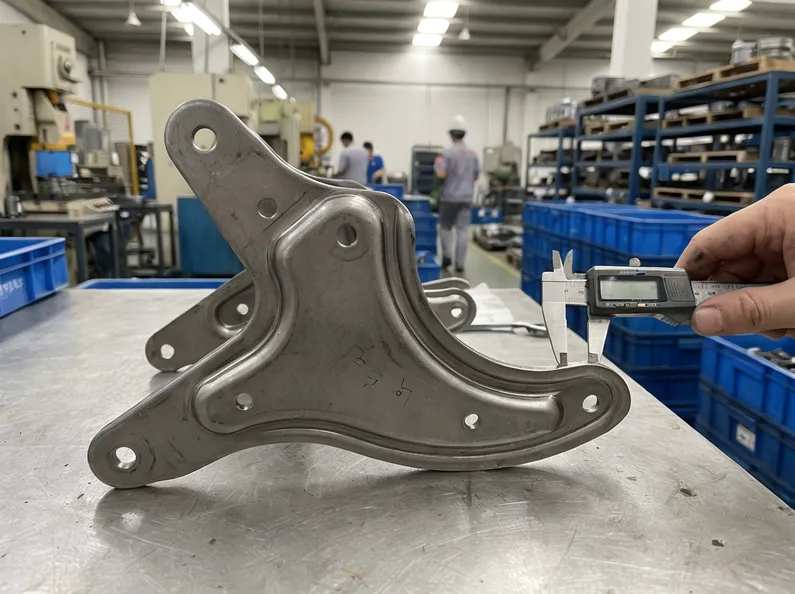
- Weld quality at the seat plate mounting points — this is where fatigue cracks initiate under repeated load cycling. Ask for weld cross-section photos or destructive test samples.
- Mounting hole tolerance — fixed mechanisms need precise hole positioning for gas cylinder and base attachment. Tolerance drift across a production batch causes assembly problems at your customer's factory.
- Surface treatment consistency — fixed mechanisms are often powder-coated or zinc-plated. Confirm the supplier runs 100% visual inspection and has salt spray test data for the specific finish.
For adjustable mechanisms, the verification list is longer:
- Tilt cycle test reports — ask for 50,000-cycle test data minimum. Some suppliers test to 30,000 cycles and call it sufficient; for commercial seating, it isn't.
- Spring pack specification — the tension spring is the most common failure point. Ask for the spring wire diameter, coil count, and load rating. A supplier who can't provide this is guessing at their own spec.
- Cam and detent wear testing — tilt-lock mechanisms wear at the cam surface. Ask how the supplier tests for detent retention force after cycling.
- BIFMA X5.1 or EN 1335 test reports — if you're selling into North America or Europe, these are non-negotiable. Confirm the reports are from an accredited third-party lab, not internal testing.
- Zinc alloy casting quality — adjustable mechanisms use zinc alloy die-cast components for levers, cam housings, and tension knobs. Ask about alloy grade (Zamak 3 or Zamak 5 are standard) and whether the supplier does incoming material verification.
We run 100% functional testing on adjustable mechanisms before shipment — every unit goes through tilt cycle verification and tilt-lock engagement check on the line. For fixed mechanisms, we run statistical sampling with 100% weld inspection. The QC protocol matches the failure mode profile of each type.
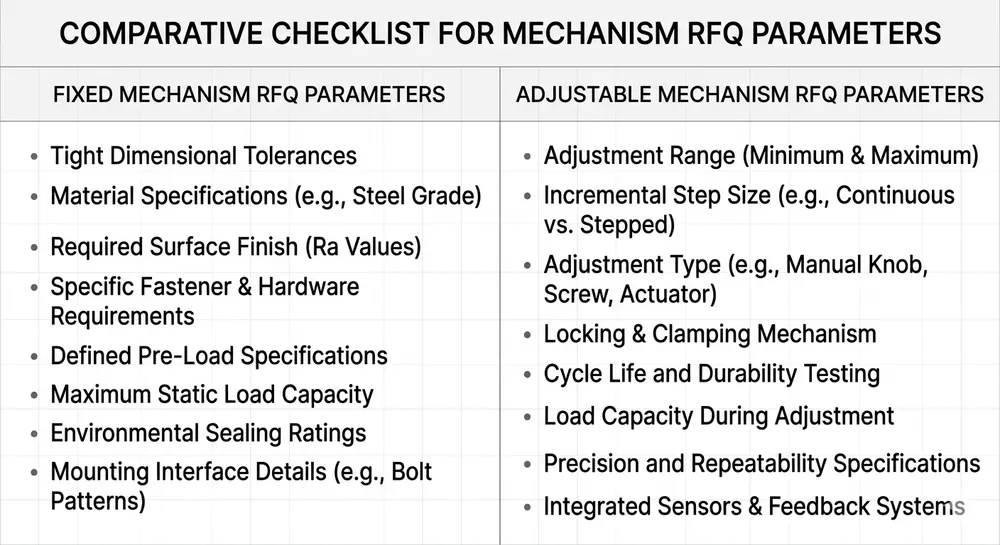
RFQ language that protects you:
When sourcing adjustable mechanisms, your RFQ should specify:
- Tilt range (degrees)
- Maximum static load rating (kg)
- Tilt-lock positions required
- Tension adjustment type (knob / lever / tool-free)
- Required certifications and test report format
- Surface finish and salt spray requirement
- Cycle life requirement
Vague RFQs get interpreted generously by suppliers under cost pressure. Specific RFQs get you what you actually need.
—
The Decision in One Framework
If you're still weighing the options, run your application through these three filters:
1. Daily use duration. Under 4 hours: fixed is defensible. Over 6 hours: adjustable is the lower-risk choice for warranty exposure.
2. End-market price point. Under $80 retail chair: fixed mechanism economics make sense. Over $150 retail: the adjustable premium is recoverable in margin.
3. Certification requirement. If your buyer's market requires BIFMA or EN 1335 compliance for commercial seating, confirm which mechanism type and spec level satisfies the standard before you commit to a product line.
The buyers who get into trouble are the ones who apply fixed-mechanism economics to a use case that needs adjustable performance, or who over-specify adjustable mechanisms for a commodity segment where the cost premium has nowhere to land. Neither mistake is obvious at the time of the order — both are obvious six months later.
We supply both types from our Chair Mechanism production lines. If you're building a new seating line or re-sourcing an existing one, the fastest path to the right spec is to send us your target retail price, end-use environment, and volume — we'll recommend the mechanism configuration that protects your margin and your warranty exposure simultaneously.
For the full Adjustable Chair Mechanism specification range, including synchro-tilt and multi-function configurations, the product page has the complete spec matrix and available certifications.
Ready to spec your order? Request a Quote with your application details and we'll come back with a configuration recommendation and pricing within one business day.
—
Frequently Asked Questions
What is the minimum order quantity for adjustable chair mechanisms? Our standard MOQ is 500 units for catalog adjustable mechanisms. For OEM configurations with custom tilt range or branding, MOQ depends on tooling requirements — most custom runs start at 1,000 units. Fixed mechanisms follow the same 500-unit standard MOQ.
Can the same chair frame accept both a fixed and an adjustable mechanism? Sometimes, but not reliably. Mounting hole patterns are often shared between mechanism families, but seat plate dimensions and gas cylinder interface geometry can differ. Before switching mechanism types on an existing frame design, confirm the mounting dimensions match or request a sample for fit verification. We can provide dimensional drawings for any mechanism in our catalog.
What causes adjustable chair mechanisms to lose tilt tension over time? Spring fatigue is the primary cause — the tension spring loses load capacity after extended cycling, especially if the mechanism was under-specified for the actual user weight range. Secondary causes are cam surface wear and lubricant migration away from the pivot points. Specifying a mechanism with a spring pack rated 20–30% above your expected maximum user weight gives meaningful service life margin. We can advise on spring pack selection once you provide your target weight rating.
Is BIFMA certification required for all commercial office chairs sold in the US? BIFMA X5.1 is a voluntary standard, not a legal requirement — but most major US corporate procurement contracts and GSA schedules require BIFMA compliance as a condition of approval. If your buyer is selling into corporate, government, or healthcare channels, treat BIFMA as effectively mandatory. We maintain BIFMA X5.1 test reports for our adjustable mechanism range and can provide copies on request.
What surface finish holds up best on chair mechanisms in humid environments? Zinc plating performs better than powder coat in high-humidity environments because it provides cathodic protection rather than just a barrier coat. For mechanisms destined for Southeast Asian markets or coastal regions, we recommend zinc plating with a chromate passivation layer — our salt spray test data shows 480+ hours to red rust on this finish. Powder coat is fine for standard indoor environments and gives better color consistency if aesthetics matter to your buyer.