Most sourcing problems with swivel chair mechanisms don't start at the factory — they start at the brief stage. A buyer sends a vague reference photo, gets a catalog price, places an order, and discovers three months later that the mounting hole pattern doesn't match their chair base, or the tilt resistance is wrong for their target market, or the surface finish fails their retailer's inspection. By then the tooling is cut and the container is on the water.
This guide covers what OEM swivel chair mechanism sourcing actually involves: what you can customize, what the MOQ structure looks like, how tooling and sampling work, and what quality documentation you should expect at shipment. If you're evaluating whether to move from catalog sourcing to a proper OEM arrangement, this is the decision framework.
—
OEM vs ODM for Swivel Mechanisms: The Distinction That Changes Your Tooling Cost
These two terms get used interchangeably by trading companies, which causes real confusion when buyers try to compare quotes.
OEM means you own the design. You provide drawings or a detailed specification — pivot geometry, spring rate, load rating, mounting pattern, surface finish — and we manufacture to that spec. The tooling may be new (if your geometry differs from our catalog) or it may use existing tooling with modified parameters. Either way, the design IP is yours.
ODM means we develop the design. You give us a brief: target retail price point, market segment, performance requirements, any aesthetic direction. Our engineering team designs the mechanism, builds the tooling, runs samples, and iterates until the spec is locked. You get a finished, tested mechanism without needing to produce engineering drawings. The design IP arrangement depends on the agreement — most ODM buyers license the design exclusively for their market.
For swivel chair mechanisms specifically, the practical difference comes down to this: if you're a furniture manufacturer with an existing chair platform and you need a mechanism that fits your base geometry exactly, that's OEM. If you're entering a new seating category and need a mechanism developed from a performance brief, that's ODM.
(We do both. The engineering process is similar — the difference is who brings the drawings to the first meeting.)
—
What You Can Actually Customize: The Full Parameter Set
Generic supplier listings say "customizable" without specifying what that means. Here's the actual scope for swivel chair mechanisms:
Pivot geometry and tilt range
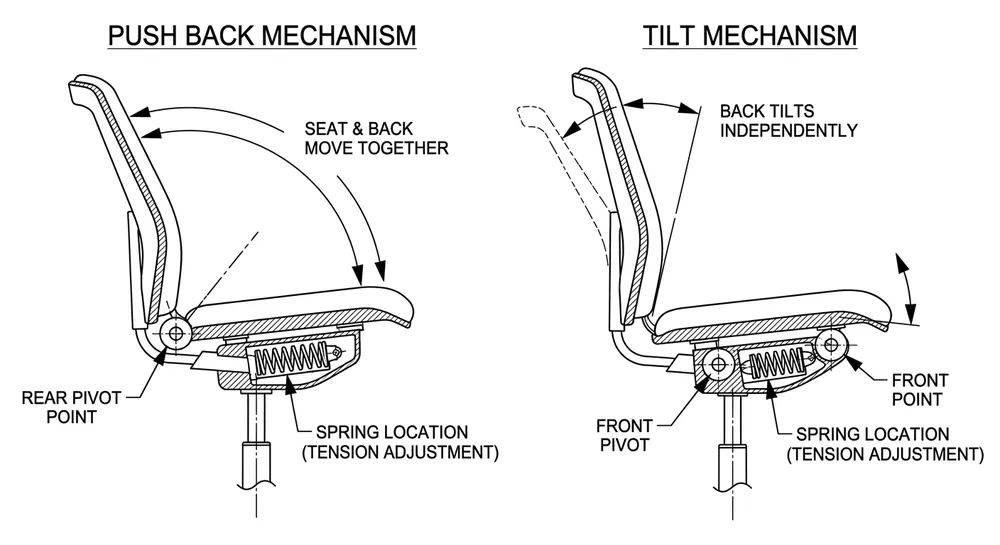
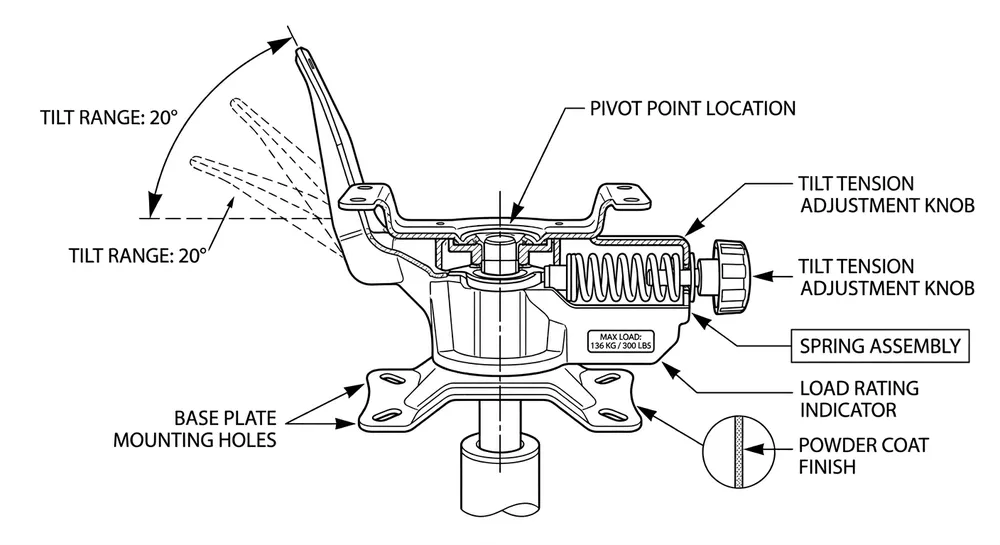
The pivot point location and tilt arc are the two parameters that most directly affect how a chair feels in use — and the two most commonly under-specified in OEM briefs. Pivot geometry affects the weight distribution during recline; a rear-pivot mechanism feels different from a center-pivot even at the same spring rate. Tilt range is typically 15°–22° for standard office mechanisms, but contract and lounge seating often requires a wider arc.
If you're matching an existing chair platform, send us the base plate dimensions and the seat attachment points. We'll confirm whether your geometry falls within our existing tooling range or requires new tooling.
Spring rate and tilt resistance
Spring rate determines how much force is required to initiate and sustain tilt. The right spec depends on your target user weight range and the feel your market expects — North American contract buyers typically want firmer resistance than residential European buyers. We can adjust spring rate within a range using existing tooling; outside that range, a new spring specification is required.
Standard catalog mechanisms cover a 40–120 kg user weight range with adjustable tension. If your product targets a specific weight band or requires a fixed (non-adjustable) resistance, that's a spec we need upfront.
Load rating
Standard commercial office mechanisms are rated to 150 kg static load. Heavy-duty variants go to 200 kg. The load rating affects the plate thickness, weld specification, and the cycle-life test standard we apply. Specify your target market — if it's contract office, healthcare, or any high-use commercial environment, the load spec matters more than it does for residential.
Surface finish
Three options, each with different cost and performance implications:
| Finish | Typical application | Salt spray rating | Notes |
|---|---|---|---|
| Powder coat | Standard commercial, residential | 500 hr | 60–80μm film; color-matchable |
| Zinc plate | Tight-tolerance components, visible hardware | 200–300 hr | Adds minimal thickness; good for close-fit assemblies |
| Nickel plate | Premium visible hardware, decorative components | 300–400 hr | Higher cost; used on knobs and adjustment collars |
For mechanisms going into coastal markets or humid climates, powder coat at 60–80μm is the right call. We ran thinner at 45–55μm for a period to reduce material cost — the salt spray results on Gulf region shipments told us that was the wrong trade-off.
Mounting hole pattern
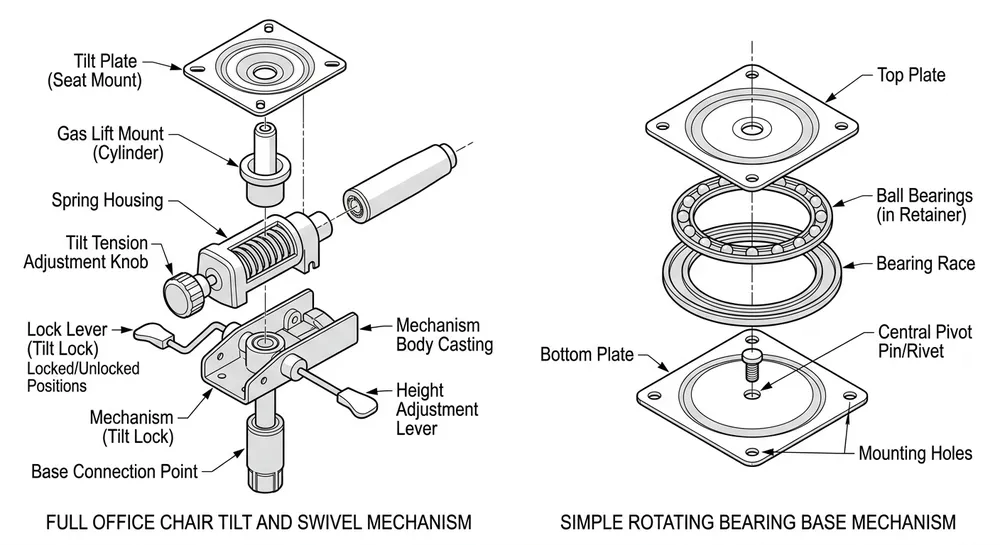
This is the most common mismatch point in OEM sourcing. The base plate mounting pattern needs to match your chair base exactly — hole diameter, bolt circle diameter, and plate thickness all affect fit. Send us your base plate drawing or a dimensioned photo of your existing mechanism. We'll confirm compatibility before quoting.
Cycle-life specification
Our standard qualification baseline is 50,000 cycles — the minimum for commercial office chair certification in most markets. High-use commercial environments (healthcare, education, 24-hour operations) typically require 80,000–100,000 cycles. Specify your target market and we'll apply the appropriate test standard.

—
MOQ Structure: Catalog vs Custom Geometry
The MOQ question is where most buyers get a non-answer from trading companies. Here's the actual structure:
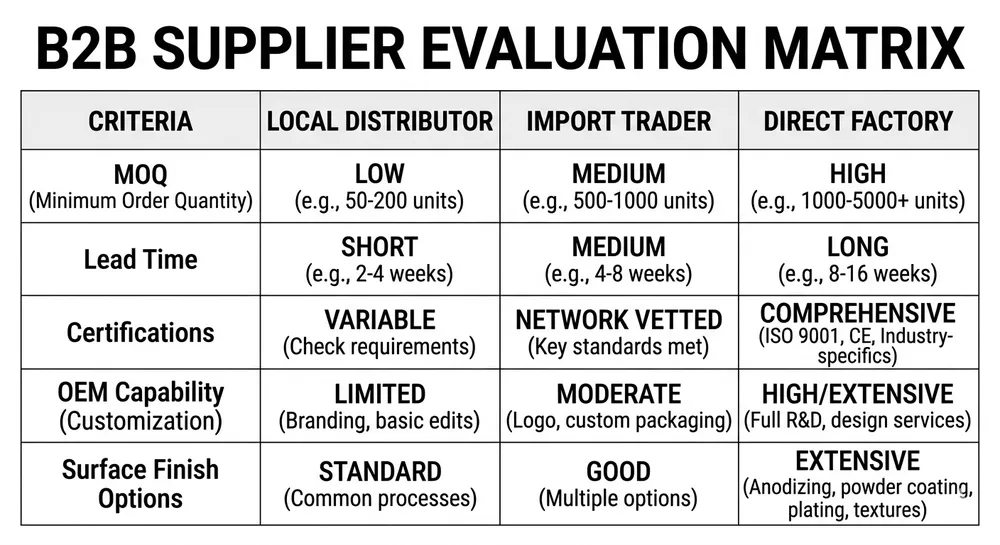
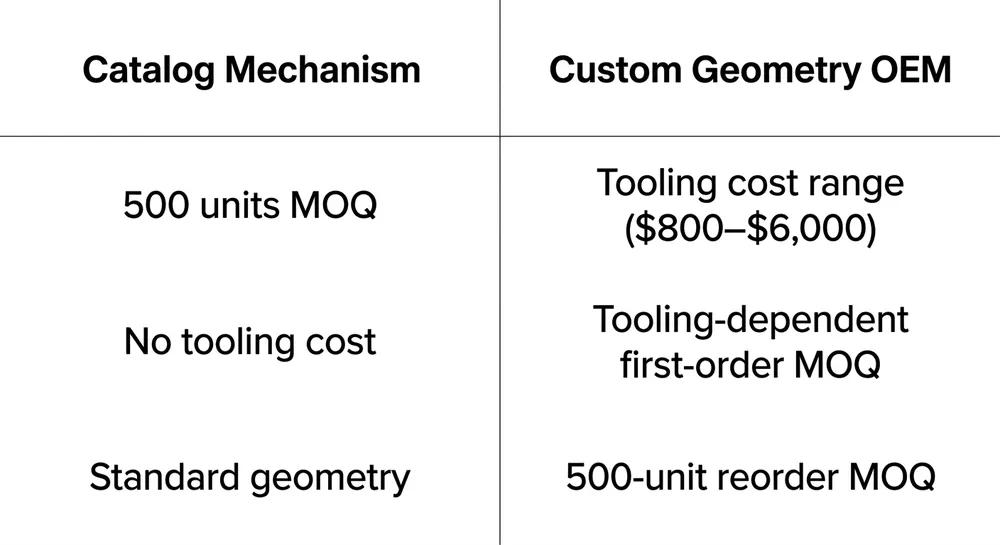
Catalog mechanisms: 500 units MOQ. These are mechanisms where your spec falls within our existing tooling range — standard pivot geometry, standard mounting patterns, adjustable spring rate, powder coat or zinc plate finish. No new tooling required. 500 units is the floor because below that, the production setup cost per unit makes the landed price uncompetitive for both sides.
Custom geometry: tooling-dependent MOQ. When your spec requires new tooling — a non-standard pivot location, a custom base plate geometry, a proprietary mounting pattern — the MOQ is calculated based on tooling amortization. We don't give a round number here because it depends on the tooling cost for your specific geometry.
The calculation works like this: tooling cost divided by a per-unit amortization target gives you the minimum run that makes the tooling investment rational. A simple base plate modification might add $800–1,500 in tooling cost; a full custom mechanism with new pivot geometry and spring specification runs $3,000–6,000 in tooling. We'll give you the honest number based on your spec.
One thing worth understanding: tooling cost is a one-time investment. Once the tooling is cut and approved, your reorder MOQ drops to 500 units. The first order carries the tooling; subsequent orders don't.
—
Tooling and Sample Process: What Happens Between Brief and Production
This is the part of OEM sourcing that most suppliers describe vaguely. Here's the actual sequence:
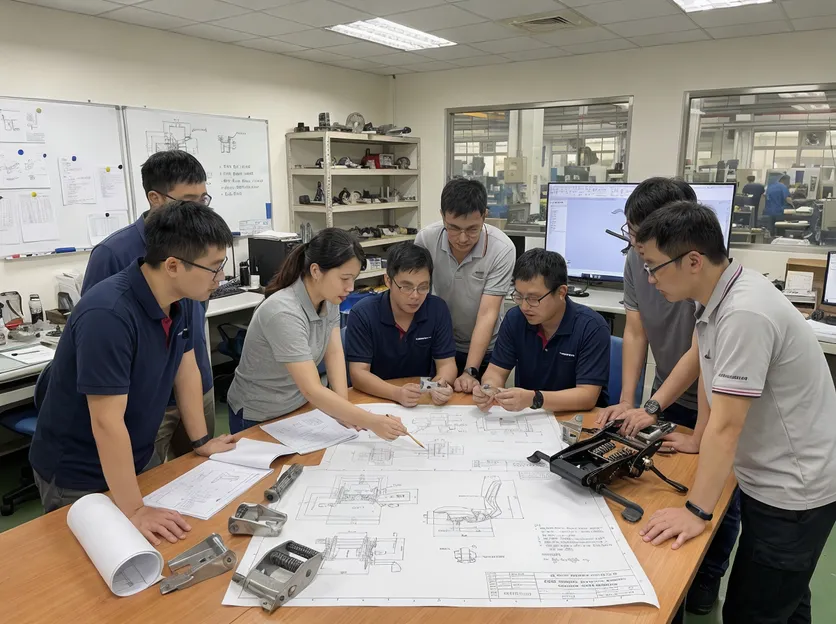
1. Brief review and DFM feedback. You send your spec — drawings, reference mechanism, or a detailed brief. Our engineering team reviews it for manufacturability and flags anything that will cause production problems: wall thicknesses that won't fill cleanly in die-casting, hole patterns that conflict with structural requirements, surface finish specs that affect dimensional tolerance on close-fit components. We come back with a DFM report and a quote that includes tooling cost and unit price at your target volume.
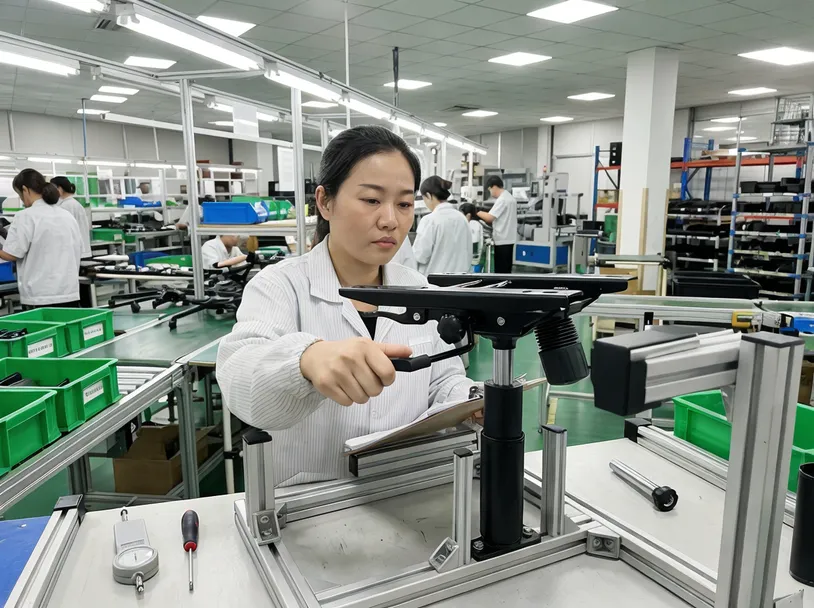
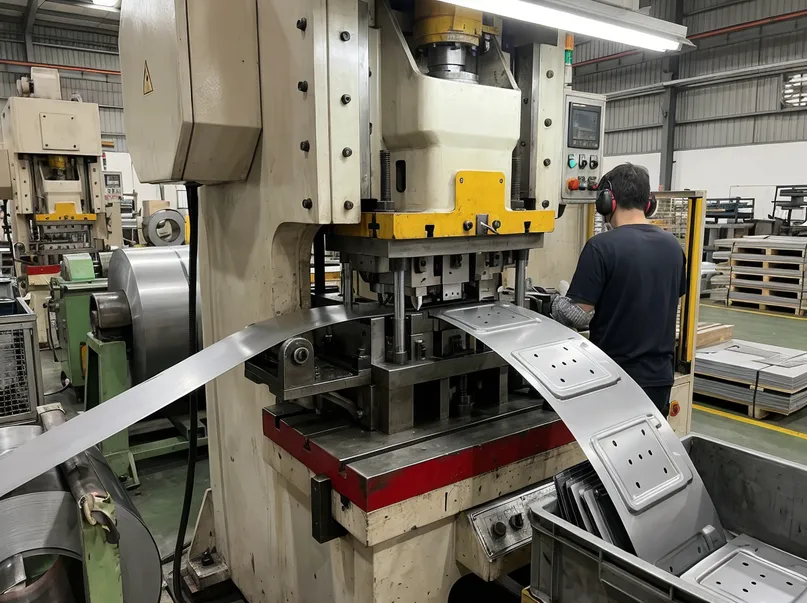
2. Tooling build. Tooling is built in-house by our tooling team. This matters because when a sample needs a geometry change — and on custom mechanisms, it usually does — the revision happens on our floor, not at a third-party tooling shop. We've seen OEM projects at other factories drag out for months because every sample revision required a separate tooling shop engagement. In-house tooling compresses that cycle significantly.
3. First-article samples. We produce a small sample run — typically 3–5 units — and send them with a first-article inspection report covering dimensional measurements against your drawing, surface finish verification, and functional test results. You test against your chair platform and confirm fit and feel.
4. Sample revision (if needed). If the first article requires changes, we revise the tooling and produce a second sample set. Most OEM projects reach approval within two sample rounds. Complex geometry changes occasionally require a third.
5. First-article approval and production release. Once you sign off on the sample, we lock the spec and schedule production. The approved first-article sample becomes the production reference standard — QC checks during production are measured against it.
The full sequence from brief to approved sample typically runs 4–6 weeks for standard OEM modifications, longer for full custom geometry. We'll give you a milestone schedule at the quote stage, not a single delivery date.
—
Quality Baseline: What Every OEM Shipment Includes
For OEM buyers, quality documentation isn't optional — it's part of what you're paying for. Your brand is on the end product; a mechanism failure is your warranty claim, not ours.
50,000-cycle load testing is our standard batch qualification check, not a special request. Every production batch goes through load-cycle verification before release. We use it as a floor — mechanisms going to high-use commercial environments get spec'd and tested to higher cycle counts based on the application.
100% functional outgoing inspection means every unit, not a sample. A mechanism that passes dimensional checks but has a sticky tilt lock, a misaligned mounting hole, or inconsistent spring engagement gets pulled before it reaches your container. Sampling-based inspection misses intermittent functional defects; 100% inspection doesn't.
In-house die-casting is relevant here because die-cast components — adjustment knobs, tilt tension collars, decorative covers — are the most common source of dimensional inconsistency and surface defects in mechanism assemblies. Most factories in this region outsource die-casting to third-party foundries, which means they have no direct control over dimensional consistency batch-to-batch. We brought die-casting in-house in 2015. When a knob feels loose or a collar finish is inconsistent, the fix is on our floor.
Certification documentation ships with every order:
- CE declaration of conformity — European market compliance
- SGS test reports — third-party verification
- RoHS compliance documentation — for EU and California market buyers
- ISO 9001:2015 quality management system
For North American importers, we provide the material and compliance documentation your customs broker needs for HTS classification. For EU buyers, CE and SGS reports are included with the commercial invoice package — your compliance team doesn't need to chase us for documents after the fact.
See our full Chair Mechanism range for the catalog specifications these OEM parameters build from.
—
How to Prepare an OEM Brief That Gets You an Accurate Quote
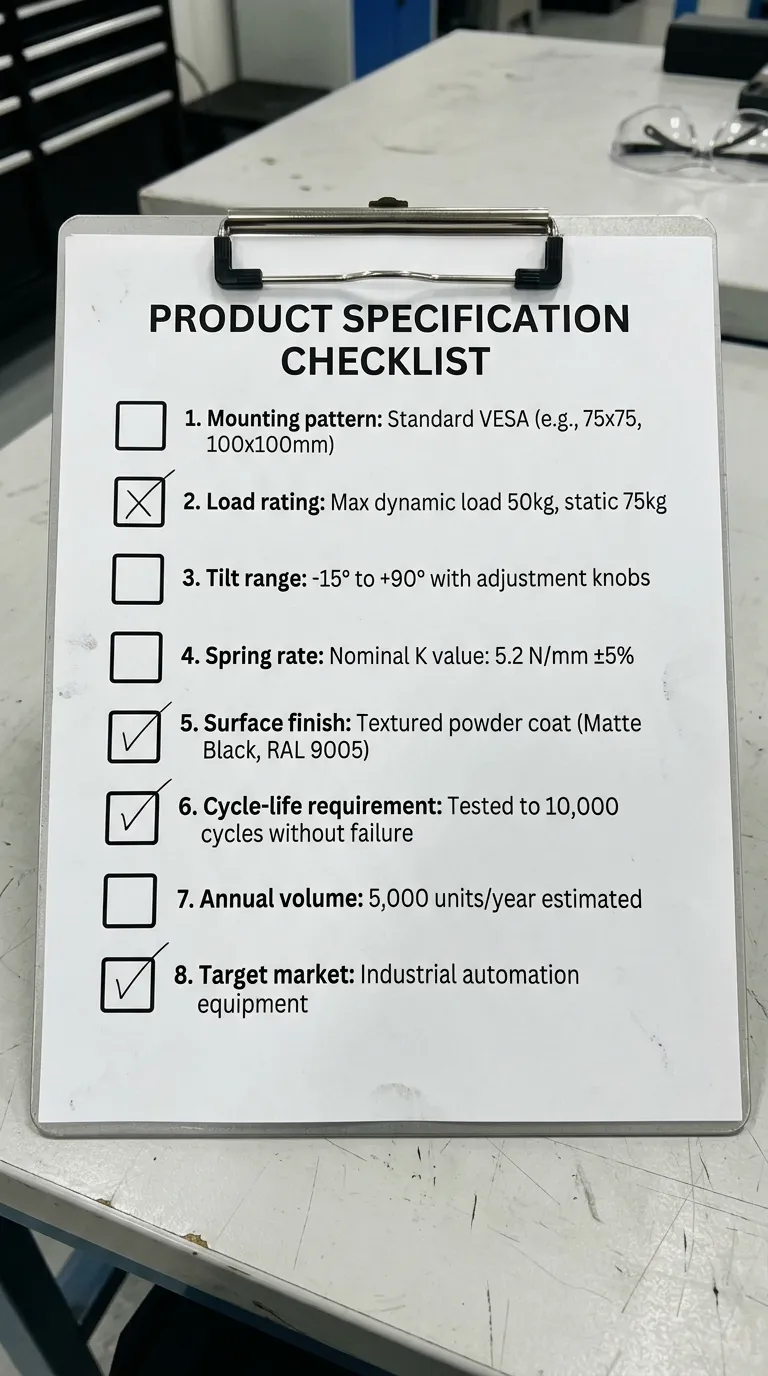
The most common reason OEM quotes come back wrong — or come back as a range so wide they're useless — is an incomplete brief. Here's what we need to quote accurately:
| Parameter | What to provide | Why it matters |
|---|---|---|
| Mounting pattern | Base plate drawing or dimensioned photo | Determines tooling scope |
| Load rating | Target user weight range and application | Affects plate spec and test standard |
| Tilt range | Degrees, or "standard" if flexible | Affects pivot geometry |
| Spring rate | Firm/medium/soft, or target weight range | Affects spring specification |
| Surface finish | Powder coat / zinc plate / nickel plate | Affects unit cost and lead time |
| Cycle-life requirement | 50k / 80k / 100k cycles | Determines test protocol |
| Annual volume | Units per year, not just first order | Affects tooling amortization calculation |
| Market | EU / NA / other | Determines compliance documentation |
You don't need engineering drawings to start the conversation. A reference mechanism, a dimensioned sketch, and your target load rating and volume gets us far enough to give you a meaningful preliminary quote. Full drawings come in at the DFM stage.
(The one thing that consistently delays quotes: buyers who send a photo of a competitor's mechanism and ask us to "match it." We can work from a reference, but we need dimensions. A photo without measurements is a starting point for a conversation, not a brief.)
For detailed technical specifications on standard catalog variants, see our swivel chair mechanism specifications reference.
—
Sourcing Risk: What Catalog Listings Don't Tell You
Trading company listings and generic Alibaba pages share a structural problem: they're optimized for click-through, not for sourcing accuracy. A few things worth checking before you commit to an OEM arrangement with any supplier:
Ask whether tooling is in-house or outsourced. If tooling is outsourced, every sample revision adds a third-party lead time and a third-party cost. For OEM projects that require geometry iteration, this compounds quickly. Ask directly: "Where is the tooling built, and who owns the revision process?"
Ask for the cycle-life test standard and the actual test report, not just a certification claim. "50,000-cycle tested" means nothing without a test report showing the load applied, the test frequency, and the failure criteria. CE certification on a mechanism covers the product category; it doesn't substitute for a batch-specific load-cycle report.
Verify that outgoing inspection is 100%, not sampling. For OEM buyers whose brand is on the end product, sampling-based inspection is a liability. Ask for the inspection protocol in writing. If the answer is "we inspect every batch," ask what percentage of units are checked per batch — those are different things.
Confirm die-cast components are controlled. Ask whether adjustment knobs, tilt collars, and other die-cast components are produced in-house or sourced from a third-party foundry. If sourced externally, ask what incoming inspection process covers dimensional consistency. Batch-to-batch variation in die-cast components is the leading cause of mechanism assembly complaints we see when buyers switch to us from other suppliers.
The Swivel Chair Mechanism product page covers our standard catalog specifications and available variants if you want to compare against your current sourcing.
—
Frequently Asked Questions
What is the MOQ for a standard OEM swivel chair mechanism?
500 units for catalog variants where your spec falls within existing tooling. For custom geometry requiring new tooling, MOQ is calculated on tooling amortization — we give you the specific number based on your spec, not a round figure. Reorder MOQ after tooling approval is 500 units regardless of whether the first order was higher.
How long does the OEM sample process take?
From brief submission to first-article samples: 3–4 weeks for standard modifications using existing tooling, 5–7 weeks for new tooling builds. Sample revision rounds add 1–2 weeks each. We provide a milestone schedule at the quote stage so you can plan your product launch timeline against actual production milestones.
What cycle-life standard do you test to?
50,000 cycles is our standard batch qualification baseline — the minimum for commercial office chair certification in most markets. We apply higher standards (80,000–100,000 cycles) for mechanisms specified for high-use commercial environments. The test applies a load at the rated weight, cycles through the full tilt arc, and checks for functional degradation and structural failure at the end of the run. Test reports are available with shipment.
Can you match a competitor's mechanism from a sample?
Yes, with dimensional measurements. Send us the reference mechanism plus a drawing or measured dimensions of the base plate mounting pattern and we can assess whether it falls within existing tooling range or requires new tooling. A physical sample alone isn't enough — we need dimensions to quote accurately.
What compliance documentation ships with OEM orders?
CE declaration of conformity, SGS test reports, RoHS compliance documentation, and ISO 9001:2015 quality system certification. For North American buyers, we provide HTS classification support documentation. All compliance paperwork ships with the commercial invoice — your customs broker and compliance team receive it with the order, not after a follow-up request.
Do you offer ODM if we don't have engineering drawings?
Yes. For ODM projects, you provide a brief: target retail price, market segment, performance requirements, and any aesthetic direction. Our 12-person engineering team develops the mechanism design, builds the tooling, and runs samples. Most ODM buyers in this category start with a performance brief and a reference mechanism from their current market — that's enough to begin the design process.
—
If you're ready to move from catalog sourcing to a proper OEM arrangement, the fastest path to an accurate quote is a brief with your mounting pattern, load rating, target volume, and market. Send it to us via the Request Quote page and we'll come back with a specific quote including tooling cost, unit price at your volume, and a sample timeline.