The question lands in our inbox more often than you'd expect: "We need a rotating mechanism for a lounge chair — is that the same as a swivel?" Sometimes it is. Often it isn't. And when it isn't, the buyer finds out after tooling is cut or a container is on the water.
Here's the short answer before we get into the detail: a swivel chair mechanism is an integrated motion assembly — it combines rotation with tilt control, height adjustment, and load management in a single engineered unit. A rotating chair mechanism is a single-function component — it provides 360° rotation and nothing else. The right choice depends entirely on what the chair needs to do, what market it's going into, and what your downstream warranty exposure looks like if the mechanism underperforms.
If you're sourcing for task seating, ergonomic office chairs, or any application where the user adjusts posture throughout the day, you need a swivel mechanism. If you're sourcing for accent chairs, lounge seating, dining pedestals, or decorative rotating furniture where the only motion requirement is spin, a rotating base mechanism is the correct — and more cost-efficient — component.
That's the verdict. The rest of this article explains the engineering behind it, the hidden cost differences, and the three sourcing scenarios where getting this wrong is expensive.

—
What Each Mechanism Actually Does — and Where the Designs Diverge
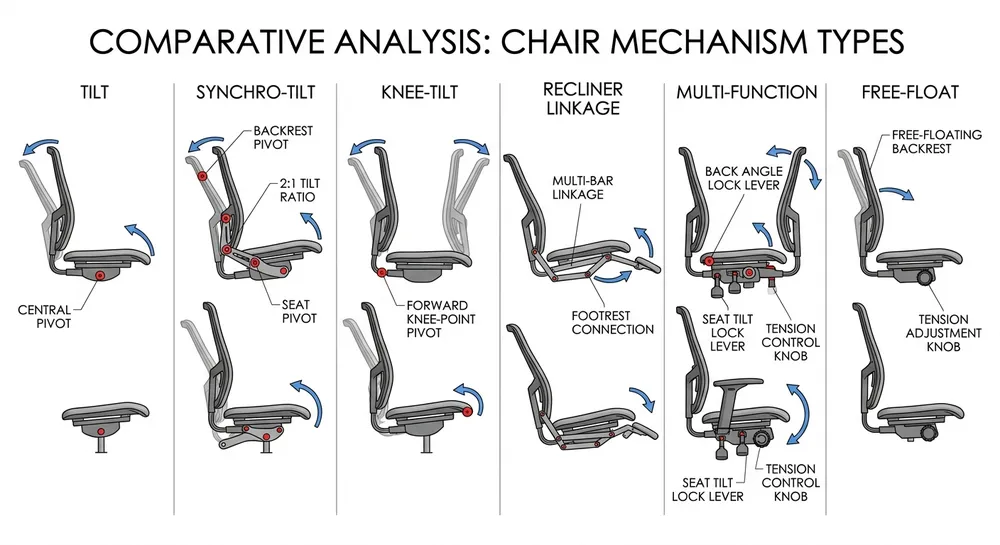
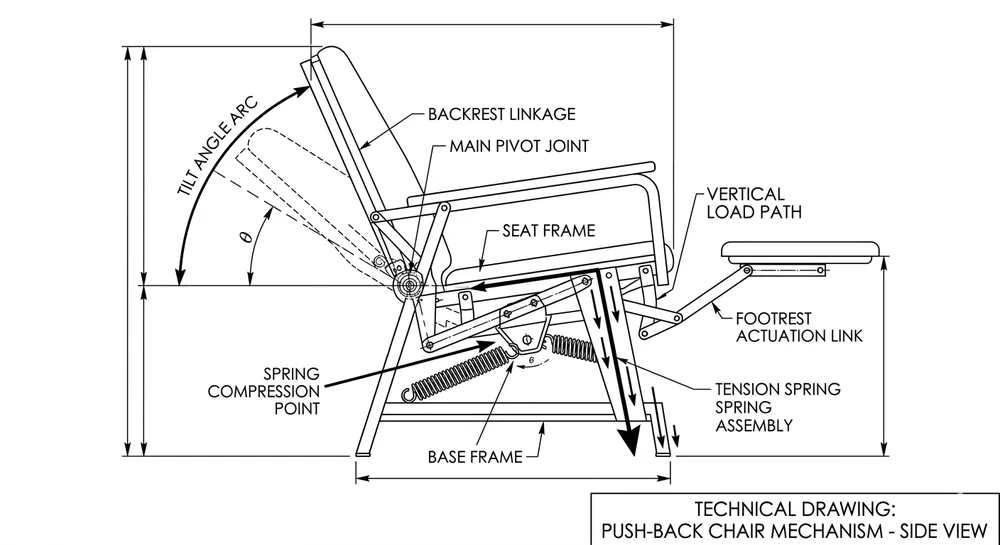
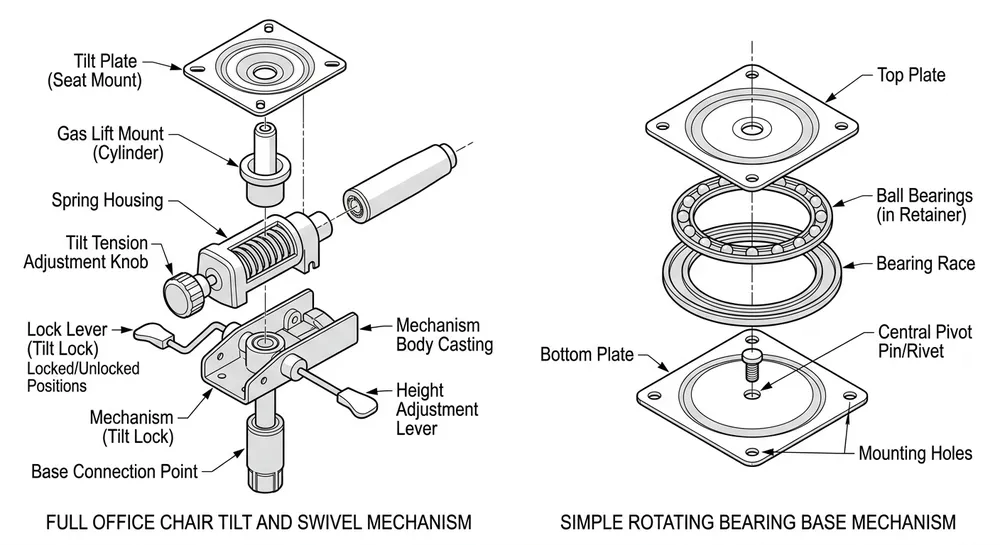
A Swivel Chair Mechanism is a multi-function assembly. The core components are a tilt plate, a spring-loaded tilt housing, a gas cylinder mount, and a locking system. Together they manage three distinct motions: the 360° rotation (via the bearing integrated into the base), the tilt arc (typically 12–18° of backward recline with spring resistance), and the height adjustment (via the gas lift interface). The mechanism plate itself is the structural spine of the chair — it takes the full dynamic load of a seated user in motion, which in commercial office environments means 8+ hours of daily use across a rated cycle life.
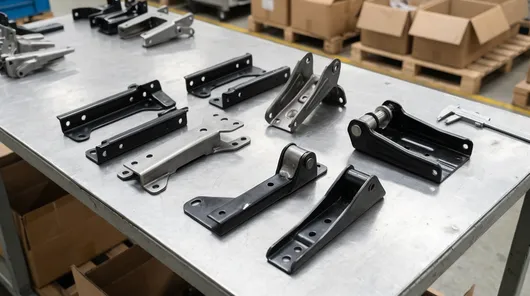
We stamp the mechanism plates from cold-rolled steel at ±0.15mm tolerance. That precision matters because the tilt pivot geometry determines how the chair feels under load — a plate that's 0.3mm off on the pivot hole throws the spring rate calculation and produces a tilt that feels either too stiff or too loose. Buyers notice. Their customers notice more.
A rotating chair mechanism — sometimes called a swivel base plate or lazy susan bearing assembly in furniture hardware catalogs — is structurally simpler. It's a bearing race sandwiched between two steel plates, designed to allow smooth 360° rotation under static or low-dynamic load. No tilt function. No spring housing. No gas lift interface. The load path is purely vertical compression, not the complex bending and shear forces a swivel mechanism handles.
That simplicity is a feature, not a limitation — for the right application. A rotating accent chair in a hotel lobby doesn't need tilt control. A dining chair on a pedestal base doesn't need height adjustment. Forcing a full swivel mechanism into those applications adds cost, adds mechanical complexity, and adds failure modes that serve no functional purpose.
—
Head-to-Head Specification Matrix
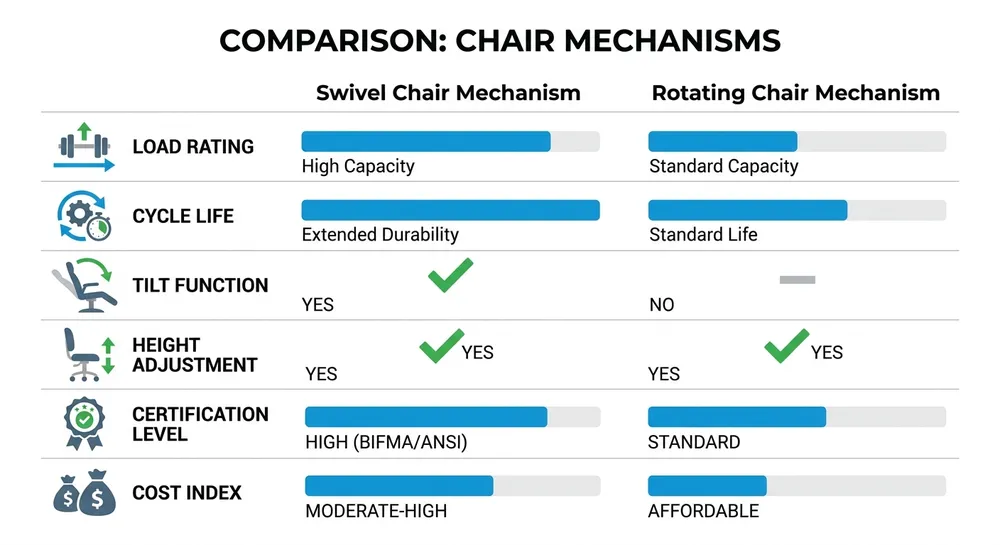
| Dimension | Swivel Chair Mechanism | Rotating Chair Mechanism |
|---|---|---|
| Primary function | Tilt + rotation + height adjustment | 360° rotation only |
| Load rating (typical) | 100–150 kg dynamic | 80–200 kg static/low-dynamic |
| Cycle life standard | 50,000–100,000 tilt cycles | Bearing-rated (rotation cycles, not tilt) |
| Gas lift compatibility | Yes — integrated mount | No (or requires adapter plate) |
| Tilt range | 12–18° recline | None |
| Spring adjustment | Yes — tension knob | None |
| Steel construction | Cold-rolled plate, 2.0–3.5mm | Stamped plate, 1.5–2.5mm |
| Surface treatment | Powder coat or zinc plate | Powder coat or chrome |
| Certifications required | BIFMA, EN 1335 (office use) | Varies — often none for lounge |
| Typical MOQ (our catalog) | 500 units | 500 units |
| Relative unit cost | Higher | Lower |
| Assembly complexity | Higher — multi-component | Lower — 2–3 parts |
—
The Hidden Cost Gap: Certification, Warranty, and Misapplication Risk
The unit price difference between a swivel mechanism and a rotating base mechanism is visible on the quote. The downstream cost difference is not — and that's where buyers get hurt.
Certification exposure is the first hidden cost. Office chair mechanisms sold into North American commercial markets need BIFMA X5.1 compliance. European markets require EN 1335. These standards specify tilt strength, fatigue cycle minimums, and stability requirements that a rotating-only mechanism cannot meet — because it was never designed to. If you source a rotating base mechanism and install it in a product marketed as an office chair, you're carrying the certification gap. One warranty claim or one product liability incident in a commercial account will cost more than the per-unit savings across your entire order.
We've seen this substitution happen. A buyer sources a lower-cost "swivel base" that is actually a rotating plate assembly, installs it in a task chair, and ships to a corporate furniture dealer. The dealer's procurement team runs a compliance check before the order ships to their client. The chair fails the tilt stability test. The entire order gets rejected. The buyer eats the return freight, the re-sourcing cost, and the relationship damage with the dealer. (That scenario is not hypothetical — we've had buyers come to us after exactly that situation to re-source correctly.)
Cycle life mismatch is the second hidden cost. A rotating mechanism bearing is rated for rotation cycles — thousands of spins under static load. It is not rated for the bending fatigue that a tilt mechanism experiences under dynamic seated use. Install a rotating mechanism where a swivel mechanism belongs, and the bearing race will develop play within months of commercial use. The chair wobbles. The user complains. The dealer calls for warranty service.
Over-specification is the third hidden cost — and it runs the other direction. Sourcing a full swivel mechanism for a lounge chair application adds 30–50% to your mechanism unit cost for functions the chair will never use. Your retail price goes up, your margin compresses, or both. For high-volume lounge or hospitality seating programs, that cost delta across 2,000–5,000 units is real money.
—
Application Showdown: Three Scenarios, Clear Winners
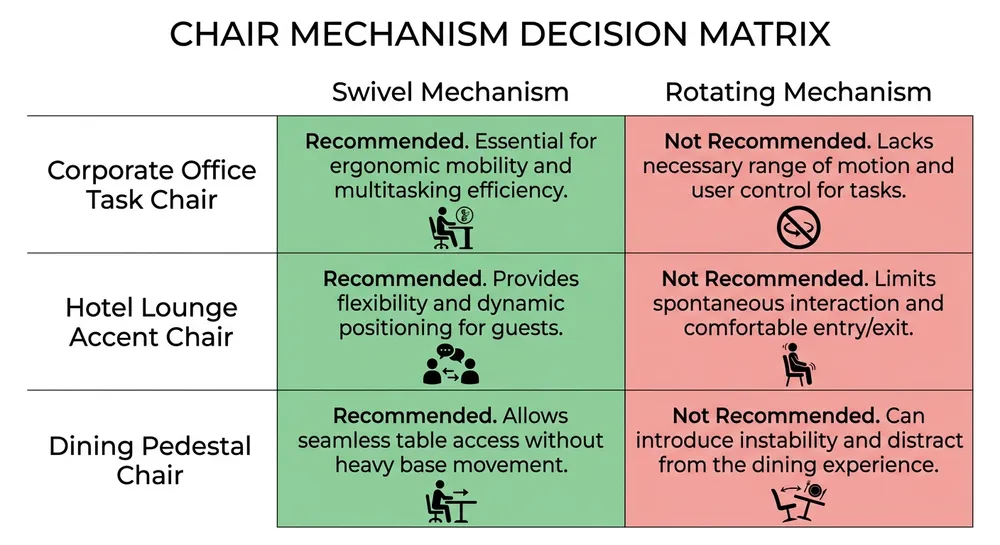
Scenario 1: Corporate Office Task Seating — Swivel Mechanism Wins
A furniture manufacturer supplying ergonomic task chairs to corporate accounts needs BIFMA compliance, 8-hour daily use durability, and tilt adjustment for posture support. The end user sits in this chair for 40+ hours a week. The dealer carries warranty liability for 3–5 years.
Winner: Swivel chair mechanism. No alternative. The tilt function, the gas lift interface, the load-cycle rating, and the certification path are all built into the swivel mechanism design. A rotating base cannot be adapted to meet this spec without rebuilding it into a swivel mechanism — at which point you're just paying for a swivel mechanism anyway.
Specify: cold-rolled steel plate, 2.5–3.0mm tilt housing, 100 kg dynamic load rating minimum, 80,000-cycle fatigue tested, BIFMA or EN 1335 documentation with shipment.
Scenario 2: Hotel Lobby Accent Chair / Lounge Seating — Rotating Mechanism Wins
A hospitality furniture importer is sourcing rotating accent chairs for hotel lobbies and lounge areas. The chairs are used intermittently, primarily for aesthetic effect and occasional repositioning. No tilt function is needed. The design brief calls for a low-profile pedestal base.
Winner: Rotating chair mechanism. A full swivel mechanism adds unnecessary cost, mechanical complexity, and height to the base assembly. A quality rotating plate mechanism with a 120 kg static load rating, smooth bearing action, and powder-coated finish handles this application cleanly. The lower unit cost protects margin on what is typically a design-driven, price-sensitive product category.
Specify: 1.8–2.0mm stamped steel plates, sealed bearing race, 120 kg static load minimum, powder coat finish, 360° smooth rotation with no detent unless specified.
Scenario 3: Dining Pedestal Chair — Rotating Mechanism Wins, With Caveats
A dining furniture brand wants a rotating pedestal chair for restaurant and residential dining use. Rotation is the feature. The chair needs to spin smoothly when the user sits down and repositions.
Winner: Rotating mechanism — but load rating and bearing quality matter more here than in the lounge scenario. Dining chairs take impact loading (people sit down with force, not just settle in). Specify a higher static load rating (150 kg minimum), a bearing race with adequate radial load capacity, and a bottom plate with enough footprint to resist tipping under off-center load.
(We've had buyers underspec the bearing on dining applications and come back six months later with field complaints about rough rotation. The bearing grade is not a place to save cost on this application.)
—
What to Verify When Sourcing Either Mechanism
The spec table and application logic above tell you which mechanism to buy. This section tells you what to check before you commit to a supplier.
For swivel chair mechanisms:
- Request the tilt fatigue test report — specifically the cycle count and load applied. "50,000 cycles" means nothing without the load spec. BIFMA X5.1 specifies the test load; ask for the actual test report, not just a certificate number.
- Check the gas lift mount tolerance. The interface between the mechanism plate and the gas cylinder is a common dimensional inconsistency point across suppliers. If your gas lift is sourced separately, confirm the taper spec (Class 4 taper is standard for most commercial cylinders) matches the mechanism mount.
- Ask about the spring adjustment range. Mechanisms with a narrow spring tension range limit the chair's usability across different user weights. A good commercial mechanism should cover 50–110 kg user weight with the tension knob adjustment.
- Verify surface treatment spec. Powder coat on a swivel mechanism needs to hold up to the underside of a chair — contact with flooring, cleaning chemicals, and occasional impact. 60μm minimum film thickness, cross-cut adhesion test passed.
For rotating chair mechanisms:
- Confirm bearing type and sealing. Open bearings collect dust and debris and develop rough rotation within months in commercial environments. Specify sealed bearings for any hospitality or commercial application.
- Check the plate flatness tolerance. A rotating mechanism with a warped top plate will cause the chair to rock on the pedestal base. Ask for flatness spec — ±0.5mm across the plate diameter is a reasonable commercial standard.
- Verify load rating is static, not dynamic. Some suppliers quote dynamic load ratings on rotating mechanisms that are primarily static-load components. Make sure the rating matches your actual use case.
- For restaurant and high-traffic applications, ask about the rotation torque spec. Too-easy rotation (very low torque) means the chair spins unintentionally when the user shifts weight. A slight resistance — typically 0.5–1.5 Nm — is the right range for dining applications.
We run 100% functional testing on every mechanism unit before shipment — tilt engagement, lock function, rotation smoothness, and mounting interface check. For swivel mechanisms, load-cycle batch qualification runs at 50,000 cycles minimum as standard. If your market or product certification requires higher, specify it in the RFQ and we'll confirm the test protocol.
—
Sourcing Both Mechanisms from One Factory: The Consolidation Argument
If your product line spans both office and lounge seating — which is common for furniture importers and distributors building out a full catalog — sourcing swivel and rotating mechanisms from the same factory has real supply chain value.
Single-source documentation: one set of compliance documents, one supplier audit, one quality agreement. When your compliance team or a retail buyer asks for test reports, you're pulling from one file, not chasing two suppliers.
Consolidated container loading: mechanisms from the same factory pack into the same container. Mixed-product loads from a single source are straightforward to document and clear customs without the complexity of multi-supplier consolidation.
MOQ flexibility across SKUs: when you're ordering both mechanism types, the combined volume often unlocks better pricing and scheduling priority than two separate small orders from two suppliers. Our standard MOQ is 500 units per SKU — if you're running both swivel and rotating mechanisms in the same order, we can discuss how to structure the run.
(We currently supply both mechanism types to several importers who started with one category and added the other after the first container. The transition is clean because the QC documentation format, packaging spec, and export paperwork are already established.)
For buyers building or expanding a Chair Mechanism product line, the consolidation argument is worth running the numbers on before you split the sourcing.
—
Frequently Asked Questions
Can a rotating mechanism be upgraded to a swivel mechanism later? No — not in any practical sense. The two mechanisms have different structural geometries, load paths, and mounting interfaces. A rotating base plate cannot be retrofitted with tilt and height-adjustment functions. If your product brief might evolve toward office or ergonomic seating, spec the swivel mechanism from the start.
What steel thickness should I specify for a commercial swivel mechanism? For standard commercial office use (100 kg user, 8-hour daily use), 2.5mm cold-rolled steel on the tilt plate is the working minimum. High-use environments — call centers, 24-hour operations, heavy-user applications — should specify 3.0–3.5mm with reinforced pivot points. Thinner than 2.5mm on a commercial swivel mechanism is a warranty risk.
Do rotating mechanisms require any certifications for export? For lounge and accent chair applications, most markets don't require specific mechanism certifications — the chair-level stability and load tests (if required) are typically conducted on the finished product. However, if the rotating mechanism is used in a product marketed for office or task use, the full BIFMA or EN 1335 certification path applies regardless of what the mechanism is called.
What's the typical lead time for a standard catalog mechanism order? For catalog swivel and rotating mechanisms, 25–35 days from order confirmation and deposit. OEM or modified-spec mechanisms with new tooling run longer — we'll give you a milestone schedule, not a single date.
Can you supply both swivel and rotating mechanisms with matching surface finishes for a coordinated product line? Yes. We run powder coat, nickel plate, and zinc plate in-house, so finish matching across mechanism types in the same order is straightforward. Specify the finish and any RAL color requirement in your RFQ.
—