The question isn't which mechanism feels better to sit in. The question is which one comes back to you in a warranty claim — and how often.
If you're sourcing seating for high-traffic commercial environments, or building a product line that needs to hold up across a three-year contract furniture cycle, the motion type you specify has a direct line to your after-sales cost. Push back and tilt mechanisms look similar in a spec sheet. They fail differently, they wear differently, and they fit different seating segments in ways that matter when you're placing a 2,000-unit order.
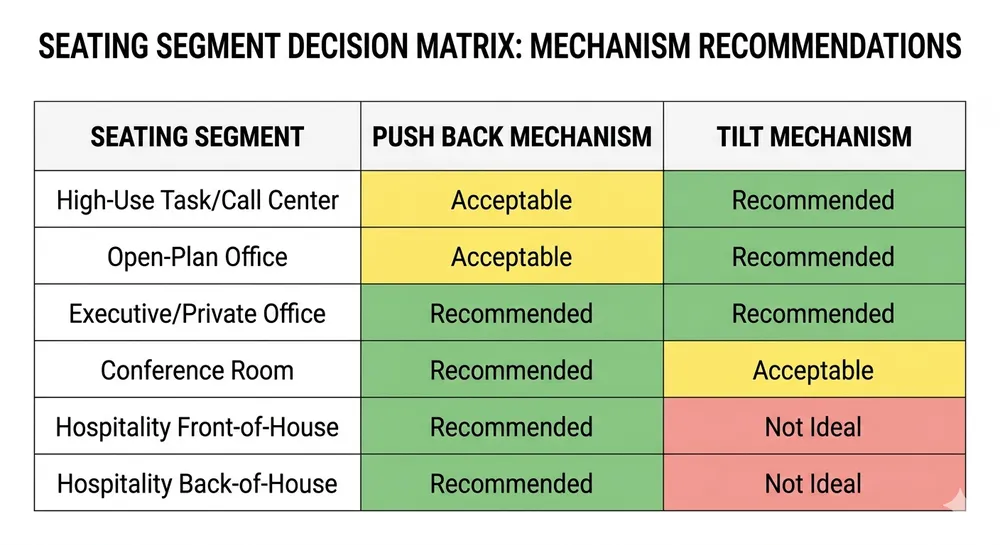
Here's the short answer before we get into the mechanics: for high-use task seating in open-plan offices, call centers, and hospitality back-of-house, push back mechanisms generate fewer warranty claims over a three-to-five year deployment cycle. Tilt mechanisms earn their place in executive and mid-market seating where usage intensity is lower and the spring-tension adjustment feature commands a retail price premium. The rest of this article explains why — and where that verdict flips.

How Each Motion Type Works — and Why the Difference Matters for Durability
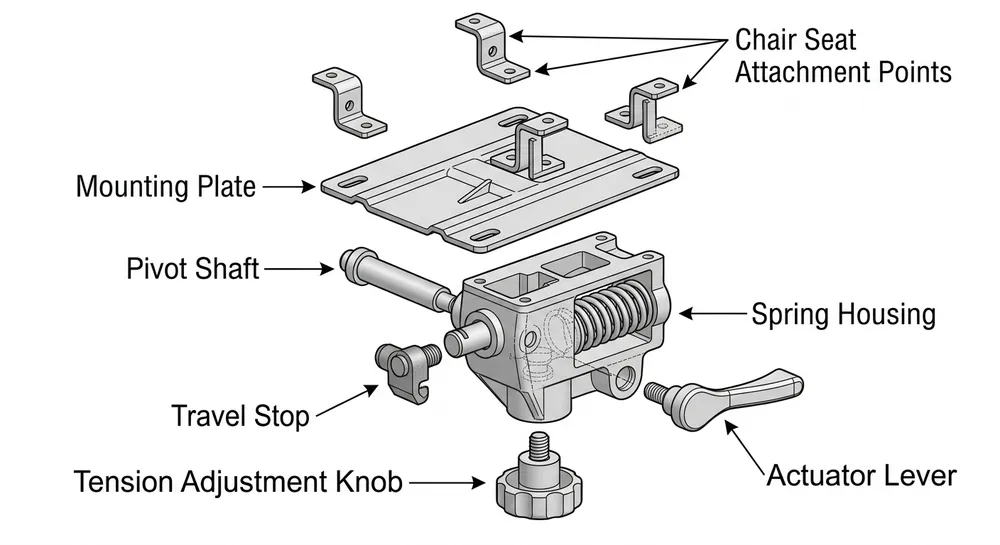
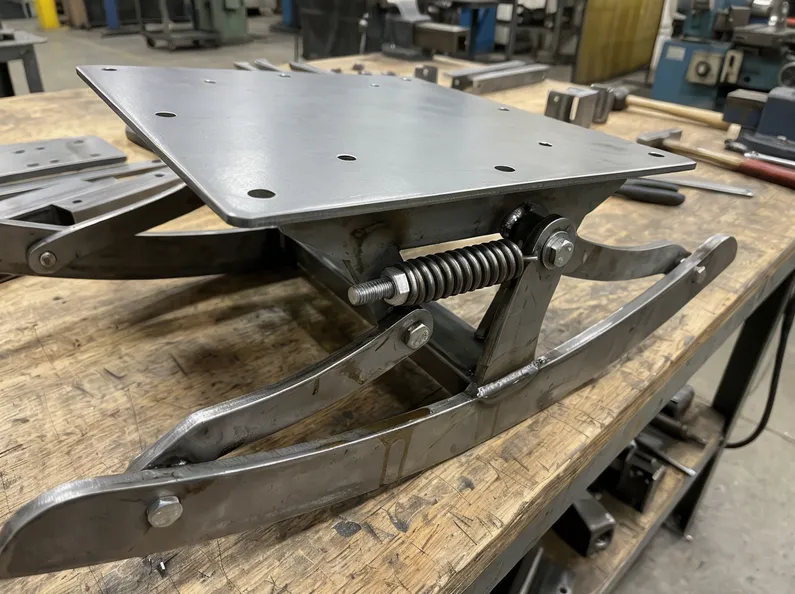
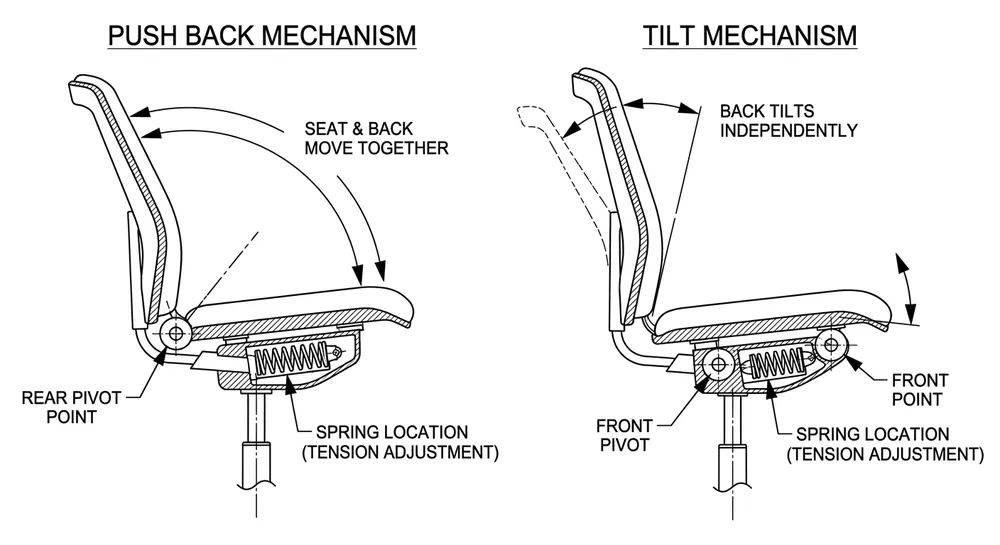
A push back mechanism moves the seat and backrest together as a single unit. The user pushes back against the backrest, and the entire seat pan travels rearward and slightly upward along a guided track. There's no independent backrest pivot. The spring load is distributed across the full seat travel path, and the mechanism locks in the upright position by default — recline only happens under active body pressure.
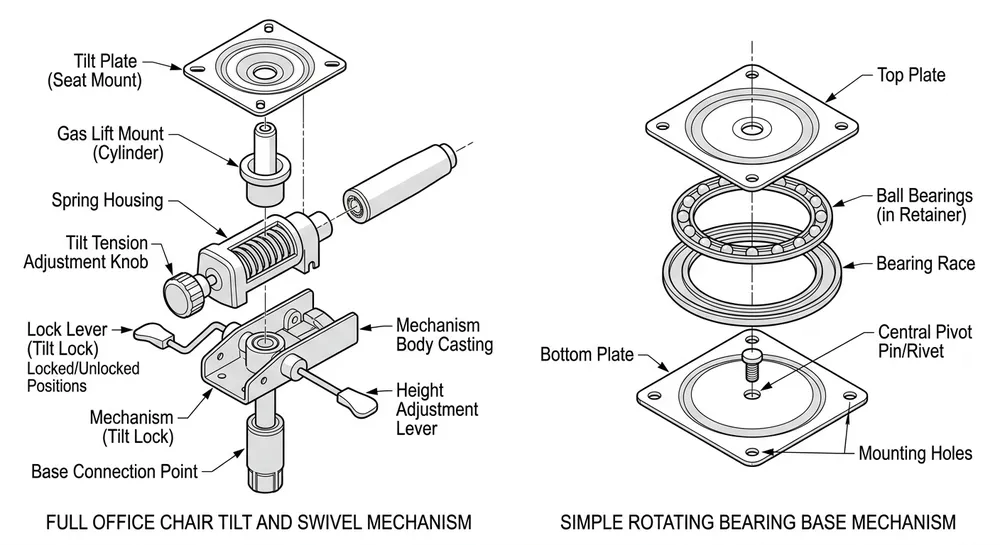
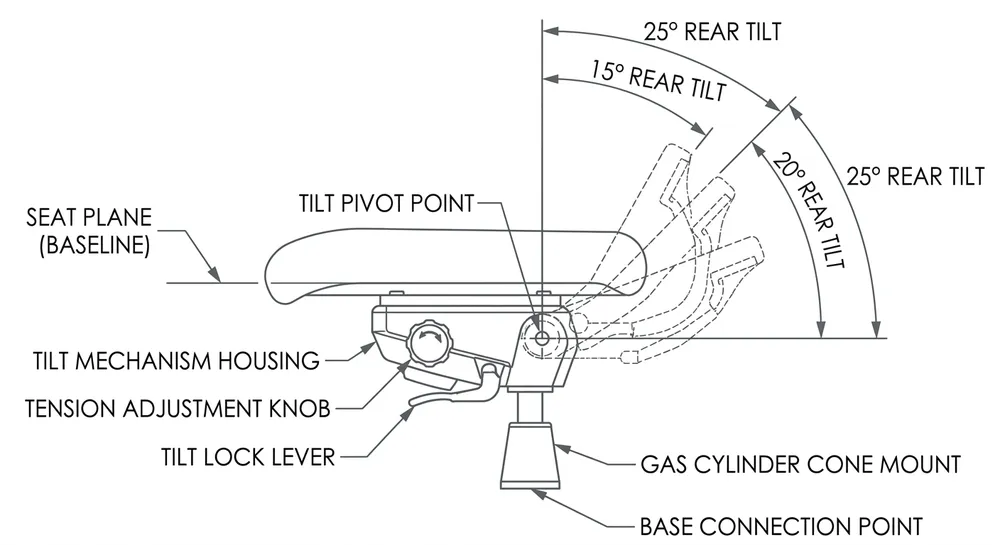
A tilt mechanism pivots the backrest independently from the seat, rotating around a front-mounted pivot point. The seat stays relatively fixed while the back tilts rearward. Most tilt mechanisms include a tension-adjustment knob — usually a threaded collar on a spring cartridge — that lets the user tune resistance to their body weight. Some variants add a tilt-lock that holds the back at a fixed recline angle.
The commercial durability difference comes down to three things: component count, pivot geometry, and the die-cast adjustment hardware.
Push back mechanisms have fewer moving parts. No tension-adjustment knob, no tilt-lock lever, no independent backrest pivot bearing. The motion path is linear and guided, which means wear is predictable and distributed. In our production experience, the failure modes on push back units are almost always in the track guides or the return spring — both of which are stamped steel components we control to ±0.15mm tolerance. They wear slowly and fail gradually, which means the chair degrades in performance before it fails outright. That's a warranty-friendly failure pattern.
Tilt mechanisms introduce the tension-adjustment knob as the highest-risk component in the assembly. That knob is a die-cast zinc alloy collar threaded onto a spring cartridge. In high-use environments, users adjust it repeatedly — and they adjust it hard, because the feedback on a worn knob is poor. The thread engagement degrades, the collar develops play, and eventually the tension adjustment stops holding. That's the number-one warranty claim we see on tilt mechanisms sourced from factories that outsource their die-casting. The dimensional inconsistency in the knob thread starts at maybe 0.3–0.4mm out of spec — invisible at incoming inspection if you're not measuring it — and it becomes a functional failure within 18 months of commercial deployment.
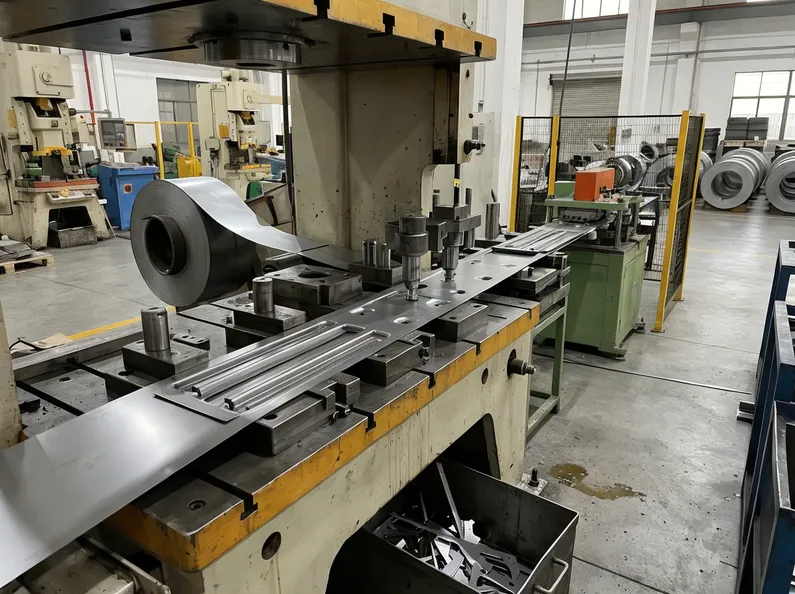
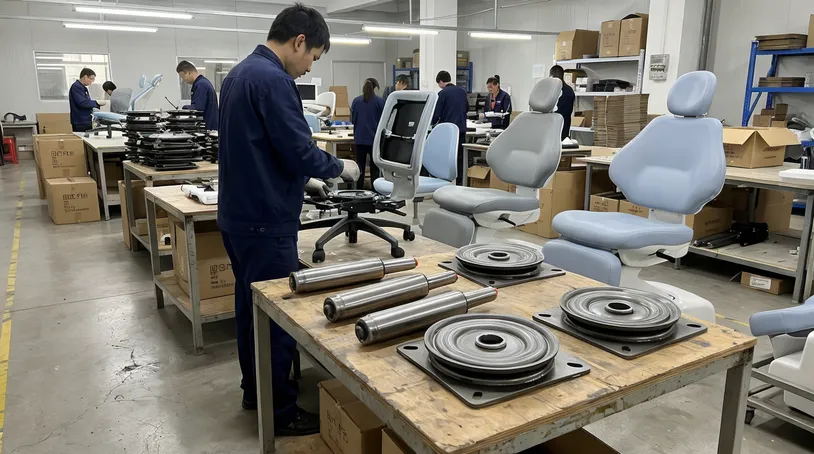
We brought die-casting in-house specifically because of this failure mode. When the knob thread is cut to our own tooling and measured on our own floor, the dimensional consistency is there from the start. (We've had buyers send us competitor samples where the knob wobble was visible before the chair was even assembled — that's what happens when the die-cast component is a purchasing line item, not a controlled process.)
Head-to-Head Specification Matrix
| Dimension | Push Back Mechanism | Tilt Mechanism |
|---|---|---|
| Motion type | Seat + back move together | Back tilts independently |
| Pivot location | Rear-mounted, linear track | Front-mounted rotary pivot |
| Adjustment hardware | None (fixed spring rate) | Tension-adjust knob + optional tilt lock |
| Component count | Lower | Higher |
| Primary failure mode | Track guide wear, return spring fatigue | Knob thread degradation, pivot bearing wear |
| Failure pattern | Gradual performance decline | Sudden loss of tension adjustment |
| Standard cycle rating | 50,000+ cycles (commercial floor) | 50,000+ cycles (varies by knob spec) |
| Warranty claim risk in high-use | Lower | Higher (knob-dependent) |
| Spring rate customization | Limited (fixed at assembly) | Yes — user-adjustable range |
| Retail price positioning | Mid-market task seating | Mid-to-premium, executive seating |
| OEM/ODM customization | Spring rate, travel stop, mounting plate | Spring cartridge, knob spec, lock positions |
| CE/SGS certification | Available | Available |
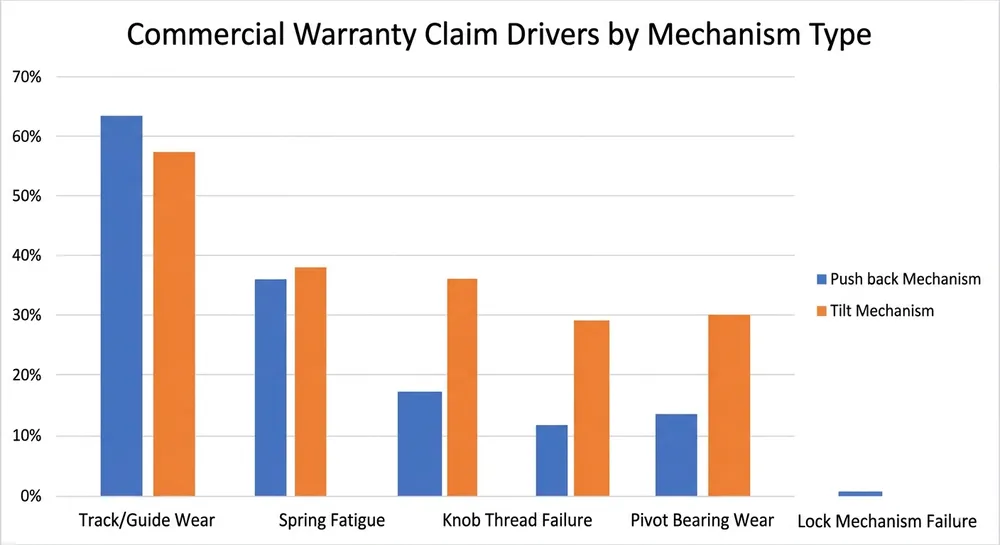
The Hidden Cost: Why Tilt Knob Failure Drives Disproportionate Returns
The spec table above shows tilt mechanisms have more components. What it doesn't show is the asymmetry in how those components fail in a commercial deployment.
When a push back mechanism degrades, it degrades in a way users tolerate for months before filing a warranty claim. The return spring gets slightly stiffer or slightly softer. The track guides develop a small amount of play. The chair still works — it just doesn't feel as crisp. In a 200-seat open-plan office, that kind of gradual decline rarely triggers a formal return. The facilities manager notices it at the next furniture refresh cycle.
Tilt knob failure is different. When the tension adjustment stops holding, the chair either reclines freely under any body pressure or locks up and won't recline at all. Both failure states are immediately noticeable and immediately uncomfortable. In a call center or hospitality environment where chairs are used by multiple people per shift, that failure gets reported the same week it happens. Your buyer files a warranty claim. You process a return or a replacement part. That's a landed cost you didn't price into the order.
The math compounds at volume. On a 500-unit contract furniture order with a 3% tilt knob failure rate at 18 months — a realistic figure for mechanisms with outsourced die-casting — you're looking at 15 replacement units or service calls. On a push back order of the same size, the equivalent failure rate on track guides at 18 months is closer to 0.5–1%, and most of those are serviceable in the field without a full unit replacement.
We run 50,000-cycle load testing as the qualification floor on all chair mechanisms before batch release. For tilt mechanisms specifically, we run the tension-adjustment knob through 2,000 adjustment cycles as a separate test — because the knob sees a different stress profile than the main mechanism body. Most suppliers don't test the knob independently. That's where the gap between a 50,000-cycle claim and a 50,000-cycle result actually lives.
Application Fit: Matching Mechanism Type to Seating Segment
High-Use Task Seating: Push Back Wins
Call centers, open-plan offices, co-working spaces, airport lounges, hospitality back-of-house — anywhere chairs are used 6–10 hours per day by rotating users. Push back is the right call here. The absence of user-adjustable tension means there's nothing for users to over-tighten, strip, or break. The mechanism either works or it doesn't, and it takes a long time to reach "doesn't."
For buyers supplying into this segment, push back mechanisms also simplify your product story. No adjustment instructions, no user error, no "the previous person cranked the knob too tight" warranty dispute. The chair reclines when you push back. That's the whole feature set.
Executive and Mid-Market Seating: Tilt Has a Place
Executive seating, private offices, conference rooms, and mid-market task chairs where the tension-adjustment feature is a selling point — tilt mechanisms belong here. Usage intensity is lower (one user, standard business hours), and the ability to tune recline resistance to body weight is a genuine feature that supports a higher retail price point.
The warranty risk profile is also lower in this segment. A single-user executive chair in a private office sees maybe 1,500–2,000 recline cycles per year. At that rate, even a tilt knob with moderate dimensional tolerance will outlast the furniture refresh cycle. The failure modes that show up in call centers don't show up here.
(The segment distinction matters for your MOQ planning too — executive seating typically runs in smaller quantities per SKU, which is where our 500-unit MOQ on standard catalog mechanisms gives you flexibility without forcing a large commitment on a single configuration.)
Contract and Hospitality Seating: Depends on the Spec
Hotel lobbies, conference centers, healthcare waiting areas — this segment splits based on usage pattern. Front-of-house hospitality seating that sees continuous public use should be specced as push back. Back-of-house staff seating follows the same logic as task seating. Conference room chairs with moderate daily use can go either way, but if the buyer's downstream customer is a hotel or healthcare facility with a strict warranty SLA, push back reduces your exposure.
Sourcing Validation: What to Check Before You Place the Order
The mechanism type decision is only half the sourcing question. The other half is whether the supplier's production process actually delivers the cycle-life rating they claim.
On cycle-life claims: Ask for the test report, not just the number. A 50,000-cycle claim means nothing without documentation of the test load, test frequency, and which components were measured for wear after the test. The standard EN 1335 test protocol specifies load and cycle parameters — if a supplier can't reference the test standard their claim is based on, the number is marketing copy.
On tilt knob dimensional spec: If you're sourcing tilt mechanisms, ask specifically about the tension-adjustment knob: what's the thread tolerance, what's the die-cast dimensional spec, and is the die-casting done in-house or outsourced? A supplier who outsources die-casting can't give you a meaningful answer to the third question — and that's your answer.
On certification documentation: CE and SGS certification should ship with the order, not arrive three weeks later when your customs broker asks for it. For EU market buyers, the CE declaration of conformity needs to reference the specific mechanism model, not a generic product category. RoHS documentation matters if your downstream customers are in California or the EU — get it confirmed before the order, not after.
On OEM/ODM customization: If your seating segment requires a specific spring rate, travel stop distance, or mounting plate geometry, confirm the supplier has in-house tooling capability. Suppliers who rely on third-party tooling shops add 2–4 weeks to every sample revision cycle. For a mechanism that needs 3–4 sample iterations to lock the spec, that's a significant timeline difference.
For our Push Back Chair Mechanism catalog, we supply full test documentation with every batch — EN 1335 load cycle reports, dimensional inspection records, and CE/SGS certificates. The same documentation package is available for tilt mechanism orders. If you're comparing supplier quotes and one of them can't produce this documentation on request, that's a risk signal worth pricing into your decision.
Scenario Decision Guide
Scenario 1: 800-unit order for a call center furniture contract, 3-year warranty obligation Push back. The usage intensity and warranty SLA make tilt knob failure risk unacceptable. Specify a push back mechanism with a 50,000-cycle test certification and a fixed spring rate matched to the average user weight range for the deployment environment. Your warranty exposure is predictable and low.
Scenario 2: 300-unit executive chair line for a mid-market office furniture brand Tilt mechanism, but specify the knob carefully. At 300 units and single-user executive deployment, the usage intensity is low enough that tilt knob failure won't be a systematic problem. The tension-adjustment feature supports your retail price point. Source from a supplier with in-house die-casting and ask for the knob dimensional spec — the thread tolerance should be within ±0.1mm to avoid early play development.
Scenario 3: 1,200-unit hospitality order for a hotel chain, mix of lobby and back-of-house Split the spec. Lobby and front-of-house seating gets push back — public-use, rotating users, no tolerance for adjustment-related failures. Back-of-house staff seating can go tilt if the hotel's procurement team wants the tension-adjustment feature for staff comfort. Run them as two SKUs with separate certification documentation.
Scenario 4: New product line entry, uncertain volume, need OEM flexibility Start with push back on a standard catalog mechanism at 500-unit MOQ to test the market. Push back mechanisms have a simpler component set, which means lower OEM tooling cost if you need a custom mounting plate or travel stop. Once volume is established, you can layer in a tilt variant for the premium SKU tier.
What to Include in Your RFQ
Whether you land on push back or tilt, the RFQ should specify:
- Seating segment and usage intensity — daily hours of use, single-user vs. rotating users
- Target cycle-life rating — minimum 50,000 cycles for commercial; specify higher for call center or 24/7 environments
- Spring rate range — or target user weight range if you want the supplier to recommend the spring spec
- Mounting plate geometry — standard 4-hole pattern or custom
- Surface finish — zinc plating, nickel plating, or powder coat depending on your assembly environment
- Certification requirements — CE, SGS, RoHS as applicable to your target market
- Annual volume and MOQ flexibility — this affects whether OEM tooling makes economic sense
The Chair Mechanism category page covers the full range of motion types we produce, including tilt variants with different lock configurations. If you're not certain which spec fits your seating segment, send us the deployment details — usage environment, target retail price, and any warranty SLA your buyer has imposed — and we'll come back with a specific mechanism recommendation and a factory-direct quote.
You can also go directly to Request Quote with your volume and market details.