Most sourcing problems with chair mechanisms don't start at the factory. They start at the RFQ stage, when a buyer sends a vague brief — "standard tilt mechanism, black finish, 150kg capacity" — and gets back ten quotes that are technically compliant but wildly different in what they'll actually deliver. The mechanism that arrives may tilt, lock, and adjust. Whether it does those things consistently across 10,000 units, survives 50,000 use cycles, and holds its finish through two years of commercial use depends entirely on design decisions the buyer never specified.
This article covers what those decisions are, why they matter at the procurement stage, and what a complete mechanism brief looks like before you send it to a supplier.
—
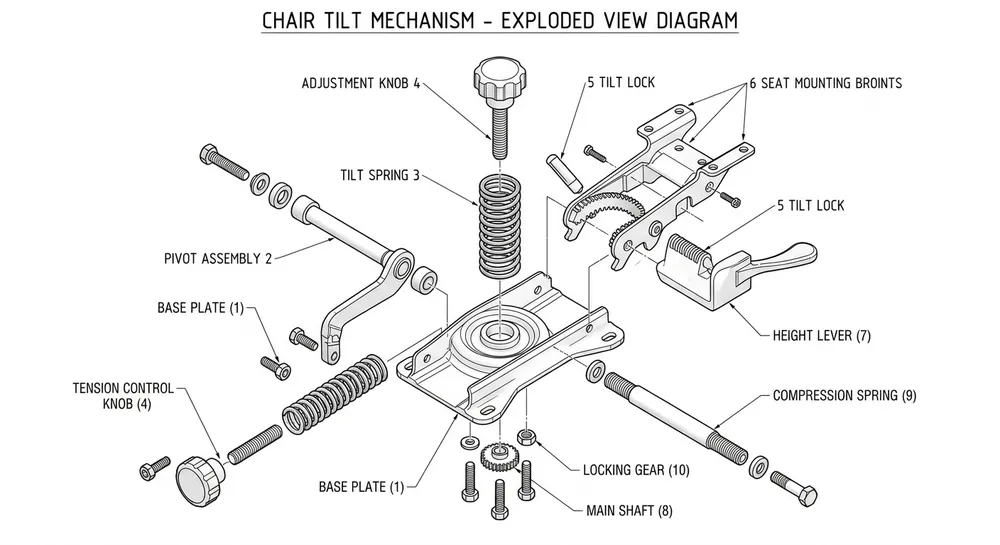
The anatomy of a chair mechanism: what the components actually do
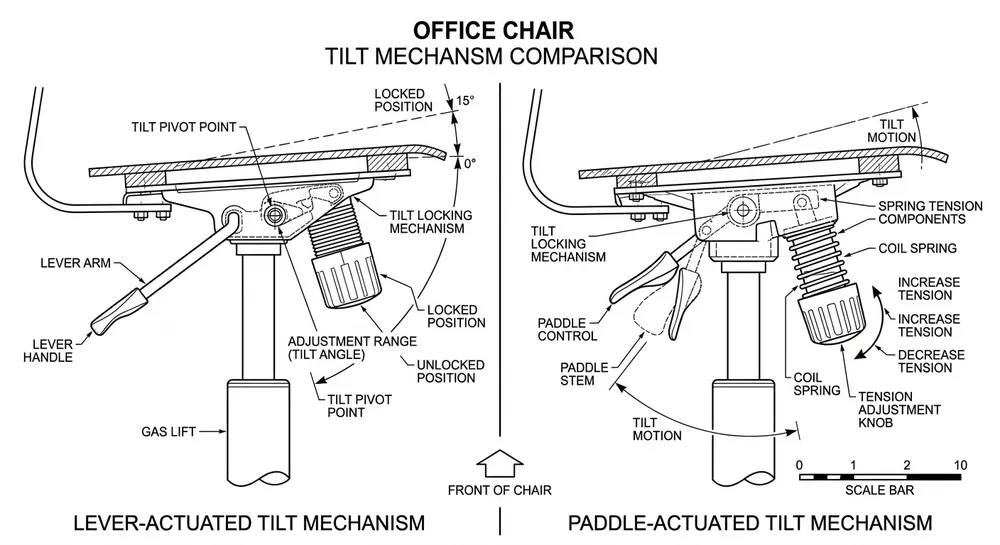
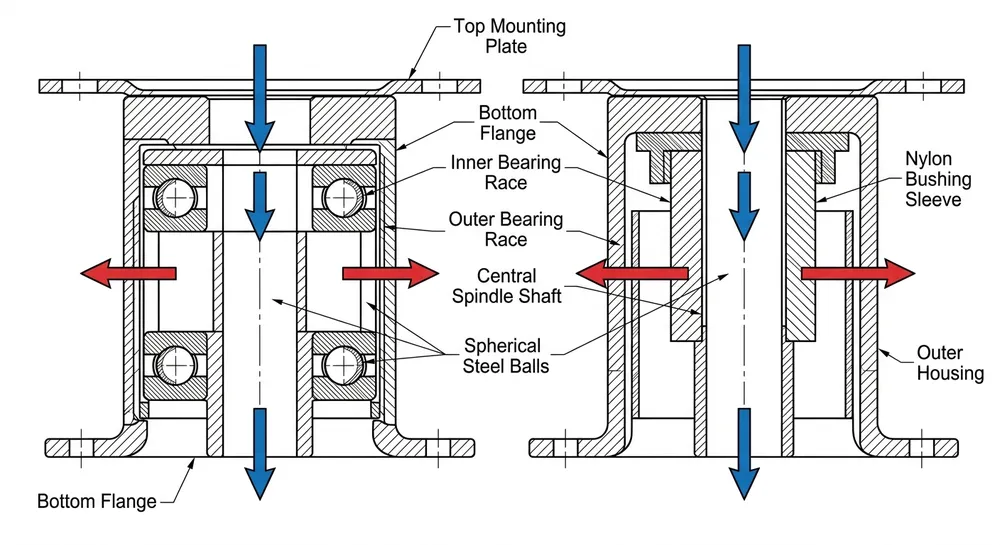
A chair tilt mechanism is a load-bearing assembly. Every component in it has a structural role, and the design of each one affects batch consistency, cycle life, and your downstream warranty exposure.
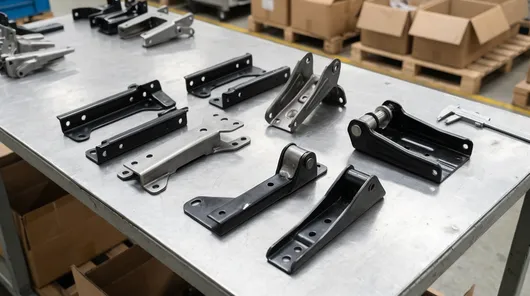
The base plate is the primary structural member — it mounts to the chair's gas cylinder and carries the full seated load. Plate thickness and steel grade determine whether the mechanism deflects under load or holds its geometry. We stamp our base plates from cold-rolled SPCC steel at 3.0–4.0mm depending on the load rating spec. Thinner than 3.0mm and you start seeing permanent deformation on high-cycle commercial applications; thicker than 4.0mm adds weight and freight cost without meaningful performance gain for standard office use.
The tilt spring controls resistance through the recline arc. Spring rate — measured in N/mm — is the parameter buyers most often leave unspecified, and it's the one that generates the most end-user complaints. Too stiff and the mechanism feels locked; too soft and it bottoms out under heavier users. Spring rate needs to be matched to the declared load rating of the mechanism, not selected arbitrarily.
The pivot assembly defines the geometry of the tilt motion. Pivot placement relative to the seat pan affects whether the chair feels like it's rotating under the user or moving with them. This is a design parameter that matters more in ergonomic and executive seating than in task chairs, but it's worth specifying if your target market has expectations about recline feel.
The tilt lock is a high-wear component. The engagement mechanism — whether it's a cam lock, a ratchet, or a friction-based system — determines how precisely the lock holds position and how long it holds it before wear introduces slop. We see more warranty returns traced to tilt lock wear than to any other single component.
The adjustment knob and tension control are typically die-cast zinc alloy. This is where a lot of batch inconsistency originates in the broader market — most factories outsource die-cast components to third-party foundries, which means dimensional variation and surface finish inconsistency are outside their control. We brought die-casting in-house in 2015 specifically because of this. When a buyer reports that the tension knob feels loose or the finish is inconsistent batch-to-batch, the root cause is almost always the die-cast part.

—
The design parameters that actually matter at the RFQ stage
Buyers who have sourced mechanisms before know the obvious specs: load rating, finish color, mounting hole pattern. The parameters below are the ones that separate a complete brief from an incomplete one — and where under-specification leads to supplier substitution you won't catch until the product is in the field.
Load rating and safety factor. The declared load rating (typically 100kg, 120kg, or 150kg for commercial office) needs to be accompanied by a safety factor. A mechanism rated at 150kg with a 1.5x safety factor is tested to 225kg static load. A mechanism rated at 150kg with no stated safety factor may have been tested to exactly 150kg. For commercial furniture going into offices, hotels, or co-working spaces, specify a minimum 2x static safety factor.
Tilt range. Standard office chair tilt range is 15–18° from vertical. Executive and ergonomic seating often specifies 20–25°. The tilt range affects spring selection, pivot geometry, and the length of the lock engagement travel — changing it after tooling is cut is expensive. Lock it in the brief.
Spring rate and user weight range. If your mechanism will be sold across a weight range (say, 60–130kg users), the spring rate needs to accommodate that range with an adjustable tension control. Specify the minimum and maximum user weight the mechanism should comfortably serve, and let the supplier confirm the spring rate and adjustment range that covers it.
Cycle life requirement. For commercial office furniture, 50,000 cycles is the standard minimum. For high-use environments — call centers, co-working spaces, hospitality — specify 80,000–100,000 cycles and ask for the test report. We run 50,000-cycle load testing as standard batch qualification on every production run, not as a special request. (If a supplier can't tell you their standard cycle test protocol without you asking, that's a signal worth noting.)
Mounting pattern. The four-bolt mounting pattern to the seat pan needs to match your chair frame. Standard patterns are 68×68mm and 100×100mm, but custom frames often use non-standard spacing. Provide a dimensioned drawing, not just a description.
Surface treatment and corrosion requirement. Nickel plating, zinc plating, and powder coating each have different performance profiles. For mechanisms going into coastal markets or humid environments, specify a minimum salt spray hours requirement — 500 hours is the standard for commercial furniture. Our powder line runs at 60–80μm film thickness, which is the range that reliably passes 500-hour salt spray. We ran thinner for a period and the coastal-market returns told us that was wrong.
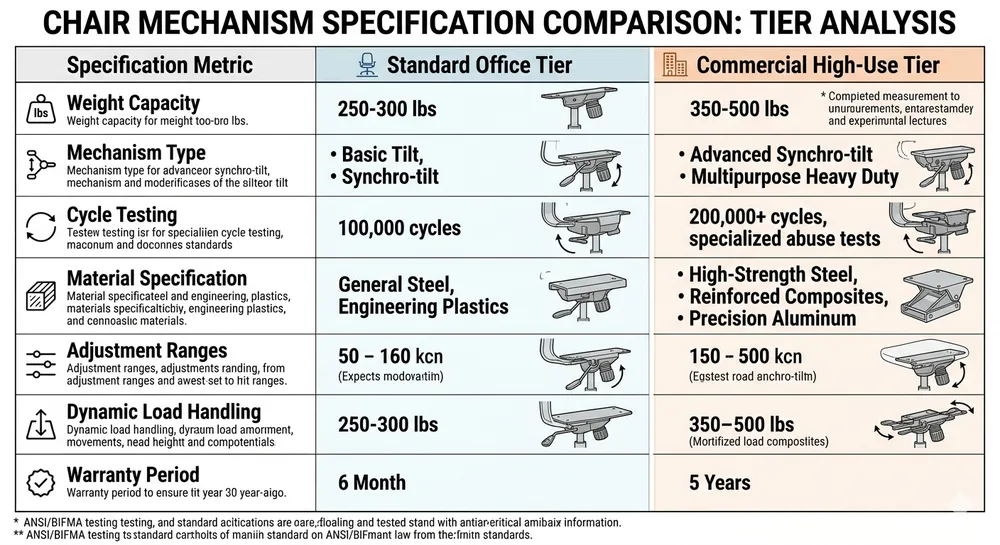
| Parameter | Standard office | Commercial/high-use | Custom/OEM |
|---|---|---|---|
| Load rating | 120kg | 150kg | Per spec |
| Safety factor | 1.5x | 2.0x | Per spec |
| Tilt range | 15–18° | 18–25° | Per spec |
| Cycle life | 50,000 | 80,000–100,000 | Per spec |
| Salt spray | 300h | 500h | Per spec |
| Spring rate | Fixed or 2-position | Adjustable | Per spec |
—
How manufacturing choices affect design performance in production
A mechanism can be correctly designed on paper and still fail in production if the manufacturing process can't hold the tolerances the design requires. This is the gap between a spec sheet and a real batch.
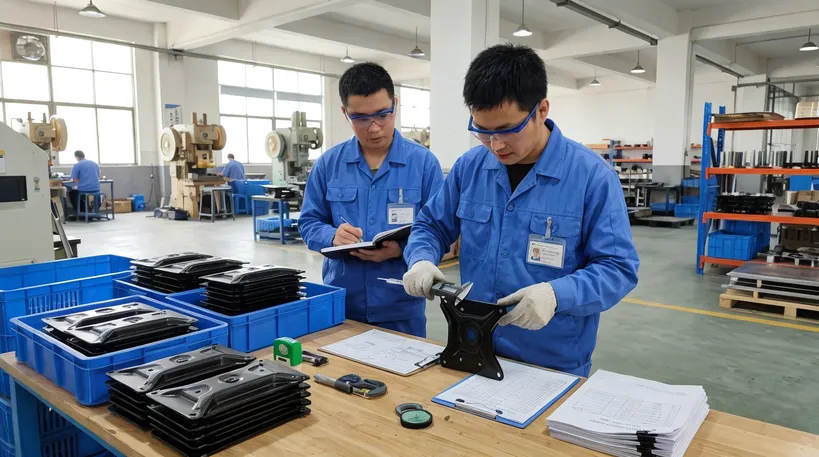
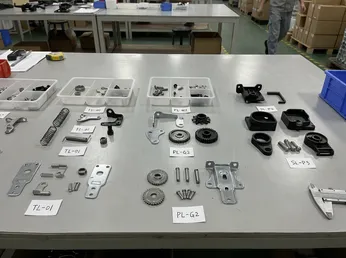
Stamping tolerance on the base plate and brackets. The base plate mounting holes need to align with the gas cylinder and seat pan within ±0.3mm or tighter, or you get assembly variation that shows up as wobble or misalignment in the finished chair. We hold ±0.15mm on structural stamped components using progressive die tooling. That's not a marketing number — it's what the tooling is built to, and it's what we check on first-article and periodic in-process inspection. Suppliers running manual or single-stage stamping typically hold ±0.5mm or worse, which is fine for non-critical brackets but not for load-bearing mechanism plates.
Die-cast component consistency. The adjustment knob, tension collar, and decorative covers are die-cast zinc alloy. The critical dimension is the bore diameter that interfaces with the adjustment shaft — if that's off by 0.2mm, the knob feels loose or binds. Foundries running high-volume multi-cavity dies without tight process control produce parts where cavity-to-cavity variation exceeds this tolerance. Because we run die-casting in-house, we control the die temperature, injection pressure, and cooling cycle — the three variables that drive dimensional consistency in zinc alloy casting. We inspect bore diameter on every die change and on periodic pulls during a run.
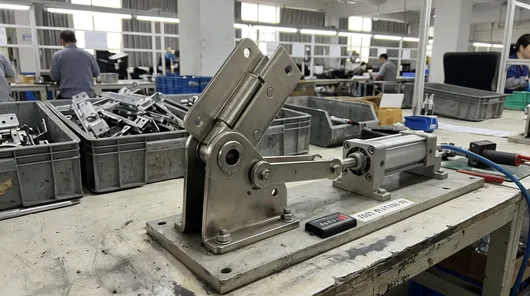
Weld quality on structural joints. The pivot bracket and spring seat are welded assemblies. Weld penetration on these joints determines whether the mechanism holds its geometry under repeated load cycling or develops play over time. We use MIG welding on structural joints and run pull-tests on welded assemblies as part of in-process inspection. Visual inspection alone doesn't catch insufficient penetration — you need a destructive pull-test on sample joints from each production run.
Surface treatment adhesion at weld seams. Powder coat adhesion failure almost always starts at weld seams, where surface contamination from flux and heat-affected zone oxidation creates a poor substrate. We grind and chemically pre-treat every weld seam before the part enters the coating line. Skipping this step saves maybe 30 seconds per part and costs you adhesion failures in the field. (We learned this from a batch of returns early on — the failures were all at weld seams, and the fix was straightforward once we traced it.)
For buyers evaluating suppliers, these are the process questions worth asking: What tolerance do you hold on base plate stamping? Do you run die-casting in-house or outsource? What's your weld inspection protocol? What pre-treatment do you run before powder coating? A supplier who can answer these specifically is running a controlled process. A supplier who answers with "we have strict quality control" is not.
—
OEM vs. catalog: when standard design is enough and when it isn't
Most buyers sourcing chair mechanisms for the first time default to catalog items — standard tilt mechanisms in common load ratings and finishes. That's the right starting point for most applications. Catalog mechanisms are proven designs with known performance profiles, available at lower MOQ (500 units for our standard range), and faster to market because tooling already exists.
The case for OEM or ODM work is narrower but real. You need a custom mechanism when:
- Your chair frame uses a non-standard mounting pattern that catalog items won't fit
- Your target market has a specific performance requirement (tilt range, cycle life, weight capacity) that falls outside standard catalog specs
- Your brand requires a specific aesthetic on visible components — knob shape, finish, logo marking — that differentiates your product at retail
- You're building a product line where mechanism performance is a selling point, not a commodity spec
For ODM work, you bring us a brief: target retail price, market segment, load and cycle requirements, and any aesthetic direction. Our engineering team — 12 people who work exclusively on mechanism hardware — develops the design, builds the tooling in-house, and runs samples. In-house tooling matters here because when a sample needs a geometry change, the revision happens on our floor, not in a negotiation with a third-party tooling shop. Typical sample-to-approval cycles run 2–3 rounds; having tooling in-house cuts the calendar time on each round.
For OEM work, you supply the drawings and we review them for manufacturability before committing to tooling. We flag issues — wall thickness that won't fill cleanly in die-casting, bend radii that will crack at the stamping stage, tolerances that require process capability we'd need to verify — before the tooling is cut, not after. That review is part of the quoting process, not a separate engagement.
If you're not sure whether your requirement fits a catalog item or needs custom work, the fastest path is to send us your load rating, tilt spec, mounting dimensions, and a photo or drawing of your current mechanism. We'll tell you whether a catalog item covers it or whether custom tooling makes sense, and what the MOQ and lead time difference looks like. See our Chair Mechanism category for the current catalog range.
—
What a complete RFQ brief looks like
The difference between a useful RFQ and a vague one is whether the supplier can quote a specific mechanism or has to make assumptions. Every assumption a supplier makes is a potential mismatch between what you expect and what arrives.
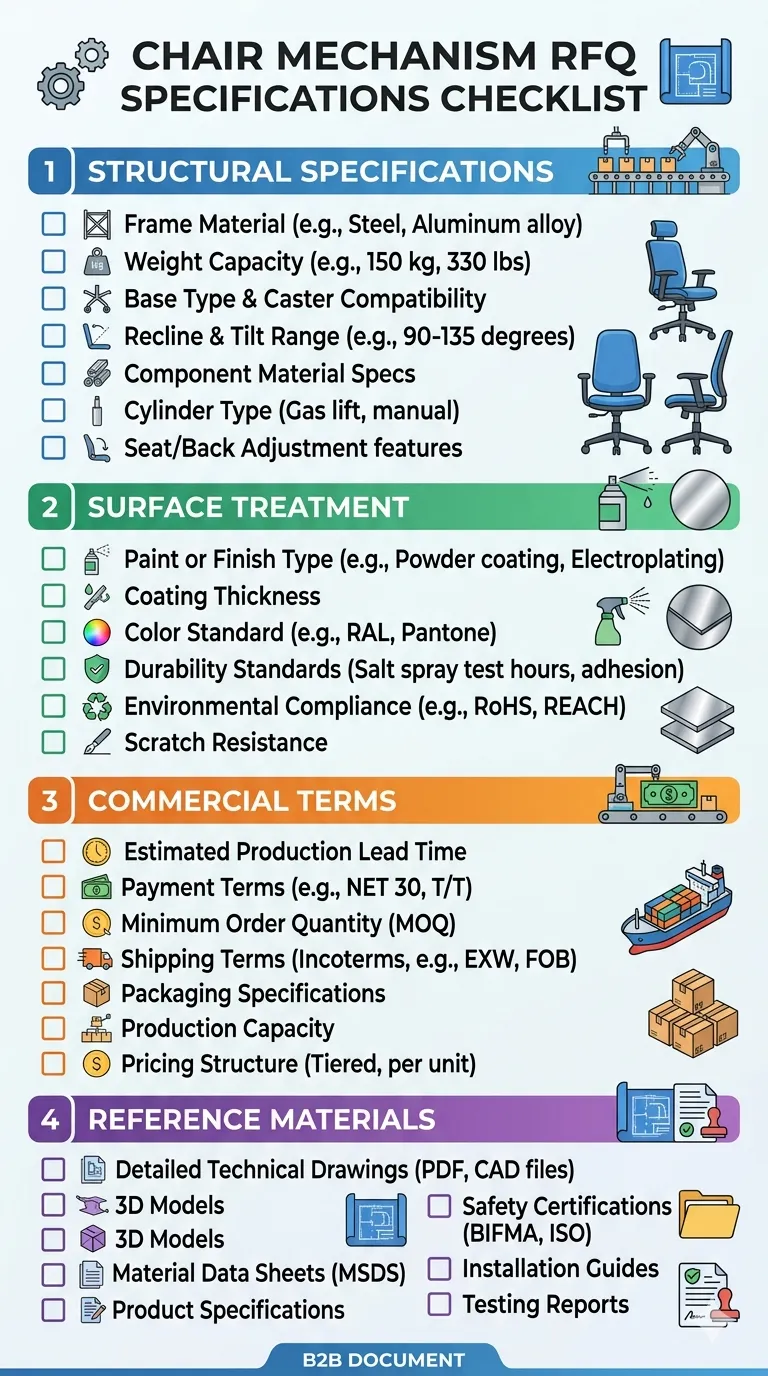
A complete brief for a chair mechanism includes:
Structural and performance specs:
- Load rating (kg) and required safety factor
- Tilt range (degrees from vertical)
- Spring rate or user weight range the mechanism must serve
- Cycle life requirement and test standard reference
- Mounting pattern dimensions (dimensioned drawing preferred)
Surface treatment:
- Finish type (powder coat, nickel plate, zinc plate)
- Color or finish reference
- Salt spray hours requirement
- Any RoHS or restricted substance requirements for your target market
Volume and commercial terms:
- Order quantity (initial and projected annual)
- Target unit price or landed cost ceiling
- Required lead time
- Sample requirement before bulk order
Reference material:
- Existing mechanism sample or photo if replacing a current supplier
- CAD drawing or sketch if custom geometry is required
- Any certification requirements (CE, BIFMA, or market-specific standards)
Sending this brief to a supplier gives them everything they need to quote a specific mechanism, not a generic one. It also makes supplier comparison meaningful — you're comparing quotes on the same spec, not on different interpretations of an incomplete brief.
For buyers new to this category, the chair mechanism types overview covers the main mechanism families (synchro-tilt, knee-tilt, multi-function) and which applications each is suited for — useful context before you finalize your spec.
—
Where design quality shows up in batch inspection
You can't verify mechanism design quality from a spec sheet. You verify it from samples and from the supplier's QC documentation. Here's what to look for.
On the sample:
- Tilt motion should be smooth through the full arc with no binding or dead spots
- Lock engagement should be positive — no play when locked, clean release when unlocked
- Tension adjustment should move smoothly through its range and hold position
- Die-cast components (knob, collar) should have consistent surface finish with no porosity, sink marks, or flash
- Powder coat should have uniform sheen with no thin spots at edges or weld seams
In the QC documentation:
- Dimensional inspection report on base plate and mounting holes
- Load test report showing static load at declared rating × safety factor
- Cycle test report showing mechanism function at declared cycle life
- Salt spray test report at declared hours
- Material certification for steel (mill test report showing grade and mechanical properties)
If a supplier can't provide these documents for a catalog item, they either don't run the tests or don't document them. Either way, you're accepting risk that will show up as warranty claims downstream. Our chair mechanism quality standards article covers the specific test protocols and what the numbers should look like for commercial furniture applications.
We run 100% functional testing on every unit before packing — not sampling. A mechanism that passes dimensional and load-cycle checks but has a sticky lock or a misaligned mounting hole gets pulled at final inspection. That's not a special arrangement; it's the standard process.
—
Frequently asked questions
What's the minimum order quantity for a standard chair mechanism? 500 units for catalog items. For OEM/ODM projects with new tooling, MOQ depends on tooling amortization — we give you the actual number based on your spec, not a round figure. Most new buyers in this category start with a 500–1,000 unit trial order to validate the mechanism with their own assembly line and end customers before scaling.
What chair mechanism design standards apply to commercial office furniture? The main references are BIFMA X5.1 (North American office seating standard) and EN 1335 (European office chair standard). Both specify static load, fatigue cycle, and stability requirements. CE marking covers EN 1335 compliance for European market entry. If you're supplying into North American contract furniture, ask your supplier whether their mechanisms have been tested to BIFMA X5.1 — not all have. Our mechanisms are tested to the load and cycle requirements of both standards; CE documentation ships with European orders.
How do I know if a catalog mechanism fits my chair frame without ordering samples? Send us your mounting pattern dimensions and gas cylinder bore diameter. We'll confirm fit against our catalog range and flag any dimensional conflicts before you commit to a sample order. If your frame uses a non-standard pattern, we'll tell you whether a simple adapter plate solves it or whether custom tooling is the cleaner path.
What causes chair mechanisms to develop play or wobble over time? Three common causes: (1) weld joint fatigue on the pivot bracket — insufficient weld penetration allows micro-movement that accumulates into visible play; (2) die-cast bore wear on the adjustment shaft interface — undersized wall thickness in the casting accelerates wear; (3) spring seat deformation under repeated load cycling — base plate gauge too thin for the declared load rating. All three are design and manufacturing process issues, not random failures. They show up in cycle testing before they show up in the field, which is why cycle test documentation matters.
Can I bring my own mechanism design for OEM production? Yes. Send us your drawings and we'll review them for manufacturability as part of the quoting process. We flag issues before tooling is cut — die-cast wall thickness, stamping bend radii, tolerance stack-ups that affect assembly. The review is included in the quote, not billed separately. If you want a Request Quote, send the drawings with your target volume and we'll come back with a manufacturability assessment and price.
—