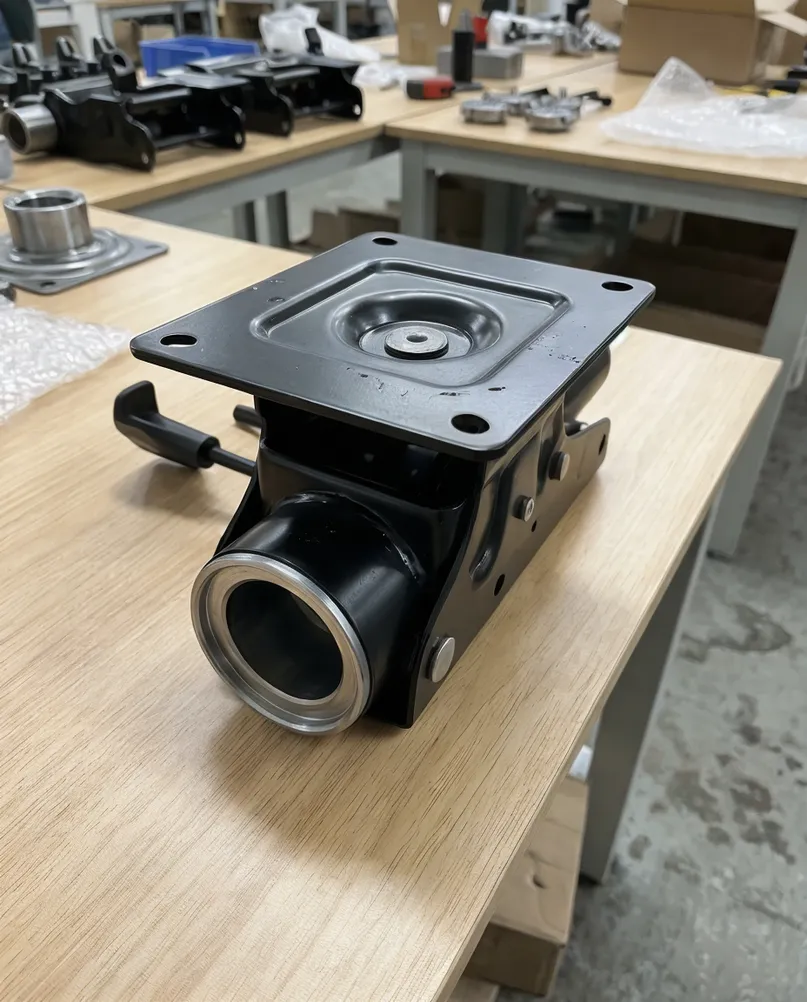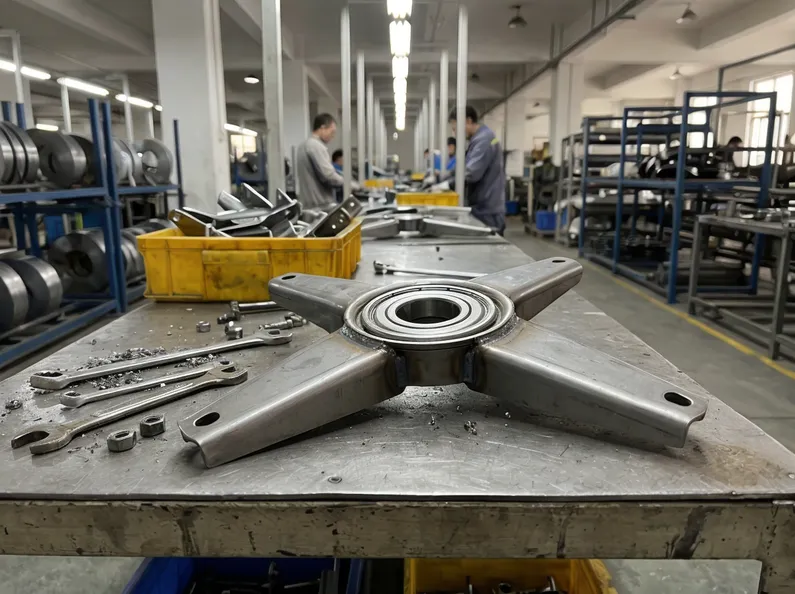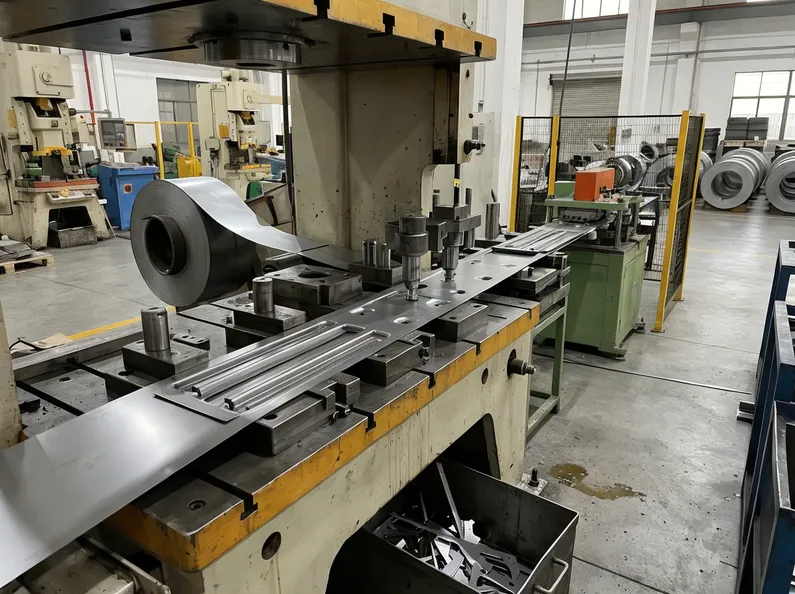
Most sourcing problems with rotating chair mechanisms don't start at the factory. They start at the spec sheet — or the absence of one. A buyer places an order based on a sample that felt smooth, a price that fit the margin, and a vague assurance that the mechanism "meets standard." Six months later, the warranty claims come in: stiff rotation after 30,000 cycles, bearing noise under load, swivel bases that wobble at 120 kg. The sample was fine. The production batch wasn't specified tightly enough to guarantee the same result.
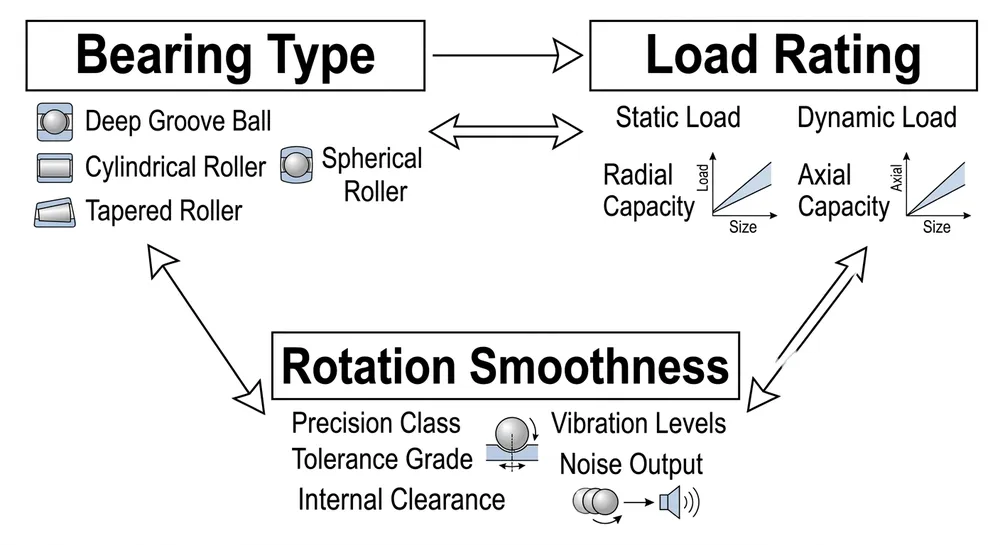
This article breaks down the three specification dimensions that actually determine whether a Rotating Chair Mechanism performs consistently across a production run: bearing type, load rating, and rotation smoothness. If you're evaluating suppliers or writing a purchase spec, these are the numbers and standards worth locking in before you place the order.

Bearing Type: The Component That Determines Everything Downstream
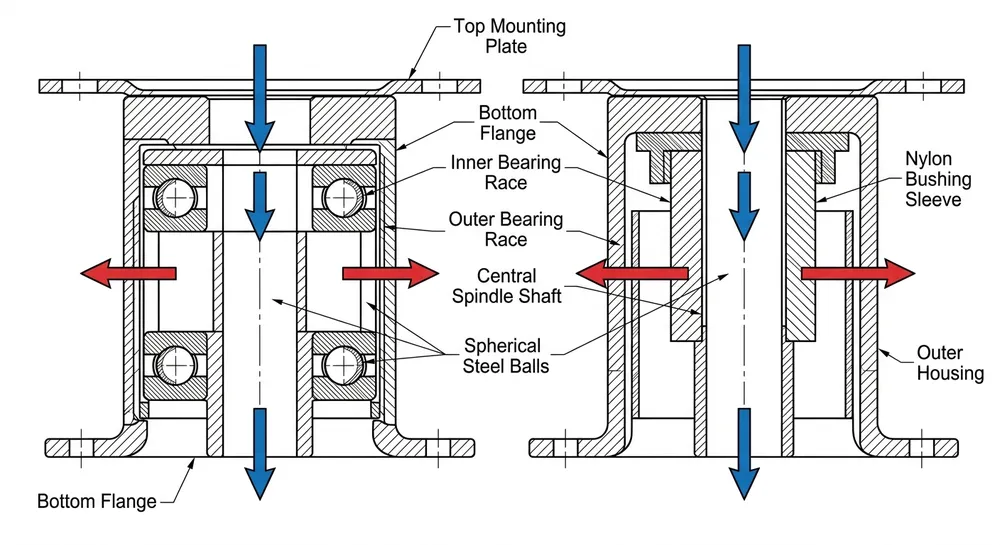
The bearing is the rotating chair mechanism's single most consequential component. It determines load distribution, rotation feel, noise profile, and long-term cycle life. Buyers who specify only "ball bearing" without further detail are leaving the most important variable open.
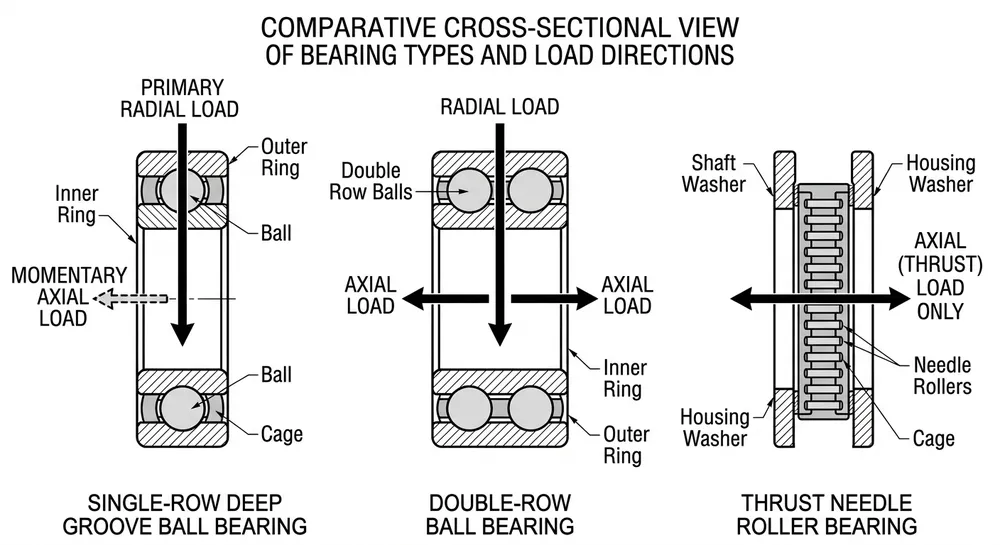
We run three bearing configurations across our chair mechanism product range, and the choice isn't arbitrary — it follows the load profile and cycle expectation of the end application.
Single-row ball bearing is the standard configuration for light-to-medium duty office chairs. Typical load capacity runs 80–120 kg static, with a cycle life of 50,000–80,000 rotations under normal use. The advantage is cost efficiency and low rotational torque — the chair spins freely with minimal effort. The limitation is that single-row geometry distributes axial load less evenly under dynamic conditions, so if your end product sees heavy users or frequent lateral loading (think task chairs in industrial environments), you'll see premature wear at the race contact points.
Double-row ball bearing adds a second row of balls in a wider outer race. Static load ratings typically reach 150–200 kg, and the geometry handles combined axial and radial loads better. We use this configuration on our heavy-duty executive chair mechanisms and on any spec where the buyer's target market includes users above 120 kg. The rotation feel is slightly firmer than single-row — not stiff, but with more resistance at the start of rotation. Some buyers in the contract furniture segment actually prefer this because it reduces the "spin-out" effect when users push off a desk.
Thrust bearing with needle roller is the configuration we specify for high-cycle, high-load applications — industrial seating, medical examination chairs, heavy-duty drafting stools. Load ratings exceed 250 kg static, and the needle roller geometry handles axial thrust loads that would deform a standard ball race within 20,000 cycles. The trade-off is rotational resistance: these mechanisms require more torque to initiate rotation, which is fine for industrial use but wrong for a light office chair where users expect effortless spin.
| Bearing Type | Typical Static Load | Cycle Life (typical) | Best Application |
|---|---|---|---|
| Single-row ball | 80–120 kg | 50,000–80,000 | Standard office, home office |
| Double-row ball | 150–200 kg | 100,000–150,000 | Executive, contract, heavy-duty office |
| Thrust + needle roller | 250 kg+ | 200,000+ | Industrial, medical, high-cycle seating |
(Note: cycle life figures assume standard lubrication at assembly and normal operating temperatures. Mechanisms used in high-humidity or high-temperature environments — coastal warehouses, commercial kitchens — should be specified with sealed bearing races and corrosion-resistant grease.)
Load Rating: What the Number Means and What It Doesn't
Load rating is the specification buyers most often misread. A mechanism rated at 150 kg does not mean it will fail at 151 kg. It means the manufacturer has tested it to perform within spec — defined rotation torque, defined deflection limits, defined cycle life — at that load. The actual failure point is typically 2–3x the rated load. What degrades first is performance consistency, not structural integrity.
This distinction matters commercially. If your buyer's end customer is a 90 kg user, a 120 kg-rated mechanism gives you adequate safety margin. But if you're selling into the North American market, where weight capacity claims on furniture are scrutinized and sometimes regulated, you want a mechanism rated at 150 kg minimum — not because the chair will be used at that load, but because the rating gives your product defensible compliance headroom.
We test load rating through two methods. Static load testing applies a fixed load at the center of the mechanism for a defined duration — typically 10 minutes at 1.5x rated load — and measures deflection and post-test rotation torque. Dynamic load testing cycles the mechanism through 100,000 rotations at rated load and checks for bearing play, torque change, and surface wear at the race. Both tests are documented in our QC reports, available on request with each production batch.
The other number buyers sometimes overlook is eccentric load tolerance — how the mechanism performs when the load isn't centered. A user leaning to one side, or a chair with an asymmetric seat shell, creates an off-center load that stresses the bearing race unevenly. Mechanisms with wider bearing pitch circles handle eccentric loads better. We specify minimum 60 mm bearing pitch diameter on all mechanisms rated above 120 kg for this reason.
(We've had buyers come to us after a competitor's mechanism failed in the field — not because the static load was exceeded, but because the seat shell design created a consistent 15-degree eccentric load that the bearing wasn't rated for. The fix was a wider-pitch bearing, not a higher load rating.)
Rotation Smoothness: How It's Measured and Why Batches Vary
Rotation smoothness is the specification that's hardest to communicate in a data sheet and easiest to feel in a sample. It's also the one most likely to drift between your sample and your production batch if it isn't locked down with measurable parameters.
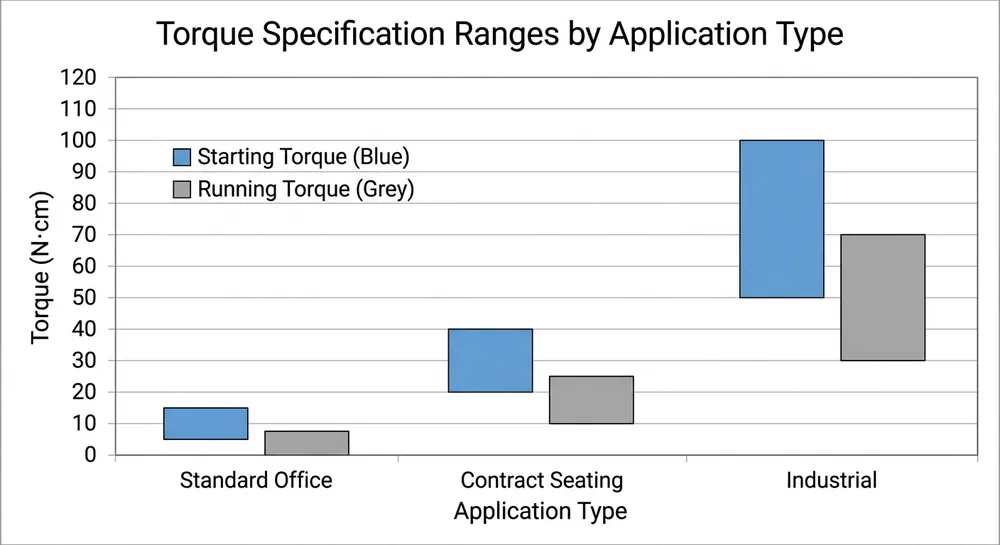
We measure rotation smoothness through two metrics: starting torque (the force required to initiate rotation from rest) and running torque (the force required to maintain rotation through a full 360-degree cycle). Both are measured in Newton-centimeters (N·cm) using a calibrated torque gauge at room temperature with standard assembly lubrication.
For a standard office chair mechanism, our target range is 8–15 N·cm starting torque and 5–10 N·cm running torque. Below 8 N·cm starting torque, the chair feels unstable — users report that it "spins too freely." Above 20 N·cm, users describe the rotation as stiff or resistant. The sweet spot varies slightly by application: contract seating buyers in Europe tend to specify tighter tolerances (10–14 N·cm) because their end customers are more sensitive to rotation feel. Industrial seating buyers are less concerned with feel and more concerned with consistency across 200,000 cycles.
The variables that cause batch-to-batch torque variation are worth knowing:
- Grease viscosity and fill volume: We use lithium-based grease at a controlled fill volume (±0.5 g per bearing assembly). Under-greased bearings start smooth and stiffen within 10,000 cycles. Over-greased bearings feel heavy from day one.
- Race surface finish: Our bearing races are ground to Ra 0.4–0.8 μm. Rougher surfaces increase running torque and accelerate wear. This is a process parameter we check on every production run, not just at incoming inspection.
- Bearing preload: The axial preload applied during assembly sets the initial torque. Too loose and you get bearing play (the wobble buyers notice immediately). Too tight and rotation stiffens. We set preload to 0.02–0.05 mm axial clearance on standard mechanisms.
What Happens When These Three Specs Aren't Aligned
Bearing type, load rating, and rotation smoothness don't operate independently. A mismatch between them is the most common root cause of field failures we see when buyers bring us problems from previous suppliers.
The typical failure pattern: a buyer specifies a 150 kg load rating but accepts a single-row bearing to keep cost down. The bearing geometry can't distribute the load evenly at 150 kg, so the race deforms slightly after 30,000 cycles. The deformation increases running torque from 10 N·cm to 25 N·cm. The chair feels stiff. The buyer gets warranty claims. The root cause isn't the load rating — it's the mismatch between the load rating and the bearing type selected to meet it.
The reverse also happens: a buyer specifies a thrust needle roller bearing for a standard office chair to get "the best bearing available." The starting torque is 30 N·cm. The chair feels like it's fighting the user. Returns come in with complaints about stiffness. The bearing is technically superior, but it's wrong for the application.
Alignment means: the bearing type is selected for the load profile, the load rating is tested under the actual bearing geometry, and the torque spec is validated at the rated load — not just at zero load on a sample unit.
Sourcing Verification: What to Request Before You Commit
When you're evaluating a rotating chair mechanism supplier, the sample tells you what one unit feels like. The documentation tells you whether the production batch will match it.
Request these before finalizing your order:
- Bearing specification sheet: bearing type, row configuration, rated load, race material (chrome steel GCr15 is standard; stainless is available for humid environments), and seal type (open, shielded, or sealed)
- Load test report: static load test at 1.5x rated load, dynamic cycle test at rated load with post-test torque measurement
- Torque measurement record: starting and running torque values from the production batch, not just the sample
- Grease specification: type, viscosity grade, and fill volume per assembly
We provide all four documents with standard production orders. For OEM or custom specifications, we can also provide dimensional inspection reports and surface finish records for the bearing race.
(One thing worth checking: ask whether the torque values on the test report were measured at room temperature or at operating temperature. Grease viscosity drops as temperature rises, so a mechanism that measures 12 N·cm at 20°C may measure 8 N·cm after an hour of use in a warm office. Both values are within spec — but if your buyer is in a cold climate, the cold-start torque matters more.)
If you're ready to specify a mechanism for your next production run, the Rotating Chair Mechanism product page has our standard configurations with bearing specs and load ratings. For custom load ratings, bearing upgrades, or OEM surface treatment requirements, send us your project specs and we'll come back with a configuration recommendation and a detailed quote.