The question lands in our inbox regularly: "Should we go with lever or paddle on this chair line?" It sounds like a simple spec decision. It isn't. The choice between a lever and a paddle chair mechanism affects your tooling cost, your assembly line speed, your warranty claim rate, and — critically — how your chair performs in the market segment you're targeting. Get it wrong and you're either over-engineering a budget chair or under-speccing a commercial one.
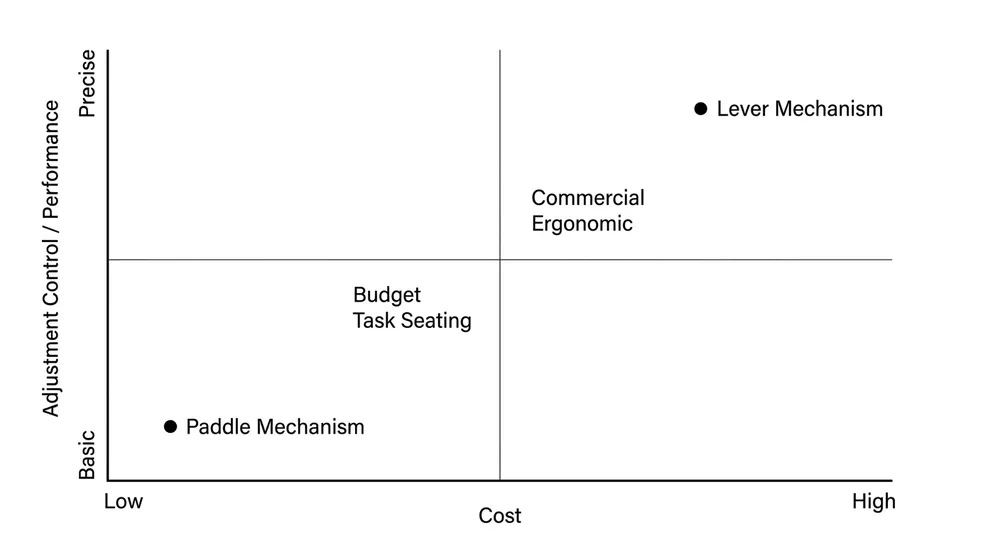
Here's the short answer before we get into the detail: paddle mechanisms win on cost and assembly efficiency for standard mid-range office chairs. Lever mechanisms win when your buyer needs precise, repeatable tilt adjustment and you're selling into commercial or ergonomic-focused segments where that control justifies a higher price point. The rest of this article explains why, and more importantly, which scenario you're actually in.

What Each Mechanism Actually Does
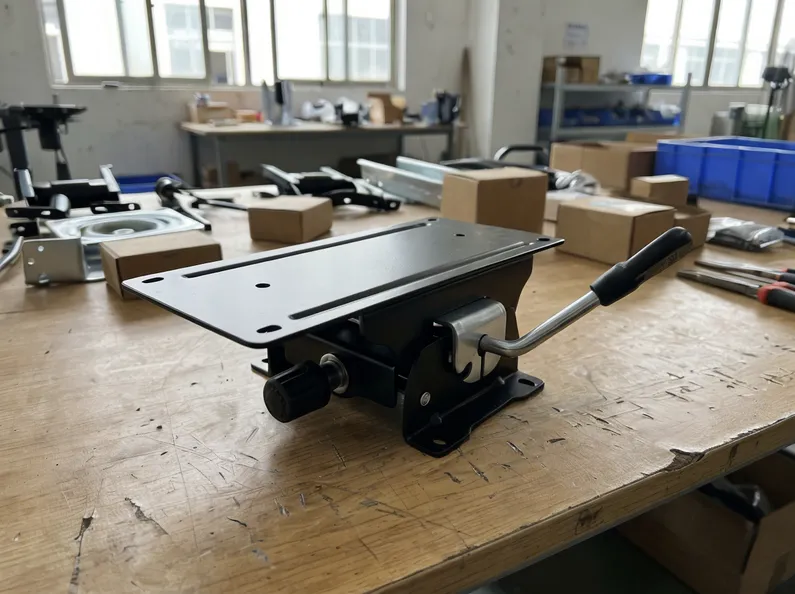
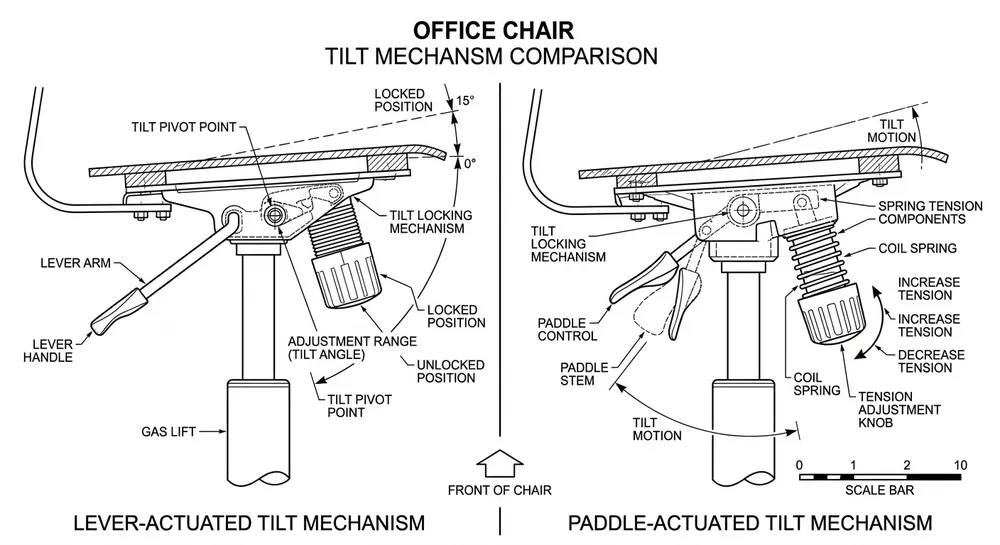
A lever chair mechanism uses a protruding lever arm — typically positioned on the right side of the seat plate — to engage and disengage the tilt lock, and in many configurations, to adjust tilt tension in discrete steps. The lever gives the user a positive, tactile control point. You pull it, the lock releases, you recline, you release it, the lock re-engages. On multi-function lever mechanisms, a second lever or a separate tension knob handles resistance adjustment.
A paddle chair mechanism replaces the lever with a flat paddle — a wider, lower-profile actuator that the user pushes or pulls with their hand or knee. The paddle typically controls tilt lock release only; tension adjustment, if present, is handled by a separate knob underneath the seat. The paddle's geometry is simpler, the actuation force is lower, and the part count is reduced compared to a full lever assembly.
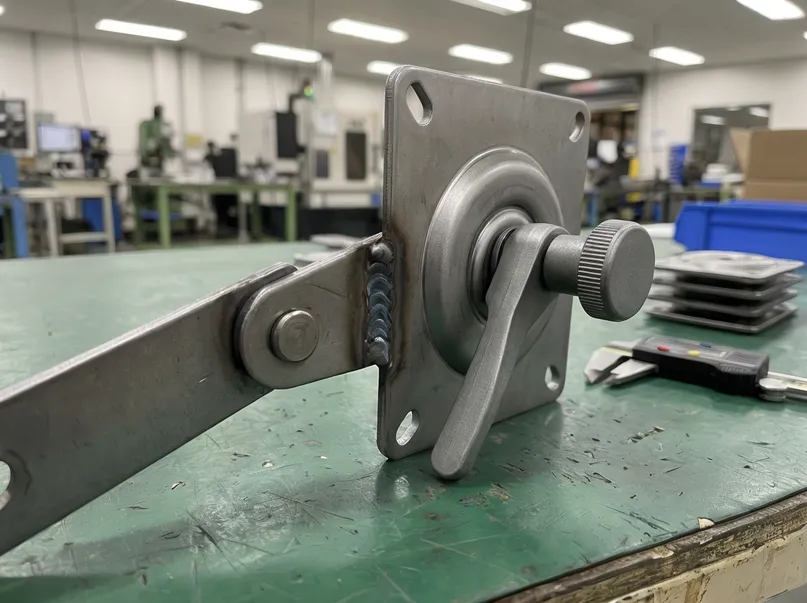
We make both. The stamped lever arm on our lever mechanisms runs through a pivot bushing pressed into the seat plate — that bushing is where most of the wear happens on cheap lever mechanisms, and it's where we spec a tighter tolerance than the market average. (We've seen competitor mechanisms where the bushing is loose enough to rattle after 6 months of daily use — that's a warranty conversation nobody wants.)
Head-to-Head: The Dimensions That Drive Your Sourcing Decision
| Dimension | Lever Mechanism | Paddle Mechanism |
|---|---|---|
| Unit cost (relative) | Higher — more components, tighter tolerances | Lower — simpler actuation, fewer parts |
| Assembly complexity | Moderate — lever pivot requires precise alignment | Low — paddle snaps into seat plate channel |
| Tilt adjustment control | Precise, multi-step or infinite | Basic — lock/unlock only in most configs |
| User actuation force | Moderate — lever provides mechanical advantage | Low — paddle is easy to operate |
| Mechanism profile height | Slightly taller — lever arm adds vertical clearance requirement | Lower profile — fits tighter seat-to-base clearances |
| Cycle life (typical) | 80,000–100,000 cycles at standard commercial spec | 60,000–80,000 cycles at standard spec |
| Warranty claim risk | Lower — positive lock engagement reduces user error | Moderate — paddle misuse or over-travel is a common failure mode |
| Target market fit | Commercial office, ergonomic, mid-to-upper mid-range | Budget to mid-range, task seating, high-volume residential |
The Hidden Cost the Spec Sheet Doesn't Show
The unit price difference between a paddle and lever mechanism is real — typically 15–25% higher landed cost for a lever mechanism at comparable quality tiers. Most buyers see that number and stop there. The downstream cost picture is more complicated.
Assembly line speed is where paddle mechanisms earn back margin. The paddle actuator on a well-designed mechanism drops into a channel in the seat plate and clips in place — a trained assembler handles it in seconds. The lever pivot requires alignment of the lever arm through the bushing, torquing the retention fastener to spec, and a functional check of the lock engagement. On a high-volume chair line running 500+ units per shift, that extra 45–90 seconds per unit compounds fast. If you're assembling in-country before distribution, paddle mechanisms reduce your labor cost per chair.
Warranty claim patterns run the other direction. Paddle mechanisms have a higher rate of over-travel failures — users push the paddle past its designed range, the detent wears, and the tilt lock stops engaging cleanly. We see this most often on chairs deployed in shared-seating environments (open-plan offices, co-working spaces, hospitality) where multiple users interact with the mechanism daily without reading any instructions. Lever mechanisms, because the lock engagement is more positive and the actuation geometry is more constrained, have a lower rate of this specific failure mode.
The math: if your warranty claim rate on paddle mechanisms runs 1.5–2% higher than on lever mechanisms for the same deployment environment, and your average warranty resolution cost (replacement unit + logistics) is $18–25, that difference erodes the unit cost saving on a 5,000-unit order faster than most buyers expect.
(We've had buyers come back after their first container of budget paddle mechanisms asking to switch to lever on the reorder — not because the chairs failed catastrophically, but because the warranty administration cost was eating their margin quietly.)
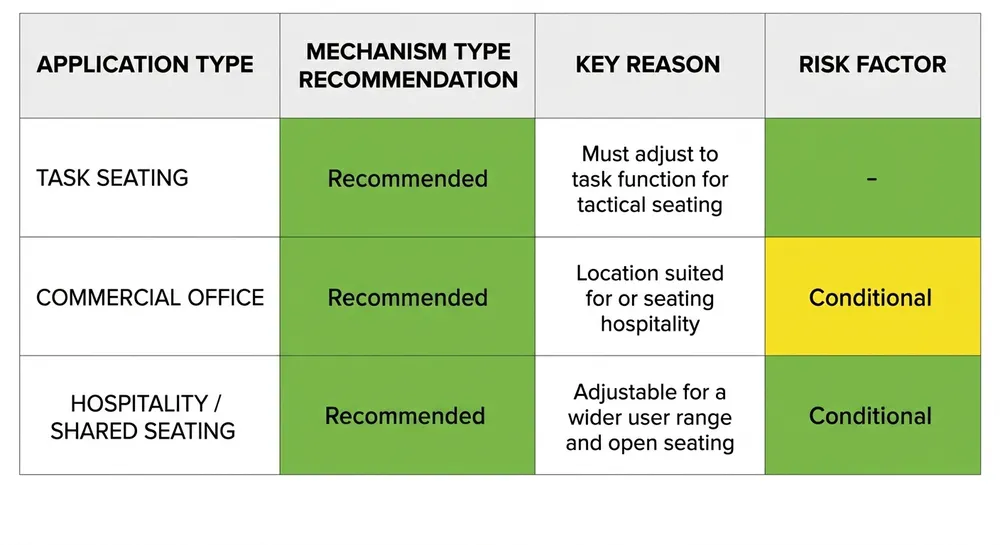
Application Showdown: Which Mechanism Wins in Your Market
High-Volume Mid-Range Task Seating — Paddle Wins
You're supplying 2,000–10,000 units per year into office furniture distributors or contract furnishing channels. The chairs are priced at $80–150 retail. The end user wants a functional tilt lock, not a precision ergonomic tool. Assembly happens at your facility or your customer's warehouse.
Paddle mechanism is the right call. The cost saving is real, the assembly efficiency advantage is real, and the performance gap doesn't matter at this price point and use case. Specify a paddle mechanism with a separate tension knob — it gives the end user enough adjustment to feel like a feature without the cost of a full lever assembly.
Commercial Office Deployment — Lever Wins
Your buyer is furnishing 50–500 workstations for a corporate client. The chairs will be used 8 hours a day by the same person. The procurement spec mentions "ergonomic adjustment" or "lumbar support with tilt control." The buyer is comparing your chair against branded ergonomic options.
Lever mechanism is the right call. The precise tilt lock engagement matters when someone is using the chair for a full workday. The higher cycle life matters when the chair is in daily commercial use for 5–7 years. The slightly higher unit cost is absorbed into a price point where the buyer is already paying for quality, and the lower warranty claim rate protects your customer's service cost.
Hospitality and Shared Seating — Paddle with Reinforced Detent
Hotel lobbies, conference rooms, co-working spaces. High turnover, multiple users per day, no consistent user. The mechanism gets actuated by people who have never used that chair before and will never read a manual.
Standard paddle mechanisms struggle here — the over-travel failure rate climbs. If you're targeting this segment, specify a paddle mechanism with a reinforced detent and a higher-spec bushing. We build this configuration for buyers in the hospitality supply chain — it's not a catalog item, but it's a straightforward spec adjustment. The alternative is a lever mechanism, which handles multi-user abuse better but adds cost that hospitality buyers often resist.
What to Verify When You Source Either Option
The mechanism category has a substitution problem. A paddle mechanism quoted at a low price point often gets delivered with a thinner seat plate gauge, a looser bushing tolerance, or a spring that's been wound lighter to reduce material cost. None of these show up on a spec sheet — they show up in your warranty claims 8 months after the container lands.
For lever mechanisms, verify:
- Lever pivot bushing material and press-fit tolerance — this is the primary wear point. Specify sintered bronze or reinforced nylon; avoid plain steel-on-steel.
- Tilt lock engagement force — should be consistent across the adjustment range, not stiffer at one end.
- Seat plate gauge — 2.0mm cold-rolled steel minimum for commercial spec; 1.5mm is a cost-cut that shows up as flex under load.
- Cycle life test documentation — ask for the test report, not just the claim. 80,000 cycles minimum for commercial office use.
For paddle mechanisms, verify:
- Detent geometry and retention force — the paddle should have a defined stop point with consistent resistance. A paddle that travels past its detent under normal use is a warranty claim waiting to happen.
- Over-travel protection — some designs include a mechanical stop that prevents the paddle from being pushed past the detent. Specify this for shared-seating applications.
- Spring tension range — the tension adjustment range should cover the realistic weight range of your end users (typically 50–120kg). A spring tuned only for the middle of that range will generate complaints from both ends.
RFQ language that protects you: When you send an RFQ for either mechanism type, include: seat plate gauge (mm), required cycle life (cycles), bushing material specification, and the deployment environment (task/commercial/hospitality). A supplier who can't respond to those parameters specifically is telling you something about their QC process.
We run 100% functional testing on every mechanism before shipment — tilt range, lock engagement, and load cycle verification. The test report is available with the order. For buyers who need third-party validation, our mechanisms carry CE and SGS certification covering the product range.
Lever vs Paddle in Your Product Line: The Margin Logic
Here's how we'd frame the sourcing decision if you're building or expanding a chair mechanism product line:
Lead with paddle for volume SKUs. The cost efficiency and assembly speed advantage makes paddle the right foundation for your mid-range volume business. A well-specified paddle mechanism at the right price point is a defensible product — don't over-engineer it.
Add lever as your step-up SKU. The price gap between a paddle and lever mechanism — $3–6 per unit at factory — supports a $15–25 retail price step-up on the finished chair. That's a margin-positive upgrade path for your distribution customers. Buyers who sell into corporate procurement channels need a lever option to compete on ergonomic specs.
Don't mix mechanism types within a chair model. We've seen buyers try to offer "lever or paddle" as a configuration option on the same chair frame. The seat plate geometry is different enough between the two that you're effectively managing two SKUs anyway — better to make the split explicit in your product line and price accordingly.
The Chair Mechanism category covers the full range of tilt mechanism configurations we produce. If you're building a product line that needs both mechanism types, the Lever Chair Mechanism page covers the specific configurations, load ratings, and customization options for that product family.
For sourcing questions on either mechanism type — including custom seat plate geometry, OEM surface finish, or volume pricing — the fastest path is to Request Quote with your target spec and annual volume. We'll come back with a specific recommendation and unit pricing based on your actual requirements, not a catalog range.