“`
The US furniture import market runs on tight landed-cost math. Chair mechanisms — tilt controls, synchro bases, knee-tilt units, multi-function controls — are a small line item per unit but a significant cost driver at container scale. Get the supplier wrong and you're dealing with warranty returns, inconsistent batch quality, or a distributor who can't hold stock when you need a reorder in six weeks.
This list covers 10 suppliers that furniture importers in the US actually encounter: domestic distributors, specialist hardware wholesalers, and factory-direct manufacturers. The goal isn't a theatrical ranking — it's a sourcing landscape you can use to make a real decision.
A note on methodology: suppliers here were selected based on market presence in the US chair hardware and furniture mechanism segment. Where a company operates primarily as a distributor or trading intermediary, that's noted. Where a company manufactures directly, that's noted too. The distinction matters for your cost structure and quality control leverage.

What Serious Buyers Check Before Placing a Chair Mechanism Order
Before the supplier list, the criteria. Most sourcing mistakes in this category happen because buyers optimize for one variable — usually price or lead time — and ignore the others until a container arrives wrong.
Cycle life rating: A chair tilt mechanism that fails at 50,000 cycles is a warranty liability. Commercial-grade mechanisms should be rated to 100,000+ cycles under BIFMA X5.1 or equivalent load testing. Ask for the test report, not just the claim.
Load capacity and tolerance consistency: Rated load is easy to state. Batch-to-batch consistency is harder to deliver. A mechanism rated at 150 kg that delivers 140 kg on 10% of units creates downstream warranty exposure. Request dimensional tolerance specs and ask how they're enforced across production runs.
Surface finish durability: Zinc plating, nickel plating, and powder coating all behave differently in humid or coastal environments. If your buyers are in Florida, the Gulf Coast, or Hawaii, a 500-hour salt spray result matters more than a glossy product photo.
MOQ and reorder flexibility: A 5,000-unit MOQ works for a container buyer. It kills a distributor who needs 300 units to fill a gap order. Know your volume profile before you start the conversation.
OEM and customization access: Branded mechanisms, custom color finishes, or modified geometry for proprietary chair frames require a manufacturer with tooling capability — not a distributor pulling from standard stock.
Certifications: ISO 9001:2015 for process control, BIFMA compliance for the US commercial market, CE for any European crossover. These aren't decorative — they're the paper trail your retail or contract furniture buyers will ask for.
The 10 Suppliers in This Market
1. Leggett & Platt — Carthage, Missouri
Website: leggett.com
Leggett & Platt is the largest US-based manufacturer of furniture components and mechanisms, with chair mechanism production as one of their core segments. Their Seating Products division supplies tilt mechanisms, synchro controls, and pneumatic cylinders to major OEM chair manufacturers globally. For US buyers, L&P offers domestic manufacturing with the supply chain reliability that comes with it — no port delays, no customs friction.
The trade-off is scale. L&P's commercial terms are structured for high-volume OEM relationships. If you're a mid-size importer buying 2,000–5,000 units per SKU, you may find their MOQ thresholds and lead time commitments designed for customers ten times your size. Their catalog mechanisms are well-engineered and BIFMA-tested, but customization outside their standard range requires a significant volume commitment.
Best fit: Large OEM chair manufacturers and high-volume contract furniture buyers with established vendor relationships.
2. Knoll / MillerKnoll — East Greenville, Pennsylvania
Website: knoll.com
Knoll (now part of MillerKnoll) is primarily a finished furniture brand, but their mechanism engineering and supply chain infrastructure is relevant context for importers. They source and specify chair mechanisms at a level of precision that sets a useful benchmark — their supplier qualification standards for tilt mechanisms, armrest hardware, and base components are among the most rigorous in the US commercial market.
Knoll doesn't sell mechanisms wholesale to third parties. They're on this list because understanding what a Tier 1 US contract furniture buyer demands from their mechanism suppliers tells you exactly what your own sourcing standards should look like if you're selling into that channel.
3. Haworth — Holland, Michigan
Website: haworth.com
Similar to Knoll, Haworth is a finished seating manufacturer whose mechanism specifications are worth studying. Their ergonomic chair lines use multi-function tilt controls and synchro mechanisms that represent the upper end of commercial-grade hardware. Haworth manufactures some components in-house and sources others from qualified suppliers.
Again, not a wholesale mechanism supplier — but a useful reference point for what the US contract furniture channel expects from mechanism performance, finish quality, and documentation.
4. Kimball International — Jasper, Indiana
Website: kimballinternational.com
Kimball International operates across office furniture and seating, with manufacturing in the US Midwest. Their seating lines use a range of mechanism types, and they have historically maintained domestic component sourcing as part of their brand positioning. For importers, Kimball is relevant as a benchmark buyer — understanding their supplier qualification process gives you a clear picture of what US commercial furniture buyers require from mechanism hardware.
5. Global Industrial — Port Washington, New York
Website: globalindustrial.com
Global Industrial is a large US B2B distributor carrying office furniture components including chair mechanisms, gas cylinders, casters, and replacement hardware. They stock a range of standard tilt mechanisms and synchro controls for the replacement and repair market, with domestic warehouse fulfillment and relatively accessible MOQs for smaller orders.
The mechanism inventory here is sourced from various manufacturers — quality consistency varies by SKU. For urgent small-volume needs or replacement parts, Global Industrial is a practical option. For a primary supply relationship on new production, the lack of direct manufacturer access limits your QC leverage and customization options.
Best fit: Replacement parts, urgent small orders, domestic warehouse convenience.
6. Grainger — Lake Forest, Illinois
Website: grainger.com
Grainger is the US industrial distribution giant, and their catalog includes chair mechanisms, gas lift cylinders, and seating hardware components. Like Global Industrial, Grainger's value is domestic stock availability and fast fulfillment — not manufacturer-direct pricing or OEM capability.
Mechanism SKUs in Grainger's catalog are typically standard configurations from established suppliers. Pricing reflects distributor margin stacking. For a furniture importer building a product line, Grainger is a gap-fill resource, not a primary sourcing channel. (We've seen buyers use Grainger to bridge a stockout while a factory order is in transit — that's the right use case.)
Best fit: Emergency replenishment, small-volume gap orders, domestic availability.
7. Seatcraft / Seatcraft Components — USA
Website: seatcraft.com
Seatcraft operates in the home theater and recliner seating segment, with mechanism components relevant to importers sourcing recliner hardware and motion seating mechanisms. Their product range includes recliner mechanisms, wall-hugger hardware, and power motion components. For importers in the residential recliner or home theater seating category, Seatcraft is a US-market reference point for mechanism specifications and consumer expectations.
Best fit: Residential recliner and motion seating importers.
8. Furniture Parts & More — USA
Website: furniturepartsandmore.com
A US-based specialty distributor focused on furniture hardware and replacement components, including chair mechanisms, gas cylinders, tilt controls, and base hardware. Their catalog covers standard replacement SKUs with domestic fulfillment. Useful for the repair and replacement market; less relevant for importers building new product lines at volume.
Best fit: Furniture repair shops, small-volume replacement hardware buyers.
9. Guangdong Longway Technology Co., Ltd. — Guangdong, China (US export focus)
Website: longway-seating.com
Longway is a China-based chair mechanism manufacturer with documented export activity to the US market. Their product range covers office chair tilt mechanisms, synchro controls, and ergonomic chair hardware. As a factory-direct supplier, they offer lower per-unit costs than US distributors, with OEM capability for buyers who need custom specifications.
The practical consideration for US importers: factory-direct from China means container-scale MOQs, 30–45 day production lead times, and the QC diligence that comes with any overseas sourcing relationship. The economics work at repeat volume; they're harder to justify for one-off or small-batch needs.
Best fit: Mid-to-high volume importers comfortable with direct factory sourcing.
10. MVMHardware (Foshan Jinruida Import And Export Co., Ltd.) — Guangdong, China
Website: mvmhardware.com
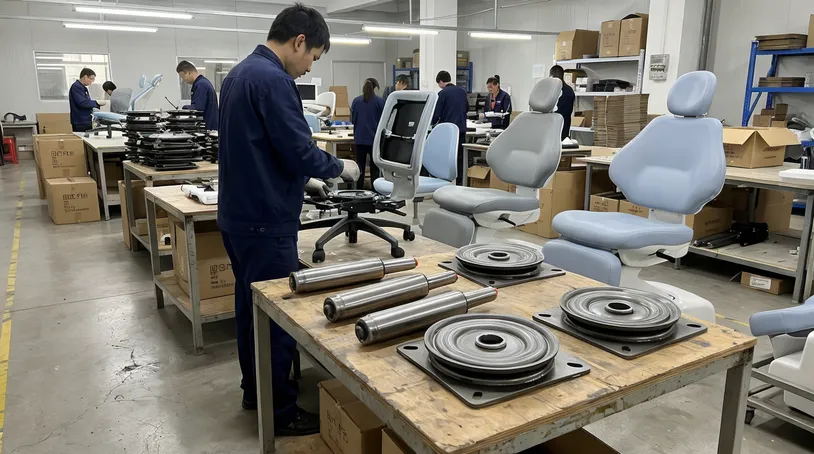
We're on this list because we belong here — not to pad a ranking. MVMHardware has been manufacturing furniture mechanisms since 2008, and the US market is one of our primary export destinations. Our 12,000 m² facility runs 6 dedicated production lines with an annual capacity of 3,000,000 units. We hold ISO 9001:2015, CE, SGS, and RoHS certifications, and every mechanism goes through 100% functional testing and load-cycle verification before it ships.
What separates us from the trading companies and distributors in this list: your order is quoted, produced, inspected, and packed here, by the same team that designed the tooling. No intermediary layer, no markup chain. Our in-house R&D team of 12+ engineers handles OEM tooling for buyers who need custom geometry, modified load ratings, or proprietary surface finishes. Standard MOQ is 500 units — low enough for a trial run, scalable to full container volume.
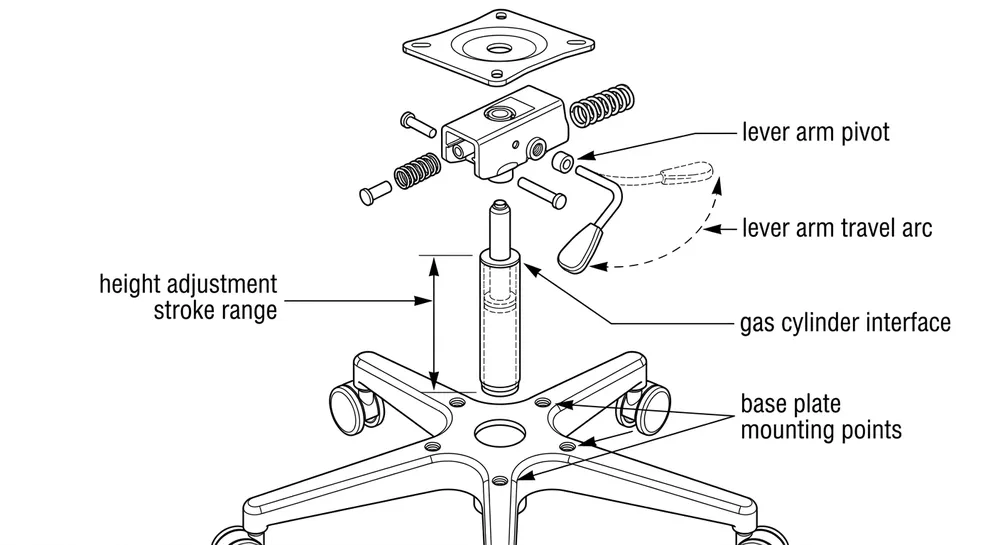
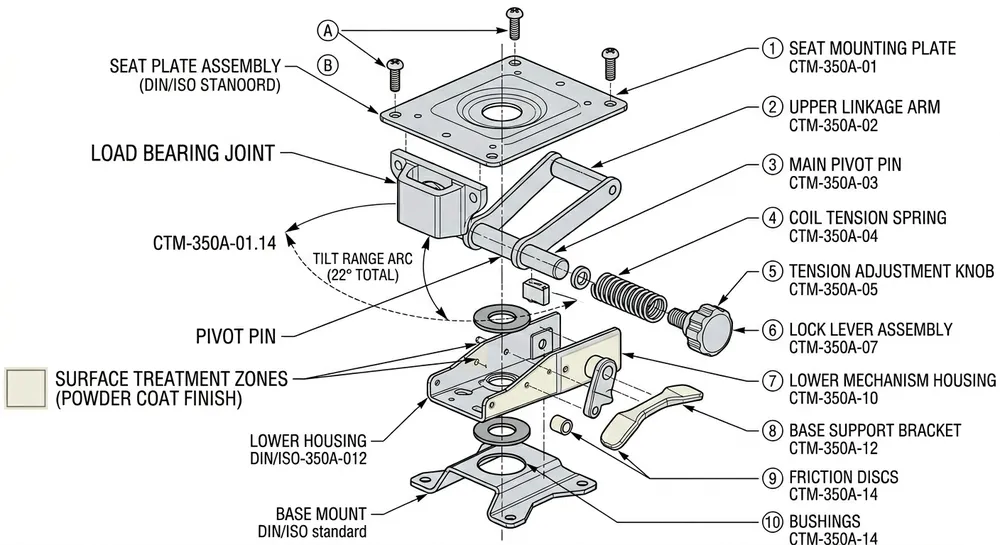
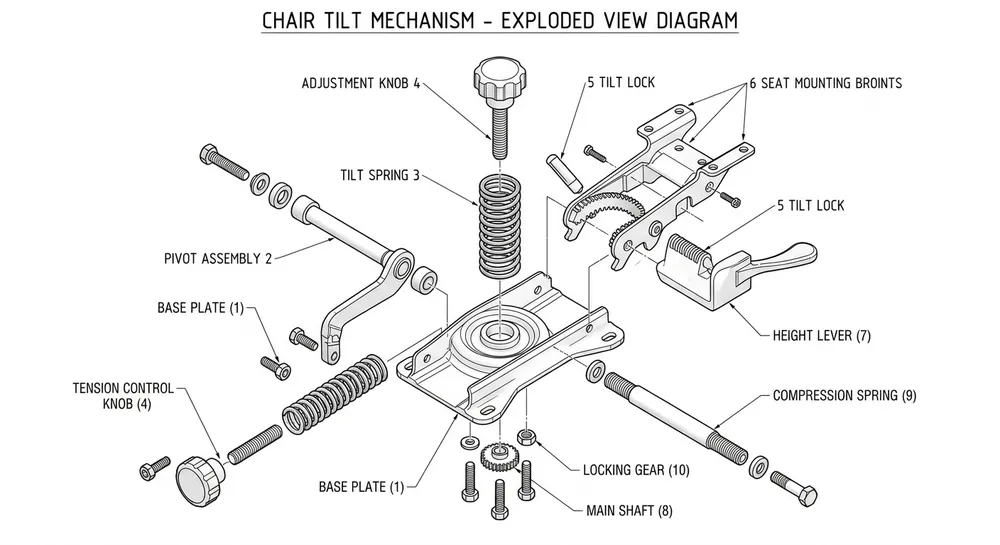
We run precision stamping and zinc alloy die-casting in-house, which matters for tight-tolerance components like tilt mechanism pivot assemblies and synchro control housings. Surface treatment lines cover nickel plating, zinc plating, and powder coating — all done on-site, so finish consistency is our problem to solve, not yours to inspect around.
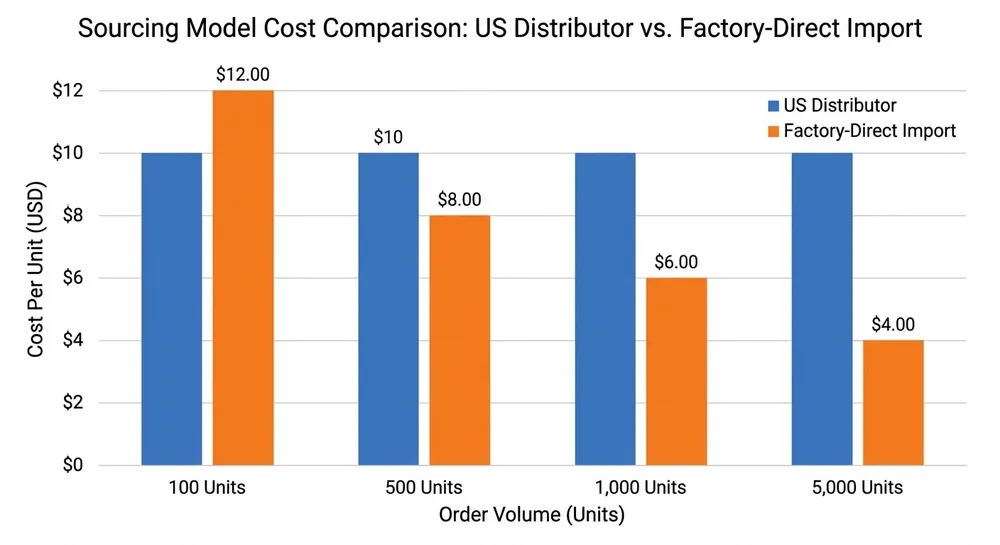
For US importers who have been buying through a domestic distributor and absorbing the margin stack, the math on factory-direct usually becomes clear around the 1,000-unit mark. Below that, local convenience often wins. Above it, the landed-cost difference is hard to ignore.
Explore our full Chair Mechanism range to see current product specifications, load ratings, and available configurations.
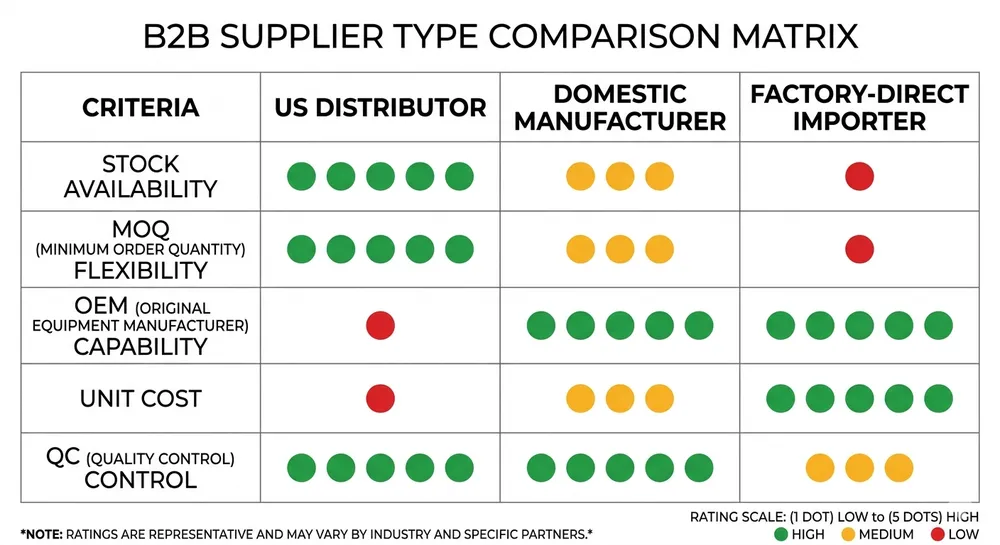
Local Distributor vs. Factory-Direct: Where the Economics Actually Split
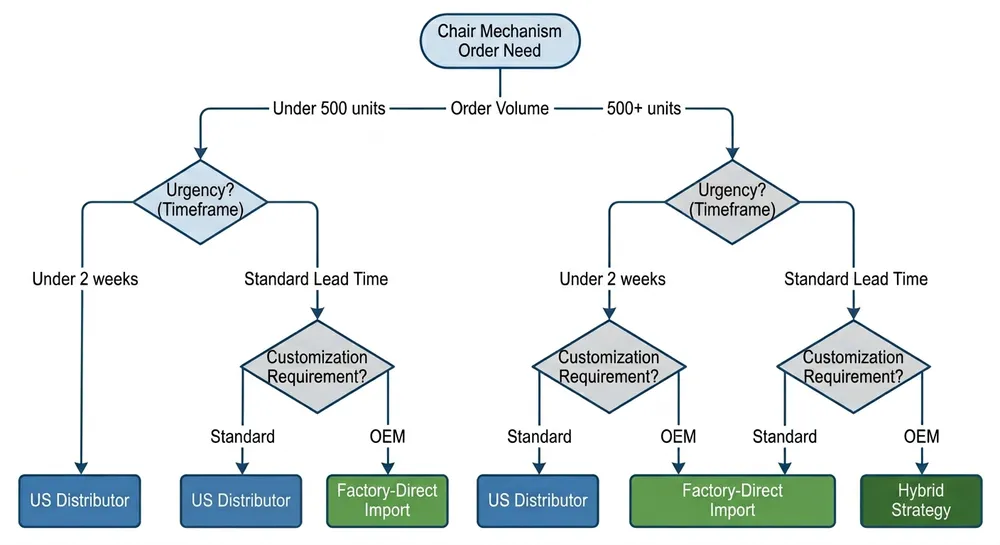
This is the decision most US furniture importers are quietly running in the background. Here's how it actually breaks down.
When local distribution wins:
- Orders under 500 units where container economics don't apply
- Urgent timelines under 3 weeks where domestic stock is the only viable option
- Replacement parts for existing product lines where exact-match SKUs are already in a distributor's catalog
- New product development phases where you need 10–50 units to test with your own assembly team
Local distributors earn their margin in these scenarios. The convenience is real, and the alternative — waiting 35 days for a factory run — isn't always viable.
When factory-direct import changes the math:
At 1,000+ units per SKU on a repeat procurement cycle, the distributor margin stack — typically 25–40% above factory price — becomes a significant landed-cost line item. At 5,000 units, you're looking at a cost difference that funds a meaningful portion of your logistics budget.
Beyond unit cost, factory-direct gives you something distributors can't: direct QC access. You can specify tolerances, request pre-shipment inspection reports, and modify surface finish or load rating for your specific product. A distributor pulls from standard stock. A factory builds to your spec.
(We've had buyers come to us after three years of distributor sourcing, run the numbers on a 12-month volume, and find they'd left six figures on the table. The switch isn't complicated — it's just a decision that requires a longer planning horizon.)
The hybrid approach works well for many importers: factory-direct for your core SKUs at volume, domestic distributor for emergency replenishment and small-batch needs. You get the economics of direct sourcing without giving up the safety net of local stock.
How to Evaluate Any Supplier on This List
The supplier name is the starting point, not the finish line. Here's the checklist we'd run on any mechanism supplier — including ourselves.
Documentation you should request before placing a first order:
- ISO 9001:2015 certificate (current, not expired)
- BIFMA X5.1 test report for the specific mechanism SKU you're buying
- Salt spray test results for the surface finish on your order
- Dimensional tolerance spec sheet for the tilt mechanism pivot and control housing
- Load cycle test report (minimum 100,000 cycles for commercial-grade)
Questions that separate serious suppliers from catalog sellers:
- What is your batch-to-batch dimensional tolerance on the pivot pin diameter? (A real manufacturer gives you a number. A trading company gives you a vague answer.)
- How do you handle a quality dispute on a shipped container? (Look for a clear process, not a promise.)
- Can you provide a pre-shipment inspection report from a third-party inspector on our first order? (SGS, Bureau Veritas, or equivalent.)
- What is your tooling lead time for a modified mechanism geometry? (Relevant if you need OEM customization.)
Red flags in supplier conversations:
- Unwillingness to share test reports before order placement
- MOQ that can't be explained by production economics (either too high with no justification, or suspiciously low for a claimed manufacturer)
- No clear answer on who actually makes the product (trading company presenting as factory)
- Surface finish specs stated as marketing language rather than measurable parameters
Sourcing Route Decision Guide
Use this to match your situation to the right supplier type.
| Scenario | Best Sourcing Route |
|---|---|
| Urgent order, under 500 units, 2-week timeline | US distributor (Grainger, Global Industrial) |
| Standard reorder, 500–2,000 units, 30-day lead time | Factory-direct or distributor depending on price delta |
| Repeat volume, 2,000+ units per SKU | Factory-direct import — run the landed cost comparison |
| OEM / custom mechanism for proprietary chair frame | Factory-direct manufacturer with in-house tooling |
| Replacement parts for existing product line | US distributor with matching SKU catalog |
| New product development, 50–200 unit sample run | Factory-direct with low-MOQ sample capability |
The right answer changes as your business scales. Most importers start with domestic distributors for speed and simplicity, then migrate core SKUs to factory-direct as volume justifies the planning overhead. That's a rational progression — the mistake is staying in distributor-only mode past the point where the economics have clearly shifted.
If you're at the point where factory-direct sourcing makes sense for your chair mechanism volume, the next step is a direct conversation about specifications, certifications, and landed cost. Request a Quote with your target SKU, annual volume, and any customization requirements — we'll come back with a detailed quote and, if the spec is non-standard, a tooling assessment.