Buyers get burned on lever chair mechanisms more often than on almost any other chair component — not because the specs are complicated, but because the wrong spec gets quoted and nobody catches it until the product is already in a container. A mechanism with 80mm of height adjustment looks identical on a spec sheet to one with 120mm. The lever travel distance rarely appears in supplier catalogs at all. And "100,000 cycles" means something very different depending on whether the test was run at rated load or at 60% of it.
This guide covers the three spec dimensions that actually determine whether a Lever Chair Mechanism will perform in your target market: adjustment range, lever travel, and cycle durability. We'll also cover what to ask for during RFQ and where the common sourcing gaps are.

Height adjustment range: what the numbers actually mean for your market
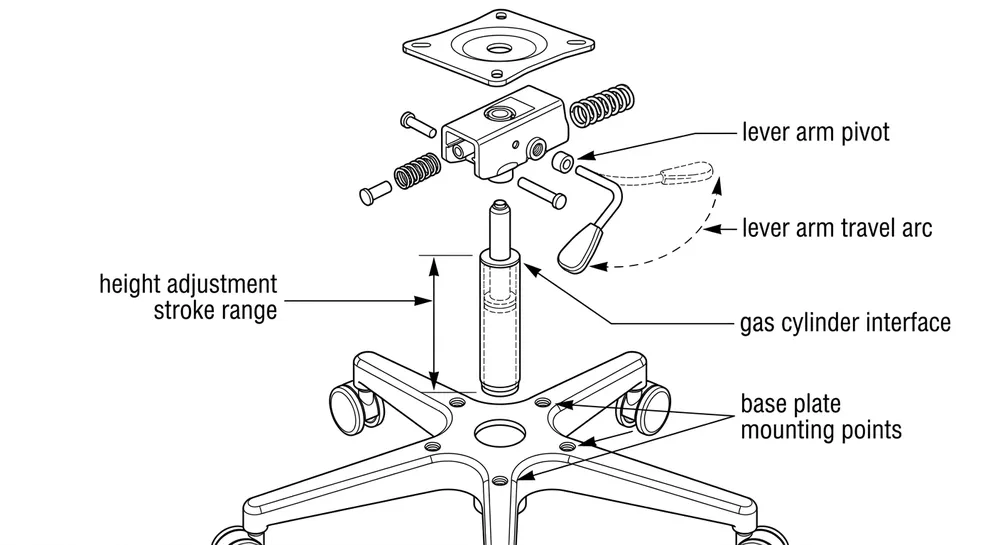
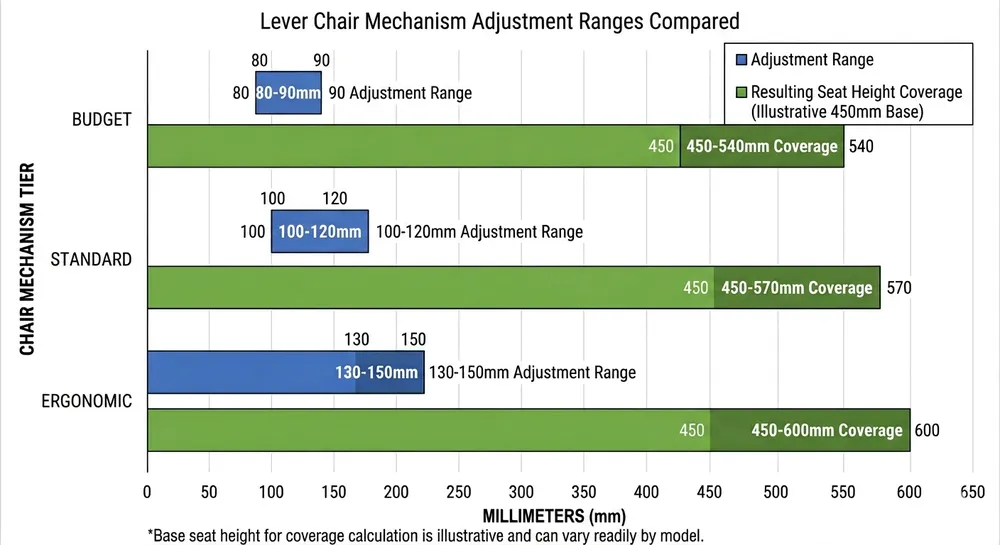
The adjustment range on a lever chair mechanism is the total vertical stroke — the difference between the mechanism's lowest and highest locked position. Standard commercial mechanisms run 100–130mm of stroke. Budget-tier product often comes in at 80–90mm. Premium ergonomic configurations go to 150mm or beyond.
The number that matters to your buyer isn't the stroke itself — it's the resulting seat height range. A 120mm stroke mechanism paired with a standard gas cylinder delivers roughly 420–540mm seat height, which covers the 5th–95th percentile seated height for most adult populations. If you're supplying into markets with taller average users (Northern Europe, North America), you want the upper end of that range to reach 550mm or higher, which typically requires either a longer stroke or a taller cylinder spec.
We've seen buyers spec a mechanism at 100mm stroke because it's cheaper, then discover their end customer's chair sits too low for taller users and generates warranty complaints. The fix at that point is a new gas cylinder spec, which means retooling the packaging and re-testing the assembly. It's a preventable problem.
| Adjustment Range | Typical Seat Height Coverage | Market Fit |
|---|---|---|
| 80–90mm | ~400–490mm | Budget residential, children's furniture |
| 100–120mm | ~420–540mm | Standard commercial, general office |
| 130–150mm | ~430–580mm | Ergonomic office, height-adjustable workstations |
| 150mm+ | ~440–590mm+ | Premium ergonomic, tall-user specifications |
One thing worth noting: the stroke spec on a mechanism is only meaningful if the gas cylinder it's paired with is matched to it. We always supply matched cylinder specs with our mechanisms — a 120mm stroke mechanism shipped with an undersized cylinder will never reach its rated upper height, and that mismatch is one of the most common causes of field complaints.
Lever travel distance: the spec nobody quotes until it causes a problem
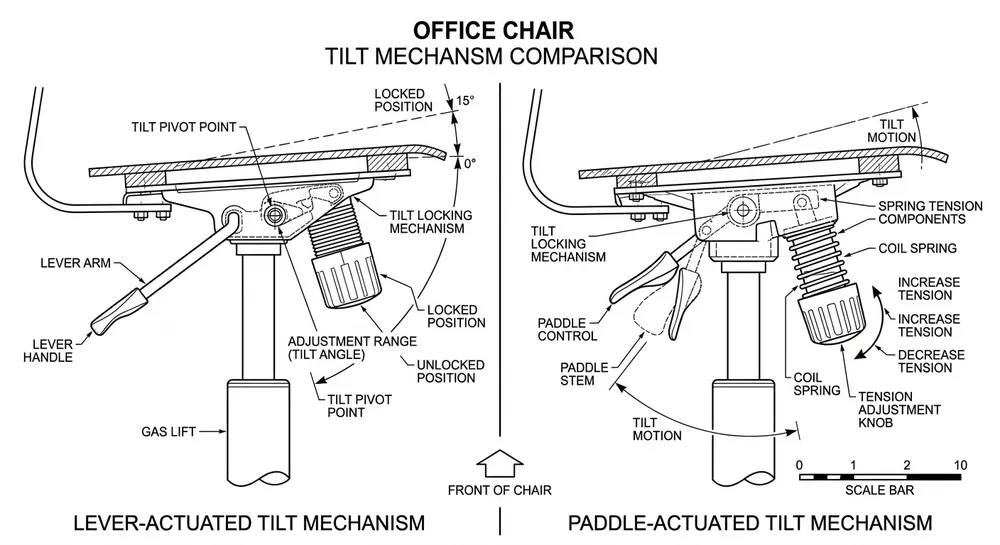
Lever travel is the arc distance the activation lever moves from its resting position to the point where the height lock releases. It's almost never listed in standard product catalogs, and most buyers don't ask for it until they've had an ergonomics complaint or a product return.
The practical range for commercial mechanisms is 25–45mm of lever travel at the tip. Below 25mm, the mechanism activates too easily — users accidentally trigger height changes while repositioning. Above 45mm, the lever requires deliberate effort that some users find awkward, particularly in task chairs used for frequent height adjustment throughout the day.
For your downstream market, lever travel affects two things: user experience (which drives warranty claims and reviews) and compliance with ergonomic standards in regulated markets. EN 1335 in Europe and BIFMA X5.1 in North America both include functional requirements for control activation force and travel — if you're selling into those markets, the lever travel spec needs to be confirmed against those standards before you finalize tooling.
We run our standard commercial mechanisms at 30–35mm lever travel, which sits in the middle of the comfortable activation range. For OEM customers who need a different feel — shorter throw for task chairs, longer throw for heavy-duty industrial seating — we can adjust the lever arm geometry within the same base mechanism. (That's a tooling conversation, not a catalog swap, but it's worth raising early in the RFQ if you have a specific target.)
| Lever Travel Range | Activation Feel | Typical Application |
|---|---|---|
| 20–25mm | Very light, easy to trigger | Residential, low-use seating |
| 30–35mm | Balanced, deliberate | Commercial office, task chairs |
| 38–45mm | Firm, intentional | Heavy-duty, industrial seating |
Load rating and structural specs: what the numbers need to cover
A lever chair mechanism carries the full static and dynamic load of the seated user through every adjustment cycle. The load rating on the mechanism needs to cover not just the rated user weight but the dynamic load factor — the additional force generated when a user drops into the seat or leans back sharply.
Standard commercial mechanisms are rated at 100–120kg static load. For markets where heavy-duty seating is a product category (North America, Australia), you want mechanisms rated to 150kg or higher, with the structural test conducted at 1.5–2x rated load per BIFMA or equivalent protocol.
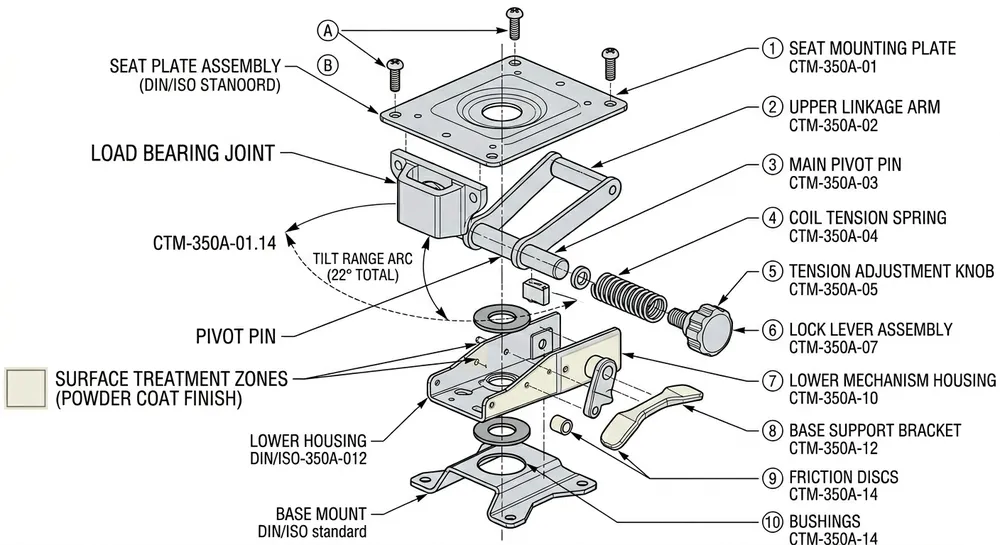
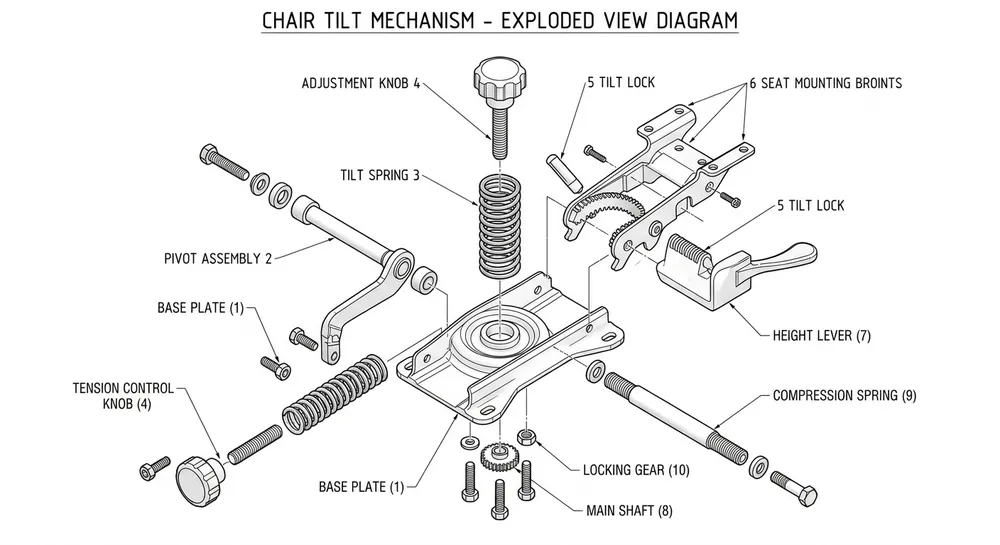
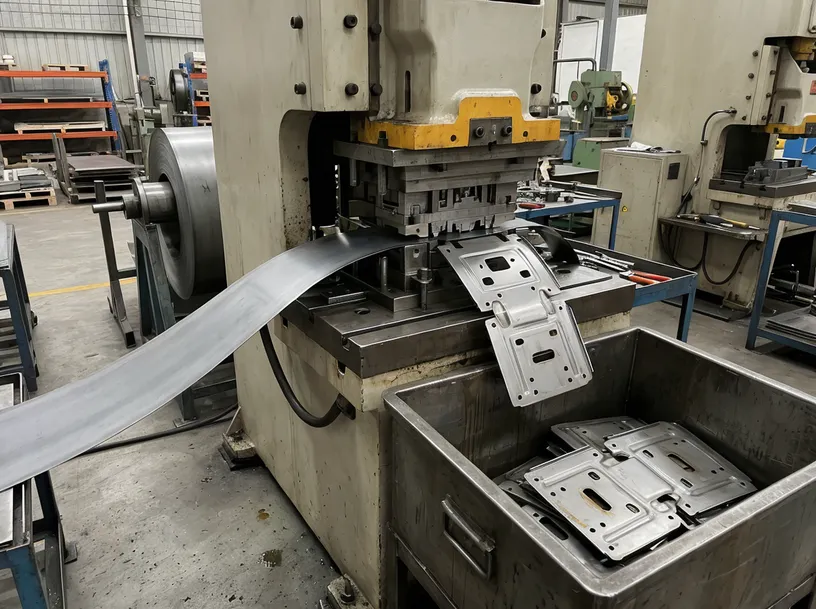
The structural components that determine load capacity are the base plate thickness, the pivot pin diameter, and the weld quality at the cylinder interface. On our mechanisms, the base plate runs at 3.0–4.0mm cold-rolled steel depending on the load tier, and the pivot pin is 10–12mm diameter hardened steel. These aren't specs we vary to hit a price point — they're the dimensions that determine whether the mechanism survives a 200,000-cycle durability test at rated load.
What to confirm during RFQ:
- Static load rating (kg) and the test standard it was verified against
- Dynamic load factor used in structural testing
- Base plate material and thickness
- Pivot pin diameter and material specification
Cycle life and durability testing: reading the spec correctly
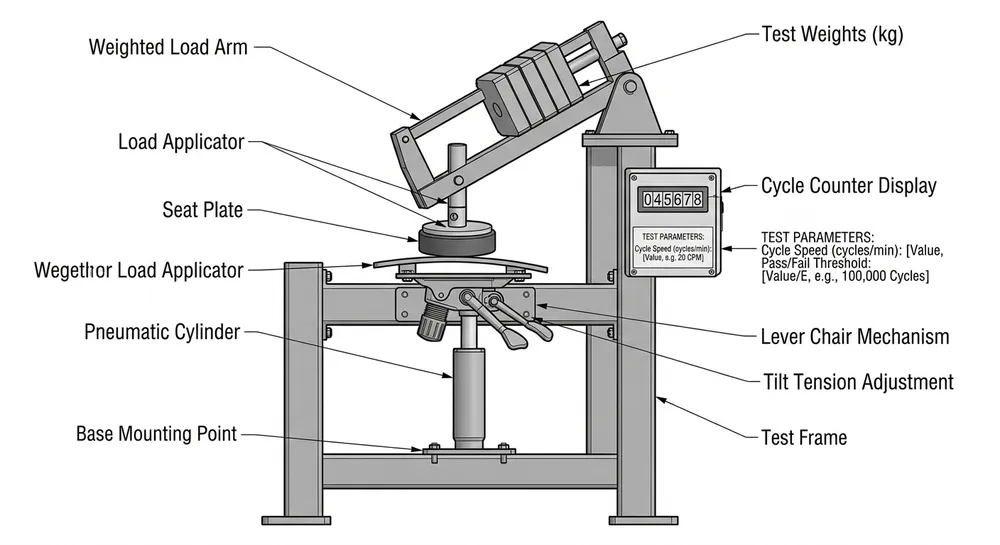
"100,000 cycles" is the number that appears most often in mechanism spec sheets, and it's also the number most likely to be misleading. The cycle count only means something if you know the test load, the test speed, and whether the test was run to failure or to a pass/no-fail threshold.
A mechanism tested at 80kg load for 100,000 cycles is not the same product as one tested at 120kg for 100,000 cycles. The first might fail at 60,000 cycles under real commercial use conditions. The second has margin. We test our standard commercial mechanisms at rated load — not at a reduced percentage — because that's the only way the cycle number is commercially meaningful.
For reference, typical durability benchmarks by application:
| Application | Minimum Cycle Life | Test Load Basis |
|---|---|---|
| Residential / light commercial | 80,000–100,000 cycles | Rated load |
| Standard commercial office | 100,000–150,000 cycles | Rated load |
| Heavy-duty / 24-hour use | 200,000+ cycles | Rated load + dynamic factor |
The other durability dimension that rarely gets discussed is corrosion resistance on the lever and spring components. Mechanisms used in humid environments — coastal markets, Southeast Asia, parts of the Middle East — need surface treatment on the internal spring and lever pivot, not just the visible exterior. We zinc-plate the internal spring assembly on all export-grade mechanisms for this reason. It adds a small cost but eliminates a failure mode that generates disproportionate warranty claims in humid climates.
Surface treatment and finish specs: the sourcing detail that affects landed cost
Surface treatment on a lever chair mechanism affects three things: corrosion resistance, visual quality, and your downstream customer's perception of product tier. The common options are zinc plating, nickel plating, and powder coating, each with different cost and performance profiles.
Zinc plating is the standard for commercial mechanisms — it provides adequate corrosion protection for indoor use and keeps unit cost low. Nickel plating gives a brighter, more premium appearance and better corrosion resistance, which matters if the mechanism is partially visible in the finished chair design. Powder coating is less common on mechanisms (the geometry makes consistent coverage harder) but is used on lever arms and base plates where appearance is a priority.
We run full surface treatment lines in-house — zinc plating, nickel plating, and powder coating — so finish spec changes don't require a separate supplier or extended lead time. For buyers sourcing into markets where the mechanism is visible (open-frame chair designs, transparent seat shells), the finish spec is worth discussing early. A nickel-plated mechanism on a visible component can support a higher retail price point for your customer, which protects your margin on the mechanism itself.
Salt spray performance by finish type, for reference:
| Surface Treatment | Typical Salt Spray Rating | Best For |
|---|---|---|
| Zinc plating | 72–120 hours | Standard indoor commercial |
| Nickel plating | 200–300 hours | Premium visible components, humid markets |
| Powder coating (lever/base) | 500+ hours | Coastal markets, outdoor-adjacent use |
What to verify before you finalize a mechanism order
The specs above cover the dimensions that determine whether a lever chair mechanism will perform in your market. Before finalizing any order, these are the documents worth requesting:
- Dimensional drawing with adjustment stroke, lever travel, and mounting hole pattern confirmed
- Load test report showing static and dynamic load ratings with the test standard referenced
- Cycle life test report with test load, speed, and pass/fail criteria documented
- Surface treatment spec with salt spray hours confirmed for the finish you're ordering
- Material certificates for base plate and pivot pin if you're supplying into regulated markets
We provide all of these as standard documentation with our export orders. If a supplier can't produce a cycle life test report with the test load specified, the cycle count number on their spec sheet is not a reliable sourcing basis.
For buyers new to this category, the most common mistake is treating the mechanism as a commodity component and selecting on price alone. The mechanism is the part that determines whether the chair works correctly for its entire service life. A $2 saving on the mechanism that generates $15 in warranty handling per unit is not a saving.
Frequently asked questions
What adjustment range do I need for a standard commercial office chair?
For general commercial office use covering most adult users, 100–120mm of stroke is the standard spec. This delivers roughly 420–540mm seat height range, which covers the 5th–95th percentile for most markets. If you're targeting ergonomic or height-adjustable workstation applications, specify 130–150mm to reach the upper seat height range that taller users require.
How do I confirm lever travel distance when a supplier doesn't list it?
Ask for the dimensional drawing and measure the lever arm length and pivot geometry — lever travel at the tip is calculable from those dimensions. Alternatively, request a physical sample and measure the activation arc directly. If a supplier can't provide either, that's a sourcing risk signal.
Does the mechanism cycle life rating include the gas cylinder?
No. The mechanism and gas cylinder are tested separately. A mechanism rated at 150,000 cycles may be paired with a cylinder rated at 80,000 cycles — the assembly's effective service life is limited by the lower-rated component. Confirm cycle life ratings for both components independently.
What's the minimum order quantity for custom lever travel or adjustment range specs?
For standard catalog mechanisms, our MOQ is 500 units. Custom lever geometry or non-standard stroke specs require tooling, which we support from 500 units with OEM tooling agreements. The tooling cost amortizes quickly on repeat orders, and the custom spec becomes your exclusive configuration — your competitors can't source the same mechanism from us.
Which certifications should I require for mechanisms going into European or North American markets?
For Europe, CE marking and EN 1335 compliance are the baseline. For North America, BIFMA X5.1 is the relevant standard for commercial seating. Our mechanisms carry ISO 9001:2015, CE, and SGS certification. If your specific market or retail channel requires additional documentation, raise it at RFQ stage — we can provide test reports and compliance documentation to support your import process.
If you're ready to spec a mechanism for your next order, the fastest path is to send us your target seat height range, rated load, and destination market — we'll match you to the right configuration and send back a detailed quote. Request a quote here, or browse our full Chair Mechanism range to see standard configurations.