

Automatic Chair Mechanism
Built for Shared-Use Seating
Self-return, auto-adjust, zero manual intervention required. Designed for environments where chairs are used by dozens of people daily and no one resets the position. 100% functionally tested before shipment. OEM/ODM tooling supported.
Product Overview
What an Automatic Chair Mechanism Is —
and Where It Earns Its Cost
An automatic chair mechanism is a self-returning or self-adjusting motion assembly that resets the chair to a neutral position without the user doing anything. The seat returns to upright after the user stands. The tilt tension adjusts to the occupant's weight automatically. The backrest angle resets between users. The defining characteristic is that the mechanism does the work — not the person sitting in it.
That distinction matters commercially because of where these mechanisms go. Public seating, shared workstations, airport lounges, library study areas, co-working spaces, waiting rooms, training rooms — any environment where the chair turns over 20, 30, 50 times a day and no individual user is responsible for maintaining it.
In those environments, a standard tilt mechanism with manual tension adjustment becomes a liability: the tension is always wrong for the next person, the backrest is always at the last user's angle, and the chair looks and feels neglected within weeks of installation. An automatic mechanism eliminates that maintenance burden entirely.
For your business, that translates directly to the segments you can sell into. Institutional procurement — airports, transit authorities, co-working operators, hotel business centers, university libraries — specifies automatic return as a functional requirement, not a preference. If your seating line doesn't include an automatic mechanism option, you're excluded from those tenders. If it does, you're competing on price and lead time rather than capability.
Co-working and shared-space operators have become some of the most consistent buyers of automatic mechanism seating. The segment is worth building inventory for — we've seen this shift accelerate over the past five years in our customer base.

Primary Deployment Environments
Engineering Data
Technical Specifications
Industry-standard parameters for automatic chair mechanisms. Actual specifications vary by configuration — contact us for exact data sheets on specific models.
| Parameter | Specification |
|---|---|
| Mechanism type | Auto-return tilt / weight-sensing auto-adjust / spring-return |
| Base material | Cold-rolled steel (SPCC/Q235), zinc alloy die-cast components |
| Plate thickness | 2.0 mm – 3.0 mm (load-rated) |
| Load capacity | 100 kg – 150 kg (standard); 150 kg – 200 kg (heavy-duty option) |
| Auto-return tilt angle | 0° – 18° (spring-return to upright) |
| Return spring rate | Adjustable within mechanism; factory-set to mid-range for standard occupant weight |
| Weight-sensing range | 45 kg – 130 kg (auto-tension models) |
| Cycle life | 80,000 – 100,000 cycles (BIFMA X5.1 equivalent protocol) |
| Gas lift compatibility | Standard Ø50 mm and Ø60 mm cylinder bore |
| Mounting pattern | Standard 4-hole and 6-hole; custom patterns available |
| Surface treatment | Zinc plating (standard), powder coating (optional, custom RAL) |
| Operating temperature | -10°C to 60°C |
| Certifications | CE, SGS, RoHS; ISO 9001:2015 quality system |
Specifications shown are industry-standard values for this product type. Actual specifications may vary by model and configuration. Contact us for detailed product data sheets.
Key Highlights
-
Up to 200 kg loadHeavy-duty option for demanding environments
-
100,000-cycle lifeBIFMA X5.1 equivalent test protocol
-
45–130 kg auto-tensionWeight-sensing range covers most occupant profiles
-
Custom mounting patterns4-hole, 6-hole, or OEM-specified layouts
-
Custom RAL powder coatMatch your frame finish exactly
Need exact specs for your volume?
Request detailed product data sheets and a quote for your specific configuration and order quantity.
Request Specs & Quote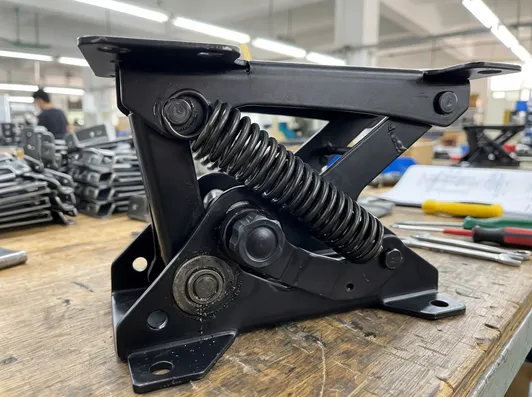
Mechanism Engineering
How the Auto-Return Mechanism Works — and Why the Spring Calibration Is the Critical Variable
The core of an automatic chair mechanism is a pre-loaded return spring assembly integrated into the tilt pivot. When the user reclines, they compress the spring. When they stand, the spring drives the seat and backrest back to the upright neutral position without any input. Simple in principle — the engineering challenge is in the spring rate calibration.
A spring that's too stiff returns aggressively and feels harsh to lighter users. A spring that's too soft doesn't fully return under lighter occupants, leaving the chair partially reclined for the next person. The target is a return force that's firm enough to complete the return cycle reliably across the full occupant weight range, but damped enough that the return motion feels controlled rather than abrupt.
We calibrate the return spring assembly to a mid-range occupant weight (approximately 70–80 kg) as the factory default, which covers the majority of shared-seating use cases. For buyers targeting specific occupant profiles — lighter users in Asian markets, heavier-duty specifications for North American institutional buyers — we can adjust the spring rate at the factory before shipment.
This is a tooling-level adjustment, not a field modification, so it needs to be specified at the order stage. Most buyers don't think to ask about this until they get a complaint from a 55 kg user whose chair doesn't fully return. Specify your target occupant range when you order and we'll set it correctly the first time.

Spring-Return vs. Auto-Adjust: Which Spec Is Right?
Fixed spring rate calibrated to your target occupant weight range at the factory. Lower unit cost and assembly complexity. Right choice for standard institutional seating where cost per unit is the primary constraint.
Variable-rate spring or gas-assist system reads occupant weight through seat compression and adjusts tilt resistance proportionally. Self-calibrates to each user — eliminates the spring-rate calibration problem entirely. Higher unit cost and assembly complexity. Right specification for high-end co-working or executive shared seating.
Commercial Applications
Market Segments Where Automatic Mechanisms Drive Recurring Orders
These are the commercial environments where automatic chair mechanisms are specified by requirement, not preference — and where your buyers reorder on predictable cycles.
Airport & Transit Seating
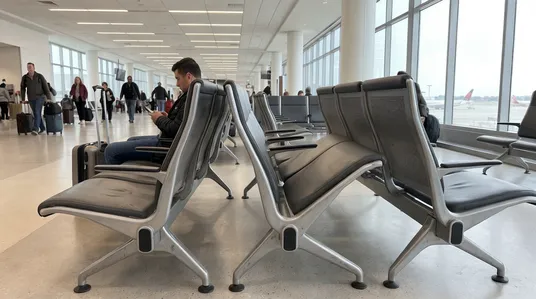
Airports, train stations, and bus terminals operate seating that turns over hundreds of times daily. Automatic return is a baseline specification for any serious tender in this segment. If you're supplying to airport furniture contractors or transit authorities, automatic mechanisms are the mechanism type that gets you into the specification.

Co-Working & Shared Workspace
Co-working operators have standardized on automatic-return seating because their members don't maintain equipment. A chair that stays reclined or has the wrong tension for the next user generates complaints and support tickets. This segment has grown significantly and shows no sign of slowing — it's worth building a dedicated SKU around.
Hotel Business Centers & Conference Rooms
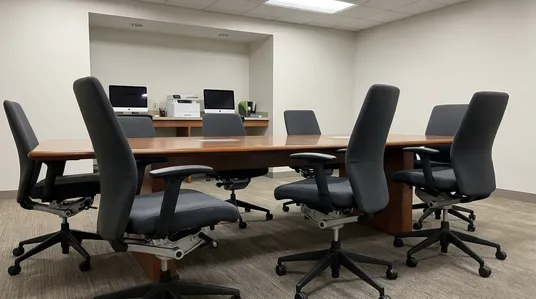
Hotel procurement teams specify automatic mechanisms for business center seating and conference room chairs because housekeeping staff reset rooms, not mechanisms. Once you're in a hotel group's approved supplier list with the right mechanism spec, the reorder relationship is stable for years.

University Libraries & Study Spaces
Universities and colleges furnish study spaces, computer labs, and reading rooms with high-turnover seating. Automatic return keeps the space looking maintained without staff intervention. Education procurement runs on annual budget cycles — price sensitivity is higher here than in hospitality, but the volume is consistent and the procurement process is predictable.
Healthcare Waiting Areas
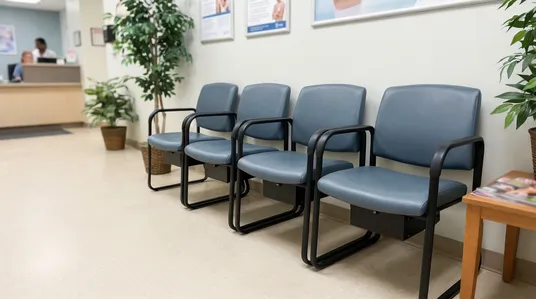
Clinics, hospitals, and outpatient facilities need waiting room seating that resets between patients without staff involvement. Infection control requirements in some markets also favor mechanisms with fewer exposed adjustment points. Automatic return with a sealed mechanism housing addresses both concerns. Healthcare procurement is specification-driven — once your product is on the approved list, it stays there.
Tell Us Which Segment You're Targeting
We'll recommend the right automatic mechanism configuration — spring rate, housing spec, and volume pricing — based on your target market and occupant profile.
Cycle Life and Durability: Why 80,000 Cycles Is the Floor, Not the Target
Public seating in high-traffic environments accumulates cycles fast. An airport chair used 200 times per day reaches 60,000 cycles in under a year. A co-working chair used 30 times daily hits the same number in about five and a half years. The mechanism needs to outlast the chair's useful life in the deployment environment — otherwise you're generating warranty claims and replacement orders that erode your margin and your buyer's confidence.
We test automatic chair mechanisms to a minimum of 80,000 cycles at rated load using a BIFMA X5.1 equivalent protocol. For heavy-duty specifications — airport, transit, 24/7 environments — we run to 100,000 cycles. The test applies the full rated load through the complete tilt-and-return cycle, not a reduced load or partial range. If a mechanism fails during cycle testing, the batch gets reworked before it ships. We don't adjust the pass threshold to clear a production run.
The spring assembly is the component most likely to fatigue under cyclic load. We use spring steel wire with controlled heat treatment to maintain consistent spring rate across the cycle life — a spring that softens over time produces a mechanism that returns more slowly as it ages, which is the failure mode that generates the most field complaints. Consistent spring rate through 80,000+ cycles is the specification that prevents that.
Spring steel wire with controlled heat treatment maintains consistent spring rate across the full cycle life. A softening spring returns more slowly as it ages — the field complaint pattern we engineer against.
Customization Options for Automatic Chair Mechanisms
Standard catalog automatic mechanisms cover the majority of sourcing requirements. When your chair design or market specification needs something different, here's what we can adjust:
| Customization Dimension | Options | MOQ Impact |
|---|---|---|
| Return spring rate | Light / medium / heavy (factory-set before shipment) | No MOQ change — specify at order stage |
| Load capacity rating | Standard (100–150 kg) / Heavy-duty (150–200 kg) | No MOQ change |
| Mounting hole pattern | Standard 4-hole / 6-hole / custom geometry | Custom: 500-unit min per pattern |
| Surface finish | Zinc plating (standard) / powder coat (custom RAL) | Powder coat custom: 500-unit min |
| Mechanism housing | Open frame (standard) / enclosed housing for hygiene applications | OEM tooling required |
| Gas lift bore | Ø50 mm (standard) / Ø60 mm | No MOQ change |
| Private label | Branded packaging, mechanism labeling | 500-unit minimum |
Enclosed Housing for Hygiene Environments
For healthcare and food-service environments where hygiene standards apply, enclosed-housing configurations are handled as OEM tooling projects. Our 12-person engineering team reviews your housing geometry requirements and provides a tooling quote and sample timeline.
Mixed Configurations, No Lead Time Penalty
Standard mechanisms ship at 500-unit MOQ. Mixed configurations — for example, two spring rates in one order — are accommodated. We produce on dedicated lines, so different configurations run in parallel without extending your lead time.
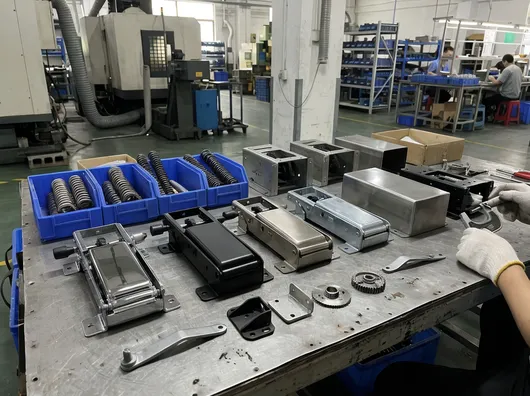
We'll confirm fit and configuration options
How We Manufacture Automatic Mechanisms — The Process Details That Affect Your Return Rate
The automatic chair mechanism has more components than a standard tilt mechanism — the spring assembly, return damper, and auto-adjust elements add parts and assembly steps that create more opportunities for quality variation. Here's where we focus the process controls.
Spring Assembly Calibration
Every spring assembly is calibrated on a dedicated fixture before installation. We measure spring rate against the target specification and reject springs outside a ±5% tolerance band. Calibrated springs are matched to mechanism bodies from the same production batch — mixing batches is how inconsistent feel develops across a run.
Why ±5%? An early batch of 800 units produced noticeable feel differences across the run — spring rate variation was within our original ±10% tolerance but still caused inconsistency. We tightened to ±5% after that return claim.
Pivot Pin and Bearing Fit
The tilt pivot is the highest-wear point in any return mechanism. We use hardened pivot pins with a controlled interference fit in the pivot bore — checked with go/no-go gauges at assembly, not by feel.
- Loose pivot: produces play in the tilt action that worsens over cycle life
- Too-tight fit: increases return resistance, spring works against pivot friction
Return Damper Installation
On models with a hydraulic return damper — used to slow return motion and prevent the seat from snapping back — the damper is installed and tested as a sub-assembly before the mechanism is completed.
Dampers producing jerky or inconsistent return motion are rejected at this stage.
100% Functional Test Before Shipment
Every automatic mechanism goes through a complete functional test cycle on the assembled, finished mechanism — not on sub-assemblies.
- Tilt engagement
- Full return to upright
- Lock engagement (on models with tilt lock)
- Height adjustment actuation
Mechanisms that pass dimensional inspection but fail functional performance are pulled before packing.

Fitting Automatic Mechanisms Into Your Chair Frame: What to Verify Before You Order
Automatic mechanisms are drop-in replacements for standard tilt mechanisms in most chair frame designs, but there are three dimensions to verify before committing to a production order.
Mounting Hole Pattern
Our standard patterns are 4-hole (typically 67 mm × 67 mm or 70 mm × 70 mm center spacing) and 6-hole configurations.
Non-standard pattern? We can produce a custom-drilled plate — specify at order stage. Adapting a mismatched hole pattern in the field is the most common installation problem we hear about.
Seat Plate Clearance
Automatic mechanisms have a slightly larger mechanism body than basic tilt mechanisms due to the spring housing. Verify your seat pan has adequate clearance around the mechanism body.
We can provide a dimensional drawing of the mechanism body before you order so your engineering team can confirm fit.
Gas Lift Cylinder Bore
We supply mechanisms pre-configured for two cylinder bore sizes. Confirm which bore your gas lift cylinder uses before ordering.
Mixing bore sizes requires an adapter that adds cost and a potential failure point. Confirm before ordering.
Order Samples Before Production
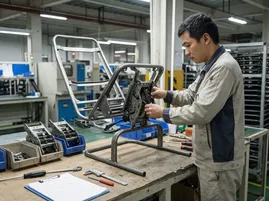
For new chair designs, we recommend ordering 2–5 sample units before committing to production quantities. Samples let you verify fit, spring rate feel, and return behavior with your actual chair frame before the production run starts.
Quality Assurance
Certifications and Compliance
Automatic chair mechanisms from MVMHardware carry the following certifications, which ship with every order.
ISO 9001:2015
Quality management system governing the full production process.
CE
European market compliance; declaration of conformity available with shipment.
SGS
Third-party audit and product testing. We can arrange additional market-specific testing through our existing SGS relationship.
RoHS
Restricted substances compliance; documentation available for EU and California market requirements.
Market-Specific Standards
For buyers supplying into markets with specific seating standards, we can arrange third-party testing through our existing SGS relationship. Specify your target market compliance requirements at the inquiry stage.
- EN 1335 — European office furniture
- BIFMA X5.1 — North American commercial seating
- AS/NZS 4438 — Australia/New Zealand
RoHS Surface Treatment Detail
Our zinc plating line uses trivalent chromium passivation, not hexavalent chromium. For buyers supplying into the EU or California, that distinction matters for customs clearance and downstream compliance documentation.
Documentation is available for both EU and California market requirements. Request at the inquiry stage.
Buyer Guidance
Frequently Asked Questions — Automatic Chair Mechanism Sourcing
Decision-support answers for buyers specifying, sourcing, and integrating automatic chair mechanisms.
What is the difference between an auto-return mechanism and a standard tilt mechanism?
A standard tilt mechanism reclines when the user leans back and stays in whatever position the user leaves it — returning to upright requires the user to actively push forward or release a lock. An auto-return mechanism uses a pre-loaded spring assembly to drive the seat and backrest back to the neutral upright position automatically when the user stands or reduces their weight on the seat. In shared-use environments, this means every user sits down to a chair in the correct neutral position without any adjustment. For high-turnover seating — airports, co-working spaces, waiting rooms — that's a functional requirement, not a feature.
How do I specify the correct return spring rate for my target market?
Spring rate is set at the factory before shipment. The standard factory setting is calibrated for a mid-range occupant weight of approximately 70–80 kg, which covers most shared-seating applications. If your target market has a different typical occupant profile, specify at the order stage and we'll set the spring rate accordingly. This is not a field-adjustable parameter on most models.
What cycle life should I specify for high-traffic public seating?
We test to both thresholds using BIFMA X5.1 equivalent protocols. Specify your target cycle life in your purchase order — it determines which spring assembly and pivot specification we use.
Can automatic mechanisms be retrofitted into existing chair frames designed for standard tilt mechanisms?
In most cases, yes — if the mounting hole pattern matches and the seat pan has adequate clearance for the slightly larger mechanism body. We recommend ordering 2–5 samples to verify fit before committing to a retrofit order. The most common incompatibility is mounting hole pattern mismatch, which we can resolve with a custom-drilled plate at no significant cost premium on orders over 500 units.
What is the MOQ, and can I mix spring rate configurations in one order?
Standard MOQ is 500 units. You can mix spring rate configurations (light/medium/heavy) within a single order — specify the quantity breakdown per configuration at order stage. Mixed configurations don't extend lead time. For new buyers, we recommend starting with a sample order of 2–5 units per configuration to verify spring rate feel before committing to production quantities.
Do automatic mechanisms require any special maintenance instructions for end users?
No field maintenance is required or recommended for the spring-return assembly — it's a sealed unit. The mechanism body should be kept free of debris around the tilt pivot, and the gas lift cylinder should be checked annually for drift (standard for any gas-lift chair). We can provide a one-page end-user care guide in your specified language as part of the OEM packaging arrangement.
Request a Quote
Get a Quote for Automatic Chair Mechanisms
Start with a Sample Order
Most buyers in this category start with 2–5 units to verify spring rate feel, mounting fit, and return behavior with their actual chair frame before committing to production quantities. Samples ship within 7–10 days of order confirmation.
Sourcing for a Tender or Project
Send us the spec sheet or a reference sample. We'll confirm which configuration matches, provide a dimensional drawing for your engineering team to verify fit, and quote the production run.
Building a New Product Line
New to automatic mechanisms and building a product line for shared-use seating? Tell us your target market segment and volume expectations — we'll suggest the spring rate configuration and mechanism model based on what's working for our existing buyers in that segment.
Request a Quote
Or email directly: [email protected]